
Consumer-Oriented Trust Communication in Fashion Digital Product Passports: An Information Architecture and Visual Communication Framework
Abstract
Background As the fashion industry moves toward sustainability and circularity, the Digital Product Passport (DPP) has emerged as a key medium for communicating product lifecycle information to consumers and stakeholders. Under the EU Ecodesign for Sustainable Products Regulation, textiles have been designated a priority product group for forthcoming mandatory DPP requirements, positioning the DPP to become a mass consumer touchpoint amid widespread distrust of sustainability claims. Existing work has concentrated on supply-chain traceability, data standards, technical implementation, and consumer adoption, while design-oriented inquiry into how consumers understand and trust such information remains limited. If this dimension is neglected, mandated transparency may fail to translate into consumer trust.
Methods Conceptualizing the fashion DPP as a visual communication medium that mediates trust between consumers and brands, this qualitative study, based on document analysis, derives a four-layer conceptual framework (Information, Visual Communication, Experience, and Trust and Auditability) through a synthesis of related literature and an analysis of publicly available policy documents. The framework is applied to seven publicly documented fashion DPP and related digital-identity or platform cases using a twelve-item coding scheme (84 coding units). As a sensitivity analysis, items are coded under both strict and expanded criteria, with agreement statistics reported as supplementary indicators comparing the two criteria.
Results The Information Layer (simple agreement 95.2%, linear weighted kappa 0.877) and the Trust and Auditability Layer (90.5%, 0.788) were comparatively stable across both criteria, whereas the Visual Communication Layer (57.1%, 0.341) showed the largest difference and could be confirmed only to a limited extent in public materials (overall 79.8%, linear weighted kappa 0.738, quadratic 0.816). The cases present product identification, traceability, certification, and circular-service functions relatively clearly, while visual communication design principles are far less documented in public materials.
Conclusions The study reframes the fashion DPP as a trust communication medium rather than a purely technical record. Trust communication in fashion DPPs should rest not merely on information volume but also on visual clarity, provenance and verifiability, and the flow of experience. Visual communication and information architecture are the key design tasks. For the fashion industry, the framework offers brands and designers a structured agenda for turning mandatory disclosure into trust-supporting communication and opportunities for differentiation, and speaks to the public interest in transparent, informed sustainable consumption. As a conceptual, document-based study, the framework does not verify consumer trust effects. The framework’s effectiveness should be examined in subsequent empirical research.
Keywords:
Consumer Trust, Digital Product Passport, Information Architecture, Sustainable Fashion, Visual Communication1. Introduction
1. 1. Research Background
The fashion industry has long been seen as environmentally burdensome owing to mass production and rapid consumption, and a transition toward sustainability and a circular economy has become an industry-wide agenda. Within this shift, the Digital Product Passport (DPP), which digitally records a product’s materials, origin, production, certification, and circularity, is drawing attention as a new information medium. The European Union introduced the DPP through the Ecodesign for Sustainable Products Regulation (ESPR), with textiles among the priority product groups, and the scope and timing to be set through delegated acts (Regulation (EU) 2024/1781, 2024; Legardeur & Ospital, 2024). This study anchors its policy context in the ESPR because it is the first binding, cross-sector framework establishing the legal basis for product-specific DPP requirements and, given the scale of the EU market, is likely to function as a de facto baseline for global fashion brands (Bradford, 2020). DPP-mediated disclosure is therefore forthcoming rather than optional; yet distrust of sustainability claims remains widespread, and a legal mandate does not automatically create trust, which makes the design of DPP communication urgent. A DPP is accessed through a data carrier such as a QR code so that consumers and stakeholders can examine product information.
1. 2. Research Need
Discussions of the DPP have tended to focus on supply-chain traceability, data interoperability, and technical implementation. Yet recording and linking information is distinct from consumers understanding and trusting it; more information does not by itself produce trust, and poorly structured information can hinder comprehension. Sustainability information for fashion, in particular, involves complex terminology and certification schemes, so unless it is structured in a visual language consumers can understand, it is unlikely to support trust. This raises a design question, namely how information should be structured and visually communicated, that has received comparatively little attention. Recent DPP scholarship reinforces this gap: empirical work has expanded rapidly but concentrates on consumer information needs, adoption, and willingness to pay (Colasante et al., 2025; Popowicz et al., 2025; Zhao & Liu, 2025), while the design of the consumer-facing communication itself, that is, how DPP information should be structured, visualized, and connected to experience, remains largely unexamined; this study addresses that specific gap.
1. 3. Research Purpose
Rather than viewing the fashion DPP merely as a technical infrastructure, this study conceptualizes it as a visual communication medium that mediates trust between consumers and brands, and examines how information architecture and visual communication can support trust communication at the consumer touchpoint. Its contribution is to reposition the DPP as a design issue concerning information architecture and visual communication and to propose a conceptual design framework that integrates readability and transparency with verifiability and auditability.
1. 4. Research Scope
The scope is limited to the consumer touchpoint: the flow of scanning a data carrier, browsing and understanding information, and connecting it to action. The technical specifications of data standards and system construction are not direct objects of study, and the policy context is anchored in the EU ESPR, while the analysis avoids claims about member-state implementation or delegated-act timetables, which remain in flux.
1. 5. Research Questions
RQ1. What information elements support trust communication in fashion DPPs?
RQ2. What roles do information architecture and visual communication play in trust communication in fashion DPPs?
RQ3. How can data provenance, verifiability, and auditability be integrated into design?
2. Theoretical Background
2. 1. The Concept and Design Significance of the Fashion DPP
The DPP is an electronic record system holding information across a product’s lifecycle. In the ESPR context it supports the circular economy and market transparency through standardized information on composition, durability, repairability, and environmental impact (Regulation (EU) 2024/1781, 2024). From the consumer touchpoint, the DPP is less a device that posts facts than a medium of interaction in which a brand presents evidence for its claims and consumers judge them. In this study, trust communication refers to this process, in which a brand presents verifiable information and its grounds, and consumers read and interpret them as a basis for trust judgment. Research on DPPs in other product domains, such as batteries, has likewise concentrated on which information to provide and how to verify it (Popowicz et al., 2025), leaving how that information is communicated to and experienced by consumers comparatively unexamined.
2. 2. Digital Fashion Communication and Visual Signs
In digital environments, fashion brands convey product value through visual signs such as images, icons, labels, and text, which function not as decoration but as a sign system interpreted for meaning. The view that visual signs form a structured system of meaning in digital fashion communication (Yun, 2026) suggests that the icons, labels, colors, and arrangements in a fashion DPP should be treated as signs that both convey information and produce meaning. Communicating sustainability information is thus a design problem of a visual language consumers can read. This view aligns with the broader digital fashion communication literature, which shows fashion communication increasingly taking place through digital, highly visual formats (Noris et al., 2021). Visual signs matter specifically in fashion DPPs: fashion consumption is strongly symbolic, so meaning travels through visual codes rather than text alone; sustainability qualities are credence attributes, so icons and marks act as proxies for verification, and their design quality shapes how such labels are perceived (Hartmann et al., 2025); and the garment offers little space for information, so the scanned DPP screen becomes a principal surface on which brand claims are read and judged.
2. 3. Information Architecture, Visual Communication, and Consumer Trust
Information architecture is the design activity of structuring information so that it can be organized, labeled, navigated, and searched (Rosenfeld et al., 2015). Visual communication mediates this structure through icons, typography, color, layout, and visual hierarchy, and Norman’s (2013) affordance and signifier concepts underscore design that visually guides user action during scanning and browsing. Trust has been discussed as expectations of a trustee’s ability, benevolence, and integrity (Mayer et al., 1995); applied to the consumer-brand relationship, consumers may form trust from the accuracy of information, consideration for their interests, and consistency between claims and reality. Taken together, consumer trust communication may depend less on the volume of information than on how clearly it is structured, visualized, and connected to experience.
2. 4. The Invisible Conditions of Trust: Data Provenance and Verification
The trustworthiness of information derives not only from how it is presented but from its evidentiary basis: by whom data are provided (provenance), by whom verified (verifying party), and when updated (update history) are important cues. Auditability and verifiability, the ability to trace and check information after the fact, form a foundation of trust. These are not merely technical matters external to design; when their basis is visualized so consumers can read it, they can act as cues that support trust judgment, treated here not as the central theme but as conditions underpinning visual communication and information architecture.
2. 5. Conditions for Trust Communication Suggested by Prior Research
Prior empirical research suggests that trust derives less from the volume of information than from its evidentiary basis and interpretability. Knowledge of third-party certification is associated with greater trust in and use of ecolabels (Gorton et al., 2021), while sponsor identity and trust in the sponsor condition how certification relates to ecolabel use (Darnall et al., 2018); thus provenance and the verifying party matter for trust judgment. Perceptions of greenwashing lower trust in green clothing brands (Policarpo et al., 2023), indicating a need for non-exaggerated communication, and traceability and transparency practices in the fashion industry remain uneven or inconsistently communicated (Bari et al., 2025). An excessive proliferation of ecolabels can also create consumer confusion (Brécard, 2014), suggesting that simplification and visual clarity shape comprehension. Accordingly, provenance, information hierarchy and visual clarity, and post-scan action flow were set as principal coding items.
3. Methods
This is a qualitative, document-based study that derives a conceptual framework and examines its applicability by integrating existing knowledge and analyzing publicly available materials rather than collecting empirical data. This design was chosen because mandatory requirements for consumer-facing fashion DPPs are forthcoming while such systems are not yet widely deployed, so regulation, policy studies, and official case materials currently constitute the most systematic body of evidence; document analysis is an established qualitative method for such settings (Bowen, 2009), and the study follows the model-building type of conceptual research, which integrates existing constructs into a new framework rather than testing hypotheses (Jaakkola, 2020). Three procedures were carried out. First, a review and conceptual synthesis of related scholarly literature, informed by literature-review methodology (Snyder, 2019), derived the framework’s constructs, because trust-relevant knowledge for DPPs is dispersed across information architecture, visual communication, and consumer trust research and requires integration. Second, an analysis of publicly available DPP policy documents and explanatory materials anchored those constructs in regulatory information requirements relevant to the consumer touchpoint. Third, a structured, framework-based analysis of publicly documented fashion DPP and related digital-identity or platform cases examined whether the constructs can be observed in current practice and where gaps lie. The sequence moves from theory to policy to practice: the literature supplies constructs, policy sets the regulatory information base, and case coding examines their observability.
This study did not conduct a systematic literature review; rather, it reviewed and synthesized related literature to derive a conceptual framework. The literature centered on the digital product passport, information architecture, visual communication, digital fashion communication, consumer trust, and sustainability labeling, and included work related to the consumer touchpoint of fashion DPPs or to the comprehensibility, visual clarity, and verifiability of information.
From this review, initial analytical categories such as information architecture, visual clarity, user action flow, and visualization of trust cues were reconfigured into Information, Visual Communication, Experience, and Trust and Auditability layers and operationalized into twelve coding items observable in public cases.
The analysis covers seven publicly documented cases; the unit of analysis is the 84 coding units formed by crossing seven cases with twelve items. Each item was coded as 0 (not confirmable in publicly available materials), 1 (partially confirmable), or 2 (confirmable). Coding was based only on publicly available materials such as official websites, press releases, and solution descriptions; non-public internal design and live screens accessible only by scanning an individual product were excluded. A score of 0 indicates not the absence of a function but its non-confirmation in the public materials available as of early June 2026. For visual communication items in particular (icon systems, typography and color, information hierarchy), a score of 2 required explicit visual evidence in public materials, such as published interface examples or stated design principles; the mere existence of an interface was not treated as confirmation. The analysis does not evaluate actual system performance or live interface operation; it compares how each case presents DPP-related information, visual, experience, and trust elements in public communication materials.
To examine the interpretive uncertainty of publicly sourced analysis, the same items were coded under a strict and an expanded criterion. All coding was conducted by a single researcher. The strict criterion assigned a high score only when an actual consumer screen, explicit function description, or concrete display method was confirmed, and judged conservatively otherwise; the expanded criterion judged an item as partially confirmed or confirmed when a function was described in official materials and could reasonably be read as part of the DPP experience. The difference between the two criteria was reported using simple agreement and weighted Cohen’s kappa (linear and quadratic) for the ordinal values. Weighted Cohen’s kappa was used not to establish inter-rater reliability, but as a supplementary indicator to examine the extent to which the strict and expanded criteria produced similar results for ordinal coding values; it is part of a sensitivity analysis and does not validate the framework or prove consumer trust effects. Because the study does not measure consumer responses, it presents no quantitative effect figures. Cited sources were checked against primary or official public materials.
4. Components of Trust Communication in Fashion DPPs
This section divides the information elements of trust communication into those directly visible to consumers and the invisible conditions that underpin them.
4. 1. Elements Visible to Consumers
First, product identification (unique identifier, brand, model, production time) anchors the credibility of all later information. Second, material and production information must be translated into comprehensible language and visual elements. Third, sustainability and circularity information acts as a trust-judgment cue when presented with its evidence. Fourth, certification and verification information becomes a cue when its meaning and verifying party are shown together. Fifth, data provenance and update information allow recency and responsibility to be confirmed. Sixth, action-guidance information (repair, resale, return, recycling) makes the DPP a practical tool of the circular economy.
4. 2. Invisible Conditions Underpinning Trust
Seventh, information access rights and personal-data protection support trust by reducing misuse concerns even when not directly visible. Eighth, tamper resistance and audit traceability support the integrity of information and preserve its modification history, invisibly underpinning its perceived trustworthiness. The study integrates these two invisible conditions into the framework’s fourth layer.
5. Proposed Framework
This study proposes a four-layer framework for designing consumer trust communication in fashion DPPs through information architecture and visual communication.
The Information Layer addresses what content to include and how to structure it. The Visual Communication Layer mediates this content through icons, labels, QR codes, layering, color, typography, and visual priority, governing clarity and comprehensibility. The Experience Layer addresses the flow from scanning and browsing to purchase or management. The Trust and Auditability Layer addresses the evidentiary basis of trust (data provenance, verifying party, update history, access rights, tamper resistance, audit trail), largely invisible but underpinning the other three layers.
These layers operate complementarily rather than hierarchically, addressing what to say, how to show it, how to connect it, and on what it is grounded; the framework proposes that trust communication depends on their coherent design (Figure 1, Table 1).
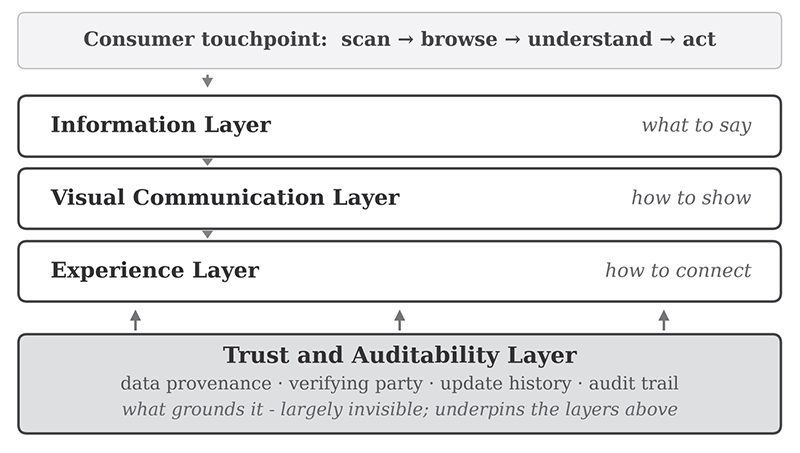
Fashion DPP trust communication framework: three consumer-facing layers underpinned by the Trust and Auditability Layer

Fashion DPP trust communication framework
6. Structured Case Analysis of Publicly Documented Fashion DPP Cases
Using the framework as an analytical lens, this section analyzes the seven publicly documented cases, coding the same public materials under both strict and expanded criteria to examine how interpretive differences affect the results.
6. 1. Cases and Coding Scheme
The seven cases are Coachtopia (Coach, EON), Chloé Vertical (Chloé, EON, Vestiaire Collective), PANGAIA ReWear (PANGAIA, EON), Aura Blockchain Consortium, CIRPASS-2, Arianee, and Mulberry (EON). Candidates were identified by searching official brand, consortium, solution-provider, and policy-project materials around keywords such as DPP, Digital ID, resale, traceability, and blockchain authentication. Cases were selected on three criteria: relevance to a DPP, digital identifier, blockchain authentication, or circular service in fashion or the textile value chain; public documentation of its consumer touchpoint, information and service structure, certification and traceability, or circular service; and the analyzability of at least one layer. The set spans consumer-touchpoint brand cases, circular-service-linked cases, blockchain-based authentication, an institutional and standardization pilot, and a solution platform, to compare how trust communication elements are publicly presented at different levels. The case selection was not intended to represent the entire population of fashion DPP cases; rather, it was a purposive selection intended to examine the applicability of the proposed framework across different types of publicly documented cases. The four layers were operationalized into twelve coding items, three per layer, with the strict and expanded criteria for each shown in Table 2. Coding drew only on official websites, press releases, and case descriptions (Arianee, n.d.; Aura Blockchain Consortium, 2023; CIRPASS-2, n.d.; EON, n.d.-a, n.d.-b, 2022, 2023). CIRPASS-2 is not a brand-level consumer-screen case; it was included to illustrate the institutional, standardization, and interoperability context of the DPP in the textile value chain.
Coding items and decision criteria for case analysis
6. 2. Results of the Sensitivity Analysis under Strict and Expanded Criteria
Across the 84 coding units, simple agreement between the two criteria was 79.8% and the overall linear weighted kappa was 0.738 (Table 3), with the quadratic weighting yielding a comparable value (0.816). Judgments thus agree at a broadly consistent level. By layer, the Information Layer (95.2%, linear weighted kappa 0.877) and the Trust and Auditability Layer (90.5%, 0.788) were comparatively stable, while the Experience Layer (76.2%, 0.658) showed some case-by-case differences in access and action flows.
Sensitivity analysis under strict and expanded criteria
By contrast, the Visual Communication Layer showed the largest difference between the two criteria (57.1%, linear weighted kappa 0.341), because items such as icons, typography and color, and information hierarchy were often unconfirmable or only partially confirmable under the strict criterion. That is, the analyzed cases present product identification, traceability, certification, and circular-service functions relatively clearly, while visual communication design principles for consumer comprehension were less clearly documented or publicly specified in the analyzed materials. This pattern admits two readings that public materials cannot fully distinguish: such design elements may be implemented but under-documented, or visual communication design in current DPP implementations may itself remain immature. The two readings call for different responses, better public documentation in one case and further visual design development in the other, but both indicate that the visual layer warrants closer design attention; the large interpretive difference likewise supports treating information architecture and visual communication as core design issues in fashion DPP trust communication.
6. 3. Summary of Framework Application by Case
Table 4 summarizes the analysis by case, qualitatively classifying the degree of confirmation in public materials by synthesizing each layer’s three items under both criteria. “High” denotes layers whose main items were broadly confirmed under both criteria; “Medium,” partial confirmation or divergence between criteria; and “Low,” limited confirmation in public materials. This labeling reflects a holistic qualitative judgment across each layer’s items rather than a fixed numerical threshold.
Summary of framework application by case
The resulting case types, ranging from consumer-touchpoint and circular-service integrated types to resale-driven, blockchain-based verification, institutional and standardization, solution-platform, and certification-and-service types, are summarized in the final column of Table 4.
7. Discussion
7. 1. Design-Research Significance
The primary significance of this study is to treat the fashion DPP as a design problem for trust communication rather than only as a means of storing and transmitting data. This brings an information-architecture and visual-communication perspective into a DPP discussion shaped by traceability and technical standards, treating trust communication as a design process supported by how information is structured, visualized, and connected to experience. Read through the four layers, the cross-domain contrast noted earlier becomes precise. In battery-focused DPP research, exemplified by Popowicz et al. (2025), attention has centered on the Information Layer, asking which data to provide to consumers, and on the Trust and Auditability Layer, asking how those data are verified and kept reliable, while visual presentation and use experience receive little attention. Under the ESPR, the Information and Trust and Auditability layers capture dimensions that are broadly shared across product groups, whereas the Visual Communication and Experience layers are where domain differences concentrate: in fashion, purchases rest on symbolic meaning and on sustainability qualities consumers cannot inspect, and the DPP screen doubles as a brand touchpoint for resale and care services, so these two under-theorized layers carry the communicative weight. In this sense the framework not only describes fashion DPPs but offers a lens for comparing DPP designs across product domains; the battery case serves here as an illustrative contrast rather than an exhaustive cross-domain comparison.
Three findings stand out. First, the analysis reveals a structural asymmetry: information provision, certification, and circular services are comparatively well evidenced in public materials, while consumer-facing visual communication is the least confirmable layer, marking the point where deliberate design effort is least visible and closer design attention is warranted. Second, provenance and verifiability are among the most consistently documented elements across the cases, indicating that who verifies and where data come from are design-relevant questions rather than merely technical ones. Third, the cases show distinct public-communication profiles, summarized as descriptive case types in Table 4; although the purposive selection spans different case categories, the framework describes this variation in a comparable form. Together, these findings locate trust communication in the joint design of information, visual language, experience, and verifiable grounds.
7. 2. Distinction from Prior Research and Cases
The contribution can be organized along three dimensions. Theoretically, redefining the DPP as a trust communication medium positions information architecture and visual communication as core design problems and integrates data verifiability and auditability as conditions design should visualize. Methodologically, operationalizing public cases into twelve items under strict and expanded criteria offers a procedure for examining interpretive range in publicly sourced case analysis. Practically, it suggests designing the DPP as a communication touchpoint that integrates information hierarchy, visual clarity, experience flow, and the visualization of trust cues. Unlike sustainability-label and QR research focused on individual display elements, the study reframes this gap as a design agenda of coherence across the four layers, consistent with prior findings that certification and sponsor trust shape ecolabel use and that greenwashing perceptions undermine trust (Darnall et al., 2018; Gorton et al., 2021; Policarpo et al., 2023).
7. 3. Implications for Fashion Brands and Designers
The framework suggests that brands and designers treat the content of information, its visual presentation, the flow of experience, and the basis of trust as a single integrated object rather than separate tasks, ideally from the early stages of product planning, so that the DPP becomes a touchpoint conveying a brand’s transparency and accountability. Because the Visual Communication Layer has been comparatively less specified in public materials, design attention to it leaves room for differentiation. Research on sustainability labels shows that visual design choices materially affect label perceptions and purchase intentions (Hartmann et al., 2025), so whether the thin public evidence reflects under-documentation or genuinely immature visual design, the visual layer remains a substantive area for further design and communication development. In terms of design innovation, the framework turns a compliance object into a design agenda, with the under-specified visual layer as its most open space. In terms of the public interest, well-designed DPP trust communication supports consumers’ access to understandable, verifiable product information, informed sustainable choice, and resistance to greenwashing. At the interface level, making otherwise invisible trust cues legible, for example by presenting the verifying organization, data source, and latest update date alongside certification marks, turns technical conditions into objects of design planning.
7. 4. Future Research Directions
The framework can be examined in two ways. First, an expert heuristic evaluation in which design and UX experts assess public DPP interfaces against criteria such as information hierarchy, clarity of icons, typography, and color, scan-to-action flow, and visibility of provenance and verification. Second, a comparative consumer study presenting interfaces with differing levels of visual communication and measuring perceived comprehensibility, trust, and behavioral intention.
7. 5. Limitations
Several limitations apply. First, the analysis is limited to public materials and does not fully reflect live screens or non-public UI; items coded 0 indicate non-confirmation, not absence. Second, the strict and expanded criteria are an analytical device for examining the interpretation of public materials, not a verification of inter-rater reliability; the weighted Cohen’s kappa is correspondingly a supplementary indicator of agreement between the two criteria that does not prove consumer trust effects. Because a single researcher applied both criteria, the two codings are not fully independent, and the agreement figures should be read with this in mind. Third, because the results do not directly measure trust or behavioral intention, subsequent research should build DPP interfaces or prototypes from the framework and test each layer through expert heuristic evaluation and consumer experiments. Because delegated acts and national implementation are still evolving, assertions about specific timetables or member-state regulations are withheld. Finally, the case materials include official promotional content and should be read as distinct from independently verified operating screens.
8. Conclusion
This study proposed a trust communication framework for fashion DPPs and examined its applicability through a structured analysis of seven publicly documented cases and a strict-versus-expanded sensitivity analysis. Information, certification and verification, and circular-service elements were comparatively clearly confirmable under both criteria, whereas the Visual Communication Layer was confirmable only to a limited extent and showed the largest difference between the criteria.
In response to the research questions: trust communication in fashion DPPs can be supported by information elements such as product identification, material and production, certification and circularity, and provenance and update history (RQ1); information architecture and visual communication organize this information into a hierarchy and visual language consumers can read and judge (RQ2); and data provenance, verifying party, update history, and auditability, though not direct visual elements, can be integrated into design when visualized as trust cues (RQ3).
These results suggest that, beyond traceability and verification, the fashion DPP as a communication touchpoint requires the joint design of information hierarchy, icons, typography, and color. As the study does not measure consumer responses, it does not verify trust-formation effects; subsequent research should examine the framework’s effectiveness through expert evaluation and consumer experiments.
Notes
Copyright : This is an Open Access article distributed under the terms of the Creative Commons Attribution Non-Commercial License (http://creativecommons.org/licenses/by-nc/3.0/), which permits unrestricted educational and non-commercial use, provided the original work is properly cited.
References
- Arianee. (n.d.). ESPR & Digital Product Passport. Retrieved June 5, 2026, from https://www.arianee.com/digital-product-passport.
- Aura Blockchain Consortium. (2023, November 10). The digital product passport: A new era of luxury unveiled. Retrieved June 5, 2026, from https://auraconsortium.com/insight/the-digital-product-passport-a-new-era-of-luxury-unveiled.
-
Bari, M. S., Jin, B. E., & Min, Y.-W. (2025). Supply chain traceability and transparency: How do fashion companies perform and evaluate? Family and Consumer Sciences Research Journal, 54, Article e70024.
[https://doi.org/10.1002/fcsr.70024]

-
Bowen, G. A. (2009). Document analysis as a qualitative research method. Qualitative Research Journal, 9(2), 27–40.
[https://doi.org/10.3316/QRJ0902027]
-
Bradford, A. (2020). The Brussels effect: How the European Union rules the world. Oxford University Press.
[https://doi.org/10.1093/oso/9780190088583.001.0001]
-
Brécard, D. (2014). Consumer confusion over the profusion of eco-labels: Lessons from a double differentiation model. Resource and Energy Economics, 37, 64–84.
[https://doi.org/10.1016/j.reseneeco.2013.10.002]
- CIRPASS-2. (n.d.). Lighthouse pilots. Retrieved June 5, 2026, from https://cirpass2.eu/lighthouse-pilots/.
-
Colasante, A., D'Adamo, I., Desideri, S., Iannilli, M., & Mangani, V. (2025). Environmental concerns in the fashion industry: A twin transition with the digital product passport. Business Strategy and the Environment, 34(7), 9242–9256.
[https://doi.org/10.1002/bse.70078]
-
Darnall, N., Ji, H., & Vázquez-Brust, D. A. (2018). Third-party certification, sponsorship, and consumers' ecolabel use. Journal of Business Ethics, 150(4), 953–969.
[https://doi.org/10.1007/s10551-016-3138-2]
- EON. (n.d.-a). Coachtopia [Case study]. Retrieved June 5, 2026, from https://eon.xyz/clients/coachtopia.
- EON. (n.d.-b). Pangaia [Case study]. Retrieved June 5, 2026, from https://eon.xyz/clients/pangaia.
- EON. (2022, June 13). Mulberry to add Digital IDs to all products by 2025. Retrieved June 5, 2026, from https://eon.xyz/press/mulberry-to-add-digital-tags-to-all-products-by-2025.
- EON. (2023, February 9). Chloé launches 'instant resale' using digital IDs on Vestiaire Collective. Retrieved June 5, 2026, from https://eon.xyz/press/chloe-launches-instant-resale-using-digital-ids-on-vestiaire-collective.
-
Gorton, M., Tocco, B., Yeh, C.-H., & Hartmann, M. (2021). What determines consumers' use of eco-labels? Taking a close look at label trust. Ecological Economics, 189, Article 107173.
[https://doi.org/10.1016/j.ecolecon.2021.107173]
-
Hartmann, M., Yeh, C.-H., Gorton, M., Tocco, B., & Török, Á. (2025). Enhancing sustainability label effectiveness through logo design modification: An analysis of the EU Green Leaf logo. Agribusiness. Advance online publication.
[https://doi.org/10.1002/agr.70013]
-
Jaakkola, E. (2020). Designing conceptual articles: Four approaches. AMS Review, 10(1–2), 18–26.
[https://doi.org/10.1007/s13162-020-00161-0]
-
Legardeur, J., & Ospital, P. (2024). Digital product passport for the textile sector (PE 757.808). European Parliamentary Research Service.
[https://doi.org/10.2861/947638]
-
Mayer, R. C., Davis, J. H., & Schoorman, F. D. (1995). An integrative model of organizational trust. Academy of Management Review, 20(3), 709–734.
[https://doi.org/10.5465/amr.1995.9508080335]
-
Noris, A., Nobile, T. H., Kalbaska, N., & Cantoni, L. (2021). Digital fashion: A systematic literature review. A perspective on marketing and communication. Journal of Global Fashion Marketing, 12(1), 32–46.
[https://doi.org/10.1080/20932685.2020.1835522]
- Norman, D. A. (2013). The design of everyday things (Rev. and expanded ed.). Basic Books.
-
Policarpo, M. C., Apaolaza, V., Hartmann, P., Paredes, M. R., & D'Souza, C. (2023). Social cynicism, greenwashing, and trust in green clothing brands. International Journal of Consumer Studies, 47(5), 1950–1961.
[https://doi.org/10.1111/ijcs.12971]
-
Popowicz, M., Pohlmann, A., Schöggl, J.-P., & Baumgartner, R. J. (2025). Digital product passports as information providers for consumers-The case of digital battery passports. Business Strategy and the Environment, 34(6), 7700-7722.
[https://doi.org/10.1002/bse.4346]
- Regulation (EU) 2024/1781 of the European Parliament and of the Council of 13 June 2024 establishing a framework for the setting of ecodesign requirements for sustainable products, amending Directive (EU) 2020/1828 and Regulation (EU) 2023/1542 and repealing Directive 2009/125/EC (Ecodesign for Sustainable Products Regulation). (2024). OJ L, 2024/1781, 28.6.2024. http://data.europa.eu/eli/reg/2024/1781/oj.
- Rosenfeld, L., Morville, P., & Arango, J. (2015). Information architecture: For the web and beyond (4th ed.). O'Reilly Media.
-
Snyder, H. (2019). Literature review as a research methodology: An overview and guidelines. Journal of Business Research, 104, 333-339.
[https://doi.org/10.1016/j.jbusres.2019.07.039]
-
Yun, S. Y. (2026). Meaning structures of visual signs in digital fashion communication. Design Research, 11(1), 372-387.
[https://doi.org/10.46248/kidrs.2026.1.372]
-
Zhao, R., & Liu, C. (2025). Consumer acceptance of digital product passports: The roles of technological awareness and value orientations. Sustainability, 17(23), Article 10878.
[https://doi.org/10.3390/su172310878]