
PoseMate: A Conceptual Framework for AI-Generated Socially Driven Pose Guidance for Gen Z Photo-Taking
Abstract
Background Z (Gen Z) spends substantial time on social media and often experiences fear of missing out (FoMO), motivating them to align everyday decisions, including photo-taking with socially visible trends. While recent design and human-computer interaction (HCI) research has examined socially driven decision support, how such support should be designed to support Gen Z’s expressive photo-taking remains underexplored.
Methods We conducted a formative study to examine Gen Z’s photo-taking practices and their reliance on socially shared visual references. Building on these insights, we introduced PoseMate, a conceptual artificial intelligence (AI) photo-taking assistant that frames posture trends from social media as designable knowledge. Then, we conducted a participatory design study to inform PoseMate’s initial analytic workflow, focusing on how Gen Z expects AI to curate the input photo set from which pose trends are derived.
Results The studies showed that Gen Z prefers socially shared, user-generated pose references over expert-driven, rule-based guidance, and that pose trends become meaningful only when derived from carefully filtered photo sets rather than all available images. In the participatory study, participants articulated key filtering dimensions that shape how socially driven pose trends are constructed and interpreted, suggesting design strategies for AI-supported pose-trend guidance generation.
Conclusions This work contributes empirical and design insights into socially inspired photo-taking in Gen Z and reframes photo filtering as a trend-making infrastructure for socially driven pose-guidance systems. By foregrounding user-controllable photo set construction, PoseMate shifts AI support away from prescribing “best” poses toward enabling interpretable, socially grounded pose references derived from shared visual practices.
Keywords:
Pose Guidance, Pose Trends, Social Sensemaking, Socially Inspired Photography, Gen Z, Photo Filtering1. Introduction
Generation Z (Gen Z), born between 1997 and 2012, has grown up immersed in digital technologies and social media, shaping not only their everyday communication but also how identity and social belonging are constructed (Dimock, 2019). For Gen Z, social media functions as a primary space for sustaining social connections and presenting the self, with visual content playing a central role in communicating presence, belonging, and personal narratives (Ahmed, 2019; Thomson, 2021).
A notable characteristic of Gen Z’s social media experience is the heightened prevalence of Fear of Missing Out (FoMO), which reflects anxiety about being excluded from socially valued experiences and trends (Przybylski et al., 2013, Reagle, 2015; Herawati et al., 2022). FoMO keeps Gen Z closely attuned to what peers and influencers share online, shaping their decision-making processes and encouraging the imitation of socially desirable content (Milyavskaya et al., 2018; Alutaybi et al., 2020; Bartosiak et al., 2025). These dynamics influence how Gen Z curates and presents socially acceptable, trend-aligned versions of themselves through visual content (Katz & Crocker, 2015; Viţelar, 2019; Yau & Reich, 2019). From a design perspective, this highlights the importance of understanding how visual trends operate as practical references in everyday decisions.
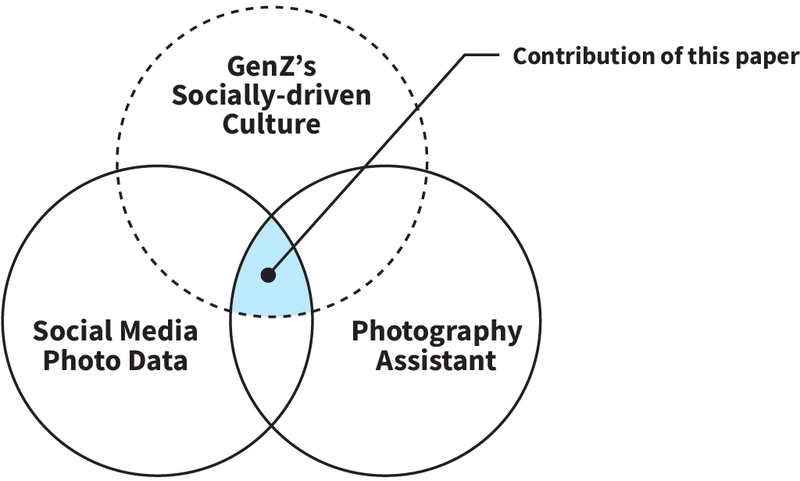
This shows our research focus at the intersection of social media photo data and photography assistants, framed by Gen Z’s socially driven self-representation
Recent work in design and Human–Computer Interaction (HCI) has begun to explore systems that respond to Gen Z’s socially driven behaviors and information practices (Hassoun et al., 2023; McDonald et al., 2024; Taber et al., 2023). Related studies have examined trend-based decision support in domains such as e-commerce and content navigation by filtering and ranking items according to popularity or engagement (Chen, 2010; Ghose et al., 2013; De Choudhury et al., 2011; Sakamoto, 2012). However, these approaches largely focus on utilitarian decision-making contexts and give limited attention to expressive practices such as everyday photography, where social meaning, imitation, and personal interpretation are deeply intertwined.
Existing photo-taking assistance systems further reveal a mismatch with Gen Z’s practices. Many systems prioritize landscape photography or professional portraiture (Amornpashara, 2015; E et al., 2020; Farhat et al., 2017; Kahlon & Liang, 2025), whereas Gen Z predominantly engages in selfie-oriented and socially motivated photography for online sharing (Katz & Crocker, 2015; Dhir et al., 2017). Moreover, current tools typically rely on rule-based photography principles—such as composition or framing—derived from professional standards (Banerjee & Evans, 2007; Liang et al., 2018; Hao et al., 2018; Li et al., 2020; Ma et al., 2019). While some systems provide pose recommendations, these are generally expert-driven and detached from the socially emergent trends found in user-generated content (Ma et al., 2014), limiting their relevance to Gen Z’s socially inspired photo-taking practices.
In this work, we focus on pose trends because they function as directly enactable and socially legible units of imitation. Unlike post-hoc editing or abstract compositional principles, poses can be readily copied on-site and are frequently used to signal social alignment in shared visual culture. Yet making sense of pose trends from social media remains difficult in practice, often requiring users to scroll through large collections of images, infer recurring patterns and decide which references are worth following. This current approach is often cognitively demanding and inconsistent, as it lacks structured support for identifying, filtering, and adapting socially relevant trend references in a systematic way. We therefore reconceptualize photography assistance from a design perspective that treats social media pose trends not merely as inspiration but as a form of designable knowledge.
To address this gap, we introduce PoseMate, an AI-driven pose-trend assistant concept that supports socially inspired photo-taking by deriving pose trends from filtered sets of user-generated photos. Rather than assuming pose trends should be extracted from all available images, PoseMate foregrounds photo set construction as the key design locus through which trends become meaningful. As illustrated in Figure 2, the entire study consists of (a) a formative investigation of Gen Z’s socially driven photo-taking practices, (b) PoseMate as a conceptual workflow for trend-mediated guidance, and (c) a participatory design study that examines how Gen Z expects AI to construct the input photo sets from which pose trends are derived. We therefore shift the focus of photography assistance from prescribing optimal poses to supporting how socially driven photo trends are constructed through the filtering of socially shared photos.
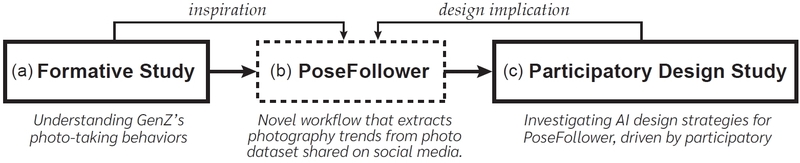
Research framework: (a) a formative study of Gen Z’s photo-taking practices, (b) a conceptual workflow (PoseMate) for trend-based photo-taking guidance system from social media photos, and (c) a participatory study informing AI design strategies for PoseMate
2. Related Work
Our work bridges Gen Z’s socially driven photo-taking practices and AI-mediated photography guidance. Prior research on Gen Z has emphasized social media–based self-expression, while most photography assistance tools have focused on optimizing image quality using professional rules. We highlight a gap: socially emergent trends from social media photos are rarely treated as design resources in photo-taking assistants.
2. 1. Gen Z’s Photo-taking Culture
Prior work shows that Gen Z’s engagement with photography is deeply shaped by social media and the FoMO, which encourages frequent platform use, content sharing, and imitation of peers and influencers (Burnell et al., 2019; Sharma et al., 2023). For many Gen Z users, replicating content seen online temporarily alleviates anxiety about social exclusion, reinforcing continuous cycles of content creation and consumption.
For Gen Z, Photography functions not only as personal documentation but also as a social artifact crafted to meet audience expectations and gain recognition (Bertini et al., 2020; Orzech et al., 2017). As Thomson (2021) describes, personal photography has evolved into a form of social interaction, while influencer practices further reinforce trend-following behaviors (De Veirman et al., 2017). However, existing studies offer limited insight into how Gen Z interprets and operationalizes visual trends when taking photos themselves. This requires a closer examination of Gen Z’s motivations, decision-making processes, and the role of social media imagery as an active reference rather than passive inspiration.
2. 2. Photography Recommendation Systems
Photography recommendations have primarily aimed to improve photo quality through context-aware and personalized guidance grounded in professional photography principles. For example, Pose Maker recommends poses based on expert practices (Ma et al., 2014), while other systems leverage deep learning to match backgrounds with predefined posture sets or to suggest optimal compositions (Song et al., 2022). Many systems provide in-camera guidance for framing and positioning (Banerjee & Evans, 2007; E et al., 2020; Hao et al., 2018; He et al., 2018; Li et al., 2020; Su et al., 2021), or use contextual cues such as location to recommend viewpoints (Rawat and Kankanhalli, 2017; Shi et al., 2023). Some approaches focus on post-capture refinement, enabling users to refine composition through interactive cropping or reframing (Liang et al., 2018).
Despite these advances, most tools remain anchored in static, expert-defined notions of “good” photography. They offer limited support for the socially emergent and rapidly evolving visual trends that shape how Gen Z plans and performs photo-taking for social media, motivating the need for photography assistance that engages with user-generated trends and supports user-controllable, socially grounded guidance.
3. Formative Study
We conducted a formative study to develop a grounded understanding of Gen Z’s photo-taking practices, with particular attention to how social media trends shape their behaviors. The study protocol was approved by the Institutional Review Board (IRB), and all procedures followed standard ethical guidelines.
3. 1. Participants
We recruited 16 Gen Z participants (4 male, 12 female), aged 18–27. All participants reported enjoying photos of themselves and actively using at least one social media platform for sharing visual content.

Study flow: recruit Gen Z (18-27), run a pre-survey (demographics, photography experience), then conduct interviews on photo-taking behaviors before, during, and after travel, including the influence of social media trends at each stage.
3. 2. Procedure
The study consisted of two phases: an online pre-survey followed by an in-depth interview. The pre-survey gathered demographic information, social media usage patterns, and travel photo-taking habits. Participants also uploaded several photos, which were used as reference materials during the interviews.
Interviews explored photo-taking practices across three stages—before, during, and after photo-taking—focusing on how participants sought inspiration, made pose-related decisions on-site, and selected photos for sharing. Sample questions included: “What kinds of guidance or information do you rely on when trying to capture a desired photo on-site?” and “What challenges do you encounter, and what kinds of support would be helpful?” Interviews lasted 45–70 minutes and were transcribed and analyzed using Braun and Clarke’s (2006) thematic analysis. We selected the travel context based on prior work on “souvenir photography,” (Wang et al, 2015), which proposed a human position recommendation system within travel settings. Travel also provides a setting where users actively engage with trends.
3. 3. Findings
Our analysis revealed that Gen Z participants’ photo-taking practices are shaped by both personal motivations and socially driven pressures.
Participants described two primary motivations for taking photos while traveling. First, photos functioned as tools for social connection, allowing participants to remain visible and engaged within their social networks. Several participants described sharing photos as a way to communicate with friends and sustain social presence (e.g., P2, P12). Second, participants described photography as visual logging—capturing moments to preserve memories and emotions. Eight participants noted that photos felt more meaningful when they aligned with popular trends or received positive social feedback, indicating that personal memory-making and social validation are closely intertwined in Gen Z’s photo-taking practices.
Social media trends strongly shaped how participants approached photo-taking. Many expressed a desire to follow trends to avoid feeling excluded, reflecting FoMO-driven concerns about social visibility. As P12 stated, Everyone is taking certain photos so I feel the need to do it also, and like, I don’t wanna miss out.” Similarly, P5 remarked on not wanting to be left out when others followed popular photo trends.
Beyond avoidance of exclusion, some participants also mentioned that they follow trends because they want to feel more connected to their friends and the online communities. They look for validation and reassurance in their choice by engaging with popular content that they came across on social media. As P2 shared, “I have a lot of friends who follow trends. They will always post on their Instagram. I’m also influenced, so I also want to try the things that they try as well.” Across interviews, participants consistently identified a particular trendy pose in a specific area as a key piece of information they relied on when attempting to align their photos with current trends during travel.
Participants frequently collected reference photos from platforms such as Instagram and Pinterest to guide how they posed for photos. While these images provided concrete examples of socially recognizable poses, identifying and interpreting pose trends required substantial manual effort. Several participants described scrolling through large numbers of images to infer recurring pose patterns, a process they found time-consuming and cognitively demanding (P4, P12). The formative study further revealed that beyond browsing, participants also evaluated whether poses fit certain criteria, such as their existing pose preferences, body type, or location, when selecting trendy pose references. However, these references did not always translate directly in practice due to real-world constraints such as lighting or crowd conditions. In such situations, participants had to make on-the-spot adjustments as shared by P5 during the interview where “maybe I went at a time when the lighting isn’t like the photo… or there’s way more people… in these cases you really just have to adjust and try to make it work.” Similarly, differences in body type often led to unsuccessful pose reproduction. As P2 explained, “this person (reference image) looks a certain way, so it works for them. But then, when I try to replicate it, it just doesn’t work out… no matter how hard I try,” which led them to “go off based on a pose I’ve previously done, which I know suits me.”
Pose reproduction is therefore not a straightforward imitation process, but involves continuous interpretation and adaptation. Participants do not passively follow trends, but selectively engage with them based on personal preferences, often combining new references with familiar styles. For example, one participant (P12) described how they “check the references first… but… every person also has their favorite pose,” noting that while they sometimes “try some new poses,” they also rely on “my own pose that I usually do.” When reproduction fails, participants tend to abandon the intended pose or revert to familiar ones that they know suit them. These findings show that the challenge lies not only in making poses work in real situations, but also in helping users better organize, interpret, and select pose references systematically.
3. 4. Discussion: Design Inspiration
The formative study reveals that Gen Z’s photo-taking decisions are guided less by professional photography principles than by socially recognizable pose references. Participants treated poses as socially validated signals that indicate what is currently visible and acceptable within their peer networks. At the same time, participants struggled to make sense of large collections of reference images, relying on prolonged scrolling and informal pattern inference to identify pose trends. This difficulty suggests that the core challenge lies not in generating new poses but in supporting how socially shared pose references are organized, interpreted, and selected. These findings motivate a design approach that treats pose trends as ‘personalized meaning-making among socially shared image data’ rather than as objectively extracted patterns.
4. Posemate: Conceptual Workflow
Building on the formative study, we introduce PoseMate as a conceptual workflow to generate socially driven pose guidance. PoseMate treats socially emergent pose trends from social media as designable knowledge and explores how such trends could be structured to support Gen Z’s pose-related decision-making. A central premise of PoseMate is that pose trends become meaningful only after users narrow down photos they personally care about (Pirolli & Card, 1999). Accordingly, PoseMate conceptualizes trend-mediated support as a process that begins with user-relevant photo set construction, followed by pose representation and pattern interpretation (Figure 4).
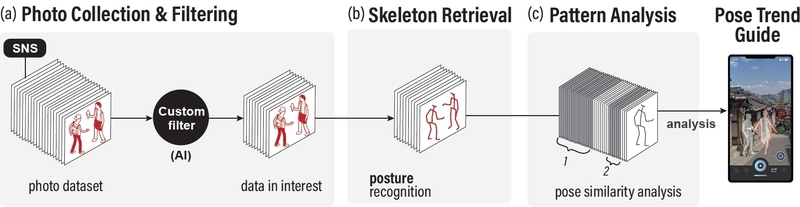
PoseMate workflow: The system filters user-consented social media photos, extracts anonymized pose cues via skeletonization, and identifies recurring pose patterns for trend-based pose guidance
PoseMate is intentionally presented as a conceptual workflow rather than an implemented system. Our goal is not to claim technical novelty or pose-estimation performance, but to articulate where design decisions shape the meaning of “pose trends” when they are derived from socially shared photos. In particular, we foreground photo set construction (i.e., filtering, Figure 4a) as the central design locus through which trends become visible, interpretable, and socially relevant.
PoseMate begins by collecting a pool of social media photos associated with a shared context and then constructing a filtered subset that will serve as the input space for pose trend analysis (Figure 4a). Rather than assuming a fixed dataset, PoseMate foregrounds user-driven filtering, allowing users to specify what kinds of photos they want pose trends to be derived from (e.g., season, popularity of photos, etc.).
While some filtering can rely on metadata (e.g., number of likes), constructing meaningful input sets for pose trend analysis often requires AI-based photo analysis (e.g., clothing, gender, special accessories, etc.). Prior work in social media analysis and recommender systems has shown that combining metadata-based retrieval with content-based visual analysis is a common and effective strategy for constructing task-relevant subsets from large image collections (Chen, 2010; De Choudhury et al., 2011; Ricci et al., 2015). PoseMate, therefore, conceptualizes filtering as a stage where social signals and AI-based visual analysis jointly shape the photo set from which pose trends are derived. Instead of serving as just a simple preprocessing step, filtering in PoseMate defines the input space that determines how pose trends are constructed for the following stages.
The second stage abstracts human poses from the filtered photo set into skeletal representations that foreground posture while removing identifiable visual details (Figure 4b). Skeleton-based pose estimation has become a widely adopted approach in computer vision, with robust methods available for extracting 2D or 3D human pose keypoints from single images (e.g., OpenPose (Cao et al., 2021), HRNet-based pose estimation (Sun et al., 2019)).
PoseMate assumes a pipeline in which raw images are accessed only to derive skeletal keypoints, after which subsequent analysis operates exclusively on skeletonized representations. This approach aligns with prior work showing that skeleton-based representations can support privacy-preserving analysis while retaining essential structural information (Lee et al., 2019). By restricting downstream analysis to skeletal data, PoseMate avoids reliance on facial features, appearance details, or background context, making this abstraction suitable for socially shared image datasets.
Once poses are represented as skeletal keypoints, recurring pose patterns can be identified within the filtered photo set using established pose similarity and clustering techniques (Figure 4c). Prior work has shown that pose similarity can be computed by comparing normalized joint configurations or learned pose embeddings, enabling unsupervised grouping of structurally similar poses without relying on appearance features (Cao et al., 2021; Sun et al., 2019; Yu et al., 2026).
Rather than prescribing a single definition of what constitutes a pose “trend,” PoseMate treats pattern identification as a flexible design choice. Pose patterns may be surfaced based on recurrence or structural similarity within the curated photo set, allowing different pose trends to emerge depending on how users have filtered the input images. This framing ensures that pose trends are understood as products of filtering decisions rather than as inherent properties of the dataset.
5. Participatory Design Study
While the proposed conceptual workflow outlines how pose patterns can be identified from a filtered set of social media photos, how such filtering should be derived is not selfevident. The formative study showed that Gen Z users do not want pose trends extracted from all available images, but from photo sets that reflect their personal interests and social relevance. As a result, the criteria used to construct the input image set directly shape which pose trends become visible and meaningful. Building on this insight, we conducted a participatory design study to examine how AI should support the selection and prioritization of photos to generate socially driven pose trend guidance in PoseMate. Through participatory exploration, we investigated which filtering logics Gen Z considers meaningful when defining the input space.
5. 1. Participants
We recruited 16 Gen Z participants (14 females, 2 males), all of whom were active social media users. Each participant had at least one active social media account and demonstrated a keen interest in taking and sharing photos of themselves while exploring new locations using their mobile devices.
5. 2. Photo Dataset
To ground discussions in realistic materials, we curated a dataset of 80 publicly available Instagram photos from two popular travel destinations in South Korea: Bukchon Hanok Village and Nami Island. These locations were selected because they are both widely photographed yet differ substantially in spatial character and atmosphere—Bukchon Hanok Village being architecturally dense and culturally symbolic, and Nami Island being open, natural, and strongly seasonal.
Each location contributed 40 photos, all with at least 50 likes, to ensure baseline social recognition (Figure 5). The dataset included hashtags and engagement metadata (e.g., like counts), which participants frequently referenced when judging whether a photo or pose was worth following. Importantly, the dataset was used solely as reference material was a way to observe how Gen Zs interpret and construct meaningful insights from the dataset, not to identify objective pose trends. From an ethical standpoint, all photos were collected exclusively from publicly accessible Instagram posts and were used under a strict research-only protocol. We did not access private accounts or restricted content, and we did not collect, infer, or report personal identifiers. Images were not redistributed outside the study context.
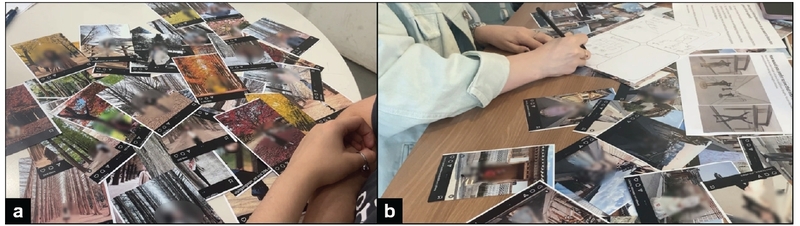
Participatory design study setup: participants engaged in a hypothetical travel-planning scenario, reviewed 80 curated Instagram photos from two destinations, and sketched preferred ways to surface and interact with pose trends in PoseMate
5. 3. Procedure
The study consisted of three phases designed to simulate a realistic travel photo-taking context. In Phase A, participants were introduced to a hypothetical travel scenario involving visits to Bukchon Hanok Village and Nami Island in the following week. They were asked to reflect on what kinds of pose references they would seek. To support this scenario, we introduced the PoseMate concept and explained its overall goal of deriving pose trends from filtered photo sets. This phase aimed to ground participants’ thinking in a concrete, personally relevant situation rather than an abstract discussion. In Phase B, participants reviewed the curated photo dataset (Figure 5) using a think-aloud protocol, discussing which images they found relevant, inspiring, or worth following. Lastly, in Phase C, participants engaged in structured ideation focused on the role of AI in PoseMate’s photo filtering stage (Figure 4a). Using the reviewed images as reference, participants explored how AI should prioritize, cluster, or exclude photos before trends are extracted.
5. 4. Result
All participants consistently described photo filtering not as a preliminary step, but as the primary mechanism through which pose trends are constructed and interpreted. Pose trends were considered meaningful only when derived from photo sets aligned with participants’ social expectations, situational intent, and personal identity. Through analysis, we identified four interrelated filtering dimensions that shape how pose trends are made sense of. These filtering dimensions don’t just function as general image search criteria. Instead, they are used to construct a subset of images that directly shapes which pose trends become both personally relevant to users and usable in specific social or situational contexts. This suggests that filtering supports how pose references are selected and made actionable, rather than simply retrieved.
Participants relied heavily on social metadata, such as the number of likes, hashtags, and social frequency, to guide their photo-taking decisions. They emphasized that PoseMate should be able to filter and organize reference images using these signals, because such cues helped them judge whether a pose was socially recognizable and “safe” to follow.
Social Frequency. All participants indicated that they wanted to understand pose trends together with how frequently those poses appeared across posts. They judged the “trendiness” of a photo by how often similar postures were repeated by others, and five participants described wanting frequency-based ranking rather than a single “top pose.” For example, one participant noted that in Bukchon Hanok Village dataset, there was a well-known traditional pose that many visitors strike in front of the hanok buildings. Participants expressed a strong desire to access this type of information—e.g., the most frequently observed poses within a given photo set—so they could replicate or reinterpret them while understanding how widely shared they are among other users.
Emotional Keywords. Participants emphasized that filtering should also account for emotion-related hashtags, so that PoseMate could surface pose references that match the mood they want to express. Rather than filtering only by popularity, P2 and P16 suggested recognizing keywords such as “happy” or “excited” to support intent-driven pose selection. P5 mentioned that it would be helpful if the system suggested a pose that matches the user’s mood. P7 further proposed to add facial expression recognition and body posture analysis to the system.
Participants emphasized that environmental conditions matter because they affect whether a pose feels feasible or aesthetically fitting in a given moment. They expressed a strong preference for filtering options that account for real-time or situational context—such as time of day, season, or weather—so that the reference photo set (and thus the resulting pose trends) better matches the context they anticipate or encounter.
Actual Timing of the Day. Participants noted that they would prefer exploring pose references drawn from photos taken at similar times of day, because lighting and crowd conditions change how a pose “works” visually. When reviewing photos taken at Bukchon Hanok Village, many participants pointed out how the same space produced different visual outcomes depending on sunrise, sunset, or twilight (“blue hour”). P8 further suggested that such information could also help them plan when to take photos (e.g., avoiding peak crowds), indicating that time-aware filtering supports both aesthetic expectations and practical planning.
Seasonal Variation. Participants also highlighted that seasonal changes influence how people pose and what feels appropriate. They wanted filtering options that reflect seasonal cues (e.g., foliage colors, winter clothing, overall atmosphere), because these factors shape both pose choice and the intended tone of the photo. For example, when taking photos at Nami Island, people are posing in different styles in each season. People are doing more lively poses in spring and autumn, like jumping and stretching their arms. But in winter, the poses were calmer and still.
Real-time Weather. Participants pointed out that the weather should be considered when giving photo recommendations in PoseMate. Many described experiences of trying to replicate poses from social media only to find that rain, snow, or harsh sunlight changed the scene and made the pose less feasible. For example, P8 said, “At least you know that, okay, it’s going to be cold. Maybe we should go inside a restaurant, or maybe we should go inside a cafe or something.” Participants also mentioned that rain or snow could create distinct photo opportunities (e.g., reflective puddles), implying that weather-aware filtering can support both feasibility and creativity.
Participants argued that personalization is essential for making pose trends feel usable rather than aspirational. While popularity matters, they emphasized that pose references become genuinely helpful only when they reflect the user’s own appearance, style, and social identity. As P16 said, “I like having a profile where I can set my preferences. It makes the suggestions feel more personalized and relevant.” Participants therefore wanted PoseMate to filter reference images in ways that increase perceived fit, so that extracted pose trends feel attainable and aligned with their self-presentation goals.
Clothing Style. Participants explained that outfits shapes how poses feel appropriate and how a pose reads visually. For instance, in Bukchon Hanok Village photos, many people wore Hanbok, which influenced unique posture choices. Participants who preferred casual outfits said they would rather see pose references associated with everyday clothing rather than traditional attire. They suggested that image recognition could identify clothing styles and filter pose references accordingly (e.g., loose vs. fitted clothes; winter outerwear). Participants wearing hijabs also mentioned that PoseMate should provide poses that are suitable for users who wear hijabs and modest clothes. P12 stated, “...because I’m wearing hijab, I also want to know how people like me pose, like this [points to reference photo of a hijabi].” This shows the importance of having pose suggestions that fit with different clothing styles and cultures.
Body Type Considerations. Participants emphasized that pose trends should be filtered by body type because the same pose can look different depending on height, proportions, or body shape. P15 explained that she wanted references from people with similar body types, because copying poses from tall, model-like figures often produced disappointing results. P14 similarly stated, “… not all of it [poses] works out for you. So I prefer that AI provides me the pose that it thinks is best for me based on my height.” These comments indicate that bodily similarity is not a minor preference but a key determinant of whether pose trends are perceived as applicable.
Number of People in the Photo. Participants also noted that pose references differ substantially between solo and group photos. They wanted filtering options that distinguish between individual and group poses, since coordination, balance, and mutual framing become central when multiple people appear. As P10 said, group photos often call for poses that feel “cute” and “memorable.” Participants suggested allowing users to filter pose references by the number of people in the photo to better match their intended photo-taking situation.
More than half of the participants described the need to understand pose trends at specific spots within a destination. They pointed out that even at the same landmark or tourist spot, pose choices change depending on background elements and spatial constraints (e.g., narrow alleys, distinct architectural features, large trees). Participants argued that this filtering should help them narrow the reference set to photos taken at visually comparable micro-areas so that the resulting pose trends better match the scene they are trying to recreate. For example, P13 stated, “When we’re traveling to some place, we always want to take pictures of the landmarks of the place and also the places where many people took pictures.”
6. Discussion
This study contributes to understanding how AI pose trend generation can be designed around socially driven sensemaking, rather than around traditional notions of photographic correctness. Through a formative study and a participatory design study with Gen Z participants, we showed that pose trends are not just perceived as objective patterns extracted from large datasets, but as socially constructed references whose meaning depends on how photos are selected, contextualized, and interpreted. Rather than treating AI just as a tool that automatically identifies optimal poses, our findings suggest that AI’s primary role lies in shaping the input space from which pose trends are derived. In this sense, photo filtering is not a preparatory step but a central design mechanism that mediates how users perceive what counts as a “trend.” PoseMate serves as a conceptual example that illustrates this shift, foregrounding filtering as a site of design rather than automation. Below, we discuss how this reframes AI’s role, the design implications for filtering, and the broader implications for socially driven AI visual trend analysis tools.
6. 1. Reframing AI as a Mediator of Social Sensemaking
Building on prior research on Gen Z’s interaction with digital technologies (Hassoun et al., 2023; McDonald et al., 2024), our findings reinforce that Gen Z does not engage with AI systems as passive recipients of algorithmic output. Instead, they expected AI to support their own judgment, interpretation, and social self-presentation. In the context of photo-taking, participants consistently expressed a desire to remain actively involved in deciding which references matter, rather than delegating these decisions entirely to automated systems.
This expectation challenges dominant, top-down AI design paradigms that emphasize prescriptive or optimized recommendations (Agosto, 2019; Seberger et al., 2021). Rather than delegating decisions to AI, participants wanted support in constructing the space from which pose trends are derived. In this role, AI functions less as an authority and more as a mediator of social sensemaking, shaping how users navigate and interpret socially shared visual practices.
6. 2. Design Implications: Filtering as Trend-Making Infrastructure
Our findings position photo filtering as the primary site where AI support meaningfully intervenes in Gen Z’s pose trend sensemaking. Participants did not treat filtering as a preliminary step, but as the mechanism through which pose trends become visible, interpretable, and socially relevant. In this sense, filtering operates as a trend-making infrastructure that shapes the reference space from which pose trends are constructed.
Rather than treating social metadata as signals that merely reflect popularity, our study shows that filtering participates in producing social legitimacy. Participants did not simply browse poses that were already popular; they deliberately shaped the reference photo set—by prioritizing certain images, communities, or contexts—thereby redefining what counted as a recognizable pose trend. In this sense, social legitimacy was not an inherent property of poses but an outcome of filtering practices. Designing filtering as infrastructure, therefore, requires enabling users to participate in how legitimacy is constructed, rather than presenting popularity as a fixed or algorithmically determined attribute.
Participants consistently framed pose trends as resources for self-presentation rather than as aesthetic options to optimize. They rejected poses that were widely shared when those poses conflicted with how they wanted to appear or what they wanted to communicate in a given situation. This highlights that filtering operates at the level of expressive intent: it allows users to construct a reference space that aligns with their desired identity, mood, or social stance. Designing filtering as infrastructure thus means supporting expressive alignment, enabling users to shape trends around meaning-making rather than visual optimization.
Our findings further demonstrate that pose trends are inherently situated. The same pose can take on different meanings depending on when and where it is performed, and participants evaluated trends in relation to anticipated environmental conditions rather than as universally transferable patterns. Filtering, in this sense, functions as a way of situating trends—constructing them relative to specific contexts such as time, season, or atmosphere. Treating filtering as infrastructure, therefore, involves supporting the contextual grounding of trends, ensuring that what is constructed as a “trend” remains relevant to users’ lived situations.
Participants emphasized that pose trends feel actionable only when they are embodied by people who resemble themselves in terms of body type, clothing style, or group configuration.
Poses derived from mismatched representations were often dismissed as aspirational but unattainable. This reveals that filtering plays a crucial role in negotiating what a trend is for. Designing filtering as infrastructure thus entails allowing users to shape trends around bodily relevance and inclusivity, so that trends emerge from representations that feel attainable rather than idealized.
6. 3. Ethical Considerations of Using Socially-driven Data
Because this study engages with socially shared, user-generated visual data, ethical considerations are central. In our study, all reference images were drawn exclusively from publicly accessible Instagram posts and used solely as contextual stimuli in participatory design sessions. We did not access private content, collect identifiable personal information, or use images for model training or automated inference.
Beyond data sourcing, the PoseMate concept also considers how visual data should be processed to minimize privacy risks. Prior work shows that pose analysis can be conducted using abstracted representations rather than raw images; for example, skeletonized pose representations remove identifiable visual features while preserving posture information (Lee et al., 2019). PoseMate therefore treats skeletonization as a baseline strategy for pose trend extraction.
At the same time, our findings indicate that some filtering criteria, such as expressive cues or clothing style, may require limited forms of appearance-based image analysis. To address this tension, PoseMate assumes a privacy-aware processing hierarchy, in which more sensitive visual features are analyzed only under stricter conditions. For instance, such analysis could be restricted to user-consented datasets, performed locally on the user’s device without transmitting raw images, or implemented through transient processing without storing original visual data.
6. 4. Limitation and Future Work
There are several limitations in our study that call for further investigation. First, our work is a user-centered investigation based on formative interviews and participatory studies, and the PoseMate system has not yet been evaluated in real-world contexts; future work should assess its usability and impact through actual development and deployment. Second, because this paper focuses on how pose trends can be derived and personalized through filtering, it does not fully address how these trends should be translated into actionable support during photo-taking. Future research should also explore interaction and visualization approaches that help users apply pose trend insights in situ. Another limitation in our study is that the participant sample is skewed toward female participants, which may influence the observed patterns. As the study aims to understand pose-related practices among Gen Z as a group, gender was not used as a filtering factor. Future work can include a more balanced and diverse sample to examine potential differences across demographics.
7. Conclusion
This study proposes a pose-centered approach to AI-generated socially driven pose guidance for Gen Z, whose photo-taking practices are strongly shaped by socially shared visual references. Through a formative study and participatory design sessions, we show that Gen Z treats poses from social media as socially recognizable cues for self-presentation, and we introduce PoseMate as a conceptual workflow that frames pose trends as designable knowledge derived from user-generated photo collections. A central contribution is reframing photo filtering as a trend-making infrastructure. Our findings indicate that pose trends become meaningful only when the input photo set is curated to reflect users’ social expectations, situational intent, and personal identity, shifting AI support from prescriptive recommendations toward user-controllable construction of what counts as a trend. These contributions offer design knowledge for developing socially aware pose-trend guidance systems that leverage socially shared visual data while preserving user agency.
Acknowledgments
This work was supported by the National Research Foundation of Korea (NRF) grant funded by the Korea government (MSIT) (RS-2024-00340828).
AI Acknowledgment
The author(s) acknowledge the use of ChatGPT-4o to proofread the final draft for language editing. The prompts used include ‘Proofread this manuscript,’ ‘Fix grammatical errors,’ and ‘Improve readability.’ The output from these prompts was used to improve the manuscript’s readability. While the author(s) acknowledge the usage of AI, the author(s) maintain that they are the sole author(s) of this article and take full responsibility for the content therein, as outlined in COPE recommendations.
Notes
Copyright : This is an Open Access article distributed under the terms of the Creative Commons Attribution Non-Commercial License (http://creativecommons.org/licenses/by-nc/3.0/), which permits unrestricted educational and non-commercial use, provided the original work is properly cited.
References
-
Agosto, D. E. (2019). Thoughts about the past, present and future of research in youth information behaviors and practices. Information and Learning Sciences, 120(1-2), 108-118.
[https://doi.org/10.1108/ILS-09-2018-0096]

-
Ahmed, N. (2019). Generation Z's smartphone and social media usage: A survey. Journalism and Mass Communication, 9(3), 101-122.
[https://doi.org/10.17265/2160-6579/2019.03.001]
-
Alutaybi, A., Al-Thani, D., McAlaney, J., & Ali, R. (2020). Combating fear of missing out (FoMO) on social media: The FoMO-R method. International Journal of Environmental Research and Public Health, 17(17), Article 6128.
[https://doi.org/10.3390/ijerph17176128]
-
Amornpashara, N., Arakawa, Y., Tamai, M., & Yasumoto, K. (2015). Landscape photo classification mechanism for context-aware photography support system. In 2015 IEEE International Conference on Consumer Electronics (ICCE) (pp. 663-666). IEEE.
[https://doi.org/10.1109/ICCE.2015.7066570]
-
Banerjee, S., & Evans, B. L. (2007). In-camera automation of photographic composition rules. IEEE Transactions on Image Processing, 16(7), 1807-1820.
[https://doi.org/10.1109/TIP.2007.898992]
-
Bartosiak, A., Lee, J., & Loibl, C. (2025). Fear of missing out, social media influencers, and the social, psychological and financial wellbeing of young consumers. PLOS ONE, 20, e0319034.
[https://doi.org/10.1371/journal.pone.0319034]
-
Bertini, M., Ferracani, A., Papucci, R., & Del Bimbo, A. (2020). Keeping up with the influencers: Improving user recommendation in Instagram using visual content. In Adjunct Publication of the 28th ACM Conference on User Modeling, Adaptation and Personalization (pp. 29-34). Association for Computing Machinery.
[https://doi.org/10.1145/3386392.3397594]
-
Braun, V., & Clarke, V. (2006). Using thematic analysis in psychology. Qualitative Research in Psychology, 3(2), 77-101.
[https://doi.org/10.1191/1478088706qp063oa]
-
Burnell, K., George, M. J., Vollet, J. W., Ehrenreich, S. E., & Underwood, M. K. (2019). Passive social networking site use and well-being: The mediating roles of social comparison and the fear of missing out. Cyberpsychology: Journal of Psychosocial Research on Cyberspace, 13(3), Article 5.
[https://doi.org/10.5817/CP2019-3-5]
-
Cao, Z., Hidalgo, G., Simon, T., Wei, S.-E., & Sheikh, Y. (2021). OpenPose: Realtime multi-person 2D pose estimation using part affinity fields. IEEE Transactions on Pattern Analysis and Machine Intelligence, 43(1), 172-186.
[https://doi.org/10.1109/TPAMI.2019.2929257]
-
Chen, L. (2010). Towards three-stage recommender support for online consumers: Implications from a user study. In Web Information Systems Engineering-WISE 2010: Lecture Notes in Computer Science (Vol. 6488, pp. 157-170). Springer.
[https://doi.org/10.1007/978-3-642-17616-6_33]
-
De Choudhury, M., Counts, S., & Czerwinski, M. (2011). Identifying relevant social media content: Leveraging information diversity and user cognition. In Proceedings of the 22nd ACM Conference on Hypertext and Hypermedia (pp. 161-170). Association for Computing Machinery.
[https://doi.org/10.1145/1995966.1995990]
-
De Veirman, M., Cauberghe, V., & Hudders, L. (2017). Marketing through Instagram influencers: The impact of number of followers and product divergence on brand attitude. International Journal of Advertising, 36(5), 798-828.
[https://doi.org/10.1080/02650487.2017.1348035]
-
Dhir, A., Torsheim, T., Pallesen, S., & Andreassen, C. S. (2017). Do online privacy concerns predict selfie behavior among adolescents, young adults, and adults? Frontiers in Psychology, 8, 815.
[https://doi.org/10.3389/fpsyg.2017.00815]
- Dimock, M. (2019). Defining generations: Where millennials end and Generation Z begins. Pew Research Center, 17(1), 1-7.
-
E, J. L., Fried, O., Lu, J., Zhang, J., Měch, R., Echevarria, J., Hanrahan, P., & Landay, J. A. (2020). Adaptive photographic composition guidance. In Proceedings of the 2020 CHI Conference on Human Factors in Computing Systems (pp. 1-13). Association for Computing Machinery.
[https://doi.org/10.1145/3313831.3376635]
-
Farhat, F., Kamani, M., Mishra, S., & Wang, J. Z. (2017). Intelligent portrait composition assistance: Integrating deep-learned models and photography idea retrieval. In Proceedings of the ACM Multimedia 2017 Thematic Workshops (pp. 153-157). Association for Computing Machinery.
[https://doi.org/10.1145/3126686.3126710]
-
Ghose, A., & Li, B. (2014). Examining the impact of ranking on consumer behavior and search engine revenue. Management Science, 60(7), 1632-1654.
[https://doi.org/10.1287/mnsc.2013.1828]
-
Hao, T., Wang, Q., Wu, D., & Sun, J. (2018). Adaptive recommendation for photo pose via deep learning. Multimedia Tools and Applications, 77, 32791-32808.
[https://doi.org/10.1007/s11042-018-5705-2]
-
Hassoun, A., Beacock, I., Consolvo, S., Goldberg, B., Kelley, P. G., & Russell, D. M. (2023). Practicing information sensibility: How Gen Z engages with online information. In Proceedings of the 2023 CHI Conference on Human Factors in Computing Systems (pp. 1-17). Association for Computing Machinery.
[https://doi.org/10.1145/3544548.3581328]
-
He, S., Zhou, Z., Farhat, F., & Wang, J. Z. (2018). Discovering triangles in portraits for supporting photographic creation. IEEE Transactions on Multimedia, 20(2), 496-508.
[https://doi.org/10.1109/TMM.2017.2740026]
-
Herawati, I., Rizal, I., & Amita, N. (2022). The impact of social media on fear of missing out among Z generation: A systematic literature review. Journal of Islamic and Contemporary Psychology, 2(2), 92-98.
[https://doi.org/10.25299/jicop.v2i2.11179]
-
Kahlon, J. S., & Liang, G. (2025). PortrAid: An AI-driven portrait assistant for professional-quality image composition. In Proceedings of the 2025 ACM Southeast Conference. Association for Computing Machinery.
[https://doi.org/10.1145/3696673.3723059]
- Katz, J. E., & Crocker, E. T. (2015). Selfies and photo messaging as visual conversation: Reports from the United States, United Kingdom, and China. International Journal of Communication, 9, 1861-1872.
-
Lee, B., Lee, M., Zhang, P., Tessier, A., & Khan, A. (2019). An empirical study of how socio-spatial formations are influenced by interior elements and displays in an office context. Proceedings of the ACM on Human-Computer Interaction, 3(CSCW), 58, 1-26.
[https://doi.org/10.1145/3359160]
-
Li, Y.-F., Yang, C.-K., & Chang, Y.-Z. (2020). Photo composition with real-time rating. Sensors, 20(3), Article 582.
[https://doi.org/10.3390/s20030582]
-
Liang, Y., Wang, X., Zhang, S.-H., Hu, S.-M., & Liu, S. (2018). PhotoRecomposer: Interactive photo recomposition by cropping. IEEE Transactions on Visualization and Computer Graphics, 24(10), 2728-2742.
[https://doi.org/10.1109/TVCG.2017.2764895]
-
Ma, S., Fan, Y., & Chen, C. W. (2014). Pose maker: A pose recommendation system for person in the landscape photographing. In Proceedings of the 22nd ACM International Conference on Multimedia (pp. 1053-1056). Association for Computing Machinery.
[https://doi.org/10.1145/2647868.2655053]
-
Ma, S., Wei, Z., Tian, F., Fan, X., Zhang, J., Shen, X., Lin, Z., Huang, J., Měch, R., Samaras, D., & Wang, H. (2019). SmartEye: Assisting instant photo taking via integrating user preference with deep view proposal network. In Proceedings of the 2019 CHI Conference on Human Factors in Computing Systems (pp. 1-12). Association for Computing Machinery.
[https://doi.org/10.1145/3290605.3300701]
-
McDonald, N., Badillo-Urquiola, K., Razi, A., Seberger, J. S., Agosto, D. E., & Wisniewski, P. (2024). AI through Gen Z: Partnerships toward new research agendas. Interactions, 31(5), 28-31.
[https://doi.org/10.1145/3681802]
-
Milyavskaya, M., Saffran, M., Hope, N., & Koestner, R. (2018). Fear of missing out: Prevalence, dynamics, and consequences of experiencing FOMO. Motivation and Emotion, 42, 725-737.
[https://doi.org/10.1007/s11031-018-9683-5]
-
Orzech, K. M., Moncur, W., Durrant, A., James, S., & Collomosse, J. (2017). Digital photographic practices as expressions of personhood and identity: Variations across school leavers and recent retirees. Visual Studies, 32(4), 313-328.
[https://doi.org/10.1080/1472586X.2017.1362959]
-
Pirolli, P., & Card, S. K. (1999). Information foraging. Psychological Review, 106(4), 643-675.
[https://doi.org/10.1037/0033-295X.106.4.643]
-
Przybylski, A. K., Murayama, K., DeHaan, C. R., & Gladwell, V. (2013). Motivational, emotional, and behavioral correlates of fear of missing out. Computers in Human Behavior, 29(4), 1841-1848.
[https://doi.org/10.1016/j.chb.2013.02.014]
-
Rawat, Y. S., & Kankanhalli, M. S. (2017). ClickSmart: A context-aware viewpoint recommendation system for mobile photography. IEEE Transactions on Circuits and Systems for Video Technology, 27(1), 149-158.
[https://doi.org/10.1109/TCSVT.2016.2555658]
-
Reagle, J. (2015). Following the Joneses: FOMO and conspicuous sociality. First Monday, 20(10).
[https://doi.org/10.5210/fm.v20i10.6064]
-
Ricci, F., Rokach, L., & Shapira, B. (Eds.). (2015). Recommender systems handbook. Springer.
[https://doi.org/10.1007/978-1-4899-7637-6]
-
Sakamoto, Y. (2012). Following trendsetters: Collective decisions in online social networks. In 2012 45th Hawaii International Conference on System Sciences (pp. 764-773). IEEE.
[https://doi.org/10.1109/HICSS.2012.283]
-
Seberger, J. S., Llavore, M., Wyant, N. N., Shklovski, I., & Patil, S. (2021). Empowering resignation: There's an app for that. In Proceedings of the 2021 CHI Conference on Human Factors in Computing Systems (pp. 1-18). Association for Computing Machinery.
[https://doi.org/10.1145/3411764.3445293]
-
Sharma, M., Kaushal, D., & Joshi, S. (2023). Adverse effect of social media on generation Z user's behavior: Government information support as a moderating variable. Journal of Retailing and Consumer Services, 72, 103256.
[https://doi.org/10.1016/j.jretconser.2023.103256]
-
Shi, Z., Hou, Q., Sheng, G., Ke, Y., Wang, K., & Jia, Y. (2023). Where2Stand: Toward a framework for portrait position recommendation in photography. IEEE Access, 11, 108864-108875.
[https://doi.org/10.1109/ACCESS.2023.3322363]
-
Song, X., Pan, J., Wu, F., & Dong, W. (2022). Optimal composition recommendation for portrait photography. In SIGGRAPH Asia 2022 Posters (Article 20, pp. 1-2). Association for Computing Machinery.
[https://doi.org/10.1145/3550082.3564206]
-
Su, Y.-C., Vemulapalli, R., Weiss, B., Chu, C.-T., Mansfield, P. A., Shapira, L., & Pitts, C. (2021). Camera view adjustment prediction for improving image composition. arXiv.
[https://doi.org/10.48550/arXiv.2104.07608]
-
Sun, K., Xiao, B., Liu, D., & Wang, J. (2019). Deep high-resolution representation learning for human pose estimation. In Proceedings of the IEEE/CVF Conference on Computer Vision and Pattern Recognition (pp. 5693-5703). IEEE.
[https://doi.org/10.1109/CVPR.2019.00584]
-
Taber, L., Dominguez, S., & Whittaker, S. (2023). Ignore the affordances; it's the social norms: How millennials and Gen-Z think about where to make a post on social media. Proceedings of the ACM on Human-Computer Interaction, 7(CSCW2), 259, 1-26.
[https://doi.org/10.1145/3610102]
-
Thomson, T. J. (2021). Exploring the life cycle of smartphone images from camera rolls to social media platforms. Visual Communication Quarterly, 28(1), 19-33.
[https://doi.org/10.1080/15551393.2020.1862663]
-
Vițelar, A. (2019). Like me: Generation Z and the use of social media for personal branding. Management Dynamics in the Knowledge Economy, 7(2), 257-268.
[https://doi.org/10.25019/mdke/7.2.07]
-
Wang, Y., Song, M., Tao, D., Rui, Y., Bu, J., Tsoi, A. C., Zhuo, S., & Tan, P. (2015). Where2Stand: A human position recommendation system for souvenir photography. ACM Transactions on Intelligent Systems and Technology, 7(1), 9, 1-22.
[https://doi.org/10.1145/2770879]
-
Yau, J. C., & Reich, S. M. (2019). "It's just a lot of work": Adolescents' self-presentation norms and practices on Facebook and Instagram. Journal of Research on Adolescence, 29(1), 196-209.
[https://doi.org/10.1111/jora.12376]
-
Yu, P., Nordman, A., Fujiwara, T., Koc-Januchta, M., Schönborn, K., Besançon, L., & Vrotsou, K. (2026). Visual extraction of interaction patterns guided by hierarchical clustering and process mining. IEEE Transactions on Visualization and Computer Graphics, 32(1), 1142-1152.
[https://doi.org/10.1109/TVCG.2025.3634837]