
Methodological Application of Future Envisioning: A Speculative Design Case Study in an Organisational Context
Abstract
Background Speculative design, and specifically future envisioning, has been explored as a way for organisations to engage with diverse futures when addressing complex, wicked problems. However, its methodological application within organisational contexts remains underexplored, partly due to a lack of clarity and guidance on how future envisioning can be conducted in a structured, rigorous, and accessible way.
Methods This paper explores the methodological application of future envisioning through a research partnership with the Queensland Department of Transport and Main Roads (TMR), focusing on the wicked problem of inclusive urban mobility. This study draws on the first two phases of the Inverted Double Diamond framework, a speculative design process model: the Select phase, which narrows the scope of inquiry; and the Explore phase, which generates diverse and imaginative futures. The study is a participatory case study involving twelve participants experiencing physical mobility impairments who were recruited through established organisational networks. Through a participatory approach that prioritised lived experience, qualitative data were collected through workshop activities, including journey mapping, scenario building, future brainstorming, and group discussions. The data were analysed thematically to support a methodological examination of how future envisioning can be applied within an organisational context.
Results The application of the Select and Explore phases of the Inverted Double Diamond framework demonstrates how future envisioning can be structured methodologically to support engagement with wicked problems in organisational contexts. The findings illustrate how methodological choices, such as participant-driven focus and the sequencing of convergent and divergent cognitive modes, shape the kinds of insights generated and engage with the complexity of wicked problems in organisational settings.
Conclusions This paper contributes to the growing discourse on speculative design in organisations by articulating a structured and participatory approach to future envisioning through the application of the first two phases of the Inverted Double Diamond framework. The Select and Explore phases enable the surfacing of insights grounded in lived experience, providing a rigorous scaffold for organisations to navigate the ambiguity of wicked problems. The framework provides an accessible entry point for organisations seeking to move beyond predictive approaches and to engage more reflectively and imaginatively with uncertainty and complexity.
Keywords:
Speculative Design, Future Envisioning, Wicked Problems, Speculative Design in Organisations, Speculative Design Process1. Introduction
Speculative design offers an approach that prioritises questioning and provocation over the development of solutions (Dunne & Raby, 2013). Speculative approaches to design aim to expand the horizon of future possibilities, challenging dominant assumptions, fostering debate, and enabling critical reflection (Auger, 2013). Over time, speculative design has been described and applied in various ways, including as an approach, an attitude, a process, a set of methods, or a mode of thinking, reflecting its adaptability across disciplines (Cardenas Cordova et al., 2025). While this diversity demonstrates the value of speculative approaches to design, it also yields diverse interpretations of their application. Notably, the process of speculative design remains underexplored, making it difficult to establish clarity and consistency in its application (Bendor & Lupetti, 2024; Zhu et al., 2024; Ringfort-Felner et al., 2023; Tsekleves et al., 2022; De Haas et al., 2019). This lack of clarity becomes especially significant in organisational contexts, where demand for innovative approaches to wicked problems is increasing, but where methods must also be structured, transparent, and practically applicable (Ringfort-Felner et al., 2023).
As a part of a broader research project on the speculative design process, this paper focuses on the practical application of the first two phases of the Inverted Double Diamond framework (Cardenas Cordova et al., 2025). These two phases, Select and Explore, centre on future envisioning, which is recognised as an essential part of all conceptions of speculative design. In the literature, regardless of the context and goal where speculative design is being used, the process consistently begins with identifying issues to interrogate and imagining a range of possible futures (Bendor & Lupetti, 2024; Ringfort-Felner et al., 2023; Marji et al., 2023; Pinto et al., 2021; Light, 2021; Mendez Gonzalez et al., 2020). This initial stage is critical as it determines the scope of exploration, expands the space of possible designs, and permits provocative ideas to emerge. Yet despite its importance, there is little guidance on how future envisioning can be applied systematically, particularly in organisational settings where such processes must be rigorous, replicable, and adaptable (Ringfort-Felner et al., 2023). This study contributes to addressing that gap by offering insights into how speculative design, and future envisioning in particular, can be consistently applied in organisational contexts.
To address this gap, this paper examines the research question: How can future envisioning be methodologically applied to wicked problems within an organisational context? This study is grounded in a research partnership with the Queensland Department of Transport and Main Roads (TMR). The collaboration provided a unique opportunity to apply future envisioning to the wicked problem of inclusive urban mobility. Importantly, the focus is on exploring the methodological application of future envisioning in this context, remaining responsive to the organisational culture and the nature of the problem, rather than evaluating its direct influence on organisational planning or decision-making. In 2025, workshops were conducted with twelve participants experiencing physical mobility impairments, during which they envisioned diverse futures for inclusive urban mobility in Brisbane, Australia, in 2032. By focusing specifically on the methodological application of future envisioning, rather than covering the entire speculative design process, this paper maintains a manageable scope. It presents and applies a structured process of future envisioning, highlighting how it can support designers and non-designers within organisations to generate critical insights grounded in lived experience, surfacing nuanced human needs within wicked problems and expanding the space of possibilities for future-oriented reflection.
2. Theoretical background
2. 1. Speculative design
Speculative design is a critical design practice that engages with the exploration of future possibilities to challenge dominant narratives and assumptions about the present (Auger, 2013; Dunne & Raby, 2013; Lindley & Green, 2021; Malpass, 2017; Tsekleves et al., 2019). Speculative design moves away from affirmative design approaches, which primarily centre on solving problems, optimising current systems and designing for production in the service of industry, to operate within a critical dimension (Dunne & Raby, 2013). This dimension prioritises instead the expansion of the problem space by questioning assumptions, encouraging critical thinking, and designing for debate in the service of society. While affirmative design seeks incremental improvement within present realities and market-driven frameworks, speculative design disengages from these parameters by exploring alternative possibilities that challenge existing norms and provoke critical thought (Bray & Harrington, 2021; Johannessen et al., 2019; Malpass, 2017; Mazé & Redström, 2009). This distinction is not only philosophical but also practical. Speculative design and similar traditions, such as design fiction or critical design, employ diverse methods that are rarely used in organisational settings. Some of these include design fiction to explore alternative futures, what-if questions to create provocative hypotheticals, worldbuilding to construct the fictional narratives and contexts, and speculative prototyping to materialise elements of imagined futures. These practices differ significantly from those typically used in organisational settings, which tend to prioritise short-term deliverables and measurable outcomes (Coulton et al., 2016).
2. 2. Future envisioning in speculative design
Organisations traditionally approach ‘the future’ through predictive methods. These practices rely on statistics and trends to identify business opportunities, drive product innovation, and anticipate what is likely to happen in order to prepare accordingly (Aguesse & Decreton, 2022; Buehring & Bishop, 2020; Dunne & Raby, 2013). In contrast, speculative design offers an alternative approach by emphasising the coexistence of multiple possible futures (Jakobsone, 2017; Mazé & Redström, 2009; Mitrović et al., 2021; Sterling, 2009). It treats the future as a plural concept, moving beyond probability to explore alternative possibilities and challenge dominant narratives (Dunne and Raby, 2013). Within speculative design, this pluralistic view is often supported by categorising futures into four types: probable, possible, plausible, and preferable (Figure 1). Probable futures reflect what is most likely to occur if current trends persist and are often used in organisational planning and forecasting. Possible futures encompass scenarios that might happen, even if they seem unlikely. Plausible futures are possible events grounded in current scientific and societal knowledge, offering a balance between realism and creativity. Preferable futures, by contrast, are shaped by values and aspirations, focusing on what individuals or societies want to happen. Speculative design typically engages with plausible futures to produce outcomes that are imaginative and relatable, often provoking ethical and societal reflection (Dunne & Raby, 2013; Malpass, 2017). Exploring multiple futures is central to speculative design, as it expands the space of possible designs and enables provocative ideas that challenge assumptions and open new avenues for inquiry.
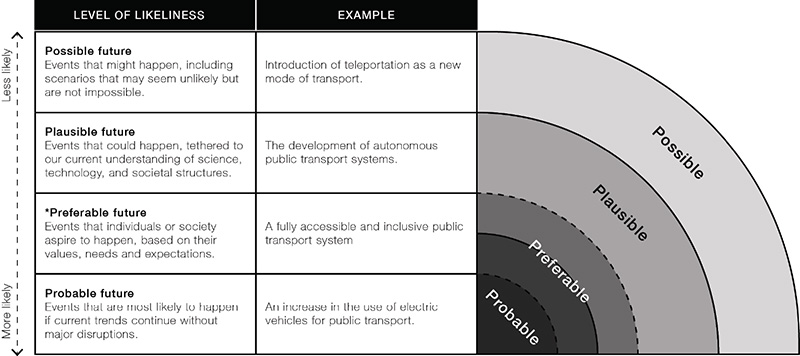
Cardenas Cordova et al.’s Arc of possibilities, 2025*Preferable futures are based on desirability, not likelihood. They overlap with probable and plausible futures.
2. 3. Speculative design in organisations
Speculative design has gradually expanded beyond its artistic origins and academic contexts to become a method explored within organisations. Early applications of speculative methods in organisational research date back to the 2000s (Balsamo et al., 2000; Wong & Khovanskaya, 2018). More recently, organisations have begun experimenting with speculative approaches, primarily as a way to engage with possible futures. For example, some have explored the near future of self-driving cars within an automobile manufacturer (Ringfort-Felner et al., 2023), while others have investigated how an assistant robot cleaner could support cleaners in a food plant (Grafström et al., 2022). A growing body of work highlights the value of speculative design in organisational contexts (Ringfort-Felner et al., 2023; Aguesse & Decreton, 2022; Bleeckler et al., 2022; Tsekleves et al., 2020). Speculative design offers new perspectives that stimulate reframing and deepening of problem understanding, while also helping organisations better understand and respond to the individuals affected by such problems (Grafström et al., 2022; Tsekleves et al., 2022).
However, despite its potential, speculative design, especially future envisioning, remains underutilised in organisations. A key barrier to its adoption is the lack of clarity and consistency about how it can be conducted (Bendor & Lupetti, 2024; Zhu et al., 2024; Ringfort-Felner et al., 2023; Tsekleves et al., 2022; De Haas et al., 2019). Additional barriers include pressure for measurable outcomes, discomfort with ambiguity, and limited familiarity with speculative methods (Ringfort-Felner et al., 2023; Coulton et al., 2016).
Notably, there is currently no widely accepted framework to help large organisations move beyond probable futures and engage with a broader spectrum of future possibilities. Given these challenges, there is a clear need for a practical guide to future envisioning, one that is methodologically grounded, adaptable, and accessible to both designers and non-designers in organisations (Ringfort-Felner et al., 2023). This paper responds to that need by investigating how future envisioning can be methodologically applied to wicked problems within a large governmental organisation.
2. 4. A framework for the speculative design process: The Inverted Double Diamond
The Inverted Double Diamond is a conceptual framework that articulates the core phases of the speculative design process (Cardenas Cordova et al., 2025). The framework comprises four sequential phases: Select, which centres on narrowing broad topics to a specific focus that can serve as a starting point for envisioning futures; Explore, which encourages an expansion of the realm of possibilities and supports the creation of diverse future visions; Transform, which involves materialising these visions into tangible artefacts and narratives; and Provoke, which stimulates critical reflection and dialogue. Each phase alternates between convergent and divergent thinking modes, supporting both structure and creativity throughout the process (see Figure 2). The framework is intentionally flexible, allowing practitioners to adapt methods within each phase to suit their context. While it provides a foundational step toward making speculative design more accessible and consistently applicable for designers and non-designers alike, it has yet to be widely validated in practice. This study addresses this gap by exploring the application of the first two phases of the Inverted Double Diamond framework, which together constitute future envisioning. By applying this within an organisational context, the study aims to provide empirical insights into its practical use.
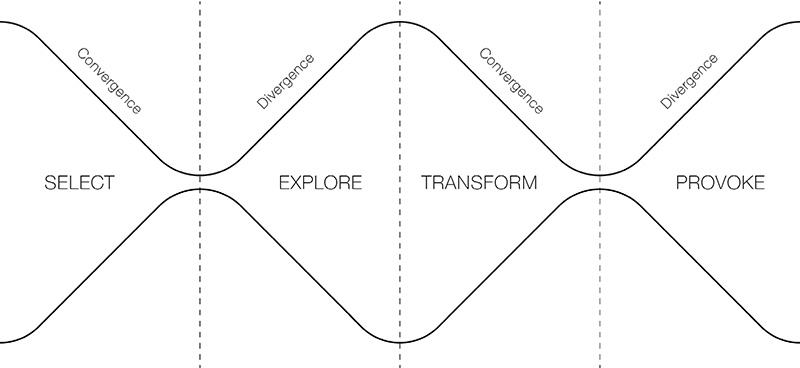
Inverted Double Diamond Framework by Cardenas Cordova et al., 2025
3. Methods
This study investigates the methodological application of future envisioning to wicked problems within an organisational context. To address this, an exploratory case study approach was used, focusing on the methodological considerations of introducing future envisioning into a large organisation. By focusing on the Select and Explore phases of the Inverted Double Diamond, this paper examines how speculative methods for future envisioning unfold in practice, including the design of the workshops and the organisational context that enables them, and what learnings this reveals about engaging with wicked problems in organisational settings. This study was conducted through a collaborative research partnership, with the organisation serving as an active collaborator in shaping the research design. This collaboration ensured that the speculative approach remained responsive to the strategic priorities and organisational context of a large public sector agency while maintaining the academic independence required for speculative inquiry. In January 2025, three future exploration sessions were conducted with 12 participants experiencing physical mobility impairments. These sessions invited participants to imagine and articulate their visions for inclusive urban mobility in Brisbane, Australia, in 2032, a future horizon shaped by the city’s hosting of the Olympic and Paralympic Games. By applying speculative and design methods, including journey mapping, scenario building, future brainstorming and group discussions, the study frames future envisioning as a temporal and participatory design practice. These methods were used to surface insights and highlight expectations and concerns about the future, reframing present-day mobility issues through imaginative exploration. This section outlines the case study context, participant recruitment, and inclusive engagement practices, followed by workshop methods and data analysis approach.
3. 1. Case study: The wicked problem in a large organisation
This study is situated within TMR, a large public sector organisation with approximately 10,000 employees, responsible for planning, managing and delivering Queensland’s integrated transport network (TMR, 2025b). TMR works to achieve sustainable transport solutions for road, rail, air and sea. As a government agency, TMR’s commitment is to contribute to people's quality of life, economic well-being and a sustainable environment. At an organisational level, TMR has a strong commitment to delivering consistent and positive mobility experiences for all Queensland locals and visitors (TMR, 2025a). While TMR is committed to delivering inclusive mobility experiences (TMR, 2025a), this represents a high level of complexity due to three core characteristics of urban mobility. First, it is a complex system composed of users, transport modes, infrastructure, regulations, control systems, and information (Stull, 2023). Second, it involves intermodal diversity, where users combine various transport modes, including walking, public transport, private vehicles, personal vehicles and rideshare services, in unpredictable ways (Ceder, 2021; Lyons, 2018). Third, it must address the diverse needs and preferences of users that influence their mobility experience across the city. Navigating these interconnected technical, social, and political challenges becomes increasingly urgent, given their cumulative impact on everyday mobility and social participation.
3. 2. Participants and recruitment
Given the breadth of TMR’s user base, ranging from local commuters and tourists to people with diverse mobility needs, it is not feasible to explore every user group in equal depth within a single study. To support a focused and manageable scope, this study concentrates on people who identify as having a physical mobility impairment. This decision enables deeper engagement with a specific user group whose lived experiences offer critical insights into accessibility and inclusion more broadly. A total of 12 people from this group were recruited to participate in the future exploration sessions. Recruitment was conducted via email and supported by the Accessibility Transport Network (ATN) within TMR. ATN’s established relationships with the Queenslanders with Disability Network (QDN) supported access to trusted community networks for recruitment purposes. The partnership with TMR provided the necessary institutional support to ensure that the recruitment process adhered to ethical standards and organisational engagement protocols. To maintain participant anonymity and align with the study’s focus on lived experience rather than disability categorisation, detailed demographic information, such as specific ages or clinical impairment types, was not collected or reported for individual participants.
However, participants ranged in age between 18 and 60 years, resided in the greater Brisbane area, and included a mix of gender identification. All participants identified as experiencing physical mobility impairments and used various assistive devices, including electronic wheelchairs, manual wheelchairs, walking sticks, and crutches. Furthermore, all were regular users of public transport (buses, trains, ferries), rideshare services (e.g., Uber or taxis) and private vehicles. These high-level characteristics were reported broadly to ensure that individuals remain non-re-identifiable within the study, while still demonstrating the diversity of perspectives required to explore visions for the future of inclusive urban mobility. The study was reviewed and approved by the Queensland University of Technology’s Human Research Ethics Committee.
3. 3. Designing for inclusion
Participatory and inclusive design approaches support the engagement with people with diverse needs and lived experiences, enabling them to contribute actively to the design process (Hendren, 2020; Holmes, 2018; Pals et al., 2008). These approaches aim to democratise design by shifting from ‘designing for’ to ‘designing with’ (Holmes, 2018). In recent research, speculative design has explored the integration of participatory approaches when envisioning future possibilities (Almohamed et al., 2020; Arora et al., 2023; Mendez Gonzalez et al., 2020; Tsekleves et al., 2022). This emerging approach, often referred to as participatory speculative design, invites communities to collaboratively envision future possibilities that reflect their needs, expectations and concerns (Tsekleves et al., 2022).
Due to the study’s focus on inclusive urban mobility, our commitment as a research team was to create an inclusive workshop where all participants felt heard and comfortable sharing their lived experiences and unique, preferred visions for the future of urban mobility. This approach was reflected in the structure of the sessions, which focused on speculating about mobility challenges rather than the body (Holmes, 2018). For this reason, participants were not required to disclose specific identification, medical diagnoses or clinical impairment types. Given the sensitive nature of the problem and the potential vulnerability of participants, experts in disability engagement, including members of QDN and ATN, were consulted to improve the inclusivity of the sessions. Based on their advice, sessions were held in a familiar and accessible location to minimise stress associated with navigating a new venue. QDN offered their premises, which most participants already knew how to access. To balance depth of engagement with participants’ comfort, each session was designed to last 120 minutes with a 15-minute break included. As meaningful participation required time for discussion and reflection, and to maintain a supportive group dynamic, sessions were limited to a maximum of four participants. The room was arranged to create generous spacing for ease of movement throughout the space. Additional measures, aligned with TMR’s inclusive engagement practices, included using plain language for clarity across activities and the option for each participant to have a support person, particularly for assistance with writing during the session. The collaborative nature of this partnership allowed the research team to anticipate and mitigate potential hurdles, resulting in a facilitation process that was pre-aligned with both the participants’ needs and the organisational culture.
3. 4. Crafting the future exploration session
The future exploration session guided participants through an imaginative process in which they were supported in shifting their focus from the present to the futures. Drawing on the Select and Explore phases of the Inverted Double Diamond framework, the future exploration session provided a clear pathway for engaging with speculative ideas (see Figure 3).

Future exploration workshop overview
Envisioning the future possibilities can be challenging without a defined focus, as the scope can become overwhelmingly broad. In the context of inclusive urban mobility, future visions might include transportation modes, payment methods, service reliability, mobility barriers, and more. Identifying which aspect of the wicked problem to speculate on and aligning this focus with the expectations and lived experiences of those most affected is a critical part of this phase. Participants were encouraged to individually reflect on their past and present urban mobility experiences and project them onto a hypothetical journey. Each participant received a destination card featuring a fictional location in Brisbane (see Figure 4). These fictional destinations were used for two reasons. First, they introduced a level of abstraction, helping participants move beyond present-day conditions and engage in future-oriented, speculative thinking. Second, they ensured that participants approached the journey as travel to an unfamiliar place, reducing the influence of prior knowledge that might make accessibility considerations implicit or unarticulated. Imagining travel to an unknown destination prompted participants to reflect more explicitly on the information, support, and environmental conditions required throughout the entire journey, including before it began (e.g., planning and researching routes), during the journey itself (e.g., reaching a bus stop or travelling by train), and upon arrival at the destination (e.g., finding accessible parking or finding ramps). Because the images varied in the accessibility features that they depicted, participants were prompted both to notice existing accessible elements and to speculate on potential barriers, shaping the scope and focus of their reflections. Reflections were documented using a journey map template (see Figure 7), a tool commonly used to capture detailed user experiences. While the destinations themselves were fictional, the activity remained grounded in participants’ real-world experiences, balancing abstraction with reality to help maintain a strong connection to the real-world conditions of the problem, supporting outcomes to be actionable within organisational planning processes.

Example of destination cardsLeft: A Vision for Toombul by Prax Studio (2022). © 2022 Prax Studio. Used with permission.Right: A Vision for Mt Coot-tha by Prax Studio (2024). © 2024 Prax Studio. Used with permission.
Following this, participants engaged in a group discussion where they shared the main challenges identified in their journey maps. This exchange of lived experiences was included to help participants connect and reflect on their needs not only at a functional level but also socially and emotionally. At the end of the discussion, each participant selected one mobility challenge to focus on in the next phase. This step was designed to allow participants to define their own priorities, avoiding assumptions about what might be considered important, which could otherwise limit the scope of future envisioning. The activities in this phase were intended to help participants reflect and identify key aspects of urban mobility they wished to speculate about. Providing a concrete starting point to help reduce the cognitive load of open-ended speculation, which can be challenging for participants, while still allowing creative exploration.
Even with a clearly defined focus for speculation, imagination can still be constrained by present-day realities, leading participants to gravitate toward prediction rather than asking ‘what if?’. Because speculative design aims to explore possibilities rather than probabilities, the objective of this phase is to shift participants’ mindset from what is likely to what is possible, encouraging divergent thinking. To support this shift, the methods in this phase were structured around three sequential activities: future exploration, worst/best case scenario, and a group discussion. In the first activity, future exploration, participants were asked to imagine individually how Brisbane might look in 2032. An aerial photograph of present-day Brisbane was provided to offer a familiar reference point while prompting participants to think broadly and spatially about possible future changes (see Figure 5). Participants were asked to consider aspects such as technologies (e.g., artificial intelligence), environmental factors (e.g., climate change), changes in transport modes and infrastructure (e.g., autonomous buses), societal shifts (e.g., work from anywhere culture), and economic factors (e.g., inflation) when imagining their future vision. These categories were adapted from the PESTLE framework (Political, Economic, Social, Technological, Legal, and Environmental) to scan external factors that influence complex systems (Tsekleves et al., 2020, 2022). This framework was selected to encourage participants to consider multiple drivers of change.
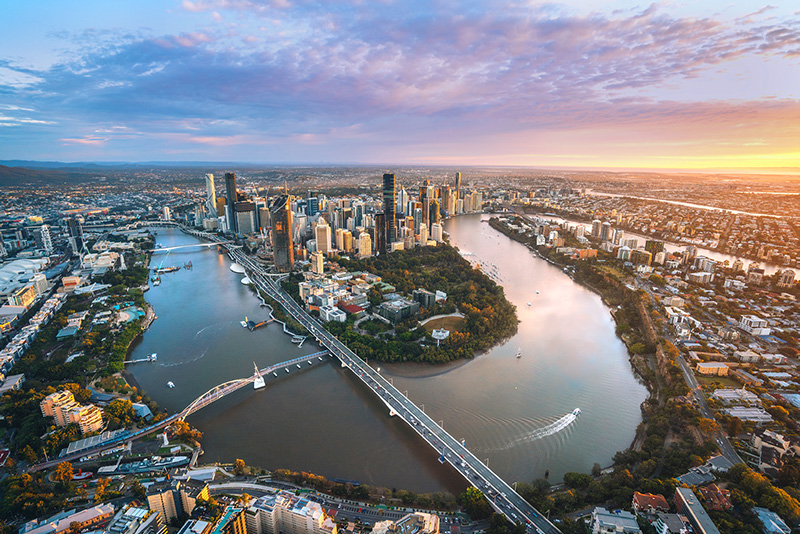
Aerial photograph of Brisbane city. Image source: Brisbane Economic Development Agency (Brisbane Content Toolkit), Asset ID 329785. Used under Royalty Free licence.
Acknowledging that thinking beyond what is probable or expected can be challenging, a set of 40 cards covering those five categories was introduced to spark creativity and reduce cognitive load, making speculative thinking more accessible. Inspired by the ‘Thing from the Future’ card set (Situation Lab, n.d.), this tool was adapted to the context of urban mobility, presenting plausible ideas within each category (see Figure 6). These cards were offered as optional prompts for those needing inspiration but also served as guidance on the kind of ideas to imagine. The cards were deliberately designed to blur the boundaries between the real and the fictional, encouraging conceptual thinking that, while imaginative, remained grounded in plausibility (Dunne & Raby, 2013). Participants documented their ideas using sticky notes (one idea per sticky note) and placed them on the photograph of Brisbane at the location where they believed each change might occur. For instance, an idea related to climate change might be placed in the sky, while one involving a new transport mode using the river could be positioned along the river. This spatial mapping was included to help participants visualise and situate their ideas within the city’s geography. To promote a vision of Brisbane that reflected technological advancements and societal change, participants were asked to include at least one idea from each category. This requirement was intended to encourage holistic consideration of multiple drivers of change.
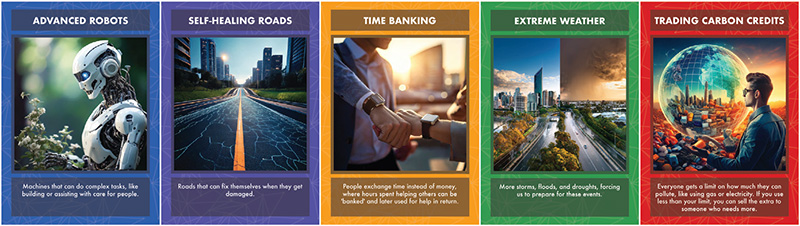
Example of each category from the card set.Images on cards created using text-to-image generative AI via Adobe Firefly.
After creating their future scenarios for Brisbane 2032, participants explored how the urban mobility challenge selected in the previous phase might evolve within their envisioned futures. The worst/best case scenario activity was included to encourage participants to think beyond linear progressions, considering risk and opportunities, which is essential for addressing wicked problems through speculative design. The worst-case scenario (a dystopian perspective) prompted them to imagine possible negative outcomes, highlighting concerns and threats. Conversely, the best-case scenario (a utopian perspective) invited them to envision positive changes, fostering optimism and creative thinking about possible future solutions and innovations. Considering both perspectives simultaneously was intended to stimulate a dynamic way of thinking, either starting with a problem and imagining ways to address it or beginning with a solution and then problematising it, which supports divergent thinking.
Participants documented their ideas using a worst/best-case scenario template (see Figure 8) because structured templates help organise complex ideas and make them easier to compare across participants, which is important for later synthesis. Following this, participants engaged in a second group discussion, where they shared the challenges that they had selected, along with the best-case scenario in which those challenges were successfully addressed. We were interested in hearing their best-case scenarios because these visions reveal participants’ hopes, values, and aspirations. This discussion helped to establish a collaborative space for participants to articulate their preferred futures while navigating the group’s collective expectations and concerns, facilitating participatory sense-making. The activities in this phase were designed to support creativity, imagination, and divergent thinking, enabling participants to explore futures that extended beyond what is currently considered predictable or probable, while remaining relevant for the organisation.
3. 5. Data analysis
The analysis began with an inductive thematic analysis to extract key insights from participant contributions, followed by a critical reflection on the application of the future envisioning process. First, inductive thematic analysis was conducted to identify participants’ concerns, expectations, and perspectives related to inclusive urban mobility, revealing how future envisioning can surface dimensions of wicked problems that are often overlooked in conventional design processes. The data analysis involved group discussions in which participants shared their mobility lived experiences, needs and expectations. These discussions were transcribed by the first author, using Notta.ai software to generate accurate transcriptions. Additionally, template activities completed by participants, including journey mapping, worst/best-case scenarios, along with facilitator notes from the group discussion, were analysed. All these data followed the six steps of thematic analysis described by Braun & Clarke (2006), offering a flexible yet systematic framework for identifying, analysing and reporting patterns (themes). While thematic analysis was used to surface insights valuable for understanding participants’ perspectives, the primary focus of the analysis was on how the application of the first two phases of the Inverted Double Diamond, Select and Explore, facilitated the future envisioning of inclusive urban mobility.
Second, a reflective practice approach was employed to analyse the methodological application of future envisioning. The first author captured detailed observations, decisions, challenges, and adjustments made during the workshop through post-session reflections with the research team. These reflections considered participant engagement, group dynamics, the clarity and effectiveness of prompts, and the flow of activities. The findings were examined alongside the thematic analysis to explore how the process influenced the quality and diversity of the outcomes produced in each phase. This process-oriented analysis facilitated the identification of methodological insights, highlighting factors that supported or hindered the process of future envisioning in an organisational context, particularly when engaging with complex, wicked problems.
4. Findings from the future exploration session
This section presents the findings from the Select and Explore phases, highlighting participants’ insights and how the facilitation tools supported the generation of these insights.
4. 1. Findings from the Select phase
The Select phase surfaced a wide array of urban mobility challenges, resulting in a rich dataset of lived experiences. Through individual reflection and group dialogue, participants identified barriers ranging from physical infrastructure to information and technology gaps. A key finding was the significant variance in how participants experienced similar mobility challenges, reflecting differences in navigation strategies and pain points shaped by individual needs and environmental contexts. This diversity of perspective is summarised in Table 1. From these challenges, each participant individually selected one to focus on in the next phase.

Select phase results overview.
The richness of this data was directly supported by the structured journey map activity (Figure 7). Participants noted that the destination cards served as vital visual prompts, while the template helped them systematically deconstruct their journeys. However, the method revealed a need for refinement regarding the ‘After the Journey’ section. Participants from the first group interpreted this as the “return trip” rather than “arrival at the destination.” This was addressed in subsequent sessions by providing clearer explanations and examples during the activity introduction, demonstrating the value of an iterative approach to the workshop design. Furthermore, the conversational nature of the facilitation played a crucial role in data generation. Even participants comfortable with independent writing preferred sharing their thoughts aloud with a facilitator or support person before documenting them. This verbal-first approach, supported by facilitators acting as active listeners, ensured that the insights captured were nuanced and deeply reflective, without guiding or influencing participants’ responses. The use of a whiteboard to capture the flow of group discussions further validated participants’ contributions, allowing them to build upon each other’s stories and exchange practical mobility strategies.
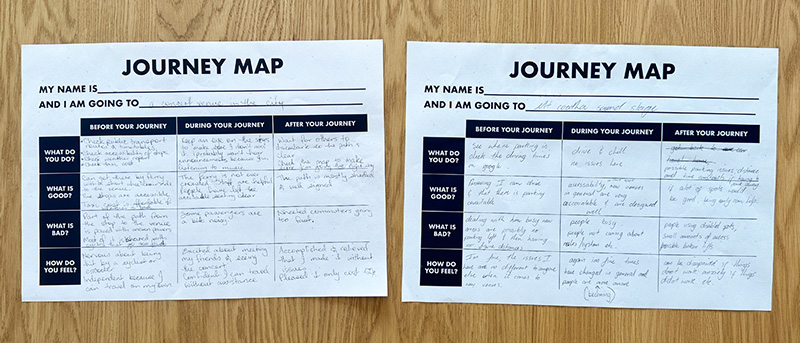
Examples of two participants’ journey map activity
4. 2. Findings from the Explore phase
The Explore phase produced a significant shift in perspective, revealing that a best-case future for inclusive mobility is defined less by new, enhanced vehicles and more by informational agency and social awareness. Many participants also expressed a strong desire to feel as capable and independent as anyone else, without needing to constantly ask for assistance or justify their needs. This aspiration was reflected in their best-case scenario ideas, which frequently envisioned flexible and personalised mobility solutions tailored to their diverse and unique requirements, as summarised in Table 2.
Explore phase results overview.
Participants across the three groups highlighted that accessing accurate, detailed information is essential for making informed decisions and maintaining a sense of control, autonomy, and independence. A participant mentioned, “If there’s no information online, then it’s very hard to plan any of this” while another added, “you asked everybody, you know, are you sure there is a ramp? Are you sure there is a lift? But, you know, someone’s going to say yes, and it turns out that there are not (ramp or lift)”. Depending on the quantity and quality of information available, they can better plan their journeys, identifying the best possible routes and considering details that people without disabilities rarely need to consider, such as lifts, accessible toilets, parking spaces, ramps, surface materials of pathways, or roadworks. As one participant noted, “the biggest hurdle for anyone with a disability I think is information that you can get”, another participant reflected, “just those crazy things that you don’t necessarily have to consider if you’re not disabled”. A major finding was that knowing about the availability and functionality of features is often more important than the features themselves. Without this information, uncertainty can lead to frustration and anxiety, which often discourages people from leaving their homes. One participant explained: “We often find that (websites) might say there’s wheelchair accessible parking, but it doesn’t give any more information than that… we know it’s there, (but) we don’t know where, how many, what’s the likelihood of there being one available. Any of that sort of information is very vague… The number of times we’ve had to pull over in a bus zone just because there’s nothing else around… no other way of getting out of the car.” Participants also emphasised the importance of more detailed information about distances, as this helps them assess the physical effort required and mentally prepare accordingly, since even a short distance can represent a significant challenge. As one participant illustrated, “the design of car parks… (often locates the) disability parking miles away. Even if you walk a bit, it takes away the whole purpose of needing the accessible parking because you cannot walk that far.”
Furthermore, the best-case ideas revealed the complexities of navigating the built environment, distinguishing between permanent, temporary, and contextual barriers to mobility. Permanent barriers were described as obstacles that consistently affect their mobility, being typically fixed features of the built environment, with no indication of change in the short term, or that required a significant financial investment to be addressed. For instance, one participant noted that “if (footpath) is paved, and the paved is uneven, that can make it really dangerous and difficult”. Due to their permanence, these barriers are often predictable and, when possible, avoidable. As another participant explained, “I will try to find the easiest route possible… but sometimes there is no choice… a cobblestone ramp is horrible, I hate it, but there is no other alternative”. Temporary barriers were characterised by their limited duration and time-specific impact on mobility. Some were described as predictable, such as weather-related disruptions, including rain or extreme heat, whose duration can be reasonably estimated. As one participant explained, “If the weather changes or if it is going to be bad, that decides how I will get there. So, I am not going to be able to take public transport if it is pouring rain”. Others were described as unpredictable, lacking a clear timeframe, yet understood to be non-permanent, such as infrastructure failures. One participant described this: “Most times it doesn’t tell you if all this stuff (lift) is working. You go to the train station, and it’s not working… and by the time you find another lift … you miss your train”. When first encountered, these barriers are unexpected, leading to frustration and stress, forcing them to find alternative routes. Contextual barriers arose from situational factors such as human behaviour, overcrowding, social norms, or cultural attitudes that temporarily affect a particular place. Participants highlighted how these barriers emerge through everyday interactions: “Disabled parks become drop-off zones”, and “When I get off the ferry, I wait for everybody else to get off first, because if I get off first, they are all like rushing past me”. Others described how crowded shared spaces intensify risk: “When everyone is out for a jog or a ride, it is really crowded… people are whizzing past me on wheels… they know where they are going, but I do not… it causes a collision”. These contextual barriers were perceived as highly unpredictable, making them difficult to anticipate or plan for, and requiring quick adaptation and decision-making on the spot to continue a journey. Many participants attributed these barriers to a lack of awareness among people without impairments regarding how their actions affect those with physical mobility impairments. As one participant observed, “People are just completely unaware, absorbed in their own world”, while another added, “Even car drivers won’t have awareness of people crossing (the street in) their wheelchairs.”
These thematic insights were directly enabled by the speculative methodology, which encouraged participants to think beyond probable, present-day constraints. We observed that the provided card set acted as a critical catalyst for inspiration, with most participants exceeding the required five ideas. While participants explored both worst-case and best-case scenarios relatively equally, there was a slight tendency to elaborate more on optimistic futures (Figure 8). This aligns with Holmes’s (2018) finding that people affected by exclusion often generate solutions deeply rooted in their lived experience to reclaim a sense of independence. From a procedural standpoint, the group discussions were vital; the collaborative environment allowed participants to validate, build upon, or propose alternative versions of one another’s ideas. While some ideas appeared fragmented or lacked specific technological detail, this ambiguity is consistent with speculative design theory (Dunne & Raby, 2013), where ideas serve as a contextual foundation for reimagining a problem. However, the fragmented nature of some responses suggests that future iterations of this phase could benefit from a specific activity designed to help participants weave these speculative threads into a single, cohesive future narrative.
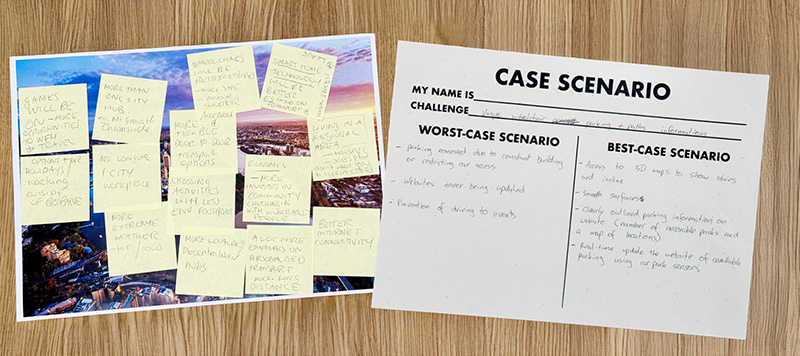
Example of a participant’s future exploration and worst and best-case scenario activity
5. Discussion
This paper presents a case study examining how future envisioning can be methodologically applied to the wicked problem of inclusive urban mobility within a large Australian government organisation. It addresses the research question of ‘How can speculative envisioning be methodologically applied to wicked problems within an organisational context?’ While the study was conducted within an organisational setting, its primary aim was to explore the application of the Select and Explore phases of the Inverted Double Diamond framework as a methodological approach to engaging with wicked problems, rather than to evaluate their direct impact on organisational planning or decision-making. The contribution of this paper lies in demonstrating how future envisioning can be applied in an organisational context to structure a participatory exploration of wicked problems, considering a broader spectrum of future possibilities, which helps surface hidden assumptions, make implicit values explicit, and open space for reframing the problem. Examination of how such outputs might inform organisational decisions is beyond the scope of this study and represents a valuable direction for future research. In this section, we reflect on the case study, the methodology itself, and the value it offers to organisations, before discussing its limitations and implications for future research.
5. 1. Methodological reflections on the case study
This section critically reflects on the methodological application of future envisioning within the case study, prioritising methodological learnings over specific organisational outcomes. By analysing the Select and Explore phases, this reflection illustrates how the transition from convergent narrowing to divergent speculation shapes participant engagement and defines the scope of the future envisioning.
The Select phase methodologically focuses on narrowing the scope to facilitate focused and practical future envisioning. Given the inherently broad and multifaceted nature of wicked problems, this phase demands convergent thinking, moving from a wide range of possibilities to a specific, actionable focus. This was evident in the case study, where inclusive urban mobility encompasses multiple domains, such as transport modes, infrastructure, and policy, each with additional layers of complexity. Participants’ selection of focus areas varied across these domains, reflecting diverse priorities and highlighting how the method captures the multifaceted nature of the wicked problem. This variation demonstrates the importance of participant-driven selection in capturing what matters most for those affected, even within seemingly homogenous groups. It also helps surface unique insights and avoid assumptions about the problem and its priorities (Arora et al., 2023; Tsekleves et al., 2022; Almohamed et al., 2020; Mendez Gonzalez et al., 2020). Methodologically, this underscores the need to structure the Select phase as a funnel, moving from the broad nature of wicked problems toward specific, actionable domains, while remaining iterative and responsive to participant interpretation. This was evidenced by the refinement of the journey map template, which was adapted to better align with participants’ own conceptualisations of the travel experience.
The Explore phase methodologically emphasises the generation of a wide range of future possibilities. Given that the core aim is to explore different perspectives and realities of the wicked problem, this phase demands divergent thinking to generate scenarios that go beyond mere prediction (Auger, 2013; Dunne & Raby, 2013). In the case study, the methods employed in this phase, such as future brainstorming and utopian and dystopian framing, were appropriate in encouraging creative foresight and open-ended thinking, resulting in over 25 envisioned futures. Most scenarios transcended present-day and market-driven constraints, fulfilling a core criterion of speculative design. During the envisioning process, ideas must be anchored in reality to remain relatable, yet sufficiently distant from current realities to remain provocative (Dunne & Raby, 2013; Malpass, 2013). Since participants envisioned futures grounded in their lived experience and framed through both utopian and dystopian lenses, this approach helped bridge present realities with aspirational futures (Auger, 2013). Although utopian scenarios were the focus, dystopian ones revealed what participants wished to avoid, showing that an aspirational tone persisted across both lenses. This balance strengthens speculative design’s capacity to produce both imaginative and grounded provocations. Methodologically, the Explore phase generates diverse, participant-grounded futures that bridge imaginative speculation with lived experience. This is exemplified by the way participants’ best-case ideas deconstructed the complexities of the built environment into permanent, temporary, and contextual barriers, deepening the understanding of the wicked problem. This categorisation challenges the dominant narrative that urban mobility is solely a technical problem; instead, it demonstrates that it should transcend mere compliance to foster autonomy and dignity actively.
Methodologically, the success of these phases within an organisational setting was facilitated by the collaborative nature of the research partnership. The inclusion of a TMR in the research team ensured that the speculative and participative nature of the workshops was pre-aligned with organisational culture and needs. This partnership was particularly instrumental in the recruitment of a specific population for a 120-minute session and in improving the accessibility and inclusivity of the facilitation process.
5. 2. Methodological reflections on the Inverted Double Diamond framework
Building on the methodological reflections from this case study, this section discusses how applying the Select and Explore phases of the Inverted Double Diamond framework in a practical setting contributes to its refinement. While the framework provides a structure for the future envisioning process, its application here has helped clarify the specific objectives, cognitive modes, strategies, tones, and outcomes required for each phase (see Figure 9). In line with Stachowiak’s (1973) reduction characteristic of model theory, the framework simplifies the complexities of future-oriented research into a structure that can be adapted to diverse organisational settings while remaining responsive to participants’ experience to be effective.
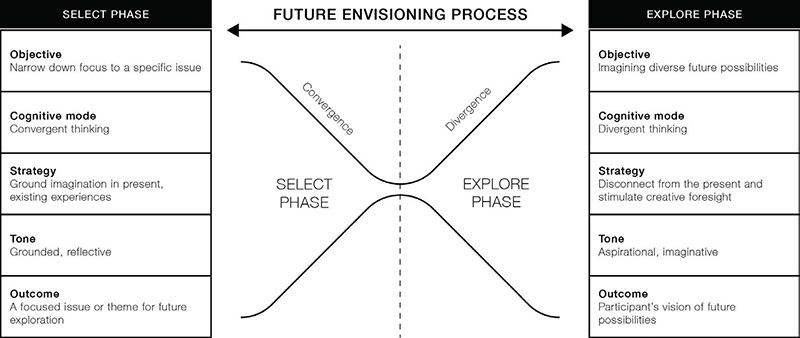
Overview of the future envisioning process
By testing the framework against a wicked problem like inclusive urban mobility, we can transition the model from a theoretical proposition to a more nuanced, field-tested resource. The true value of this case study lies in the empirical grounding it provides to establish key parameters for each phase, understood as methodological principles derived from situated practice. Refining these parameters, such as the tone of the Select phase as grounded and reflective, or defining the outcome of the Explore phase as a vision of possibilities, establishes a clearer standard for what organisations should aim for when using the model. This clarified structure could act as a scaffold for the unknown, reducing the ambiguity often associated with speculative design and providing a consistent language for cross-disciplinary teams. By making the cognitive modes (convergent versus divergent) and strategies explicit through this case study, the framework becomes a more accessible entry point for organisations unfamiliar with speculative design (Ringfort-Felner et al., 2023; Aguesse & Decreton, 2022; Tsekleves et al., 2020).
Ultimately, the application of the framework provides a foundation for understanding how to conduct future envisioning and what to aim for, while allowing for the flexibility needed in complex, participant-centred contexts. The framework’s value lies in articulating transferable methodological principles that can inform future envisioning across a range of organisational contexts, with further empirical applications offering opportunities to extend and refine its use in practice. For the field of design research, reporting on such a case study serves to validate the existing framework’s utility and strengthen organisational design capabilities by building internal capacity to address complexity in a systematic way (Junginger, 2009).
5. 3. Potential value of future envisioning in organisations
Through design and designing, organisations continuously change, develop and reshape their realities over time. (Junginger, 2015). Yet, this engagement is often limited to a predictive stance, anticipating future events merely to prepare for them. While valuable, this approach may be insufficient for addressing the inherent complexity of wicked problems. Future envisioning can function as a form of strategic foresight within organisations, providing a way to expand their perspectives by moving beyond probable outcomes to consider the (un)desirable futures of diverse stakeholders (Auger, 2013; Dunne & Raby, 2013). In this sense, future envisioning can support innovation in organisations by broadening practices beyond traditional forecasting (Dorst, 2015).
Future envisioning, when methodologically structured, expands a space within organisations to consider concepts that may seem improbable under conventional forecasting methods. This aligns with the capacity of speculative design to surface the social and cultural implications of emerging technologies before they materialise (Dunne & Raby, 2013; Tsekleves et al., 2020). The resulting imagined futures provide dual value: they surface the immediate concerns and latent expectations of participants while simultaneously acting as a catalyst for deeper organisational learning and societal reflection (Dunne & Raby, 2013). Grounded in lived experience, these insights may support organisations in exploring, considering, and perhaps anticipating not only technological opportunities but also the potential ethical and systemic challenges that accompany them (Dunne & Raby, 2013; Tsekleves et al., 2020). The value of participant-generated futures lies not in their literal realisation, but in how they are collectively interpreted and synthesised. In this study, imagined futures and participant reflections can be clustered thematically to identify shared concerns, tensions, and values that could be used as prompts for structured reflection among organisational stakeholders. Such synthesis can support sensemaking by informing problem reframing, surfacing ethical considerations, and shaping strategic questions that guide subsequent planning or design activities. In that sense, this approach could enable organisations to expand their understanding of latent user needs and inform future strategic decisions. However, adoption may remain constrained by organisational cultures that favour certainty and efficiency. For future envisioning to be impactful, organisations must cultivate an openness to ambiguity and invest in design capabilities that support speculative thinking.
Beyond conceptual insights, future envisioning offers a practical structure for organisations to engage with the community, particularly underrepresented groups. Future envisioning offers not only a democratic platform for sharing voices but also allows participants to imagine and articulate their aspirational futures. By shifting the focus from present conditions to preferred futures, participants can unfold complex and sensitive topics through hypothetical scenarios, surfacing challenges and opportunities with greater empathy and less confrontation (Tsekleves et al., 2020, 2022). As demonstrated in this case study, this process empowers participants with the agency to influence how future possibilities are imagined (Almohamed et al., 2020; Arora et al., 2023; Mendez Gonzalez et al., 2020; Tsekleves et al., 2022), an essential capability when addressing wicked problems.
5. 4. Limitations and future work
This study explored the methodological application of future envisioning to wicked problems within an organisational setting, through the Select and Explore phases of the Inverted Double Diamond framework. While it offers valuable methodological insights, these are subject to limitations at two levels: those related to the specific case study context, and those related to the transferability of the findings beyond that context.
This study examined the specific wicked problem of inclusive urban mobility from the perspective of a single stakeholder group, people experiencing physical mobility impairments, within one organisation, TMR. While this focused approach enabled a manageable scope, it also limited the diversity of perspectives considered. Future studies could broaden understanding of this wicked problem by involving multiple stakeholder groups, such as individuals experiencing other types of impairments, architects, urban planners, and policymakers. Incorporating a wider range of perspectives and values would enrich the speculative design process and provide a more holistic view of inclusive urban mobility.
The findings presented in this study are context-specific and should not be interpreted as generalisable. While the discussion highlights the potential organisational value of future envisioning, including its role in innovation, stakeholder engagement, and strategic foresight, these insights are derived from a single case study and reflect the specific conditions and dynamics of that context. Although this study advances understanding of how future envisioning can be methodologically applied to wicked problems within an organisational setting, further empirical applications are needed to examine the framework’s adaptability across other contexts. Applying this methodology to different wicked problems and contexts would enable comparative insight into how the Select and Explore phases operate under varying conditions, supporting the continued development of the Inverted Double Diamond framework as a flexible methodological resource for speculative design.
6. Conclusion
This paper addresses the research question of How can future envisioning be methodologically applied to wicked problems within an organisational context? By applying the Select and Explore phases of the Inverted Double Diamond framework to the wicked problem of inclusive urban mobility, this study demonstrates that future envisioning could be applied through a structured yet iterative process. This methodology transitions the process from a theoretical proposition to a field-tested resource, providing organisations with a scaffold for the unknown that balances the need for clarity with the openness required for speculative thought.
The case study with TMR illustrates that the ‘how’ of this application within this context involves a participatory and possibility-based exploration. Methodologically, this requires narrowing the scope of inquiry through a convergent Select phase while a divergent Explore phase supports the generation of diverse and imaginative futures, which are anchored in lived experience. The application of this process was observed to yield rich experiential data, uncover latent needs, and prompt critical reflection on technological and systemic challenges. A significant finding of this application is that such a structure guides speculative thinking, enabling both the deconstruction and the expanded understanding of complex problems. This was evidenced by the identification of the critical role of accessibility information and the diverse mobility barriers encountered by people experiencing physical mobility impairments. These insights help challenge the dominant technical narrative, revealing that inclusivity in urban mobility should move beyond mere compliance to actively foster social autonomy and dignity.
In conclusion, this study contributes to the growing discourse on speculative design, especially in organisational contexts, by offering a methodological and practical roadmap for applying future envisioning to wicked problems. Through the Select and Explore phases of the Inverted Double Diamond framework, it shows that the methodology can also function as a strategic vehicle for collaborative problem-framing. Future research is needed to refine this process and test its applicability and adaptability across diverse settings and stakeholder groups. It could also build on this work by exploring subsequent phases of the Inverted Double Diamond framework. This includes transforming the future-oriented ideas generated in this study into speculative artefacts (Transform phase), which can provoke reflection and stimulate discussion about the broader implications of emerging technology (Provoke phase). Such exploration would enable a fuller practical application of speculative design, further strengthening its value as a methodological approach for navigating the complexity and uncertainty of our shared futures.
Acknowledgments
This research has been supported by the Queensland Government Department of Transport and Main Roads (TMR) in partnership with the ARC Training Centre for Behavioural Insights for Technology Adoption (IC210100008). We thank Mikayla Johnson, Shellee Franssen and Yah Kakia from the Queensland Department of Transport and Main Roads (TMR) and Carla Mendoza from the Queenslanders with Disability Network (QDN) for their assistance with recruiting participants and advising on workshops.
Notes
Copyright : This is an Open Access article distributed under the terms of the Creative Commons Attribution Non-Commercial License (http://creativecommons.org/licenses/bync/3.0/), which permits unrestricted educational and non-commercial use, provided the original work is properly cited.
References
- Aguesse, M., & Decreton, B. (2022). Using Fiction to Find Your Strategy. Harvard Business Review. https://hbr.org/2022/06/using-fiction-to-find-your-strategy.
-
Almohamed, A., Zhang, J., & Vyas, D. (2020). Magic Machines for Refugees. Proceedings of the 3rd ACM SIGCAS Conference on Computing and Sustainable Societies, 76-86.
[https://doi.org/10.1145/3378393.3402256]

-
Arora, S., Kaur, S., Kar, R., Sharma, S., & Eden, G. (2023). What Not to Wear: Exploring Taboos in Clothing Through Speculative Design. Proceedings of the 2023 ACM Designing Interactive Systems Conference, 1-14.
[https://doi.org/10.1145/3563657.3595972]
-
Auger, J. (2013). Speculative design: Crafting the speculation. Digital Creativity, 24(1), 11-35. Design & Applied Arts Index (DAAI).
[https://doi.org/10.1080/14626268.2013.767276]
-
Balsamo, A., Gorbet, M., Harrison, S., & Minneman, S. (2000). The methods of our madness: Research on experimental documents. CHI'00 Extended Abstracts on Human Factors in Computing Systems, 207-208.
[https://doi.org/10.1145/633292.633411]
-
Bendor, R., & Lupetti, M. L. (2024). Teaching speculative design. International Journal of Technology and Design Education.
[https://doi.org/10.1007/s10798-024-09908-3]
- Bleeckler, J., Foster, N., Girardin, F., Nova, N., Frey, C., & Pittman, P. (2022). The manual of design fiction. Near Future Laboratory.
-
Braun, V., & Clarke, V. (2006). Using thematic analysis in psychology. Qualitative Research in Psychology, 3(2), 77-101.
[https://doi.org/10.1191/1478088706qp063oa]
-
Bray, K., & Harrington, C. (2021). Speculative Blackness: Considering Afrofuturism in the Creation of Inclusive Speculative Design Probes. Proceedings of the 2021 ACM Designing Interactive Systems Conference, 1793-1806.
[https://doi.org/10.1145/3461778.3462002]
- Brisbane Economic Development Agency. (2024). Hero destination [Photograph]. Brisbane Content Toolkit. https://brisbane.brandkit.io/asset-page/329785-hero-destination.
-
Buehring, J., & Bishop, P. C. (2020). Foresight and Design: New Support for Strategic Decision Making. She Ji: The Journal of Design, Economics, and Innovation, 6(3), 408-432.
[https://doi.org/10.1016/j.sheji.2020.07.002]
-
Cardenas Cordova, D., Kelly, N., & Rezayan, L. (2025). A systematic literature review of the speculative design process and a proposed framework for speculative design. Design Science, 11, e38.
[https://doi.org/10.1017/dsj.2025.10030]
-
Ceder, A. (2021). Urban mobility and public transport: Future perspectives and review. International Journal of Urban Sciences, 25(4), 455-479.
[https://doi.org/10.1080/12265934.2020.1799846]
-
Coulton, P., Burnett, D., & Gradinar, A. (2016). Games as Speculative Design: Allowing Players to Consider Alternate Presents and Plausible Features. Proceedings of the Design Research Society 2016.
[https://doi.org/10.21606/drs.2016.15]
-
De Haas, M., Jun, G. T., & Hignett, S. (2019). Design as a provocation to support discussion about euthanasia: The plug. In Advances in human aspects of healthcare (Vol. 826, pp. 137-152). Springer.
[https://doi.org/10.1007/978-3-319-96065-4_17]
-
Dorst, K. (2015). Frame Innovation: Create New Thinking by Design. MIT Press.
[https://doi.org/10.7551/mitpress/10096.001.0001]
- Dunne, A., & Raby, F. (2013). Speculative Everything: Design, Fiction, and Social Dreaming. MIT Press.
-
Grafström, A., Holmgren, M., Linge, S., Lagerberg, T., & Obaid, M. (2022). A Speculative Design Approach to Investigate Interactions for an Assistant Robot Cleaner in Food Plants. In Proceedings of the ACM International Conference.
[https://doi.org/10.1145/3547522.3547682]
- Hendren, S. (2020). What Can a Body Do?: How We Meet the Built World. Penguin Publishing Group.
-
Holmes, K. (2018). Mismatch: How Inclusion Shapes Design. The MIT Press.
[https://doi.org/10.7551/mitpress/11647.001.0001]
-
Jakobsone, L. (2017). Critical design as approach to next thinking. The Design Journal, 20(sup1), S4253-S4262.
[https://doi.org/10.1080/14606925.2017.1352923]
-
Johannessen, L., Keitsch, M., & Pettersen, I. (2019). Speculative and Critical Design-Features, Methods, and Practices. Proceedings of the Design Society: International Conference on Engineering Design, 1, 1623-1632.
[https://doi.org/10.1017/dsi.2019.168]
- Junginger, S. (2009). Design in the Organization: Parts and Wholes. Research Design Journal, 23-29.
-
Junginger, S. (2015). Organizational Design Legacies and Service Design. The Design Journal, 18(2), 209-226.
[https://doi.org/10.2752/175630615X14212498964277]
-
Light, A. (2021). Collaborative speculation: Anticipation, inclusion and designing counterfactual futures for appropriation. Futures, 134, Article 102855.
[https://doi.org/10.1016/j.futures.2021.102855]
-
Lindley, J., & Green, D. P. (2021). The Ultimate Measure of Success for Speculative Design is to Disappear Completely. Interaction Design and Architectures, 51, SI, 32-51.
[https://doi.org/10.55612/s-5002-051-002]
-
Lyons, G. (2018). Getting smart about urban mobility - Aligning the paradigms of smart and sustainable. Transportation Research Part A: Policy and Practice, 115, 4-14.
[https://doi.org/10.1016/j.tra.2016.12.001]
-
Malpass, M. (2013). Between wit and reason: Defining associative, speculative, and critical design in practice. Design and Culture, 5(3), 333-356.
[https://doi.org/10.2752/175470813X13705953612200]
-
Malpass, M. (2017). Critical design in context: History, theory, and practices. In Critical design in context: History, theory, and practices. Bloomsbury Academic.
[https://doi.org/10.5040/9781474293822]
-
Marji, N., Thibault, M., & Hamari, J. (2023). A Typology of Fantastical Cities and Architecture: Categorizing the Urban Imaginary. Proceedings of the 26th International Academic Mindtrek Conference, 207-222.
[https://doi.org/10.1145/3616961.3616983]
- Mazé, R., & Redström, J. (2009). Difficult Forms: Critical practices of design and research. Research Design Journal, 1, 28-39.
-
Mendez Gonzalez, P. A., Castañeda Mosquera, S., Bernal Tinjaca, M. P., Mejía Sarmiento, R., Morales Rubio, R. A., Giraldo Manrique, J. C., & Baquero Lozano, S. (2020). Participatory construction of futures for the defense of human rights. In Proceedings of the 16th Participatory Design Conference 2020: Participation(s) otherwise (Vol. 2, pp. 10-16).
[https://doi.org/10.1145/3384772.3385155]
- Mitrović, I., Auger, J., Hanna, J., & Helgason, I. (Eds). (2021). Beyond speculative design: Past - present - future. SpeculativeEdu; Arts Academy, University of Split. https://speculativeedu.eu/beyond-speculative-design-past-present-future/.
-
Pals, N., Steen, M. G. D., Langley, D. J., & Kort, J. (2008). Three approaches to take the user perspective into account during new product design. International Journal of Innovation Management, 12(03), 275-294.
[https://doi.org/10.1142/S1363919608002023]
-
Pinto, J. P., Ramírez-Angulo, P. J., Crissien, T. J., & Bonett-Balza, K. (2021). The creation of dystopias as an alternative for imagining and materializing a university of the future. Futures, 134, Article 102832.
[https://doi.org/10.1016/j.futures.2021.102832]
- Prax Studio. (2022). A Vision for Toombul [Architectural rendering]. https://praxstudio.com.au/projects/visionfortoombul.html.
- Prax Studio. (2024). A Vision for Mt Coot-tha [Architectural rendering]. https://praxstudio.com.au/projects/visionformtcoottha.html.
- Queensland Department of Transport and Main Roads. (2025a). Customer Strategy 2024-2029. Queensland Department of Transport and Main Roads. https://www.tmr.qld.gov.au/about-us/ourorganisation/customer-strategy.
- Queensland Department of Transport and Main Roads. (2025b). What we do. Queensland Department of Transport and Main Roads. https://www.tmr.qld.gov.au/About-us/Ourorganisation/Organisational-structure.
-
Ringfort-Felner, R., Neuhaus, R., Doerrenbaecher, J., Grosskopp, S., Theofanou-Fuelbier, D., & Hassenzahl, M. (2023). Design Fiction in a Corporate Seting-A Case Study. In Poceedings of the Designing Interactive Systems Conference 2023(DIS '23) (pp. 2093-2108).
[https://doi.org/10.1145/3563657.3596126]
- Situation Lab. (n.d.). The thing from the future. The Ontario College of Art and Design University. https://library.teachthefuture.org/wp-content/uploads/2017/01/The-Thing-From-The-Future..
-
Stachowiak, H. (1973). Allgemeine Modelltheorie. Springer.
[https://doi.org/10.1007/978-3-7091-8327-4]
-
Sterling, B. (2009). Cover Story Design fiction. Interactions, 16(3), 20-24.
[https://doi.org/10.1145/1516016.1516021]
- Stull, T. (2023). A transdisciplinary approach to the wicked problem of urban mobility system design (Doctoral dissertation, University of Massachusetts Boston). https://scholarworks.umb.edu/doctoral_dissertations/864.
- Tsekleves, E., Lee, C. A. L., Darby, A., & Yong, M. H. (2020). The Little Book of Speculative Design for NGOs and Community Groups. Lancaster University.
-
Tsekleves, E., Ling Lee, C. A., Yong, M. H., & Lau, S. L. (2022). Exploring the use of speculative design as a participatory approach to more inclusive policy-identification and development in Malaysia. Design Studies, 81, Article 101118.
[https://doi.org/10.1016/j.destud.2022.101118]
-
Tsekleves, E., Yong, M. H., Lee, C. A. L., Giga, S., Hwang, J. S., & Lau, S. L. (2019). Rethinking how healthcare is conceptualised and delivered through speculative design in the UK and Malaysia: A Comparative study. Design Journal, 22(1), 429-444.
[https://doi.org/10.1080/14606925.2019.1595430]
-
Wong, R. Y., & Khovanskaya, V. (2018). Speculative Design in HCI: From Corporate Imaginations to Critical Orientations. In M. Filimowicz & V. Tzankova (Eds), New Directions in Third Wave Human-Computer Interaction: Volume 2-Methodologies (pp. 175-202). Springer International Publishing.
[https://doi.org/10.1007/978-3-319-73374-6_10]
-
Zhu, L., Chao, C., & Fu, Z. (2024). How HCI Integrates Speculative Thinking to Envision Futures. Journal of Futures Studies, 28(4), 95-109. Scopus.
[https://doi.org/10.6531/JFS.202406_28(4).0007]