
The Role and Effectiveness of the Life Map Design Tool in Establishing a Care Plan
Abstract
Background In response to the increasing demand driven by an aging population, the number of nursing homes and residents in Japan continues to rise. Upon admission, an assessment is conducted to develop a care plan, which serves as the basis for the services provided to residents. However, the current process has limitations in effectively gathering comprehensive information about residents. Therefore, this study aims to examine the impact of the Life Map Design Tool (LDT) on the development of care plans.
Methods For this study, one care manager from a nursing home in Japan was designated as a co-worker. The research involved 25 nursing home residents and was conducted in two phases. The first group consisted of existing residents, while the second group comprised new residents who moved in between September 1, 2023, and December 31, 2023. To assess the impact of the Life Map Design Tool, the Holden Communication Scale and Ikigai-9 were used to measure outcomes before and after its implementation. The collected data was analyzed using statistical methods.
Results The Wilcoxon Signed-Rank Test on 25 nursing home residents showed significant positive effects. For Communication, the first phase (n=17) showed an 11.768-point decrease in post-test scores, while the second phase (n=8) showed a 4.375-point decrease, both statistically significant. For A Life Worth Living, the first phase (n=17) showed a 13.368-point increase, and the second phase (n=8) a 6.121-point increase, confirming significant improvements. Lastly, A comparison of care plans revealed notable differences. In the provisional care plans, residents gave brief responses, whereas after using the Life Map Design Tool, the main care plans reflected more freely expressed opinions, allowing for personalized and appropriate care planning.
Conclusions This study demonstrates that the Life Map Design Tool serves as a mediating tool that facilitates communication between care managers and residents during nursing home assessments. Therefore, further research utilizing this tool is encouraged to enhance the Quality of life in nursing homes.
Keywords:
Life Map Design Tool, Care Plan, A Life Worth Living (Ikigai-9), Communication, Quality of Life1. Introduction
Care Plan is a term mainly used in the nursing and care fields. To briefly summarize the process of this care plan, it proceeds in this order: Assessment-Planning–Implementation-Evaluation (Vera, 2024). If you look at the content a little more, you can easily see that, ironically, it is the same flow used in our design field. First, requirements are collected, various information is analyzed, and a plan is established after completing the diagnosis. Then, the design is implemented according to the established plan. As a final step, a final evaluation is conducted to determine whether the desired results have been achieved according to the originally established plan. By executing these steps repeatedly, we obtain and commercialize the best results. Likewise, in the field of nursing and care, starting with assessment, a care plan is established and then transferred to overall implementation. In this study, we would like to focus on nursing homes that use this care plan.
Currently, Japan is aging at the fastest rate in the world. As of 2023, the proportion of elderly people in Japan is 29.1% (36.23 million people), the highest in the world. In the same year, Japan’s population decreased by 820,000 compared to the previous year, while the number of seniors over 65 years old increased by 60,000 people (Statistics Bureau of Japan, 2023). In this situation, it is expected that the public’s demand for medical and nursing care will increase further after 2025 (approximately 6.77 million people) when Japan’s “Dankai Generation” or “Baby Boomers” (born between 1947 and 1949) turn 75 years old or older. In fact, in response to this increasing demand, the number of nursing homes and residents in the country continues to increase yearly (Ministry of Health, Labour and Welfare, 2024), highlighting the importance of research with nursing home residents and staff. Due to changes in cognitive and physical functions, the elderly find it challenging to live at home and, as a result, consider moving into a nursing home as an alternative. In this research, we adopt the definition of a nursing home as “a facility with a domestic-styled environment that provides 24-hour functional support and care for persons who require assistance with [activities of daily living] ADLs and who often have complex health needs and increased vulnerability” (Sanford et al., 2015, p. 183).
According to Japan’s long-term care insurance system implemented in 2000 a nursing care service plan (care plan) written by a nursing care support specialist (care manager) is required when moving into a nursing home. This is to provide personalized services to elderly people residing in nursing homes after identifying their mental and physical condition and issues that need to be solved so that they can lead independent daily lives (Ministry of Health, Labor and Welfare, 2021).
The care plan is an important document that regularly monitors the living conditions of nursing home residents and checks whether effective services are being provided. In this way, the Quality of the care plan is directly linked to the improvement of the resident’s Quality of life (hereinafter referred to as QOL), and it plays the basic role from the information collection stage to planning implementation and evaluation (Nishiguchi, 2023).
However, it is indeed difficult to create and utilize this care plan in nursing care settings:
- · In order to create a care plan, an assessment is first conducted, but it is difficult to understand the overall picture of the elderly person being targeted. Therefore, it is suggested that a review of the form of assessment is necessary (Kyoko, 2010).
- · It is analyzed that not only is there a lack of basic training to conduct assessments within the nursing care field, but also the situation is such that appropriate assessments are not carried out due to the busyness of various tasks (Shiho et al., 2018).
- · In identifying residents moving into a nursing home, it was confirmed that there were many items to collect information on the physical aspect. Still, on the contrary, the amount of information collection items on the psychological aspect was small (Ishino, 2012).
As considered above, there are many difficulties in conducting assessments in the current nursing care field, and it can be seen that there are limitations in collecting information about residents. Therefore, from a comprehensive design perspective, let’s verify the final result (The Life Map Design Tool (hereinafter referred to as LDT)) created by various stakeholders participating in the project to derive new service requirements within the nursing home (Hirai Laboratory, 2015). Therefore, this study sought to examine the role and effect of the “LDT” in providing practical assistance in the process of establishing a “Care Plan” for care managers within a nursing home.
2. Literature review and hypotheses development
2. 1. Need for Assessment in Nursing Homes
The goal of care management in nursing homes is to “maintain personal dignity and lead an independent daily life according to the individual’s abilities,” as stated in Article 1 of Japan’s Nursing Care Insurance Act (Sato, 2022, p. 11). Therefore, care managers must provide care and support so that the elderly residents can realize “a life like their own,” that is, a life with high QOL, and further support the elderly residents so that they can form decisions and make decisions (Tsujimoto, 2023). In order to provide appropriate support to improve QOL, the most important procedure is assessment upon moving into a nursing home, and a care plan is established based on this (Kyoko, 2010).
The care manager creates a care plan through consultation and assessment with nursing home residents and, at the same time, finalizes the service plan through business consultation with nursing home staff (Ministry of Health, Labour and Welfare, 2024).
In this way, at the assessment stage, the basis for improving residents’ QOL, it is important to fully understand the environment and overall living conditions surrounding the elderly residents (Masui et al., 2019).
Regarding the procedure for carrying out this assessment, the target is identified based on 23 items of the task analysis standard items set by the Ministry of Health, Labor and Welfare, as shown in Figure 1. All procedures in this process are carried out only verbally, and the assessment items are largely divided into two categories (Ministry of Health, Labour and Welfare, 2022). Basic items one to nine are classified as “items related to basic information.” Next, items from item ten, the reason for task analysis, to item 23, the special situation, are classified as items related to task analysis. Based on these items, the care manager comprehensively understands all situations and creates a care plan to enable the resident to live independently. Next, we meet with relevant staff, residents, and their families to check whether the contents of the care plan are appropriate. Accordingly, the contents will be revised if necessary, and a care plan will be issued afterward. Afterward, residents will receive services according to the care plan within the nursing home, and monitoring will be conducted to determine whether nursing care services are appropriately provided according to the care plan for between six months and one year (Ministry of Health Labour and Welfare, 2024). Accordingly, the care plan plays an important role in verifying whether regular monitoring for residents is being effectively supported (Nishiguch, 2023).
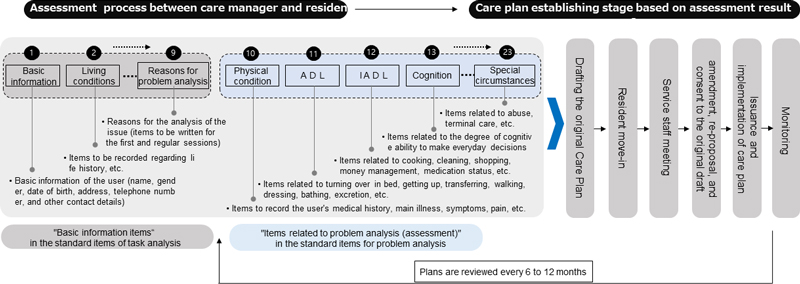
23-item assessment flow provided by the Ministry of Health, Labour and Welfare
According to Kyoko (2010), the elderly say that assessment, which is the first step after moving in, is very important, but when carrying out the assessment (information collection and analysis), it is not easy to understand the overall picture of the subject and then identify the needs. Therefore, she says that the assessment form needs to be reviewed.
In the case of elderly people, regardless of whether they have dementia or not and their communication skills, it takes a long time, and they have difficulty expressing their opinions and making decisions. In addition, even if their opinions are written down on the assessment paper, there is difficulty in determining what kind of service plan should be implemented (Wakamatsu, 2005).
As such, care managers experience various difficulties during the assessment stage. As considered above, the important role in improving the QOL of residents begins at the assessment stage. The assessment is conducted using the basic items provided by the government. Through this, the care manager only conducts conversations with the residents and determines that the parts they are aware of are tasks in the nursing care process. This is because there are clear limitations in understanding the overall picture of elderly residents only through conversation.
2. 2. Communication Approaches with Older Adults
In a situation where various problems are emerging due to an aging society, the reminiscence method is presented as an effective method in terms of psychological issues (depression, communication, self-esteem, etc.) of the elderly (Collins,2006; Um,2000). The reminiscence method is a meaningful approach to communication because it not only helps older people find psychological stability but also helps them remember the past and express themselves correctly (Kim, 2006).
The reminiscence method was evaluated as an alternative that positively impacts various psychological variables by allowing older people to remember pleasant experiences from past events and share those memories through stories with other older people (Fry, 1983).
Butler’s spoke of the value of reminiscence, or life review, in that it promotes the psychological reconstruction of older people and their general response to any crisis, including developmental crises. He also said that reminiscing about the past is a highly normal thing and a potential tool to help people adapt to the stress that occurs in old age. He also said that by carrying out recollection techniques on a large scale, one can improve sociality and interpersonal relationships and increase self-esteem (1963).
In addition, it is explained that the subjects of the recall method include everyone from healthy elderly people to those with physical, emotional, and cognitive disabilities, and it is beneficial for elderly people who have dementia (Pragya, 2019).
When we investigated and classified previous studies that used reminiscence in the research process, we found that it was divided into individual recollection (Nomura, 2005; Yun, 2005; Kim et al., 2006) and group recollection (Sivis, 2005; Yoi, 2006; Liu et al., 2007; Hong et al., 2015; Youn, 2011; Jo, 2018). In addition, to maximize the effect of reminiscence, research is ongoing by combining it with arts such as art and music (Cho, 2006; Ueshima et al., 2010; Matsubara, 2011; Son, 2011; Istvandity, 2017; Kelly, 2021; Engelbrecht et al., 2023).
This structured recall method has been shown to be effective in dealing with psychological problems in old age by improving the self-concept and cognitive function performance of older adults (Fry, 1983; Hughston & Merriam, 1983).
In this way, reminiscing gives the elderly a sense of psychological stability simply by reliving good memories of the past. Also, if he can remember the past and express himself appropriately, it will be a very meaningful approach in terms of communication.
Therefore, using the methodology of recollection considered above as the central concept, assessment is carried out as a process of developing a story by reviving the resident’s remaining memories. This serves as an important bridge that reflects on the resident’s past and connects their happy memories with the care plan.
3. Research methods
Based on the review of the above literature, this study sought to demonstrate a research tool utilizing reminiscence in the assessment stage carried out within nursing facilities. we designed an experiment to test the following three research questions:
Research Question,
1: When using the LDT, is there a difference in effectiveness in terms of communication?
2: When using the LDT, is there a difference in effectiveness in terms of A Life Worth Living?
3: When using the LDT, is there a positive difference in establishing a care plan?
3. 1. Research Procedures and Targets
To begin this study, the researcher visited S Nursing Home on June 6, 2023, and conducted the survey with one care manager from the nursing home as a co-worker. The research procedure was divided into two rounds: first and second. The target of the first group is the existing residents of the nursing home, and the target of the second group is new residents from September 1, 2023, to December 31, 2023.
The criteria for selecting subjects are (1) elderly men and women living in S nursing homes in Kitakyushu, Japan, aged 65 to 94, (2) subjects who can communicate with care managers and run the LDT, (3) Those who agreed to participate in this study were selected. The basic information of the participants is presented in Table 1. The Care level is categorized into seven stages, ranging from Support Levels 1 and 2 to Care Levels 1 to 5, based on the degree of need for care services as defined by Japan’s Ministry of Health, Labour and Welfare.

The basic information of the subjects
3. 2. Research tools: about the Life Map Design Tool (LDT)
The LDT originated from a comprehensive design approach to addressing nursing home residents’ QOL. It was developed as part of a research project titled QOL in a Nursing Home to Ensure Sustainability as a Country with a Declining Birthrate and Aging Population, conducted from September 18, 2014, to March 28, 2015.
The project involved diverse stakeholders, including designers, nursing home officials (management, business, technology, care managers, nursing care, and welfare workers), coordinators from industry-academia collaboration, and elderly residents, who participated from the early research stages (Hirai Laboratory, 2015). The study aimed to develop and evaluate prototypes by exploring the question: “How can prototypes derived from inclusive design workshops impact the QOL of nursing home residents?”
This research tool facilitates communication with elderly residents in nursing homes. It consists of two A3-sized map boards depicting the life trajectory from birth to death, 28 visual image pieces (e.g., gender-specific characters, pets, buildings), and 15 image cards representing hobbies and interests. As shown in Figure 4, the care manager and resident engage in a face-to-face discussion using this tool. The process is not purely verbal but incorporates visual elements, making conversations more engaging and helping residents set life goals.
The implementation begins with an explanation of the tool’s purpose to reduce psychological distance. The resident is then asked, “Until what age do you wish to live?” to establish a goal. Past life experiences are explored chronologically with the aid of image cards, focusing on key events like employment and marriage. Next, the resident selects three image cards representing “important aspects of their future life.” This fosters deeper discussion on memories and future aspirations. The care manager then records this information in the care plan, ensuring the resident’s individuality is reflected in their service plan.
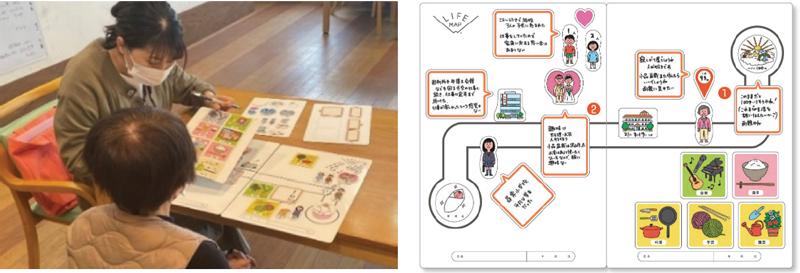
How to use the Life Map Design Tool
3. 3. Measurement tools
This tool used in the study by Holden and Sinebruchow was designed to evaluate the subject’s emotional expression and communication (Strøm et al., 2016). It consists of three areas: Conversation, Awareness and knowledge, and Communication. There are 12 questions, 4 in each section, and each question is scored from 0 to 4 depending on the degree of response. This means that the lower the score, the higher the communication ability, and the reliability Cronbach’s α value in this study was 0.91, indicating high reliability.
Ikigai-9 is an evaluation tool developed by IMAI (2009) that can measure the psychological state of whether one is feeling “A Life Worth Living.” This is composed of three sub-areas: (I) Optimistic and positive feelings about life (3 points to 15 points), (II) Positive and positive attitude toward the future (3 points to 15 points), (III) Recognition of the meaning of one’s existence (3 points to 15 points).
As shown in Table 2, this measurement tool consists of 9 questions, and the response to each question is measured on a 5-point scale (total of 9 to 45 points). Higher scores indicate stronger positive emotions and positive attitudes toward life today. The reliability Cronbach’s α value in this study was 0.93, indicating high reliability.
Subdomains and items of the Holden Communication Scale
Subdomains and items of the Ikigai Scale
3. 4. Detailed research design and analysis method
This study is a single-group pre-post design to determine the impact of the research tool “LDT” on residents’ “communication” and “sense of rewarding life.”
First research design
As mentioned above, in the 2nd stage of prior research, an assessment is conducted when elderly residents move into a nursing home. Accordingly, as shown in Figure 3, a “Life Map Design Stage” was additionally created to compare the differences before and after using the “LDT” in the “existing procedure.” In the case of the “existing resident group,” the primary research subjects, “The Holden Communication Scale” and “Ikigai-9,” were tested twice before and after, based on the care manager’s judgment based on the stored personal “health check data.”
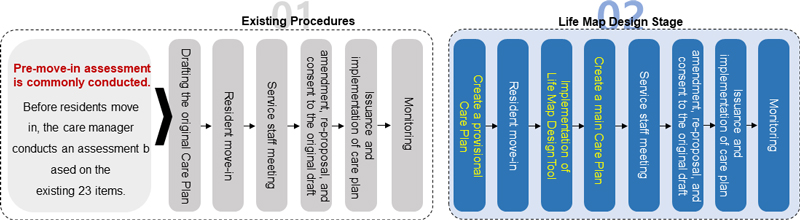
1st experiment process
Second research design
The subjects of the second study were elderly people who had newly moved into a nursing home. Therefore, unlike the primary research flow, the testing period was detailed as shown in Figure 4. First, the care manager measures “The Holden Communication Scale” and “Ikigai-9” by focusing on conducting an assessment before moving in. And “The Holden Communication Scale” is measured after the resident uses the “LDT” within two weeks after moving in. Then, the resident’s “Ikigai-9” is measured after three months. Additionally, in the second research procedure, “Provisional Care Plan” and “Main Care Plan” were inserted to enable specific comparison in terms of results.
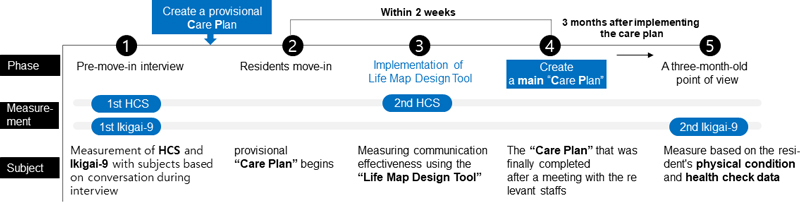
2ndexperiment process
The data collected in this study were analyzed using Python 3.X to examine the differences between pre- and post-assessment scores of the experimental group. A Wilcoxon Signed-Rank Test was conducted for this purpose. Additionally, reliability testing and normality checks were performed prior to the analysis.
4. Result
The analysis examines how the use of the LDT by care managers impacts “Communication” and “A Life Worth Living” among older adults residing in Nursing Homes. Additionally, mean values and standard deviations were included to clearly illustrate the distribution of the results. In the second phase of the study, “Care Plan” were further analyzed, and the findings are as follows.
4. 1. First results: Measurement results of the First research design
Communication results of 17 people
The results of communication measured for 17 individuals were analyzed using the Wilcoxon Signed-Rank Test to verify whether the pre-test and post-test means showed significant differences. As a result, significant differences were found in all areas of The Holden Communication Scale (W=0.0, p < .001). First, the results by subcategory are listed as follows. In the first subcategory, Conversation, significant differences were observed (W=0.0, p < .001). The mean comparison revealed that the score decreased from the pre-test (M=7.825) to the post-test (M=3.593). Second, in the subcategory Awareness and Knowledge, significant differences were also observed (W=0.0, p < .001). The mean comparison revealed that the score decreased from the pre-test (M=5.358) to the post-test (M=3.352). Third, in the subcategory Communication, significant differences were observed as well (W=0.0, p < .001). The mean comparison revealed that the score decreased from the pre-test (M=7.418) to the post-test (M=1.885).
A Life Worth Living results of 17 people
The results of the Wilcoxon Signed-Rank Test conducted on the Ikigai-9 scale for 17 individuals showed significant differences across all items (W=0.0, p < .001). First, significant differences were observed in the subcategory (I) Optimistic and positive feelings about life (W=0.0, p < .001). The mean comparison revealed that the score increased from the pre-test (M=6.063) to the post-test (M=11.943), showing the largest difference compared to other subcategories. Next, in the subcategory (II) Positive and positive attitude toward the future, significant differences were also observed (W=0.0, p < .001). The mean comparison indicated that the score increased from the pre-test (M=6.188) to the post-test (M=10.822). Finally, significant differences were observed in the subcategory (III) Recognition of the meaning of one’s existence (W=0.0, p < .001). The mean comparison revealed that the score increased from the pre-test (M=7.125) to the post-test (M=9.942).
4. 2. Second result
The Holden Communication Scale and Ikigai-9 results for 8 individuals were analyzed using the Wilcoxon Signed-Rank Test to verify whether the pre-test and post-test means showed significant differences. Additionally, the results for the Provisional Care Plan and Main Care Plan were derived.
Measurement results of the Secon research design
Communication results of 8 people
First, a significant difference was observed in the total score of The Holden Communication Scale (W=0.0, p < .05).
The Wilcoxon Signed-Rank Test revealed significant results in the subcategories Conversation (W=0.0, p < .01) and Awareness and Knowledge (W=0.0, p < .05). However, unlike the results from the first phase, the Communication subcategory showed no significant difference (W=1.0, p = .285).
A Life Worth Living results of 8 people
Significant differences were observed in the items of the Ikigai-9 scale for 8 individuals (W=0.0, p < .01). As shown in Table7, the subcategories revealed the following results: (I) Optimistic and positive feelings about life (W=0.0, p < .01) and (II) Positive and positive attitude toward the future (W=0.0, p < .05) showed significant outcomes. However, the subcategory (III) Recognition of the meaning of one’s existence (W=0.0, p = .108) did not show significant results.
Characteristics of the results of “Provisional Care Plan” and “Main Care Plan”
Table 8 is a care plan created by a care manager after assessing the residents. The left part of the table is the result of creating a Provisional Care Plan based on the results of the assessment conducted through the consultation process before the residents move in. The right part of the table is the result of creating a Main Care Plan by conducting an assessment using the LDT within two weeks after moving in. A comparison table was created by extracting only the characteristic parts of these areas.
Care Plan created by a care manager after assessing the residents.
The results for major residents are as follows. In the case of resident M.N (91), when looking at the answers in terms of response or intention of the provisional care plan, they showed the opinion that there is nothing much I want to do. However, the results of the main care plan after using the LDT say, “I like baseball, karaoke, and playing trump card games” She responded, “Let’s work hard until we are 100 (Participants M.N, 2023).” Next, the results of tasks and services for residents. According to the results written in the provisional care plan, “We will provide support for function maintenance and fall prevention.” As a result of the main care plan, it is written that “By supporting exchanges with other residents, she can come out to the living room with a comfortable mind. And it is written that we will support watching baseball games, playing Trump cards, gardening, and playing music (Care Manager, 2023).”
As described above, when establishing a provisional care plan, conventional evaluations were conducted solely through structured assessment procedures, resulting in limitations in eliciting responses from the residents. However, after applying the LDT, it became possible to gather information on the residents past interests and hobbies. Based on these responses, an appropriate main care plan for resident M.N. could be established during the main care planning process.
Next, the results of the care plan of resident H.K (71). Looking at the answers in terms of responses or intentions regarding the provisional care plan, the opinion was “I am not sure yet.” Next, the surface of the main care plan was obtained using the LDT, “He said he used to take care of trees and flowers and grew watermelons, tomatoes, melons, etc. “She was able to work hard on rehabilitation training for her son,” the resident responded. The following are the results of tasks and services for residents. Looking at the results written in the provisional care plan, it is written that “the facility will support her to work hard in her rehabilitation training.” As a result of her main care plan, “Just as she has been working hard on her rehabilitation treatment for her son, we will continue to support her so that she can maintain the function of moving her body.” It is written. Based on this assessment, the care plan before and after implementation for resident M.N (91) created by the care manager is shown in Figure 5.
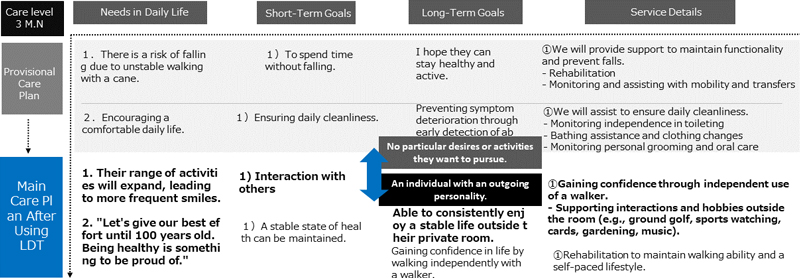
Care Plan Changes After Using the Life Map Design Tool
5. Discussion
Developing the care process in a nursing home requires empathizing with the elderly residents, thinking from their perspective, and supporting them toward the life they want, that is, independence (Nozaki, 2022). To do so, it is important to accurately understand not only the physical but also the mental and physical situation (Ishino, 2012). It is difficult for elderly residents to enjoy most of their leisure time or be active due to decreased motivation. Therefore, it is very important for users and residents to spend quality time in a nursing home to achieve a “better life.” Thus, programs within nursing homes are increasingly planning recreational activities, sports, and physical activities (Fujii et al., 2015). Consequently, it is necessary to consider the psychological and physical aspects of elderly residents of nursing homes and, at the same time, make a plan that takes advantage of the hobbies and pleasures each individual truly desires. If that happens, seniors will be able to continue to spend the time they want, which will naturally lead to improved QOL. Therefore, this study conducted an experiment with this sense of purpose.
The results of the first research question, which proposed whether the LDT demonstrates effectiveness in the communication aspect, are as follows. Among the 17 participants in the first phase, the post-test score (M=8.824) decreased by 11.768 points compared to the pre-test score (M=20.592), yielding statistically significant results (W=0.0, p < .001). Notably, the effect of the LDT was particularly pronounced in the Communication domain. The mean score decreased significantly from the pre-test (M=7.418) to the post-test (M=1.885), showing a reduction of approximately 5.533 points, highlighting a substantial improvement in communication activities. These findings suggest that the LDT contributes to enhancing older adults’ communication capabilities, particularly in improving the quality and success rate of conversations, promoting verbal expression, and facilitating deeper communication. In the second phase, conducted with 8 participants, the post-test score (M=9.375) decreased by 4.375 points compared to the pre-test score (M=13.750), yielding statistically significant results (W=0.0, p < .05). Unlike other subdomains, the Communication domain did not show statistically significant results. However, in the first phase, this domain exhibited the most prominent and significant differences with the highest changes. This discrepancy may have been caused by the difference in sample size. Therefore, further studies with larger sample sizes are required to enhance the consistency of the results. However, in both the first and second phases, the total scores of the Holden Communication Scale showed significant differences between pre-test and post-test, confirming that the LDT had a positive impact on overall communication among older adults. According to the interpretation of the Holden Communication Scale, the observed changes in scores suggest that “the disability is much lighter, and the group is capable of being sufficiently active with minimal need for techniques or instructions (Strøm et al., 2016).”
The results of the second research question, which examined whether the LDT demonstrates differences in effectiveness in the “A Life Worth Living,” are as follows. Based on the results measured using the Ikigai-9 tool, the pre-test score (M=19.350) increased by 13.368 points to the post-test score (M=32.718) among 17 participants in the first phase, yielding statistically significant results (W=0.0, p < .001). Among the subdomains in the first phase, the greatest difference was observed in (I) Optimistic and positive feelings about life, with a difference of 5.88 points between the pre-test and post-test. This confirms that the LDT effectively enhances emotional stability and positive feelings among older adults. In the second phase, conducted with 8 participants, the pre-test score (M=29.380) increased by 6.121 points to the post-test score (M=35.501), also yielding statistically significant results (W=0.0, p < .01).
As a third research question, the results of whether a positive difference in “care plan establishment” appears when using the LDT are as follows. Regarding the provisional care plan, most residents responded in a short answer format, as shown in Table 8, summarized above. On the other hand, if you look at the contents of the “main care plan,” the resident freely expressed their opinion, and based on that, a main care plan appropriate for the resident was established. As shown in the secondary results, it was possible to obtain information about the behaviors and lifestyles that older people (M·N, H·K, S·T, M·H, H·C) have liked in the past. Based on this, the Main Care Plan established a service plan tailored to each resident. As shown in Figure 5, the initial response in the care plan for resident M.N at the time of admission revealed no particularly noticeable reactions from the elderly resident. Based on this, the care manager devised a plan focusing on “maintaining physical function,” addressing the resident’s physical characteristic of “instability in walking with a cane.” Meanwhile, through the use of the LDT, it was discovered that the resident had been actively engaged in outdoor activities in the past, with a particular interest in baseball and singing. Based on this information, a service plan supporting hobby activity was introduced, aiming to encourage the resident to regain motivation and enthusiasm for daily life. These results collectively indicate that the LDT contributed to the overall improvement of communication among older adults. In particular, the use of image cards facilitated the visualization of relevant stories, enabling elderly residents to recall past memories and express themselves more effectively. This conversation-based approach appears to have had a positive impact, providing meaningful support in enhancing the Quality of care plans created by care managers in Nursing Homes.
When identifying elderly people residing in nursing homes, a holistic(past) analysis approach is necessary, not only for physical defects but also for the subject (Youn, 2011). Using reminiscence strategies to understand better the needs of older adults creates a social bond with them, as well as making them feel psychologically safe (Collins, 2006). Through the LDT used by the care manager, residents’ interests, feelings, and needs were communicated in a stable manner. In addition, information was easily conveyed visually through image cards and sculptures, doubling communication effectiveness. This is consistent with the results shown in Kim & Doh’s (2005) study, which found that conversation using pictures was helpful for improving communication and expression among the elderly. In this way, residents could reminisce without difficulty and express themselves by remembering and sharing enjoyable experiences properly.
In this way, residents could reminisce without difficulty and express themselves by remembering and sharing enjoyable experiences properly.
This is consistent with the claims of Fry (1983) and Kim (2006) among the previous studies reviewed above and is a stable communication approach. Based on the above results, it is supported that it is important for the elderly, as users, to have the intention (motivation) to live in a nursing home (Sato, 2022).
6. Conclusion
This study aimed to evaluate the impact of the LDT on the care plan development process. To achieve this, the study utilized scales related to communication and A Life Worth Living for analysis. The participants consisted of 25 elderly residents in a nursing home, divided into two groups for a two-phase experiment. The findings revealed that the LDT had a positive influence on the development of care plans, which can be considered as daily schedules for nursing home residents. In particular, a significant difference was observed in the responses obtained from elderly residents when assessments were conducted using the LDT compared to traditional conversational methods, indicating improvements in communication. This conclusion is supported by quantitative evidence from pre- and post-assessment results using the Holden Communication Scale and the A Life Worth Living Scale (Ikigai-9), which showed statistically significant differences. These findings provide foundational evidence that the LDT can serve as a valuable tool in the assessment process for nursing home residents.
Limitations and avenues for continued research
Limitations include the fact that the experimental subjects and the study were conducted only in one selected nursing home in Japan and that data were collected from a limited number of subjects. Therefore, the results of this study cannot be generalized. Additionally, data results were collected from only one care manager during the verification process using two scales. In the future, continued research on more nursing homes and subjects is needed to promote and improve QOL in nursing homes. Implementing care processes is necessary for residents to live better and will also lead to “improvement in professionalism” and “rewarding work” for nursing care staff (Shiho et al., 2018). Accordingly, it appears that follow-up research will need to be conducted on staff working in nursing facilities. Furthermore, the existing image cards predominantly reflect Japanese culture. Therefore, to increase their applicability and validity in nursing homes in other countries, improvements and cultural adaptations of the images are necessary. Lastly, it was partially confirmed that using this research tool was effective during the assessment stage. Subsequently, continuous research and experimentation will develop an evaluation scale for “Life Map Tool Design” so that more appropriate evaluation standards can be established and verified during the verification process.
Notes
Copyright : This is an Open Access article distributed under the terms of the Creative Commons Attribution Non-Commercial License (http://creativecommons.org/licenses/by-nc/3.0/), which permits unrestricted educational and non-commercial use, provided the original work is properly cited.
References
-
Butler, R. N. (1963). The life review: An interpretation of reminiscence in the aged. Psychiatry, 26(1), 65-76.
[https://doi.org/10.1080/00332747.1963.11023339]

- Cho, S. (2006). A study on the effects of group art therapy in structured reminiscence on self-expression of the old with dementia (Master's thesis). ProQuest Dissertations and Theses database.
- Collins, C, J. (2006). Life review and reminiscence group therapy among senior adults (Doctoral dissertation). ProQuest Dissertations and Theses database.
-
Engelbrecht, R., Bhar, S., & Ciorciari, J. (2023). Music-assisted reminiscence therapy with older adults: Feasibility, acceptability, and outcomes. Music Therapy Perspectives, 41(1), 37-46.
[https://doi.org/10.1093/mtp/miac021]
-
Fry, P. S. (1983). Structured and unstructured reminiscence training and depression among the elderly. Clinical Gerontologist, 1(3), 15-37.
[https://doi.org/10.1300/J018v01n03_06]
- Fujii, S., Komoda, M., Kusanagi, M., & Iwanaga, T. (2015). A study on the development of the care process: A survey of case studies by students of Kagawa Junior College. Kagawa Junior College Department, 43(1), 103-113.
- Hirai, Y. Laboratory. (2015). Social Inclusion with Senior Citizens. COI STREAM (Center of Innovation Science and Technology based Radical Innovation and Entrepreneurship Program). Kyushu University.
-
Hong, K., Ju, A., Koo, S., Kim, Y., & Jung, H. (2015). Effects of the Group Reminiscence Program for Elderly with Dementia. The Journal of Korean Society of Community Based Occupational Therapy, 5(2), 57 - 64.
[https://doi.org/10.18598/kcbot.2015.05.02.06]
-
Hughston, G., & Merriam, S. (1983). Reminiscence: A nonformal technique for improving cognitive functioning in the aged. The International Journal of Aging and Human Development, 15(2), 139-149.
[https://doi.org/10.2190/61H0-ECQ8-1M8H-NDY]
- Ishino, I. (2012). All the latest books on nursing care and welfare 7: Nursing care process (2nd ed., pp. 15-18). Media Friend Corporation.
-
Istvandity, L. (2017). Combining music and reminiscence therapy interventions for wellbeing in elderly populations: A systematic review. Complementary Therapies in Clinical Practice, 28(1), 18-25.
[https://doi.org/10.1016/j.ctcp.2017.03.003]
-
Jo, K., & An, G. (2018). Effects of a group reminiscence program on self-forgiveness, life satisfaction, and death anxiety among institutionalized older adults. Korean Journal of Adult Nursing, 30(5), 546-554.
[https://doi.org/10.7475/kjan.2018.30.5.546]
-
Kelly, L., & Ahessy, B. (2021). Reminiscence-Focused Music Therapy to Promote Positive Mood and Engagement and Shared Interaction for People Living With Dementia: An Exploratory Study. Voices: A World Forum for Music Therapy, 21(2).
[https://doi.org/10.15845/voices.v21i2.3139]
- Kim, J. (2004). Analysis of Korean Design Study Tendency. Jounal of Korean Society of Design Research, 17(4), 159-168.
-
Kim, K. (2021). Effects of collective art therapy on the depression, communication, self-efficacy, and the subjective happiness of the elderly with dementia. Industry Promotion Research, 6(4), 59-68.
[https://doi.org/10.21186/IPR.2021.6.4.059]
-
Kim, K., Yun, J., & Sok, S. (2006). Effects of individual reminiscence therapy on older adults' depression, morale, and quality of life. Journal of Korean Academy of Nursing, 36(5), 813-820.
[https://doi.org/10.4040/jkan.2006.36.5.813]
- Kim, S. (2006). The effect of reminiscence therapy on recognition, response of emotion, communication ability of elderly patient with Alzheimer's dementia (Master's thesis). ProQuest Dissertations and Theses database. (KDMT1200677940).
- Kim, Y., & Doh, B. (2005). Effects of the group art therapy program with reminiscence on cognitive function, depression, and quality of life of demented elderly. Korean Art Therapy Association, 12(1), 483-500.
- Kyoko, F. (2010). Two assessment sheet suggestions for improving the understanding of the steps taken in the care process. Kyosai Gakuen Junior College Research Notes, 26, 1-27.
- Liu, S., Lin, C., Chen, Y., & Huang, X. (2007). The effects of reminiscence group therapy on self-esteem, depression, loneliness and life satisfaction of elderly people living alone. Mid-Taiwan Journal of Medicine, 12(3), 133-142.
-
Masui, H., Otaga, M., Moriyama, O., & Matsushige, T. (2019). Current issues in long-term care policy and research: Toward the promotion of evidence-based policy. National Institute of Public Health, 68(1), 34-44.
[https://doi.org/10.20683/jniph.68.1_34]
- Matsubara, U. (2011). Music therapy for elderly dementia using familiar music. Journal of Health and Welfare Investigation, 12(1), 79-84.
- Vera, M. (2024). Nursing care plans (NCP) ultimate guide and list. Nursing Care Plans, Nurselabs. Retrieved May. 17, 2024, from https://nurseslabs.com/nursing-care-plans/.
- Ministry of Health, Labour and Welfare. (2024). Establishment and dissemination of appropriate care management methods. Retrieved May. 17, 2024, from https://www.mhlw.go.jp/stf/seisakunitsuite/bunya/hukushi_kaigo/kaigo_koureisha/hoken/jissi_00006.html.
- Ministry of Health, Labour and Welfare. (2024). Community comprehensive care system. Retrieved May. 21, 2024, from https://www.mhlw.go.jp/stf/seisakunitsuite/bunya/hukushi_kaigo/kaigo_koureisha/chiiki-houkatsu/.
- Ministry of Health, Labour and Welfare. (2020). Overview of nursing service facility/business establishment surveys. Retrieved May. 21, 2024, from https://www.mhlw.go.jp/toukei/list/24-22-2.html.
- Ministry of Health, Labour and Welfare. (2020). Overview of long-term care staff and long-term care support specialists. Retrieved May 10, 2024, from https://www.nia.nih.gov/health/long-term-care/what-long-term-care.
-
Nishiguchi, S. (2023). Prospects for care management utilizing care plan creation support AI. The Japan Academy of Home Care, 27(1), 18-22.
[https://doi.org/10.60272/jjahc.27.1_18]
-
Nomura, B. (2009). Individual reminiscence therapy improves self-esteem for Japanese community-dwelling older adults. Japanese journal of psychology, 80(1), 42 - 47.
[https://doi.org/10.4992/jjpsy.80.42]
- Nozaki, K.(2022). Social Welfare Laws. Minerva Publishing Editorial Department.
-
Sanford, A. M., Orrell, M., Tolson, D., Abbatecola, A. M., Arai, H., Bauer, J. M., ... & Vellas, B. (2015). An international definition for "nursing home." Journal of the American Medical Directors Association, 16(3), 181-184.
[https://doi.org/10.1016/j.jamda.2014.12.013]
-
Sato, N. (2022). Impact of care management in the revision of the care plan format in the long-term care insurance system. Journal of Miyazaki Prefectural Nursing University, 22(2), 1-11.
[https://doi.org/10.57521/mpu.22.2_11]
-
Shiho, Y., Masaki, N., Hitoshi, H., Kotaro, M., Miyuki, Saitou., & Motoyuki, Kawatei. (2018). A Study on the practice of Care process as a method to appropriately carry out individual support care that emphasizes the needs of the individual in care facilities. Keishin Journal of Life and Health, 2(1), 121-128.
[https://doi.org/10.24759/vetrdi.2.1_121]
- Sivis, R. (2005). The effect of a reminiscence group counseling program on the life satisfaction of older adults (Doctoral dissertation). ProQuest Dissertations and Theses database. https://etd.lib.metu.edu.tr/upload/12605949/index.
- Son, Y. (2011). The effect of group art therapy applied structural remembrance remedy on self expression and problematic behavior of dotard at residential treatment facility (Master's thesis). ProQuest Dissertations and Theses database.
- Statistics Bureau of Japan. (2023). Outline of the 2023 population census of Japan. Retrieved June 13, 2024, from https://www.stat.go.jp/english/index.html.
-
Strøm, B., Engedal, K., Benth, J., & Grov, E. (2016). Psychometric evaluation of the Holden Communication Scale (HCS) for persons with dementia. BMJ Open, 6(12), e013447.
[https://doi.org/10.1136/bmjopen-2016-013447]
- Tsujimoto, M., Saiki, D., Tada, R., Yamauchi, A., Minami, K., & Yamazaki, K. (2023). Appropriate care management methods Basic care and disease-specific care. The Japan Research Institute. Retrieved from https://www.jri.co.jp/service/special/content11/corner113/caremanagement/03/.
- Ueshima, H., Itakura, Y., & Minazuki, A. (2010, August). Music therapy for dementia patients using reminiscence therapy. In IEICE Conferences Archives. The Institute of Electronics, Information and Communication Engineers.
- Um, M. (2000). Evaluating the Effects of A Reminiscence Group Therapy for the Elderly with Stroke: In A Social Welfare Center for the Elderly. The Korean Gerontological Society, 20(1), 21-35.
-
Wakamatsu, S. (2005). Supporting the independence of elderly people in their daily lives: From the perspective of care management under long-term care insurance. Journal of Japan Academy of Gerontological Nursing, 9(2), 45-49.
[https://doi.org/10.20696/jagn.9.2_45]
-
Pragya, L., Avinash, D. (2019). Reminiscence therapy in geriatric mental health care: A clinical review. Journal of Geriatric Mental Health, 6(1), 7-13.
[https://doi.org/10.4103/jgmh.jgmh_1_19]
- Yeo, I. (2006). The development and effects of reminiscence-narrative group therapy program to increase ego-integrity in the elderly (Doctoral dissertation). ProQuest Dissertations and Theses database.
- Youn, S. (2011). Study on the Effectiveness of Group Reminiscence Program (Master's thesis). ProQuest Dissertations and Theses database. (KDMT1200677940).
- Yun, J. (2005). Effects of individual reminiscence therapy on old people's depression, morale and the quality of life (Master's thesis). ProQuest Dissertations and Theses database.