
Methodological Application of Speculative Provocation: A Speculative Design Case Study in an Organisational Context
Abstract
Background Speculative provocation, a core aspect of speculative design, has the potential to support organisations in engaging with wicked problems by surfacing underlying assumptions and competing values that shape how problems are understood and framed. However, limited empirical detail exists on how speculative provocation has been methodologically applied and experienced within large organisations.
Methods This paper explores the methodological application of speculative provocation in partnership with the Queensland Department of Transport and Main Roads (TMR), using inclusive urban mobility as the organisational wicked-problem context. The study applied the Transform and Provoke phases of the Inverted Double Diamond framework, which respectively materialise speculative concepts and use them to stimulate critical reflection rather than to generate solutions. An exploratory case study was conducted with four organisational participants. Speculative artefacts, including photo-realistic images and an information bulletin, representing a speculative accessibility technology, were used to facilitate dyad focus groups and individual follow-up discussions. Qualitative data were analysed through inductive thematic analysis, complemented by reflective practice to examine methodological decisions, facilitation strategies, and challenges in applying speculative provocation within an organisational context.
Results The application of the Transform and Provoke phases provided provisional insights into how their distinct methodological objectives were translated into practice within this organisational case. Transform enabled the speculative concept to be encountered and interpreted through artefacts, while Provoke used these artefacts within facilitated dialogue to surface tensions and competing values underlying participants’ understanding of the wicked problem. The findings also revealed methodological challenges associated with constructing speculative artefacts that participants perceived as contextually meaningful and plausible, and with navigating organisational tendencies towards solution-oriented thinking.
Conclusions This paper contributes a situated and provisional methodological account of how speculative provocation was applied through the distinct yet connected Transform and Provoke phases within an organisational context. The findings suggest that speculative provocation may complement technical rigour and evidence-based decision-making by creating conditions for broader problem framing and critical engagement with assumptions, interdependencies, tensions, and competing values. Its potential contribution to organisational engagement with wicked problems lies in supporting reflective inquiry rather than producing directly implementable solutions.
Keywords:
Speculative Design, Speculative Provocation, Design Methods, Inclusive Urban Mobility, Wicked Problems1. Introduction
Speculative design has emerged as a designerly approach to engaging with wicked problems, offering ways to explore alternative future possibilities and challenge prevailing assumptions about technology, society, and human behaviour (Dunne & Raby, 2013). Its value lies not in predicting futures, but in provoking critical reflection on underlying beliefs, values, and systemic structures (Lindley & Green, 2021; Malpass, 2017; Tsekleves et al., 2019), opening space for deeper inquiry into societal and ethical dilemmas. Originally rooted in the fine arts and radical architecture, speculative design has been conceptualised in different ways over time and across disciplines due to its utility in generating creative and reflective outcomes (Ringfort-Felner et al., 2025). While this breadth highlights the relevance and value of speculative approaches to design, it has also led to varied interpretations of their practical applications. In particular, there is limited discussion of the processes involved in applying speculative design, making it difficult to achieve shared understanding and consistency across studies (Bendor & Lupetti, 2024; De Haas et al., 2019; Ringfort-Felner et al., 2023; Tsekleves et al., 2022; Zhu et al., 2024). This lack of clarity becomes especially important in organisational contexts, where interest in speculative approaches to engage with wicked problems is growing, but where methods are also expected to be structured, transparent, and practically applicable (Ringfort-Felner et al., 2023).
This paper presents the second empirical study within a broader research project exploring the methodological application of speculative design (Cardenas Cordova et al., 2025, 2026). Grounded in a partnership with the Queensland Department of Transport and Main Roads (TMR), the project focuses on inclusive urban mobility for people experiencing physical mobility impairments. Inclusive urban mobility is considered a wicked problem because it is shaped by complex interdependencies between infrastructure, policy, technology, social behaviour, and diverse user needs, with no straightforward or universally agreed problem definition or solution (Buchanan, 1992; Rittel & Webber, 1973). The empirical work was structured across two studies to reflect the two distinct, yet interrelated purposes of speculative design described by Auger (2013): enabling consideration of possible futures and critiquing current practice. The previous study examined the Select and Explore phases of the Inverted Double Diamond speculative design framework (Cardenas Cordova et al., 2026) focusing on how possibilities were identified, framed, and expanded.
The present study explores the Transform and Provoke phases, focusing on how a selected speculative concept was materialised and used to prompt critical reflection. Treating these phases as a distinct cluster enabled closer examination of their methodological functions. Together, the Transform and Provoke phases constitute speculative provocation, a recurring element across diverse accounts of speculative practice (Bendor & Lupetti, 2024; Ringfort-Felner et al., 2023; Marji et al., 2023; Pinto et al., 2021; Light, 2021; Dunne & Raby, 2013; Auger, 2013). Despite this broad recognition, limited empirical detail exists regarding how it is methodologically applied, especially in organisational contexts where the exploration of wicked problems is often shaped by evidence-based, solution-oriented perspectives (Ringfort-Felner et al., 2023). To address this gap, this paper is guided by the question: How can speculative provocation be methodologically applied to engage with wicked problems within an organisational context?
To address this question, two dyad focus groups and four individual follow-up discussions were conducted in 2025 with four representatives from the organisation. Participants’ responses were examined through inductive thematic analysis to identify patterns of critical reflection and competing values arising from their engagement with the provocation. In parallel, a reflective practice lens informed a process-oriented analysis of the methodological decisions, facilitation strategies, and challenges encountered throughout the study. This paper offers a situated and provisional methodological account of how the distinct objectives of the Transform and Provoke phases were translated into practice within this organisational case, including the methodological considerations that shaped their application.
2. Theoretical background
2. 1. Speculative design
Speculative design is a critical design approach that encourages the exploration of alternative futures by envisioning scenarios that challenge dominant narratives and assumptions about the present (Auger, 2013; Cardenas Cordova et al., 2025; Dunne & Raby, 2013; Lindley & Green, 2021; Malpass, 2017; Tsekleves et al., 2019). In this paper, speculative design is used as an umbrella term for related approaches, including design fiction, critical design, and other practices that use speculation as a mode of critical inquiry. It diverges from affirmative design approaches, which focus on solving problems, refining existing systems, and producing solutions in the service of industry (Auger, 2013; Dunne & Raby, 2013). In contrast, speculative design prioritises the expansion of the problem space by critically and creatively questioning the assumptions, beliefs, values, attitudes, and behaviours that shape present realities (Dunne & Raby, 2013; Malpass, 2013). Speculative design emphasises problem-finding, using design to stimulate critical thinking that supports debate and discussion in the service of society (Dunne & Raby, 2013). Through this approach, designers are encouraged to suspend ingrained judgements, creating space to reframe existing problems and imagine alternative ways of living beyond current social and technological constraints (Johannessen et al., 2019; Malpass, 2017; Mazé & Redström, 2009).
2. 2. Speculative artefacts and provocation
Speculative artefacts play a central role within speculative design by materialising hypothetical futures into forms that can be experienced, discussed, and reflected upon (Dunne & Raby, 2013). Within speculative provocation, these artefacts are not neutral representations of imagined futures, but methodological devices used to elicit reflection, disagreement, interpretation, and dialogue around the social, ethical, and systemic implications of alternative futures (Auger, 2013; Boer & Donovan, 2012; Dunne & Raby, 2013). Through this process, abstract ideas and imagined futures become more accessible and discussable, enabling participants to engage more concretely with uncertainty, ambiguity, and complex societal issues. Within design research, this provocative function shares similarities with the concept of provotypes, where artefacts are intentionally designed to provoke reactions among participants (Boer & Donovan, 2012). Provotypes are not intended to resolve problems or test final solutions, but rather to stimulate reflection, expose tensions, and generate dialogue around contested issues. Similarly, speculative artefacts can function as elicitation devices that support participants in articulating perspectives, concerns, and values that may otherwise remain implicit or difficult to express through discussion alone.
2. 3. Speculative design in organisations
Speculative design has increasingly been explored within organisational contexts to support future-oriented reflection, problem reframing, and engagement with customer-citizen needs (Cardenas Cordova et al., 2026; Aguesse & Decreton, 2022; Tsekleves et al., 2020; Wong & Khovanskaya, 2018). However, organisational applications remain methodologically inconsistent, with speculative practices often used as isolated tools within conventional solution-oriented processes rather than as part of a distinct methodological approach (Cardenas Cordova et al., 2026; Mitrović, 2015). This distinction is important because while practices such as forecasting and scenario planning may involve imaginative futures, they typically remain solution-oriented and grounded in evidence-based reasoning (Buehring & Bishop, 2020), limiting their capacity to support the forms of critical reflection, problem framing, and dialogue central to speculative design. Contemporary speculative practice also includes more radical, discontinuous, and deliberately impossible propositions that extend beyond plausible near-future scenarios (Dunne & Raby, 2025). In organisational contexts, however, the balance between plausibility and provocation may be shaped by the tensions and concerns specific to the field of interest, as well as by the organisational conditions within which speculative propositions are developed and facilitated (Boer & Donovan, 2012; Ringfort-Felner et al., 2023).
As organisations increasingly face wicked problems, speculative design holds promise not only as a means of exploring possible futures but also as a reflective and dialogic process capable of challenging dominant logics (Ringfort-Felner et al., 2023). Within organisational contexts, wicked problems are characterised by interconnected systems, evolving conditions, competing stakeholder values, and disagreement about both the definition of the problem and what would constitute an appropriate response (Rittel & Webber, 1973; Buchanan, 1992). Wicked problems are understood differently across organisational teams and stakeholders because their definitions are shaped by different responsibilities, priorities, constraints, perspectives, and criteria for success. Attempts to address one aspect may produce consequences elsewhere (Rittel & Webber, 1973). Head and Alford (2015) argue that public-sector organisations can strengthen their capacity to engage with wicked problems by moving beyond technical-rational thinking, working collaboratively, adopting new modes of leadership, and reforming managerial structures. These strategies can support partial and provisional responses by developing shared understandings of the problem and possible ways of addressing it. This emphasis on moving beyond technical-rational reasoning and expanding possible responses aligns with speculative design. In this context, speculative design offers a way to temporarily suspend solution-oriented thinking and engage critically with uncertainty and ambiguity without seeking their immediate resolution (Bleeckler et al., 2022).
2. 4. A framework for the speculative design process: The Inverted Double Diamond
The Inverted Double Diamond is a conceptual framework that organises the speculative design process into four core phases (Cardenas Cordova et al., 2025). Adapted from the British Design Council’s Double Diamond (Design Council, 2005), which structures design as an iterative process from problem definition to solution delivery, the Inverted Double Diamond challenges this logic. Rather than narrowing towards resolution, it expands towards reflection and provocation. This framework comprises four sequential phases: Select, Explore, Transform, and Provoke, alternating between convergent and divergent thinking to balance structure and creativity throughout the process (Figure 1). Select and Explore phases focus on identifying and expanding the realm of possibilities, aligning with what Auger (2013) describes as the generative function of envisioning possibilities. The Transform phase involves materialising these visions into speculative artefacts and narratives, while the Provoke phase stimulates critical reflection, discussion, and debate, rather than providing solutions (Cardenas Cordova et al., 2025). Together, these two phases constitute the reflective dimension of the process, enabling engagement with fictional propositions to surface the assumptions, values, and logics present in current realities (Auger, 2013; Dunne & Raby, 2013). The preceding empirical study examined the application of the Select and Explore phases within this organisational case (Cardenas Cordova et al., 2026), whereas the present study examines how the objectives of Transform and Provoke were translated into practice within the same context.
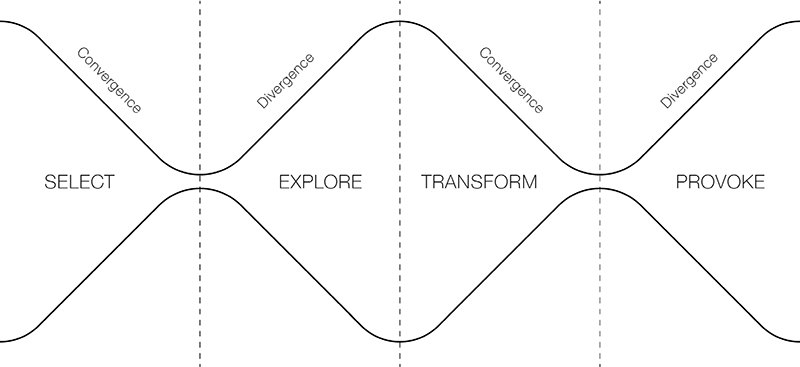
Inverted Double Diamond Framework by Cardenas Cordova et al., 2025
3. Methods
This paper presents the second of two linked but distinct studies investigating the methodological application of the Inverted Double Diamond framework for engaging with wicked problems in organisations. Building on the previous study (Cardenas Cordova et al., 2026), which explored the Select and Explore phases of the framework, this paper focuses on the subsequent Transform and Provoke phases within the same organisational case of inclusive urban mobility. An exploratory case study approach was adopted to examine how these latter phases were applied in practice. This involved creating speculative artefacts and facilitating dyad focus groups and follow-up discussions with four organisational representatives. The study was conducted through a collaborative research partnership with TMR, with one senior TMR representative also serving as a member of the research team and contributing to organisational access, contextual relevance, and alignment with organisational priorities throughout the study. The lead researcher retained responsibility for the study design, facilitation, analysis, and interpretation to support the academic independence necessary for critical inquiry. The study was designed to provide a situated and illustrative methodological account of how these phases were applied, rather than to test or validate the complete Inverted Double Diamond framework or produce generalisable findings. This section outlines the case study context, participant recruitment, methods and procedures, and concludes with the approach to data analysis.
3. 1. Case study: The wicked problem in a large organisation
This study was conducted in partnership with TMR, a Queensland public agency with approximately 10,000 employees responsible for an integrated transport network across road, rail, air, and sea (TMR, 2025b). Its mandate includes providing safe and accessible transport services that support social, economic, and environmental outcomes (TMR, 2025a, 2025b). Within this setting, the study engages with the wicked problem of providing safe, inclusive, and accessible urban mobility across an interconnected transport network while navigating diverse and evolving user needs, infrastructure and policy constraints, technological possibilities, regulatory responsibilities, and competing organisational priorities. To engage with this complexity beyond conventional solution-oriented approaches, the previous study applied the Select and Explore phases of the Inverted Double Diamond with twelve Greater Brisbane area residents experiencing physical mobility impairments (Cardenas Cordova et al., 2026). Participants engaged in speculative and participatory design activities to identify a range of challenges encountered throughout their journeys, such as uneven or hazardous pathways, limited public awareness of disability needs, and limited access to comprehensive travel information. Participants also envisioned speculative concepts that reimagined how these challenges could be addressed within future scenarios. These concepts, summarised in Table 1, informed the subsequent Transform and Provoke phases examined in the present study.

Summary of Speculative concepts generated during the preceding study (Cardenas Cordova et al., 2026).
3. 2. Participants and recruitment
Given the size and diversity of TMR, participant recruitment was intentionally focused on teams with direct relevance to the research topic and methodological approach. Two teams were selected through purposive sampling: the Accessibility Transport Network (ATN) and the Policy, Planning and Investment (PPI) team. This sampling strategy was appropriate as it enabled the deliberate selection of participants based on their relevance to the phenomenon under investigation (Etikan et al., 2016; Palinkas et al., 2016). ATN contributed specialised expertise in inclusive urban mobility and accessibility, while PPI contributed expertise in foresight and future-oriented policy and planning. The inclusion of both teams enabled engagement across complementary organisational perspectives, combining accessibility expertise with future-oriented strategic perspectives. Eligibility criteria required participants to be members of either the ATN or PPI teams within TMR and to have professional experience related to accessibility or future-oriented strategic practices. Recruitment was facilitated through TMR organisational networks, with the lead researcher distributing email invitations alongside participant information materials. Four participants were recruited in total, with P1 and P2 from the Policy, Planning and Investment team and P3 and P4 from the Accessibility Transport Network. The sample was considered appropriate for the exploratory aims of the study, which prioritised sustained engagement with participants and in-depth examination of their responses over breadth or representativeness across the organisation. Detailed individual-level information was not collected because it was not required to address the study aims and could have increased the risk of identification within the small participating teams. Instead, the study foregrounded participants’ professional expertise and organisational perspectives relevant to the wicked problem under investigation. The study received ethics approval from the Queensland University of Technology’s Human Research Ethics Committee.
3. 3. Developing the speculative provocation process
The speculative provocation process was developed in alignment with the core objectives of the Transform and Provoke phases of the Inverted Double Diamond framework (Cardenas Cordova et al., 2025). The Transform phase focused on translating speculative concepts into speculative artefacts and narratives capable of supporting engagement with fictional propositions. Building on this, the Provoke phase focused on using these speculative materials to stimulate critical reflection, discussion, and dialogue regarding the assumptions, tensions, and implications surrounding inclusive urban mobility futures. The following sections describe how these phases were translated into practice through the development of speculative artefacts and the facilitation of organisational discussions, as illustrated in Figure 2.
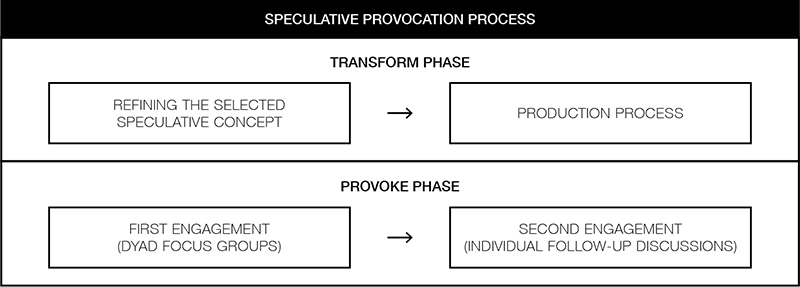
Speculative provocation structure overview
The Transform phase was primarily led by the lead researcher and was structured into two stages: refining the selected speculative concept and the production of speculative artefacts. Drawing on insights and concepts generated during the previous Select and Explore phases, the lead researcher developed speculative artefacts based on the selected concept to be used later in the Provoke phase activities. The following subsections describe how this transformation process was conducted.
Refining the selected speculative concept
To move from broad speculative ideation towards the materialisation of a specific provocation, the present study focused on a single speculative concept from the previous study (Table 1). The concept was selected through collective discussion among the research team, including the senior TMR representative, based on its relevance to the organisational context and its potential to provoke discussion around accessibility and mobility. In line with Boer and Donovan’s (2012) provotyping approach, the selected concept was not treated as an arbitrary design choice, but as a contextually grounded provocation intended to surface discussion around organisationally relevant tensions. The selected concept was the Giant 3D Printer (Participant in previous study, Cardenas Cordova et al., 2026), which was initially described as:
“A 3D scan and printer that can be used when there is inaccessible infrastructure. People with mobility disabilities could scan the area, and then enormous 3D printers could print the accessibility feature needed, such as a ramp for stairs”.
The Giant 3D Printer concept positioned people experiencing physical mobility impairments as active agents in shaping urban infrastructure rather than as passive recipients of accessibility interventions. The concept reimagined how infrastructural limitations affecting people experiencing physical mobility impairments might be addressed through more immediate and user-driven accessibility responses. However, the idea of a large-scale 3D printer also implied significant spatial and temporal constraints, which conflicted with the concept’s emphasis on immediate accessibility responses. To address these limitations and strengthen the concept’s contextual credibility while retaining its provocative potential, the lead researcher conducted a brief desktop review to examine emerging developments in drone-assisted 3D printing and assess whether the concept could retain technological credibility within a seven-year near-future timeframe. This review identified emerging research into drone-assisted 3D printing (Zhang et al., 2022), indicating that the refined concept could remain provocative while retaining credibility within a near-future context.
To further situate the concept within a plausible near-future context, the speculative concept was framed around a fictional private company named Architech, presented as the developer and provider of the drone-assisted 3D-printing technology. Set in the year 2032, the concept was positioned as an on-demand accessibility service capable of generating accessibility infrastructure in response to barriers identified by people experiencing physical mobility impairments in the built environment. Within this case, this framing was selected to make the concept recognisable and relevant within the organisational setting while retaining its capacity to provoke reflection. This context-specific methodological choice was not intended to suggest that speculative provocation must always rely on plausible futures. Consistent with speculative design approaches, this framing aimed to reduce the perceptual distance between present realities and the speculative future while retaining the provocative potential of the concept (Auger, 2013; Bleeckler et al., 2022).
Production process of speculative artefacts
Speculative design requires translating speculative concepts into artefacts capable of supporting engagement with possible futures and provoking reflection on present realities (Dunne & Raby, 2013). However, within organisational contexts, the development of speculative artefacts may present a practical barrier for non-designers who do not possess specialised prototyping, visualisation, or production skills. Recent developments in generative AI technologies have created new possibilities for visual production through the rapid generation and iterative refinement of imagery, potentially reducing reliance on advanced technical expertise. In this study, AI image generation was intentionally used to explore a potential production pathway through which practitioners without specialised visualisation skills might materialise speculative concepts during the Transform phase. This was not intended to position AI as the only approach to artefact production, to suggest that design expertise is unnecessary, or to establish that organisational practitioners could independently undertake the production process, but rather to provide an exploratory example of how this phase might be supported beyond specialist design practice. Prior research using AI to fabricate speculative concepts in educational settings provided a precedent for exploring similar possibilities in organisational contexts (Ojeda Ramirez et al., 2026).
Visual imagery was selected as the primary medium because static images provide contextual cues without fully determining the narrative, enabling participants to interpret, imagine, and question what may be occurring beyond the frame. The intention was not to fully explain the speculative concept, but rather to provide enough contextual detail to support reflection, ambiguity, and discussion. Consistent with speculative design approaches, photo-realistic imagery was intentionally prioritised over abstract sketches, line drawings, or highly conceptual renderings to situate the speculative concept within recognisable everyday environments and reduce the perceptual distance between present realities and the speculative future being proposed. This approach supported participants in engaging with the speculative future as a plausible extension of present reality rather than as a purely conceptual idea (Auger, 2013; Bleeckler et al., 2022).
The production process drew directly on accessibility challenges identified by participants during the previous Select and Explore phases, including uneven pavements, inaccessible infrastructure, limited accessibility features, and broader social awareness surrounding disability needs, with the intention of grounding the speculative provocation within these insights. Field exploration was conducted across Brisbane to photograph urban environments reflecting these accessibility conditions. These photographs initially served as the basis for generating speculative visualisations of the 3D-printing drone technology. AI image generation platforms, including ChatGPT-5, Copilot GPT-5, and Google Gemini 2.5 Flash, were used to digitally overlay accessibility structures onto the collected images. However, these early outputs lacked the level of visual coherence and realism required to support plausibility within the speculative provocation. Subsequent iterations instead generated complete photo-realistic scenes through text-based prompting, with Google Gemini 2.5 Flash selected because it produced the most coherent and visually consistent results. Prompt development focused on maintaining continuity across images, including consistent architectural aesthetics, accessibility structures, and urban environments. The speculative accessibility structures generated by Architech were also consistently represented in blue, referencing colours commonly associated with accessibility signage within the Australian context. Additional contextual details, including potential users interacting with the accessibility technology, were incorporated to support reflection on the potential social, ethical, technological, and organisational implications of the speculative future.
While the speculative images provided visual representations of the concept situated within everyday urban environments, they did not fully communicate the broader service logic of the speculative technology. To support this, a complementary information bulletin was developed in the style of a professional corporate communication, consistent with speculative design approaches that use this type of artefact to situate speculative technologies within believable sociotechnical contexts (Brown et al., 2016; Fox et al., 2019). The bulletin included fictional company messaging, descriptions of the service, information regarding who could use the technology, how the service operated, and associated costs. In this sense, the images functioned primarily as contextual visual cues, while the bulletin provided additional conceptual and organisational framing for the speculative future. The final speculative artefacts consisted of four high-resolution photo-realistic images produced on photographic paper and an information bulletin designed to resemble professional promotional material (Figure 3). The photographic format was selected to enhance perceptual realism and support the contextual credibility of the speculative future being presented. The material quality of the artefacts was intentionally selected to support physical interaction, shared viewing, and critical engagement with the speculative concept.
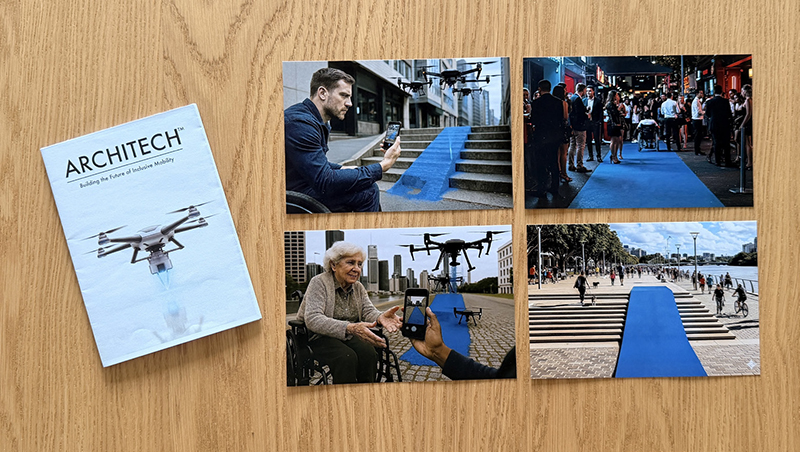
Speculative artefacts (adapted from Architech (Cardenas Cordova, 2025a), and Architech | Outcomes (Cardenas Cordova, 2025c), CC BY 4.0)
Previous applications of speculative design within organisational contexts have shown that speculative concepts are often interpreted through the lens of feasibility and problem-solving rather than as provocations for critical reflection (Ringfort-Felner et al., 2023). In response, the Provoke phase was structured as a facilitated engagement process designed to support movement from participants’ initial interpretations towards discussion and critical reflection on the broader social, organisational, ethical, and technological implications of the speculative concept. To achieve this, participant responses were explored through two complementary forms of engagement:
First engagement: Dyad focus groups
Speculative artefacts were presented to participants in facilitated dyad focus groups, chosen for their capacity to support collective sense-making and open discussion (Albanesi, 2014). A total of two 60-minute dyad focus groups were conducted, each involving two participants from the same team. Participants were grouped by team to support discussion among colleagues with shared organisational language and professional responsibilities, allowing each session to capture team-specific interpretations of the speculative concept. The sessions were facilitated by the lead researcher and aimed to capture participants’ initial interpretations and responses to the speculative artefacts. At the beginning of each session, the lead researcher emphasised that the focus of the session was on exploring implications rather than assessing technical feasibility. This framing was used to move beyond evaluative or solution-oriented thinking and ref lect on the values, assumptions, and potential consequences embedded in the speculative concept presented.
Each session began with an introduction to inclusive urban mobility, with a particular focus on accessibility challenges faced by people experiencing physical mobility impairments, to establish participants’ perspectives on the topic. A brief overview of emerging drone-based 3D printing technology was provided to support the concept’s plausibility. Following this, the speculative concept was introduced, outlining its purpose, operation, and potential users. This explanation was supported by printed visual materials adapted from the information bulletin, allowing key details of the concept to be presented clearly during the session without requiring participants to read the full bulletin at that point (see Figure 4). Participants shared their initial impressions of the concept before the four photo-realistic images were introduced. The photographs were not introduced in a fixed order. Instead, they were introduced in response to participants’ comments, allowing the discussion to develop around issues that emerged during the session. At the end of the session, participants were given the photographs and the information bulletin to take home (see Figure 3), encouraging continued reflection on the concept beyond the workshop in preparation for the second engagement.
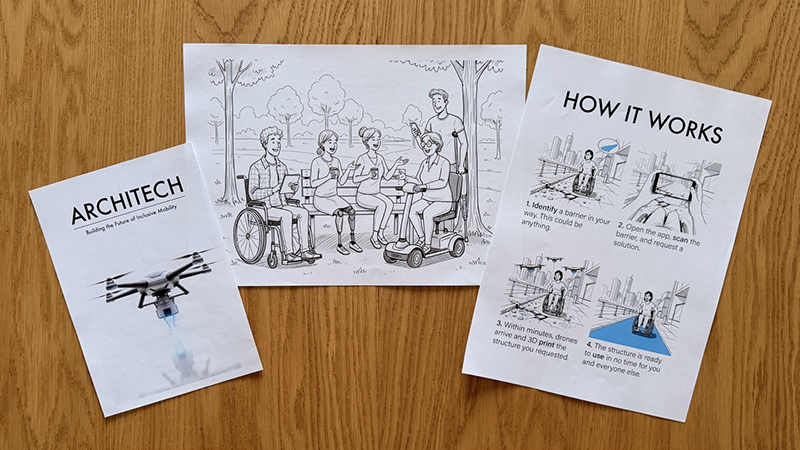
Example of visual supporting material (adapted from Architech | How it works (Cardenas Cordova, 2025b), People with diverse experiences of physical mobility impairments (Cardenas Cordova, 2025d), and Architect (Cardenas Cordova, 2025a), CC BY 4.0)
Second engagement: Individual follow-up discussions
Follow-up discussions were conducted one week later to explore how participants’ perspectives developed after further reflection. Informal individual discussions were conducted online via Microsoft Teams. The individual format was intentionally selected to provide participants with space for personal reflection without the immediate influence of group dynamics. Each session lasted approximately 30 minutes and was structured into two parts: first, participants shared any additional, evolving, or deeper thoughts, questions, or reflections that had emerged since the dyad focus groups; second, participants reflected on the speculative approach itself, including the design of the speculative artefacts and the potential value of speculative design in large organisations like TMR. Importantly, the speculative artefacts were not reused as stimuli during these sessions, as the intention was to explore how participants’ reflections and interpretations evolved after the initial engagement.
3. 4. Data analysis
Given that this study aimed to examine how speculative provocation operated methodologically within an organisational context, the analysis focused on how participant engagement and responses reflected the functioning of the Transform and Provoke phases of the Inverted Double Diamond framework. Participant responses were treated as methodological indicators of how the artefacts produced during the Transform phase functioned within the focus groups and how facilitation during the Provoke phase supported critical reflection in the context of persistent solution-oriented thinking. The analysis drew on data from the two dyad focus groups, four individual follow-up discussions, and reflective notes produced by the lead researcher. Dyad focus groups and individual follow-up discussions were audio-recorded via Microsoft Teams, with automatically generated transcripts. Transcripts were reviewed by the lead researcher for accuracy before analysis.
To examine participants’ responses to the speculative artefacts, the study employed inductive thematic analysis using Braun and Clarke’s (2006) six-phase framework for identifying and interpreting patterns in qualitative data. Transcripts from the dyad focus groups and follow-up discussions were first read repeatedly to support familiarisation with the dataset. Initial codes were then generated inductively from participants’ responses, focusing on how they interpreted the speculative artefacts, what concerns or implications they raised, and what assumptions, values, or tensions became visible through discussion. Codes were then reviewed, compared, and grouped into broader patterns of meaning, which informed the development of the tensions presented in the findings. These tensions were reviewed against the coded extracts to assess their coherence with participants’ responses and ensure that the interpretation remained grounded in the dataset. The tensions were understood both as empirical outcomes of participants’ engagement during the Provoke phase, reflecting competing values articulated through discussion, and as methodological indicators of how the artefacts produced during Transform and the facilitated engagement during Provoke supported or constrained the articulation and critical examination of those values.
In parallel, a reflective practice lens complemented the thematic analysis by examining the methodological process itself. To support this, the lead researcher collected reflective notes immediately after the dyad focus groups and individual follow-up discussions. These notes supported reflective practice by documenting methodological decisions, facilitation moments, participant engagement, and challenges encountered during the application of speculative provocation. Together, the thematic analysis and reflective practice lens enabled the study to examine both the meanings and tensions generated through participants’ engagement with the speculative artefacts and how the methodology functioned in practice.
4. Findings from the speculative provocation process
This section presents the findings of the case study in relation to the research question: How can speculative provocation be methodologically applied to engage with wicked problems within an organisational context? The focus is on how speculative provocation operated in practice, with findings organised around the Transform and Provoke phases.
4. 1. Findings from the Transform phase
As organisational participants were not directly involved in the Transform phase, the findings presented here concern how they perceived and responded to the speculative artefacts and the material and contextual decisions they embodied. Materially, the use of photo-realistic images and an information bulletin helped translate the Architech concept into a form that participants could interpret, question, and discuss. The artefacts gave the speculative concept a recognisable and tangible form, with P2 describing them as “fit for purpose” because they prompted critical considerations that they “wouldn’t have considered otherwise”. The high level of visual detail and alignment with recognisable emerging technologies, including drones and 3D printing, were described as “very much in the realm of plausibility” (P2) and “not that far-fetched because this is how the technology is already being used in other industries” (P3).
Interpretively, the artefacts supported participants in engaging with the concept and exploring its broader implications. P1 noted that the artefacts “challenge the way that you think” and helped them “gather a wider… range of problem identification”, while P3 reflected that they “challenge that chain reaction of assumptions or known truths”. This contributed to an immersive quality that enabled participants to “disengage from the present and immerse in the future scenario” (P1) and feel “like they were already there” (P2). At the same time, participants’ responses suggest that material plausibility was not automatic. The use of AI-generated imagery introduced a degree of scepticism. P3 explained that because the images were clearly AI-generated, they could make the concept feel fabricated, stating, “you show me a picture of AI… I’m like… you’re making this up.” While P3 acknowledged that AI can be useful for representing possibilities, they also noted that it carries the sense that this isn’t real. This indicates that visual realism alone does not guarantee plausibility.
Taken together, these findings indicate that the Transform phase performed a materialising function by making the selected concept sufficiently concrete to serve as a shared point of reference. This function depended not only on visual realism, but also on how participants related the artefacts to recognisable technologies and assessed the credibility of the AI-generated imagery. The artefacts therefore supported engagement while leaving the plausibility of the concept open to interpretation.
4. 2. Findings from the Provoke phase
The application of the Provoke phase revealed methodological opportunities and challenges within this organisational case. A key finding was that participants from both groups repeatedly interpreted the speculative artefacts through the lens of feasibility and problem-solving during the dyad focus groups. Participants responded with technical and logistical questions, proposed modifications, and evaluated the practicality of the speculative technology. Despite the sessions being framed around implications rather than technical feasibility, discussions frequently returned to solution-oriented thinking. P1 described engaging with speculative approaches as “tricky” and “foreign” within a context accustomed to evidence-based constraints and measurable outcomes, a view also reflected by P3. For P1, the challenge involved “trying to step aside from the today” and considering “to what extent… do you disregard what’s happening today to kind of immerse yourself in this future state?”
P1 further reflected on the facilitation process, noting that the “gentle reminders” provided throughout the discussions helped shift participants’ mode of engagement from assessing feasibility to considering the broader organisational, social, ethical, and technological implications of the speculative future presented.
Through this facilitated engagement, five tensions emerged from participants’ responses: empowerment versus regulation, immediate repair versus long-term urban planning, individual needs versus collective public space, technological enablement versus technological exclusion, and visible accessibility versus aesthetic and social acceptance. These tensions, summarised in Table 2, reveal how participants interpreted the speculative concept.
Tensions surfaced through the Provoke phase
The follow-up discussions reinforced these tensions. Although the one-week interval between engagements was intended to encourage continued reflection beyond the initial session, participants did not introduce substantially new concerns or themes. Instead, they returned to the follow-up discussions with more developed reflections on the tensions already identified during the dyad focus groups. This suggests that the follow-up format supported further elaboration of existing reflections, rather than generating a separate set of new insights. Beyond the specific tensions identified, participants reflected that speculative provocation created a space for engaging with possibilities that would not normally emerge through conventional organisational processes. P1 described the approach as allowing for “breaking the linear chains of assumptions that often dominate technical planning”, while P3 and P4 characterised the speculative process as a safe space to “trial or play around with an idea” without the constraints typically associated with organisational decision-making. P2, P3, and P4 suggested that the speculative approach enabled discussion before solutions, policies, or infrastructural decisions became fixed, helping to shift attention away from existing assumptions and towards alternative possibilities.
At the same time, the findings revealed significant friction between speculative design approaches and the prevailing organisational culture. P3 described the organisational environment as “fundamentally engineering-focused rather than design-focused”, emphasising efficiency, measurable outcomes, and predefined indicators of success. In contrast, P3 observed that speculative provocation operated through uncertainty and exploratory reflection, where outcomes and measures of success could not always be clearly defined in advance. As P3 explained, “a research or proof-of-concept project always needs indicators of success... but here (speculative provocation), we do not really know what success looks like yet, we have a vision for the future instead”. These findings suggest that speculative provocation supported exploratory dialogue but that this engagement required careful facilitation to temporarily suspend conventional expectations surrounding certainty, evaluation, and solution-oriented outcomes.
These findings indicate that the Provoke phase performed a facilitation-dependent function within this case. Rather than eliminating feasibility-oriented responses, facilitation helped extend discussion beyond immediate problem-solving towards broader organisational, social, ethical, and technological implications. The tensions that emerged made visible the competing values shaping participants’ understandings of the wicked problem, while their repeated return to feasibility revealed the organisational conditions within which speculative provocation had to be actively sustained.
5. Discussion
This paper has examined how speculative provocation was translated into practice through the Transform and Provoke phases of the Inverted Double Diamond within an organisational case focused on inclusive urban mobility. The study did not examine how the insights surfaced through this process informed subsequent organisational decision-making, which remains an area for future research. This section reflects on how the distinct methodological objectives of these phases were pursued, presents a case-derived synthesis of what was learned through their application, and considers the potential value and limitations of speculative provocation in organisational contexts.
5. 1. Methodological reflections on the case study
This section critically reflects on what the case study reveals about the methodological application of the Transform and Provoke phases, focusing on how artefact design and facilitation shaped participants’ engagement with the speculative provocation process. The Transform phase focuses methodologically on materialising speculative concepts into forms that participants can meaningfully engage with and reflect on (Cardenas Cordova et al., 2025; Dunne & Raby, 2013). In this study, the speculative artefacts acted as dialogical objects, encouraging imaginative and reflective discussions about inclusive urban mobility (Akkerman & Bakker, 2011), and as boundary objects, grounding discussion through a shared reference point while still allowing for varied interpretations (Johnson et al., 2017). In this sense, speculative artefacts allowed participants to move beyond questions of ‘what is this?’ and instead engage with ‘what does this mean?’. In this case, the speculative artefacts were designed to establish contextual credibility that supported participants’ critical engagement with the speculative concept, rather than to convince them that the future presented was real. This aligns with Walton et al.’s (2019) argument that recognisable contextual references can help participants connect speculative imaginaries with existing frames of understanding.
Within this case, plausibility functioned as a means of supporting engagement rather than than as the endpoint or measure of the provocation’s quality. Familiar technologies and organisational references provided an entry point for discussion, while the Architech concept remained provocative in its implications for authority, regulation, accessibility, public infrastructure, and organisational responsibility. The five tensions surfaced through the Provoke phase indicate that this contextual grounding did not prevent the concept from challenging existing assumptions. The methodological challenge in this organisational application of the Transform phase was therefore to construct artefacts that were relevant and credible within the organisational setting while retaining the capacity to question established organisational assumptions.
While Transform materialised the speculative concept as a shared point of reference, Provoke used that reference as the basis for facilitated dialogue. Consistent with the cognitive structure proposed in the Inverted Double Diamond (Cardenas Cordova et al., 2025), this sequence moved from convergence in Transform, where one selected concept was refined into a defined set of artefacts, to divergence in Provoke, where facilitated dialogue encouraged varied interpretations, questioning, and critical reflection. In the case study, the application of the Provoke phase surfaced five tensions (Table 2). These tensions illustrate how speculative provocation supported participants in considering interconnected technological, ethical, social, and organisational dimensions of the problem. Rather than offering a pathway to implementation, these tensions acted as friction points that exposed competing values shaping how participants framed the wicked problem within its organisational context. This suggests that one methodological value of the Provoke phase lies not in solving the wicked problem, but in encouraging participants to dwell in the complexity of the problem space.
The application of this phase also highlighted the methodological importance of active facilitation. Within contexts characterised by strong data-driven and engineering-oriented perspectives, speculative artefacts may be interpreted as representations of possible solutions rather than prompts for critical reflection. This tendency should not be understood solely as a product of organisational culture, but also as a response to the uncertainty and ambiguity of wicked problems, where participants may seek resolution, closure, and actionable outcomes (Rittel & Webber, 1973). Organisational cultures that prioritise efficiency, accountability, and measurable outcomes can further reinforce this inclination, embedding solution-oriented thinking as the dominant mode of engagement (Ringfort-Felner et al., 2023). In this sense, facilitation functioned not merely as a practical support mechanism, but as a methodological condition for sustaining speculative provocation within this case.
5. 2. Methodological synthesis of speculative provocation
While the preceding sections examined the Transform and Provoke phases separately, this section brings their findings together to clarify their distinct yet connected methodological functions within this organisational case. Figure 5 integrates the phase objectives and cognitive structure articulated in the Inverted Double Diamond (Cardenas Cordova et al., 2025) with case-derived observations of how the phases were applied in practice. These insights are synthesised across five descriptive dimensions: objective, cognitive mode, strategy, tone, and outcome. Together, these dimensions provide a consistent basis for comparing what each phase sought to achieve, how it structured thinking and engagement, and what emerged through its application. The five-dimensional synthesis was developed following the analysis to organise and communicate the findings. Figure 5 therefore presents a provisional reference point for comparison across future applications of speculative provocation in other organisational contexts.
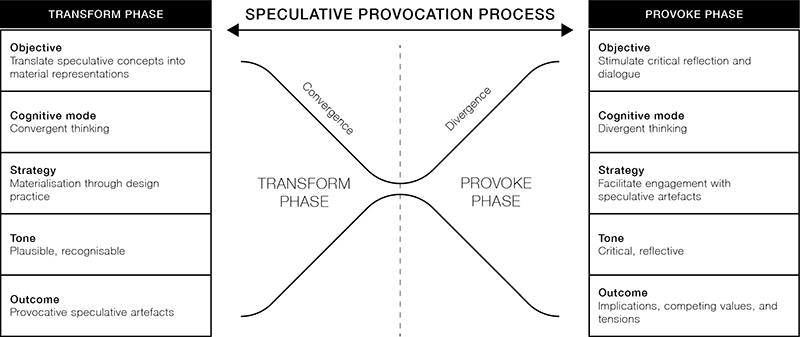
Methodological synthesis of speculative provocation through the Transform and Provoke phases across five descriptive dimensions
5. 3. Potential value of speculative provocation in organisations
The findings suggest that the potential value of speculative provocation in organisations lies in its capacity to create a structured space for reflection before decisions, policies, or infrastructural solutions are defined. In contexts where uncertainty is often managed through feasibility, evidence, and predefined indicators of success, speculative provocation may help redirect attention from the pressure to reach a resolution towards examining assumptions, consequences, and competing values. It complements technical rigour and evidence-based decision-making by providing a mode of inquiry through which organisations can engage critically with aspects of wicked problems that may receive less attention within conventional organisational processes. The significance of this capacity becomes clearer when considered in relation to how organisations engage with wicked problems. Head and Alford (2015) argue that engaging with wicked problems requires broader ways of thinking about the variables, options, and linkages associated with complex problems. Speculative provocation can enable this broader mode of inquiry by materialising an alternative possibility as a shared point of reference through which participants can examine interdependencies and value conflicts. In this case, the five tensions connected the technical and infrastructural dimensions of inclusive urban mobility with regulation, accountability, urban planning, shared public space, technological access, and social acceptance. Accordingly, speculative provocation may support organisational engagement with wicked problems by broadening problem framing, rather than by producing a solution to the problem itself. In this case, the process concluded with the surfacing of implications, tensions, and competing values, while translating these insights into organisational priorities or actions would require a subsequent organisational process.
5. 4. Limitations and future work
The study provides a situated and exploratory methodological account of how speculative provocation was applied through the Transform and Provoke phases of the Inverted Double Diamond framework to engage with a wicked problem in an organisational setting. Limitations should be acknowledged concerning the participant and organisational scope, methodological design and researcher-led application, and the absence of longitudinal evidence about subsequent organisational influence. These limitations also mean that the findings should be treated as provisional, with their transferability examined through further applications across other organisational contexts and wicked problems.
As a single case study focused on TMR, the participant sample included representatives from only a small segment of the extensive organisational structure, limiting the range of perspectives captured. A more diverse sample, including varied roles, seniority levels, and regional offices, could provide further insight into how speculative artefacts are interpreted across the organisation and reveal tensions between operational, managerial, and strategic perspectives. Furthermore, the insights are closely tied to TMR’s specific organisational culture, professional composition, and engineering orientation. These factors likely shaped how participants engaged with and interpreted the speculative artefacts, including the emphasis they placed on feasibility, risk, and regulation. These responses may therefore reflect the specific context rather than universal organisational tendencies. The collaborative nature of the research partnership should also be acknowledged. The involvement of a senior TMR representative as part of the research team supported organisational access and contextual relevance but may have shaped the framing of organisational priorities. While the lead researcher retained responsibility for facilitation, analysis, and interpretation, future studies could examine how insider organisational involvement influences the design and reception of speculative provocation processes.
The study used a specific set of speculative artefacts, including photo-realistic images and an information bulletin. Alternative artefact formats, such as sketches, videos, physical prototypes, or interactive materials, could shape participants’ engagement and interpretation in different ways. Future applications could explore different media to examine how artefact format influences immersion, interpretation, and dialogue in organisational contexts. In relation to the use of AI, future research could investigate whether and under what conditions AI image generation reduces production barriers for practitioners without specialised design skills while maintaining contextual credibility. Furthermore, because the study used a single contextually plausible near-future proposition, it cannot determine how more radical, discontinuous, or deliberately impossible propositions might shape organisational engagement differently. Future research could examine how such propositions are received and how their capacity to support reflection varies according to the purpose of the inquiry and the organisational culture in which they are introduced.
The study also did not evaluate whether organisational practitioners without prior speculative design expertise could independently design, produce, or facilitate the process. The speculative concept was selected and refined by the research team, while the lead researcher produced the artefacts and facilitated the engagement activities. The findings therefore demonstrate how organisational participants engaged with a facilitated speculative provocation process, but do not establish whether organisational practitioners can independently apply the framework. Future research should examine practitioner-led applications and the forms of training, facilitation support, or methodological resources required for organisational use.
Finally, the study did not examine whether the insights and tensions surfaced through speculative provocation influenced subsequent organisational problem framing or decision-making. Longitudinal research could investigate how these insights are carried beyond the facilitated engagement and whether they inform later organisational discussions, practices, or decisions.
6. Conclusions
This paper addressed the question of ‘How can speculative provocation be methodologically applied to engage with wicked problems within an organisational context?” Using TMR as an exploratory case study, the paper examined how speculative provocation was translated into practice through the Transform and Provoke phases of the Inverted Double Diamond framework to engage with the wicked problem of inclusive urban mobility.
Methodologically, the study contributes a situated and provisional account of the distinct yet connected functions performed by these phases within this case. The Transform phase materialised a selected alternative possibility as a shared point of reference that participants could engage with while allowing for different interpretations. The Provoke phase used that reference as the basis for facilitated dialogue. Active facilitation helped extend discussions beyond feasibility-oriented responses towards reflection on broader implications, through which tensions and competing values to surface and provide insight into how participants framed and understood the wicked problem. Rather than positioning the speculative concept represented by the artefacts as an implementable solution, speculative provocation created a structured space in which participants could examine assumptions, consequences, interdependencies, and value conflicts without requiring immediate resolution. The findings suggest that speculative provocation may complement technical rigour and evidence-based decision-making by supporting broader problem framing and critical engagement with aspects of wicked problems that may receive less attention within conventional organisational processes.
The findings from this case provide a provisional reference point for examining future applications of speculative provocation across different organisational contexts, wicked problems, proposition types, artefact formats, and practitioner-led processes. Longitudinal studies are also required to investigate whether the insights surfaced through speculative provocation subsequently influence organisational discussions, problem framing, practices, or decisions.
Acknowledgments
This research has been supported by the Queensland Government Department of Transport and Main Roads (TMR) in partnership with the ARC Training Centre for Behavioural Insights for Technology Adoption (IC210100008). We thank Shellee Franssen from TMR for her assistance with recruiting participants and logistics.
Declaration of generative AI and AI-assisted technologies in the writing process
During the preparation of this work, the lead author used ChatGPT-5 to enhance language and readability of some text in the manuscript. It was not used for initial text generation. After using this tool, all authors reviewed and edited the content as needed and take full responsibility for the content of the publication.
Notes
Copyright : This is an Open Access article distributed under the terms of the Creative Commons Attribution Non-Commercial License (http://creativecommons.org/licenses/by-nc/3.0/), which permits unrestricted educational and non-commercial use, provided the original work is properly cited.
References
- Aguesse, M., & Decreton, B. (2022). Using Fiction to Find Your Strategy. Harvard Business Review. https://hbr.org/2022/06/using-fiction-to-find-your-strategy.
-
Akkerman, S. F., & Bakker, A. (2011). Boundary Crossing and Boundary Objects. Review of Educational Research, 81(2), 132–169.
[https://doi.org/10.3102/0034654311404435]

-
Albanesi, C. (2014). Focus Groups. In Encyclopedia of Quality of Life and Well-Being Research (pp. 2310–2313). Springer, Dordrecht.
[https://doi.org/10.1007/978-94-007-0753-5_1066]
-
Auger, J. (2013). Speculative design: Crafting the speculation. Digital Creativity, 24(1), 11–35. Design & Applied Arts Index (DAAI) (1622045803; 0001150249).
[https://doi.org/10.1080/14626268.2013.767276]
-
Bendor, R., & Lupetti, M. L. (2024). Teaching speculative design. International Journal of Technology and Design Education, 35(1), 403–425.
[https://doi.org/10.1007/s10798-024-09908-3]
- Bleeckler, J., Foster, N., Girardin, F., Nova, N., Frey, C., & Pittman, P. (2022). The manual of design fiction. Near Future Laboratory.
-
Boer, L., & Donovan, J. (2012). Provotypes for participatory innovation. Proceedings of the Designing Interactive Systems Conference, DIS '12, 388–397.
[https://doi.org/10.1145/2317956.2318014]
-
Brown, B., Bleecker, J., D'Adamo, M., Ferreira, P., Formo, J., Glöss, M., Holm, M., Höök, K., Johnson, E.-C. B., Kaburuan, E., Karlsson, A., Vaara, E., Laaksolahti, J., Lampinen, A., Leahu, L., Lewandowski, V., McMillan, D., Mellbratt, A., Mercurio, J., … Ydholm, M. (2016). The IKEA Catalogue: Design Fiction in Academic and Industrial Collaborations. Proceedings of the 2016 ACM International Conference on Supporting Group Work, Group '16, 335–344.
[https://doi.org/10.1145/2957276.2957298]
-
Buchanan, R. (1992). Wicked Problems in Design Thinking. Design Issues, 8(2), 5-21.
[https://doi.org/10.2307/1511637]
-
Buehring, J., & Bishop, P. C. (2020). Foresight and Design: New Support for Strategic Decision Making. She Ji: The Journal of Design, Economics, and Innovation, 6(3), 408-432.
[https://doi.org/10.1016/j.sheji.2020.07.002]
- Cardenas Cordova, D. (2025a). Architech [Digital image]. Figshare. https://figshare.com/account/articles/30513815.
- Cardenas Cordova, D. (2025b). Architech | How it works [Digital image]. Figshare. https://figshare.com/s/929ebb5a7121df306c4e.
- Cardenas Cordova, D. (2025c). Architech | Outcomes [Digital image]. Figshare. https://figshare.com/account/articles/30513719.
- Cardenas Cordova, D. (2025d). People with diverse experiences of physical mobility impairments [Digital image]. Figshare. https://figshare.com/account/articles/30513656?file=59244869.
-
Cardenas Cordova, D., Kelly, N., & Rezayan, L. (2025). A systematic literature review of the speculative design process and a proposed framework for speculative design. Design Science, 11, e38.
[https://doi.org/10.1017/dsj.2025.10030]
-
Cardenas Cordova, D., Kelly, N., Rezayan, L., & Sandall, J. (2026). Methodological Application of Future Envisioning: A Speculative Design Case Study in an Organisational Context. Archives of Design Research, 39(1), 103-127.
[https://doi.org/10.15187/adr.2026.02.39.1.103]
- Design Council. (2005). The Double Diamond: A Universally Accepted Depiction of the Design Process. Design Council. https://www.designcouncil.org.uk/newsopinion/double-diamond-universally-accepted-depiction-design-process.
- Dunne, A., & Raby, F. (2013). Speculative Everything: Design, Fiction, and Social Dreaming. MIT Press.
-
Dunne, A., & Raby, F. (2025). Not here, not now : speculative thought, impossibility, and the design imagination (1st ed.). The MIT Press.
[https://doi.org/10.7551/mitpress/15700.001.0001]
-
Etikan, I., Musa, S. A., & Alkassim, R. S. (2016). Comparison of convenience sampling and purposive sampling. American journal of theoretical and applied statistics, 5(1), 1-4.
[https://doi.org/10.11648/j.ajtas.20160501.11]
-
Fox, S., Howell, N., Wong, R., & Spektor, F. (2019). Vivewell: Speculating Near-Future Menstrual Tracking through Current Data Practices. Proceedings of the 2019 on Designing Interactive Systems Conference, DIS '19, 541-552.
[https://doi.org/10.1145/3322276.3323695]
-
Head, B. W., & Alford, J. (2015). Wicked Problems: Implications for Public Policy and Management. Administration & Society, 47(6), 711-739.
[https://doi.org/10.1177/0095399713481601]
-
Johannessen, L., Keitsch, M., & Pettersen, I. (2019). Speculative and Critical Design-Features, Methods, and Practices. Proceedings of the Design Society: International Conference on Engineering Design, 1, 1623-1632.
[https://doi.org/10.1017/dsi.2019.168]
-
J ohnson, M., Ballie, J., Thorup, T., & Brooks, E. (2017). Living on the Edge: Design artefacts as boundary objects. The Design Journal, 20(sup1), S219-S235.
[https://doi.org/10.1080/14606925.2017.1352771]
-
Light, A. (2021). Collaborative speculation: Anticipation, inclusion and designing counterfactual futures for appropriation. Futures, 134. Scopus.
[https://doi.org/10.1016/j.futures.2021.102855]
-
L indley, J., & Green, D. P. (2021). The Ultimate Measure of Success for Speculative Design is to Disappear Completely. Interaction Design and Architectures, (51, SI), 32-51.
[https://doi.org/10.55612/s-5002-051-002]
-
Malpass, M. (2013). Between wit and reason: Defining associative, speculative, and critical design in practice. Design and Culture, 5(3), 333-356. Scopus.
[https://doi.org/10.2752/175470813X13705953612200]
-
Malpass, M. (2017). Critical design in context: History, theory, and practices. In Critical design in context: History, theory, and practices. Bloomsbury Academic, an imprint of Bloomsbury Publishing Plc.
[https://doi.org/10.5040/9781474293822]
-
Marji, N., Thibault, M., & Shawash, J. (2023). Blueprints of Tomorrow Co-Designing Speculative Urban Futures. Proceedings of the 26th International Academic Mindtrek, Mindtrek, 305-308. Scopus.
[https://doi.org/10.1145/3616961.3616980]
- Mazé, R., & Redström, J. (2009). Difficult Forms: Critical practices of design and research. Research Design Journal, 1, 28-39.
- Mitrović, I. (2015). Introduction to Speculative Design Practice - Eutropia, a Case Study (1.0). Croatian Designers Association, Arts Academy / University of Split.
-
Ojeda Ramirez, S., Hakim, N., & Danies, G. (2026). A Grammar of Speculation: Learning Speculative Design with Generative AI in Biodesign Education. Education Sciences, 16(1).
[https://doi.org/10.3390/educsci16010102]
-
Palinkas, L. A., Garcia, A. R., Aarons, G. A., Finno-Velasquez, M., Holloway, I. W., Mackie, T. I., ... & Chamberlain, P. (2016). Measuring use of research evidence: the structured interview for evidence use. Research on Social Work Practice, 26(5), 550-564.
[https://doi.org/10.1177/1049731514560413]
-
Pinto, J. P., Ramírez-Angulo, P. J., Crissien, T. J., & Bonett-Balza, K. (2021). The creation of dystopias as an alternative for imagining and materializing a university of the future. Futures, 134, 1. ProQuest Central (2619667302).
[https://doi.org/10.1016/j.futures.2021.102832]
- Queensland Department of Transport and Main Roads. (2025a). Vision, purpose and values. https://www.tmr.qld.gov.au/about-us/our-organisation/vision-purpose-and-values.
- Queensland Department of Transport and Main Roads. (2025b). What we do. Queensland Department of Transport and Main Roads. https://www.tmr.qld.gov.au/About-us/Our-organisation/Organisational-structure.
-
Ringfort-Felner, R., Dörrenbächer, J., & Hassenzahl, M. (2025). The Quality of Speculation - A Scoping Review. Proceedings of the 2025 ACM Designing Interactive Systems Conference, DIS '25, 2373-2394.
[https://doi.org/10.1145/3715336.3735794]
-
Ringfort-Felner, R., Neuhaus, R., Dörrenbächer, J., Grosskopp, S., Theofanou-Fuelbier, D., & Hassenzahl, M. (2023). Design Fiction in a Corporate Setting-A Case Study. Designing Interactive Systems Conference, DIS 2023, 2093-2108.
[https://doi.org/10.1145/3563657.3596126]
-
Rittel, H. W. J., & Webber, M. M. (1973). Dilemmas in a general theory of planning. Policy Sciences, 4(2), 155-169.
[https://doi.org/10.1007/BF01405730]
- Tsekleves, E., Lee, C. A. L., Darby, A., & Yong, M. H. (2020). The Little Book of Speculative Design for NGOs and Community Groups. Lancaster University.
-
Tsekleves, E., Ling Lee, C. A., Yong, M. H., & Lau, S. L. (2022). Exploring the use of speculative design as a participatory approach to more inclusive policy-identification and development in Malaysia. Design Studies, 81, Article 101118.
[https://doi.org/10.1016/j.destud.2022.101118]
-
Tsekleves, E., Yong, M. H., Lee, C. A. L., Giga, S., Hwang, J. S., & Lau, S. L. (2019). Rethinking how healthcare is conceptualised and delivered through speculative design in the UK and Malaysia: A Comparative study. Design Journal, 22(1), 429-444.
[https://doi.org/10.1080/14606925.2019.1595430]
-
Walton, S., O’Kane, P., & Ruwhiu, D. (2019). Developing a theory of plausibility in scenario building: Designing plausible scenarios. Futures, 111, 42-56.
[https://doi.org/10.1016/j.futures.2019.03.002]
-
Wong, R. Y., & Khovanskaya, V. (2018). Speculative Design in HCI: From Corporate Imaginations to Critical Orientations. In M. Filimowicz & V. Tzankova (Eds), New Directions in Third Wave Human-Computer Interaction: Volume 2-Methodologies (pp. 175-202). Springer International Publishing.
[https://doi.org/10.1007/978-3-319-73374-6_10]
-
Zhang, K., Chermprayong, P., Xiao, F., Tzoumanikas, D., Dams, B., Kay, S., Kocer, B. B., Burns, A., Orr, L., Alhinai, T., Choi, C., Darekar, D. D., Li, W., Hirschmann, S., Soana, V., Ngah, S. A., Grillot, C., Sareh, S., Choubey, A., ... Kovac, M. (2022). Aerial additive manufacturing with multiple autonomous robots. Nature, 609(7928), 709-717.
[https://doi.org/10.1038/s41586-022-04988-4]