
Designing Cultural Tourism Experiences: An Identity-Based Service Design Framework for Hanbok Rental Experiences
Abstract
Background Traditional attire rental has become an important form of cultural tourism in South Korea, where hanbok rental allows tourists to engage with heritage settings through embodied participation. However, little is known about how identity-oriented motivations shape experiences across the service journey, leaving service improvements overly general rather than tailored to different tourist motivations.
Methods This study adopts a two-phase mixed-method design. The qualitative phase used focus group interviews, self-observation, and user-generated content analysis, interpreted through self-concept theory, experience economy, and product–service system (PSS) perspectives to derive a service blueprint with nine stage-based improvement elements. The quantitative phase surveyed 131 foreign tourists with hanbok rental experience and used importance–performance analysis (IPA) to evaluate these elements across identity-oriented segments.
Results The findings indicate that hanbok rental experiences are primarily driven by internal identity motivations, particularly actual self and ideal self, rather than externally oriented social motivations. IPA results reveal a convergence of key performance gaps in three critical stages: Fitting & Dressing, Hair Styling & Accessories, and Entry & Welcome. These findings indicate the need for differentiated design approaches at these stages to reflect distinct experiential priorities for actual-self– and ideal-self–oriented tourists.
Conclusions This study demonstrates that integrating identity-based segmentation with stage-based service design provides a structured approach to understanding and improving traditional attire rental experiences. The study further proposes a segmented service design framework for hanbok rental services.
Keywords:
Hanbok Rental, Self-concept Theory, Service Design, Experience Economy, Product–Service System (PSS)1. Introduction
Traditional attire rental has become a growing form of cultural tourism, allowing tourists to engage with local heritage through embodied participation. In Korea, hanbok has been incorporated into tourism through the expansion of the hanbok rental market (Shim, J. 2017). Wearing hanbok in historical settings enables tourists to experience cultural spaces more actively and enrich their heritage experience (Lee and Lee, 2019). For many foreign visitors, it also serves as a means of cultural curiosity, aesthetic transformation, or social image expression.
Despite these varied motivations, hanbok rental services are still delivered through standardized processes, and existing research has paid limited attention to how identity-oriented motivations shape evaluations across different stages of the rental journey. As a result, service development may remain generalized rather than differentiated according to tourist motivations. To address this gap, this study examines how identity-oriented motivations shape tourists’ experiences across a nine-stage hanbok rental service journey using a two-phase mixed-method approach. The qualitative phase develops a service blueprint and identifies nine stage-based improvement elements, while the quantitative phase applies importance–performance analysis (IPA) to evaluate these elements across identity-oriented tourist segments.
By framing hanbok rental as a form of identity expression across a staged service journey, this research identifies distinct identity-oriented tourist types and translates these differences into service design strategies, referring to practical design recommendations developed from interpreting identity-based service priorities. The study proposes a segmented service design framework that links tourist motivations with practical improvements for cultural tourism experiences.
Accordingly, the study addresses the following research questions:
- 1. What identity-oriented motivations drive foreign tourists to participate in hanbok rental, and how can distinct tourist types be classified based on these motivations?
- 2. How do these tourist types differ in their evaluation of key service elements across the hanbok rental journey?
- 3. How can these differentiated evaluations be translated into segmented service design improvement strategies?
2. Literature Review and Conceptual Framework
2. 1. Identity Expression in Cultural Tourism
Identity expression plays a central role in contemporary tourism experiences. Self-concept theory explains this through four dimensions: the actual self (current self-perception), ideal self (aspired identity), social self (others’ perception), and ideal social self (desired social image) (Sirgy, 1982). Prior tourism research also highlights the diversity of tourist motivations and experiences (Nyaupane et al., 2006). These identity dimensions influence how individuals select and interpret experiences, particularly when they carry symbolic cultural or social meanings (Lewis et al., 2010). Tourism is therefore not only a functional activity but also a form of symbolic and experiential consumption (Holbrook & Hirschman, 1982), and clothing, especially traditional attire, serves as a powerful medium for identity expression (Barnard, 2002).
In cultural tourism, identity expression occurs through embodied participation in local traditions and heritage spaces. Clothing can shape cognition and behavior by activating the symbolic meanings of what is worn (Adam & Galinsky, 2012). Traditional attire thus allows tourists not only to observe culture but also to temporarily embody it, often extending this experience through visual documentation and social media sharing (Arnaboldi & Diaz Lema, 2022).
While this perspective explains why tourists are drawn to culturally symbolic activities, it does not fully capture how these motivations translate into experiential engagement. Therefore, this study also draws on the experience economy to examine the emotional, sensory, and participatory dimensions of hanbok rental.
2. 2. Hanbok Rental as an Embodied Cultural Tourism Experience
The experience economy framework explains how cultural tourism activities such as hanbok rental become meaningful and memorable by creating value through staged experiences rather than through goods or services alone (Pine & Gilmore, 1998). In this context, consumers seek emotionally engaging and immersive encounters beyond functional consumption (Poulsson & Kale, 2004), where value is co-created through interactions between consumers and service providers (Prahalad & Ramaswamy, 2004). Pine and Gilmore (1998) further describe four realms of experience: entertainment, esthetic, educational, and escapist, which represent different modes of engagement, ranging from passive enjoyment and visual immersion to active learning and deeper role adoption.
Hanbok rental activates all four realms: entertainment through photo-taking, esthetic through visual immersion in heritage settings, educational through learning about traditional attire, and escapist through temporarily embodying cultural identities. Such experiences involve embodied participation, where visitors engage through bodily practices as well as observation (Edensor, 2001). However, these perspectives provide limited insight into how experiences are structured within tourism services. Activities such as hanbok rental unfold through multiple service interactions, requiring a service design perspective that examines the service journey and its touchpoints.
2. 3. Service Design Analytical Framework for Hanbok Rental Experiences
This study adopts an integrated framework linking tourist motivations, experiential engagement, and service system design in cultural tourism activities such as hanbok rental. In this context, experiences are shaped by interactions between product elements, service encounters, and culturally immersive environments. Product–service systems (PSS) describe configurations in which physical products and service components jointly create value for users, while the product–service system (PSS) framework distinguishes product-oriented, use-oriented, and result-oriented systems based on how products, service access, and experiential outcomes are integrated (Tukker, 2004).
Within hanbok rental services, the garment is not the final object of consumption but an enabling product that supports participation in a broader cultural activity. To examine how this service structure supports or constrains cultural tourism experiences, this study employs service blueprint analysis to map the service journey and identify how identity-related meanings, experiential values, and service gaps emerge across stages. This framework provides the basis for understanding how tourists perceive and prioritize different aspects of the hanbok rental process.
3. Methodology
3. 1. Research Design
This study uses a two-phase mixed-method design integrating qualitative exploration of the service journey with quantitative evaluation of service priorities. Phase 1 qualitatively maps the nine-stage hanbok rental journey and derives nine stage-based service improvement elements, referring to key service components identified across journey stages and later evaluated in the IPA analysis. Phase 2 surveys 131 foreign tourists with hanbok rental experience and applies importance–performance analysis (IPA) to evaluate the importance and performance of these elements across identity-oriented tourist segments.
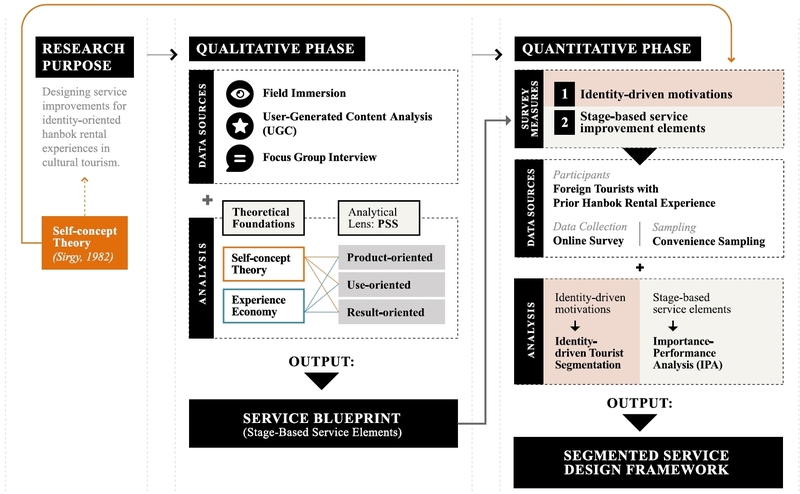
Conceptual and Methodological Framework of the Study
3. 2. Phase 1: Qualitative Service Journey Analysis
Phase 1 used researcher immersion, focus group interviews, and Naver Map user-generated reviews to examine foreign tourists’ hanbok rental experiences. Fieldnotes, interview materials, and translated reviews were read repeatedly to achieve familiarity with the data. Initial open coding was conducted to identify recurring issues, pain points, experiential highlights, and emotional responses across the hanbok rental process. Codes were then compared across data sources and grouped according to similar meanings and journey-stage relevance. Repeated patterns appearing across multiple sources were treated as more salient qualitative findings, as their recurrence indicated aspects of the service journey that were consistently experienced or emphasized by tourists. These themes were subsequently organized into sequential journey stages and interpreted through self-concept theory, experience economy dimensions, and product–service system (PSS) principles to examine identity expression, experiential value, and service configurations across stages. Based on iterative comparison across themes and stages, a service blueprint was developed to visualize key interactions and touchpoints, from which nine stage-based service improvement elements were synthesized and translated into IPA evaluation items for Phase 2.
3. 3. Phase 2: Quantitative Evaluation Using IPA
Based on the nine service improvement elements derived from the qualitative service journey analysis in Phase 1, Phase 2 evaluated these elements through a survey of foreign tourists with prior hanbok rental experience. A total of 135 responses were collected, of which 131 were valid. The questionnaire measured identity-oriented motivations across four dimensions (actual self, ideal self, social self, and ideal social self), each using two items on a five-point Likert scale, with composite scores calculated by averaging item pairs. The identity dimensions showed acceptable internal consistency based on correlations between paired items. Respondents also rated the importance and performance of the nine stage-based service elements using a five-point Likert scale.
Importance–performance analysis (IPA) was applied to compare perceived importance and performance and identify high-importance, low-performance priorities for service improvement (Martilla & James, 1977; Wu et al., 2023). Mean scores were plotted on a two-dimensional matrix to highlight these strategic areas.
4. Qualitative Service Journey Analysis
4. 1. Service Blueprint of the Hanbok Rental Experience
A service blueprint was developed based on the qualitative findings to visualize the hanbok rental journey, organizing the service into nine sequential stages from pre-booking to post-experience reflection. To support interpretation, three analytical dimensions are applied across all stages: identity connection (primary and secondary self-concept motivations), experiential value (experience economy realms classified as dominant, significant, or minor, corresponding to the strongest, secondary but still meaningful, and supporting experiential patterns, respectively), and PSS orientation (product-, use-, and result-oriented value from strongly to weakly represented).
Figure 2 presents the blueprint, illustrating how these dimensions interact across the journey and providing a basis for identifying stage-specific service improvement opportunities.
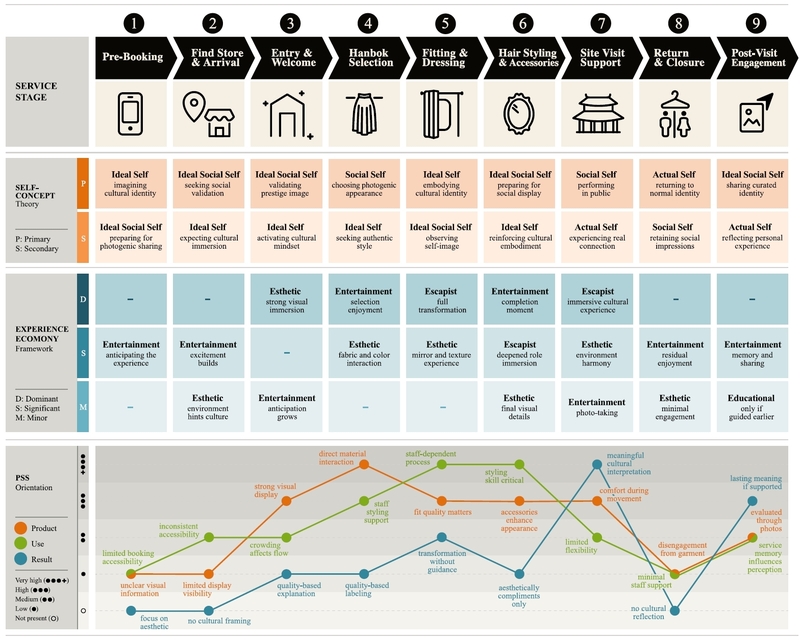
Service Blueprint of the Hanbok Rental Experience
4. 2. Stage-Based Service Journey Analysis and Improvement Elements
The service blueprint reveals distinct patterns across the hanbok rental journey, highlighting how identity-related motivations and experiential values evolve across the hanbok rental journey:
- • Stage 1 – Pre-Booking: Motivated by ideal self and ideal social self, this stage reflects a significant entertainment experience driven by anticipation and imagination. However, limited product visibility and pre-experience guidance constrain tourists’ ability to clearly visualize the upcoming experience.
- • Stage 2 – Find Store & Arrival: Driven by ideal social self, this stage maintains a significant entertainment experience as anticipation continues through observation and expectation. Yet unclear accessibility and insufficient wayfinding, especially for international visitors, disrupt early engagement.
- • Stage 3 – Entry & Welcome: Motivated by ideal social self, this stage reflects a dominant esthetic experience supported by strong product-oriented display. Crowding and inconsistent organization, however, undermine comfort and clarity, indicating weak use-oriented support at a critical first in-store touchpoint.
- • Stage 4 – Hanbok Selection: Guided by social self, this stage represents a dominant entertainment experience supported by product- and use-oriented service. The lack of cultural framing leads tourists to focus on visual appeal over cultural meaning.
- • Stage 5 – Fitting & Dressing: Driven by ideal self, this stage reflects a dominant escapist experience as tourists embody cultural identity. Limited result-oriented guidance reduces deeper engagement with posture and cultural etiquette.
- • Stage 6 – Hair Styling & Accessories: Motivated by ideal social self, this stage corresponds to a dominant entertainment experience completing aesthetic preparation. However, limited result-oriented explanation reduces understanding of the cultural meaning behind hairstyles and accessories.
- • Stage 7 – Site Visit Support: Shaped by social self and actual self, this stage reflects a dominant escapist experience supported by product- and result-oriented service. Restricted rental duration and limited flexibility constrain engagement across sites.
- • Stage 8 – Return & Closure: As motivation shifts to actual self, experiential intensity declines to a minor level, with residual enjoyment from earlier stages. Low service support and the absence of a clear closure ritual weaken the emotional ending of the experience.
- • Stage 9 – Post-Visit Engagement: Driven by ideal social self, this stage sustains a significant entertainment experience through reflection and sharing. Limited post-visit interaction reduces opportunities to reinforce cultural meaning and sustain the relationship.
Based on these patterns, nine stage-based service improvement elements were defined to address gaps between experiential expectations and current delivery (Table 1), which are subsequently evaluated using importance–performance analysis (IPA).

Stage-Based Service Improvement Elements for IPA Evaluation
5. Importance–Performance Analysis of Hanbok Rental Service Stages
5. 1. Respondent Characteristics
A total of 135 responses were collected, of which 131 valid responses were retained after excluding ineligible participants. Table 2 presents the demographic characteristics of the respondents.
Demographic Characteristics of Respondents(N = 131)
The sample primarily consisted of recent hanbok rental participants (62.6% within the past year). Respondents represented diverse international backgrounds, with the majority from Asia (66.4%), followed by the Americas (15.3%), Europe (12.2%), and other regions (6.1%). Most were aged 25–34 (63.4%), indicating a predominance of young adult tourists. Overall, these characteristics provide an appropriate basis for analyzing identity-oriented motivations and service experience evaluations.
5. 2. Identity–Oriented Tourist Segmentation
Identity-oriented motivations were examined across four self-concept dimensions (actual self, ideal self, social self, and ideal social self), each measured using two items on a five-point Likert scale. Paired items showed moderate positive correlations (r = 0.56–0.64), indicating acceptable internal consistency for an exploratory brief measure. However, because each construct was measured using only two items, the scale should be interpreted as an exploratory measure rather than a comprehensive psychometric instrument. As shown in Table 3, actual self had the highest mean score, followed by ideal self, while social self and ideal social self were comparatively lower.
Mean Scores of Identity Motivations
Respondents were classified according to the self-concept dimension(s) with the highest score. When two or more dimensions shared the same highest score, respondents were categorized as having a mixed identity profile. A substantial proportion of respondents (n = 53) exhibited mixed identity orientations, suggesting that multiple identity motivations may operate simultaneously during the hanbok rental experience (Table 4).
Identity Type Distribution
Rather than excluding these respondents, all tied dimensions were incorporated through an activation-based approach in which multiple identities could be simultaneously counted as active (Table 5).
Identity Motivation Activation
Results showed that actual self (74.8%) and ideal self (42.7%) were the most frequently activated dimensions, whereas social self and ideal social self appeared less prominent. Given their substantially higher activation frequencies and their relevance to self-congruity theory as dimensions reflecting current and desired self-perceptions in relation to symbolic service image (Sirgy, 1982), subsequent IPA analyses focused on actual self and ideal self to identify stage-based service improvement priorities across the hanbok rental journey.
5. 3. Importance-Performance Analysis Results
The IPA matrix plots importance on the vertical axis and performance on the horizontal axis, using grand mean values as crosshairs to identify strategic priorities across four quadrants. Elements in the “priority for improvement” quadrant represent high importance but relatively low performance, while other quadrants reflect areas of maintain, low priority, or possible overinvestment.
Separate IPA matrices were generated for tourists with activated actual self motivations (n = 98) and ideal self motivations (n = 56), enabling subgroup comparison.
The grand mean values used as crosshairs are 4.26 for importance and 3.67 for performance. Table 6 presents the importance, performance, and gap scores for each stage, with results visualized in Figure 3.
Importance-Performance Scores for Actual Self Tourists
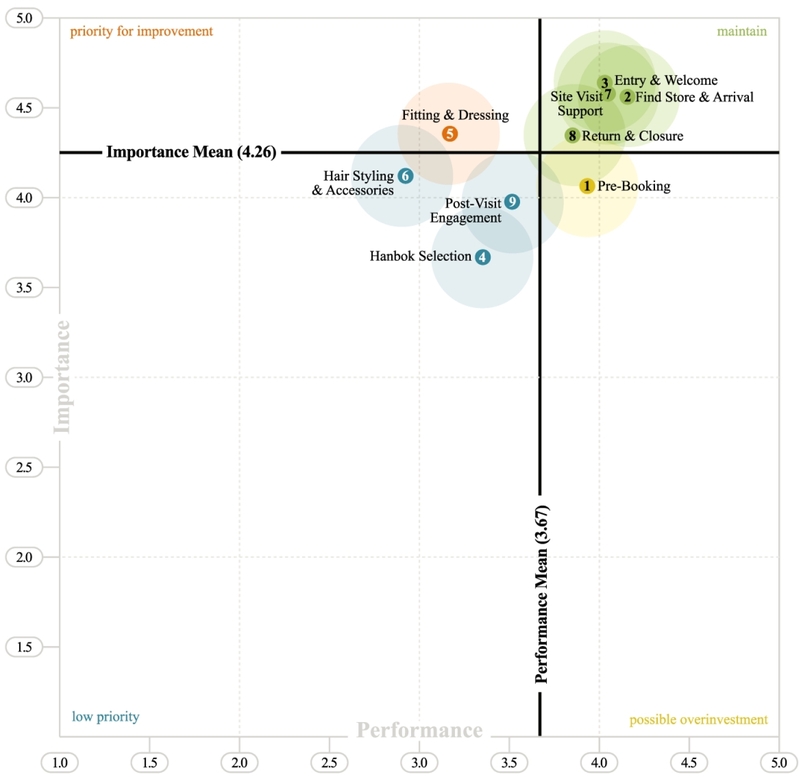
IPA Results for Actual Self Tourists
For actual-self–oriented tourists, Entry & Welcome (4.64), Site Visit Support (4.57), and Find Store & Arrival (4.53) show the highest importance, with Fitting & Dressing and Return & Closure also above the overall mean. Gap analysis indicates the largest performance shortfalls in Hair Styling & Accessories (1.19) and Fitting & Dressing (1.17), followed by Entry & Welcome (0.63), suggesting that transformation-related and initial reception stages require stronger support despite their differing priority levels in the IPA quadrants.
The grand mean values used as crosshairs are 4.30 for importance and 3.80 for performance. Table 7 presents the importance, performance, and gap scores for each stage, with results visualized in Figure 4.
Importance-Performance Scores for Ideal Self Tourists
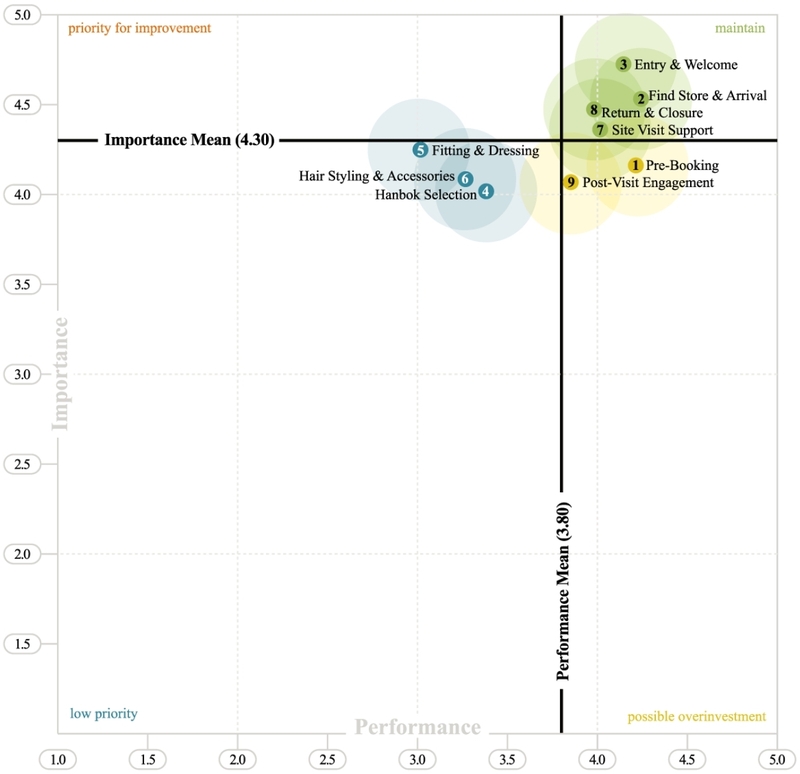
IPA Results for Ideal Self Tourists
For ideal-self–oriented tourists, Entry & Welcome (4.71), Find Store & Arrival (4.54), and Return & Closure (4.48) show the highest importance, with Site Visit Support also above the overall mean. Gap analysis indicates the largest performance shortfalls in Fitting & Dressing (1.20), followed by Hair Styling & Accessories (0.80) and Hanbok Selection (0.68), suggesting that transformation and selection stages require stronger support.
6. Discussion
6. 1. Identity-Oriented Cultural Tourism Experiences in Hanbok Rental
From a theoretical perspective, the findings support self-concept theory, which suggests that consumption behavior is shaped by the relationship between products and multiple dimensions of the self (Sirgy, 1982). In this study, hanbok rental experiences are primarily driven by internal identity motivations, particularly actual self and ideal self, while social self and ideal social self are comparatively less prominent. This suggests that tourists participate not mainly for external validation, but to experience a personal connection with cultural identity and to explore an aspirational version of themselves. This contrasts with prior studies emphasizing socially oriented motivations such as conformity, memory sharing, and “Instagrammable” display (Lee & Lee, 2019; Shim, J, 2017).
Identity motivations are also closely linked to how the experience is structured across service stages. Entry & Welcome is consistently rated as highly important, while the largest performance gaps appear in Fitting & Dressing and Hair Styling & Accessories across both identity groups. These transformation stages involve direct physical interaction and intensive service support, yet remain below expectations. This indicates that experiential value in hanbok rental is strongly tied to embodied participation, aligning with embodied perspectives on tourism and research highlighting the importance of personalized and contextual service (Edensor, 2001; Yoanto & Lee, 2025).
Within this framework, identity-based segmentation offers a more meaningful lens than demographic or behavioral approaches. Actual-self–oriented tourists tend to prioritize authentic engagement and meaningful interaction, whereas ideal-self–oriented tourists focus on transformation, aesthetic enhancement, and aspirational identity expression.
6. 2. Service Design Implications for Traditional Attire Rental Services
Building on identity-oriented findings and stage-based IPA results, this section outlines differentiated service design strategies for actual-self–oriented and ideal-self–oriented tourists. Rather than proposing a single generic approach, the strategies focus on key priority stages identified through gap analysis, translating critical service deficiencies into targeted design interventions that reflect each group’s experiential priorities.
For actual-self–oriented tourists, the hanbok rental journey appears to function as a process of confirming and externally expressing an already held self-image, which is consistent with self-congruity theory’s emphasis on matching consumption experiences with the actual self. In this orientation, Entry & Welcome, Site Visit Support, and Find Store & Arrival are relatively important, while the largest performance gaps appear in Fitting & Dressing, Hair Styling & Accessories, and Entry & Welcome. These stages become particularly meaningful because they represent points at which self-image is translated into visible and embodied cultural performance, making them central to identity expression rather than merely functional service delivery.
- • Fitting & Dressing functions not only as a technical preparation stage but also as a point where tourists begin physically enacting cultural participation from an identity-expression perspective. To strengthen this experience, a brief staff-led cultural orientation integrated into the dressing process (approximately 5–10 minutes), including posture, bowing, movement, and basic etiquette guidance, may transform the stage from clothing preparation into a more meaningful moment of embodied participation.
- • Hair Styling & Accessories appears closely linked to cultural understanding and identity expression. To extend engagement during this stage, short explanations may be expanded through QR-based interactive content that allows tourists to browse accessory collections and explore the meanings behind specific hairstyles or ornaments while waiting. This approach may encourage curiosity and integrate cultural learning naturally into the service process.
- • Entry & Welcome establishes the interpretive frame of the overall experience and shapes early participation expectations. Introducing a structured queue guidance system together with a brief welcome interaction may reduce confusion while creating an opportunity to identify tourists’ experiential preferences. Lightweight questions regarding interest in cultural learning, photography, or styling experiences may help staff understand visitor priorities and adapt subsequent service interactions accordingly. A brief welcome script explaining the cultural context of hanbok wearing may further frame the experience as participation in tradition rather than a purely transactional rental process.
For ideal-self–oriented tourists, the journey appears to function as aspirational self-presentation: the service does not simply reflect the self but supports construction of a more desired version of it. This aligns with Sirgy’s distinction between actual and ideal self-congruity, where the former reflects congruence with the current self and the latter reflects congruence with the desired self. Entry & Welcome, Find Store & Arrival, and Return & Closure are highly important, followed by Site Visit Support and Fitting & Dressing, while the largest performance gaps appear in Fitting & Dressing, Hair Styling & Accessories, and Hanbok Selection. These stages become critical because ideal-self expression is most strongly activated when tourists can see, adjust, and refine their appearance throughout the transformation process.
- • Fitting & Dressing functions as a transition point where tourists begin aligning appearance with desired self-images. Brief styling consultation supported by preference cards (e.g., elegant, youthful, royal, traditional) may help staff facilitate appearance preferences aligned with tourists’ preferred self-image. In line with the original stage-based improvement element, light contextual cues may be incorporated to provide cultural reference while maintaining the primary emphasis on transformation and desired self-presentation.
- • Hair Styling & Accessories functions as a stage where transformation becomes visually complete. Rather than providing standardized styling, staff may recommend themed accessory combinations aligned with selected hanbok styles. This approach may strengthen visual coherence while preserving optional cultural references that support a satisfying transformation experience.
- • Entry & Welcome was prioritized over Hanbok Selection because it combines the highest importance score with a substantial performance shortfall, suggesting that early-stage interactions may disproportionately shape expectations for transformation-oriented experiences. Once tourists’ experiential priorities are recognized, visual presentation through organized displays, mirrors, and spatial arrangement may be adjusted to reinforce expectations prior to the experience and enhance aesthetic immersion. This aligns with the esthetic dominance identified in the service blueprint and supports the beginning of a transformation-oriented experience.
Fitting & Dressing, Hair Styling & Accessories, and Entry & Welcome emerge as shared priority stages across identity orientations, but their experiential meanings differ according to identity goals: actual-self experiences emphasize cultural congruence and grounded participation, whereas ideal-self experiences emphasize aspirational transformation and visual self-enhancement. This extends prior cultural tourism research by suggesting that the same service stages may support different identity outcomes depending on which self-concept becomes most salient. Practically, the implication is not to standardize a single “best” experience but to adapt staff scripts, spatial cues, and styling options according to tourists’ identity orientation.
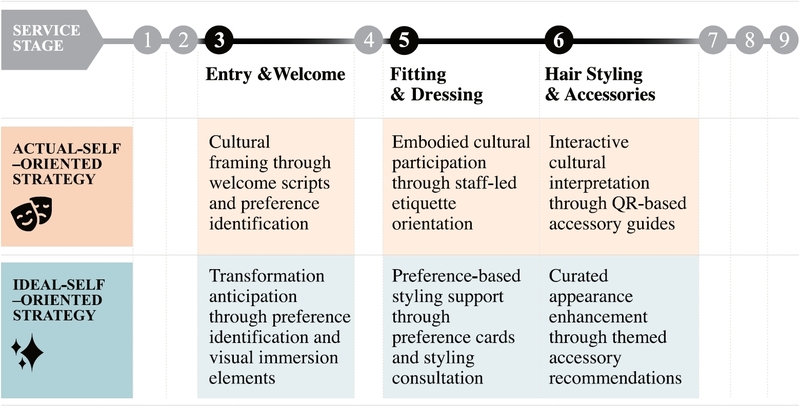
Identity-Oriented Service Design Framework for Priority Service Stages Identified through IPA
7. Conclusion
This study contributes to cultural tourism and service design in three ways. First, it extends self-concept theory into traditional attire rental contexts by demonstrating that actual-self and ideal-self motivations play a central role in shaping hanbok rental experiences among foreign tourists. Second, rather than treating identity as a broad motivational trait, this study shows how identity orientation shapes what tourists perceive as important across different stages of the hanbok rental journey. The key novelty lies in integrating identity analysis with service journey analysis, offering a more service-contextualized understanding of cultural tourism experiences and informing segmented service design. Third, the study demonstrates the value of combining qualitative service journey analysis with quantitative IPA to support both interpretation and prioritization within cultural tourism research.
Several limitations of this study should be acknowledged, which offer avenues for future research. First, the qualitative phase was exploratory and limited in scope, drawing primarily on focus group interviews, field observations in selected locations, and user-generated reviews from a specific platform. While these sources provided rich insights, they may not capture the full diversity of hanbok rental practices or tourist interpretations across different cities or business types. Additional qualitative work in different settings, including longitudinal or ethnographic approaches, could broaden and deepen understanding of identity-oriented experiences.
Second, the IPA-based analysis primarily emphasizes major improvement priorities and may overlook broader contextual influences that shape tourist experiences. Future studies could integrate IPA with structural models of satisfaction and loyalty, or with experimental approaches, to examine how specific design changes influence experience outcomes.
Third, although the study considered all four self-concept dimensions, the analysis emphasized actual self and ideal self because they emerged as the most prominent dimensions in this sample. Social self and ideal social self may play stronger roles in other contexts, such as among domestic tourists, different age groups, or visitors whose primary motivation is social media sharing. Further research is needed to explore these identity dimensions in greater depth, including how they interact with cultural background, group composition, and digital platforms.
Fourth, while this study proposes a segmented service design framework, it does not empirically evaluate the effects of implementing these strategies in practice. Future work could involve prototyping and piloting specific interventions, such as revised reception procedures, structured transformation-related interventions, or enhanced cultural explanations, and assessing their impacts through experimental, quasi-experimental, or longitudinal designs.
Finally, the findings are contextually bounded to hanbok rental among foreign tourists in Korea, which may limit the direct transferability of these findings to other cultural settings.
Future research could apply and adapt the identity-based, stage-based framework to other traditional attire rental services or culturally symbolic experiences, such as kimono, kebaya, or indigenous clothing rental, to test its applicability and refine the segmented service design principles.
The proposed framework should therefore be understood as a set of feasible, touchpoint-level service improvements rather than a broader organizational redesign. The practical implications are intended as adaptable service cues within existing hanbok rental contexts, not as fixed implementation prescriptions.
Acknowledgments
This work was supported by the Ministry of Education of the Republic of Korea and the National Research Foundation of Korea (NRF-2024S1A5A2A01023564).
Notes
Copyright : This is an Open Access article distributed under the terms of the Creative Commons Attribution Non-Commercial License (http://creativecommons.org/licenses/by-nc/3.0/), which permits unrestricted educational and non-commercial use, provided the original work is properly cited.
References
-
Adam, H., & Galinsky, A. D. (2012). Enclothed cognition. Journal of Experimental Social Psychology, 48(4), 918-925.
[https://doi.org/10.1016/j.jesp.2012.02.008]

-
Arnaboldi, M., & Diaz Lema, M. L. (2022). Shaping cultural participation through social media. Financial Accountability & Management, 38(2), 299-321.
[https://doi.org/10.1111/faam.12293]
- Barnard, M. (2002). Fashion as Communication. Psychology Press.
-
Edensor, T. (2001). Performing tourism, staging tourism: (Re)producing tourist space and practice. Tourist Studies, 1(1), 59-81.
[https://doi.org/10.1177/146879760100100104]
-
Holbrook, M. B., & Hirschman, E. C. (1982). The Experiential Aspects of Consumption: Consumer Fantasies, Feelings, and Fun. Journal of Consumer Research, 9(2), 132-140.
[https://doi.org/10.1086/208906]
-
Lee, K.-Y., & Lee, H. (2019). Traditional costume experience at a cultural heritage festival. Tourism Management Perspectives, 32, 100555.
[https://doi.org/10.1016/j.tmp.2019.100555]
-
Lewis, C., Kerr, G., & Pomering, A. (2010). Self-identity and social norms in destination choice by young Australian travellers. Tourist Studies, 10(3), 265-283.
[https://doi.org/10.1177/1468797611407753]
-
Martilla, J. A., & James, J. C. (1977). Importance-Performance Analysis. Journal of Marketing, 41(1), 77-79.
[https://doi.org/10.1177/002224297704100112]
-
Nyaupane, G. P., White, D. D., & Budruk, M. (2006). Motive-Based Tourist Market Segmentation: An Application to Native American Cultural Heritage Sites in Arizona, USA. Journal of Heritage Tourism, 1(2) 81-99.
[https://doi.org/10.2167/jht010.0]
- Pine, J., & Gilmore, J. H. (1998). Welcome to the experience economy. Harvard Business Review, 76(4), 97-105.
-
Poulsson, S. H. G., & Kale, S. H. (2004). The Experience Economy and Commercial Experiences. The Marketing Review, 4(3), 267-277.
[https://doi.org/10.1362/1469347042223445]
-
Prahalad, C. K., & Ramaswamy, V. (2004). The Future of Competition: Co-Creating Unique Value With Customers. Harvard Business Press.
[https://doi.org/10.1108/10878570410699249]
-
Shim, J. (2017). A study on the rental Hanbok-Focusing on the market and consumer changes between 2006 and 2016 -. The Research Journal of the Costume Culture, 25(3), 405-418.
[https://doi.org/10.29049/rjcc.2017.25.3.405]
-
Sirgy, M. J. (1982). Self-Concept in Consumer Behavior: A Critical Review. Journal of Consumer Research, 9(3), 287.
[https://doi.org/10.1086/208924]
-
Tukker, A. (2004). Eight types of product-service system: Eight ways to sustainability? Experiences from SusProNet. Business Strategy and the Environment, 13(4), 246-260.
[https://doi.org/10.1002/bse.414]
-
Wu, C.-H., Kuo, P.-L., Yang, C.-H., Chang, Y.-C., & Chen, T.-L. (2023). Importance-Performance Analysis (IPA) in Analyzing the Satisfaction of Administrative Support in Teaching Practice Research Programs. Sustainability, 15(3), 1943.
[https://doi.org/10.3390/su15031943]
-
Yoanto, F., & Lee, Y.-K. (2025). A Service Perspective on Cultural Authenticity: Case Study of Hanbok Rentals for Global Tourists. IASDR 2025: Design next.
[https://doi.org/10.21606/iasdr.2025.873]