
Directional Variation in Brand Image Positioning Across Message Strategies: An Adjective-Based Analysis of Social Media Branded Video
Abstract
Background Branded video has become a central medium of brand communication in social media environments. Prior research on social media-based branded video posts has primarily examined message strategies in terms of persuasive effectiveness and evaluative outcomes, focusing on their influence on consumer responses such as attitudes and engagement. However, limited attention has been given to how message orientation is associated with variation in brand image positioning across shared adjective-based dimensions. This study examines whether informational versus transformational message orientation is associated with directional differences in brand image positioning and whether interactional cues act as secondary modifiers.
Methods A mixed-methods design combined expert-based content analysis and a consumer survey. Instagram branded video posts from eight global brands were coded for informational versus transformational orientation and for interactional presence using a structured expert consensus procedure. Brand image perceptions were measured among Millennial and Gen Z consumers using 13 bipolar adjective axes. Aggregate-level analyses employed a repeated-measures general linear model, and brand-level analyses employed linear mixed-effects models to estimate condition-specific positioning patterns across adjective axes.
Results Significant Orientation × Adjective interaction patterns were observed, indicating variation in brand image positioning across the adjective-based dimensions. Informational orientations were more frequently associated with shifts toward attribute-oriented descriptors, whereas transformational orientations were associated with shifts toward experiential and symbolic descriptors. Interactional cues accounted for comparatively smaller variance and did not substantially alter the orientation-based contrast.
Conclusions This study shows that message orientation is associated with directional variation in brand image positioning across shared adjective-based dimensions. Rather than suggesting causal effects or structural changes in brand meaning, the findings indicate that message strategies are associated with subtle differences in which aspects of brand image are emphasized. Informational and transformational orientations correspond to distinct patterns of mean positioning across these dimensions in social media branded video communication. These findings suggest that message orientation can serve as a useful consideration in communication design, particularly when designers seek to emphasize selected aspects of brand image within social media branded video.
Keywords:
Adjective-Based Brand Image Measurement, Brand Image, Branded Video Communication, Message Strategy, Social Media1. Introduction
In social media environments, brand communication extends beyond the transmission of product information or promotional messages. Branded video posts integrate visual composition, message structure, and narrative sequencing that shape how users perceive brand image (Kapferer, 2008; Keller, 1993; Geise & Baden, 2015; Ge et al., 2021). Traditional brand communication research has primarily examined how message types or visual elements are associated with brand awareness, attitudes, and behavioral intentions (Laskey et al., 1989; Voorveld et al., 2018). Although such studies have demonstrated variation in outcome magnitude, they provide limited insight into how brand image varies across shared bipolar adjective axes. Design-oriented research has also investigated brand responses to different video formats and communication strategies, often emphasizing evaluative outcomes (Yang & Kim, 2024; Hwang & Lee, 2025). Brand image has been conceptualized as a set of associations that can be described along dimensions (Aaker, 1997), a perspective aligned with the semantic differential tradition using bipolar adjective scales (Osgood et al., 1957). Within this tradition, adjective-based measures provide a descriptive framework for comparing relative positions of brand image across dimensions, rather than modeling latent structural relationships among them. Adjective-based approaches have been used to capture variation in positioning associated with communication stimuli (Yang et al., 2025). However, prior research has rarely examined how message strategy is associated with observable variation in mean positioning across shared adjective axes. Rather than focusing solely on changes in response intensity, this study examines how message orientation is associated with directional variation in brand image positioning across adjective-based dimensions.
To address this gap, this study examines message strategy as a conceptual distinction between informational and transformational orientations widely discussed in advertising and message strategy research, with interactional elements incorporated as contextual modifiers. The study does not seek to model an underlying semantic structure; instead, it examines whether different message orientations correspond to different patterns of mean positioning across shared adjective axes. Rather than focusing on evaluative outcomes, the analysis examines these positioning patterns using Instagram branded video posts. Condition × Adjective interaction patterns are used to describe how brand image is positioned across the same adjective dimensions under different message conditions. This operationalization is not intended to indicate structural relationships among dimensions or a transformation of underlying associative networks, but instead captures observable variation in relative positioning. This perspective highlights that brand communication involves not only evaluative responses but also the positioning of brand meaning across shared descriptive dimensions.
The observed differences are interpreted as shifts in the relative emphasis of brand meaning across shared descriptive dimensions. Importantly, the analysis focuses on observable positioning patterns rather than generalizable structural relationships. From a communication design perspective, message strategy can be understood as a design consideration that foregrounds selected aspects of brand meaning within a shared descriptive framework. Accordingly, this study examines how informational and transformational message orientations are associated with variation in mean positioning across shared adjective-based dimensions, and how interactional message elements contribute to these variations in relation to message orientation.
2. Theoretical Background
2. 1. Brand Image as Multidimensional Associations
Brand image is better understood not as the result of a single evaluation or attitude, but as a set of associations formed through consumers’ repeated encounters with a brand (Park et al., 1986; Keller, 1993). Rather than a unidimensional construct, brand image reflects multiple layers of associations stored in consumers’ memory (Keller, 1993). In this view, brand image extends beyond recognition to encompass how a brand is perceived in terms of its character and associations. These associations are often discussed in terms of functional, emotional, and symbolic meanings, corresponding to different aspects of consumer interpretation (Park et al., 1986). Within this framework, brand image emerges through associations formed in memory, where brands are differentiated by the strength, favorability, and uniqueness of their associations (Keller, 1993). Importantly, such associations are not static; they are continuously shaped and reinforced through brand communication. In this sense, brands can function as carriers of cultural associations, with communication processes enabling the transfer of symbolic and social values to consumers (McCracken, 1986).
This perspective has been extended to digital environments, where brand-generated communication signals contribute to the formation and expression of diverse association categories (Veloutsou & Ballester, 2025). Similarly, research based on online communities and digital data has examined how brand-related associations are expressed across multiple association categories (Divakaran & Xiong, 2022).
Taken together, brand image can be understood as comprising multiple associations shaped through brand communication. In visually dominated communication environments, these associations may be expressed in different ways across communication contexts, including variations in message orientation and delivery. This perspective provides a conceptual basis for examining variation in brand image positioning across shared descriptive dimensions, while keeping the focus on association-based interpretation rather than causal explanation.
2. 2. Message Strategy as a Meaning-Forming Frame
In brand communication, message strategy has been discussed as a way of distinguishing how brand-related associations are communicated (Puto & Wells, 1984; Taylor, 1999). In branded video communication, message strategies combine attribute-based and experiential-symbolic cues, which may be reflected in variation in how brand image is positioned across associations. The narrative structure of video facilitates engagement with brand content (Escalas, 2004), while repeated exposure to social media posts provides cumulative cues through which users form brand associations (Ashley & Tuten, 2015). Traditional advertising research conceptualizes message strategy through a distinction between informational and transformational orientations. Informational strategies emphasize objective and functional aspects of products or services, whereas transformational strategies relate brand usage to emotional and psychological experiences (Puto & Wells, 1984). Informational messages communicate brand utility through factual information and logical reasoning, while transformational messages emphasize symbolic and experiential aspects such as brand image, user identity, and usage situations (Laskey et al., 1989). The informational–transformational distinction has also been linked to broader consumer behavior perspectives, in which functional, transmission-oriented communication is contrasted with ritual-oriented communication emphasizing emotional fulfillment, social approval, and sensory experience (Taylor, 1999). Informational and transformational strategies therefore reflect different orientations in how brand-related associations are communicated, rather than differences in the amount of information provided.
In social media branded video communication, these orientations are expressed through different types of cues. Informational strategies emphasize functional product attributes and objective information, whereas transformational strategies highlight usage experiences, emotional value, and brand atmosphere. Interactional strategies, in turn, incorporate participatory elements such as questions and comment prompts to facilitate engagement (Tafesse & Wien, 2017).
Although prior research has discussed these distinctions in relation to different response tendencies, this study does not examine these mechanisms directly. Instead, the focus is on whether message orientation corresponds to observable positioning patterns across adjective-based dimensions. From this perspective, message orientation is examined as a basis for comparing brand image positioning across shared adjective axes, rather than as a predictor of overall evaluative outcomes.
2. 3. Adjective-Based Measurement of Brand Image
Brand image refers to consumers’ perceptions of a brand and is inherently abstract (Nandan, 2005). In contrast to brand identity, which denotes the intended meaning articulated by the brand, brand image is constructed through consumers’ perceptions formed in communication processes (Kapferer, 2008). Accordingly, capturing brand image requires measurement approaches that address its abstract and descriptive nature. Such approaches are aligned with the semantic differential tradition, which represents meaning using bipolar adjective scales (Osgood et al., 1957). Prior research has therefore employed adjective-based scales to capture perceived brand characteristics. Adjectives are commonly used to describe perceived characteristics associated with brands, as reflected in trait-based approaches to brand personality measurement (Aaker, 1997). They also allow subjective responses to be compared consistently across multiple dimensions. Numerous studies have therefore measured brand image using adjective axes or adjective lists to analyze variation in perceived brand image (Gwinner & Eaton, 1999; Cretu & Brodie, 2007; Shim & Lee, 2017).
To examine brand image without restricting analysis to specific product categories, this study adopts an adjective-based measurement framework. Adjective axes commonly employed in brand image and advertising communication research were identified through a review of prior empirical studies (Gwinner & Eaton, 1999; Cretu & Brodie, 2007; Rageh Ismail & Spinelli, 2012; Shim & Lee, 2017). Axes with high conceptual redundancy or strong contextual dependency were excluded through an initial screening to ensure cross-category applicability. Based on this review, an initial pool of 53 adjectives used in prior empirical brand image studies was compiled. One negatively valenced descriptor, ‘‘Dangerous,’’ was excluded, and the remaining adjectives were provisionally arranged into bipolar adjective pairs. The preliminary pairings were subsequently refined through a two-stage expert validation process, in which an external expert in lexical semantics assessed the semantic opposition of the adjective pairs and suggested additional semantically opposing terms to complete the final set of bipolar adjective axes. This procedure was intended to improve contrast between paired terms, rather than to establish strict antonymic equivalence. The selection was informed by prior theoretical discussions on the multidimensional nature of brand associations, including functional, emotional, and symbolic aspects (Keller, 1993; Kapferer, 2008). However, these discussions were used only as conceptual guidance and were not treated as fixed dimensional structures in the present analysis. Through this procedure, the 13 bipolar adjective axes were established for directional comparison, as shown in Table 1.

Final Set of Bipolar Adjective Axes
In this approach, bipolar adjective pairs are used as descriptive reference points for comparison rather than as indicators of a single latent construct. Each adjective pair is therefore treated as an independent reference for examining relative positioning across conditions. The analysis does not assume a common underlying factor structure or attempt dimensional reduction. Instead, the focus is on mean positioning across shared adjective axes. Accordingly, the purpose of this measurement approach is to support descriptive comparison of positioning across conditions, rather than to establish a validated psychometric scale.
2. 4. Brand Communication on Instagram
In social media environments, brand communication extends beyond message exposure or information delivery to encompass how brand image is perceived through visual composition and narrative structure (Geise & Baden, 2015; Ge et al., 2021). Instagram represents a visually oriented platform in which brands present visual expression and narrative structures primarily through images and videos, thereby providing an appropriate context for examining branded video communication. Prior research indicates that visually oriented social media content plays a role in attracting attention and is associated with how users process brand-related content (Bruns et al., 2025). These characteristics suggest that Instagram constitutes a suitable communicative environment for examining the relationship between message strategy and brand image positioning.
Brand communication on Instagram is primarily centered on content posted by brand accounts, through which users engage with brand messages by viewing, liking, and commenting. In particular, branded video posts simultaneously deliver visual stimuli and brand messages within limited time frames, conveying functional information as well as emotional and symbolic associations (Ge et al., 2021). Compared to static images, videos incorporate temporal progression and narrative structure, making them well suited to presenting brand-related content sequentially and potentially eliciting affective responses (Geise & Baden, 2015). Interactional elements such as comment prompts, questions, and participation requests reflect the communicative affordances of social media environments (Tafesse & Wien, 2017). In this study, such elements are positioned as contextual modifiers rather than as primary determinants of variation in brand image positioning.
Instagram is widely used as a platform for visual brand communication. Recent industry reports indicate that communication on the platform is increasingly organized around video-led narratives (We Are Social & Meltwater, 2024). Moreover, its primary user groups—Millennials and Generation Z—actively engage with brand content through visual and video-based formats (Voorveld et al., 2018; Leaver et al., 2020). These characteristics support the use of Instagram branded video posts as an empirical context for examining how message strategies are associated with variation in brand image positioning across adjective axes.
The following section describes the research design used to examine these relationships across message conditions.
3. Research Method
This study employed a mixed-methods design combining content analysis and a user survey to examine how message strategies are associated with directional variation in brand image positioning in social media–based branded video communication. The research procedure was structured into four sequential stages: (1) collection of branded video posts, (2) classification of message strategy through content analysis, (3) adjective-based measurement of brand image via a consumer survey, and (4) two-stage statistical modeling.
The statistical analysis stage consisted of two complementary components. First, an aggregate-level repeated-measures general linear model (GLM) was conducted to examine whether message orientation and interactional presence were associated with positioning differences across the 13 adjective axes. In this study, message orientation refers to the informational versus transformational distinction, and interactional presence indicates the presence or absence of interactional elements. In brand-level models, the four Orientation × Interactional cells are parameterized as a single four-level factor (Condition). Second, brand-level analyses were performed using linear mixed-effects models (LMEM) to estimate condition-specific mean positioning across adjective axes while accounting for within-participant dependency. The overall research design and analytical procedure are summarized in Figure 1.
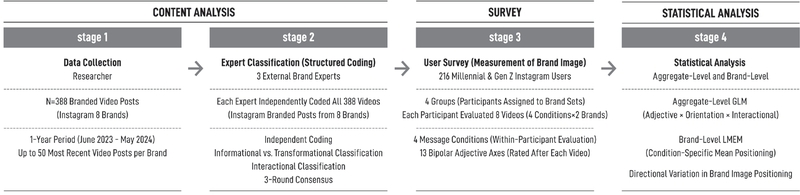
Overview of the Research Design and Analytical Framework
3. 1. Data Selection and Research Design
The empirical materials analyzed in this study were branded video posts on Instagram. Instagram is a visually oriented social media platform widely used for brand communication, where branded content integrates message orientation and visual presentation (Tafesse & Wien, 2017).
Case brand selection was guided by global brand value rankings. This study draws on the Best Global Brands 2023 (Interbrand, 2023), which evaluates brand equity in terms of financial performance and brand strength. The Interbrand Best Global Brands ranking provides a widely recognized list of globally valued brands and has been used in prior research as a basis for selecting brand samples (e.g., Madden et al., 2006; Johansson et al., 2012). From the top 15 brands in the index, eight were selected based on Instagram activity, operationalized in terms of follower size and posting frequency as observable indicators of account activity and content presence. Prior research has examined social media metrics such as posting behavior and engagement-related indicators as observable characteristics of brand activity and content presence (De Vries et al., 2012; Tafesse & Wien, 2017). These criteria were intended to ensure the inclusion of brands with active official Instagram accounts and sufficient video content for cross-brand comparison. Only official global brand accounts were included. Amazon, ranked third in the index, was excluded because its Instagram content primarily promotes individual product offerings rather than corporate-level brand communication, whereas this study focuses on brand-level communication. Table 2 summarizes the selected brands and their Instagram activity.
Overview of Selected Global Brands and Instagram Video Posts
Following prior social media content analyses (Liu et al., 2017; Kim et al., 2021), branded video posts published within the most recent one-year period (June 1, 2023–May 31, 2024) were collected. The unit of analysis was individual branded video posts published on each brand’s official Instagram account. To maintain cross-brand comparability, the number of video posts per brand was capped at 50. When more than 50 posts were available during the designated period, the 50 most recent posts were selected to reflect recent communication practices while preserving comparability across brands. This decision maintained temporal consistency across brands while limiting overrepresentation of highly active accounts. When fewer than 50 video posts were available, all posts were included. Only posts containing video content were analyzed; single-image posts were excluded.
Based on these criteria, the final dataset comprised 388 branded video posts across eight global brands. This sampling approach prioritizes cross-brand comparability but is limited to recent communication outputs.
3. 2. Message Strategy Classification and Analysis
Expert Participants
The collected branded video posts were evaluated along informational and transformational message strategy dimensions and coded for interactional presence, based on established frameworks in prior research (Puto & Wells, 1984; Tafesse & Wien, 2017). Classification was conducted using expert consensus coding, which combined independent coding with subsequent consensus-building, a common approach in qualitative content analysis to enhance interpretive validity and reduce coder bias (Riffe et al., 2023). The same three experts served as coders throughout the entire classification process.
Expert participants were selected based on domain expertise in design analysis, informed by prior discussions of design expertise (Galle & Kovács, 1996; Lawson, 2005). Accordingly, experts were recruited from design professionals with formal training and practical experience in brand communication, providing a basis for distinguishing message strategy embedded in branded video posts. All participants had demonstrated professional familiarity with brand communication processes. Professional expertise was operationalized as the combined duration of relevant industry practice and research or teaching experience in design communication, as summarized in Table 3.
Brand Design Experts for Message Strategy Classification
To mitigate cognitive fatigue during the evaluation of 388 video posts, expert assessments were segmented into sessions of 25 videos (approximately 50 minutes per session), followed by a mandatory 10-minute break. Each video required approximately two minutes for viewing and evaluation. Experts evaluated no more than three brands per day. This segmented procedure was intended to reduce fatigue-related bias and maintain rating stability across the full dataset. The full evaluation was completed over multiple days following this schedule. These procedures were used to support consistency in expert judgment across the full coding process.
Evaluation Procedure
All 388 branded video posts were first rated using five-point scales to assess informational and transformational message emphasis. Informational and transformational strategies were operationalized as continuous dimensions capturing varying degrees of emphasis within each video post. Final ratings were established through a three-round consensus process among the three expert coders. In contrast, interactional message strategy was operationalized as a categorical variable, indicating the presence or absence of explicit consumer engagement prompts (e.g., requests for comments, participation cues, or calls to action).
For the survey experiment, stimulus videos were selected from the coded dataset to represent distinct message conditions within each brand. Within each brand, candidate videos were shortlisted based on relatively high informational or transformational ratings. Selection thresholds were determined relative to brand-specific rating distributions to ensure within-brand contrast rather than absolute scale values. Final stimuli were selected by pairing higher emphasis on one strategic dimension with comparatively lower emphasis on the other. This selection procedure was intended to maximize within-brand contrast in message orientation, rather than to represent population-level variability of brand communication.
Specifically, for each brand, four videos were selected to represent the four experimental conditions: (1) high informational with interactional presence, (2) high informational without interactional presence, (3) high transformational with interactional presence, and (4) high transformational without interactional presence. Thus, experimental message conditions were constructed from continuous expert ratings (informational and transformational dimensions) combined with the dichotomous interactional classification. The consumer survey used the 32 branded video stimuli selected in Stage 2 (8 brands × 4 conditions), and brand image perceptions were measured using the 13 bipolar adjective axes. In the aggregate-level analysis, the experimental structure comprised three within-subject factors: adjective axis (13 levels), message orientation (informational vs. transformational), and interactional presence (present vs. absent). This structure enabled the examination of Adjective × Orientation × Interactional interaction effects across adjective axes.
Coding and Reliability
Each of the three external experts independently coded all 388 branded video posts using the defined coding scheme. Disagreements in coding decisions (i.e., message strategy ratings and interactional presence) were resolved through a three-round reconciliation process following established content analysis procedures (Riffe et al., 2023). Prior to the main coding phase, coder training sessions and pilot coding were conducted to align interpretive standards. Inter-coder reliability was assessed using Perreault and Leigh’s Ir index, with coefficients exceeding the recommended threshold of 0.80 for both informational and transformational ratings (Perreault & Leigh, 1989). These results indicate satisfactory agreement among coders and support the consistency of the coding procedure used in subsequent analyses.
3. 3. Measurement and Analysis of Brand Image
To analyze consumer-perceived brand image, this study employed an adjective-based measurement approach. Brand image was examined at the brand level to enable cross-industry comparison rather than restrict analysis to specific product categories. Adjective-based measurement has been used in prior research to capture consumer-perceived brand meanings and is appropriate for this study (Shim & Lee, 2017). Adjective axes identified in prior brand image and advertising research were systematically reviewed and consolidated (Gwinner & Eaton, 1999; Cretu & Brodie, 2007; Rageh Ismail & Spinelli, 2012; Shim & Lee, 2017). Selected descriptors were organized into bipolar adjective axes, resulting in a final set of 13 adjective dimensions. To improve the clarity of adjective pairings, the axes underwent a two-stage expert validation process conducted by an external expert in lexical semantics with doctoral training in English literature, who assessed the semantic opposition of the adjective pairs and suggested additional semantically opposing terms. The finalized set of adjective axes is presented in Table 1.
The survey examined consumer perceptions of brand image under different message strategy conditions presented in branded video posts. Based on the finalized informational and transformational ratings derived from the three-round expert consensus procedure in Stage 2, four message conditions were constructed for each brand: informational with interactional presence, informational without interactional presence, transformational with interactional presence, and transformational without interactional presence. Thirty-two branded video stimuli (8 brands × 4 conditions) were selected to represent these conditions within each brand, and brand perceptions were measured using five-point bipolar adjective scales.
An a priori power analysis using G*Power (f =.25, α=.05, power=.80) indicated a minimum required sample size of 172 participants (Faul et al., 2007). Responses exhibiting zero variance across the 13 adjective axes or extreme straight-lining patterns were excluded during data screening. Following these exclusions, the final analytic sample comprised 216 Millennial and Gen Z Instagram users. Participants were randomly assigned to four brand-set groups to balance exposure across brands; within each assigned brand, all participants evaluated the four message strategy conditions. The online survey was administered by a professional research agency, MBrain, from July 29 to July 31, 2024. Each participant evaluated two brands and viewed four videos per brand (eight stimuli in total). The average stimulus duration was 23.75 seconds, and a minimum 15-second viewing threshold was enforced prior to evaluation. Stimulus order and brand assignment were randomized to reduce order effects. After viewing each video, participants rated the corresponding brand across the 13 adjective axes. The questionnaire required approximately 30 minutes to complete.
To examine whether message strategy conditions were associated with variation in brand image positioning across adjective axes, analyses were conducted at two levels. At the aggregate level, a repeated-measures GLM tested Adjective × Orientation × Interactional interaction effects. At the brand level, LMEMs were estimated, in which the four Orientation × Interactional cells were parameterized as a single four-level factor (Condition). Accordingly, variation in mean positioning across adjective axes was assessed through the Condition × Adjective interaction. Because Condition represents the four combinations of Orientation and Interactional presence, this omnibus interaction encompasses the Adjective × Orientation, Adjective × Interactional, and Adjective × Orientation × Interactional effects examined separately in the aggregate analysis. Random intercepts were specified for participants to account for within-participant dependency across repeated adjective evaluations. Because each condition within each brand was represented by a single stimulus video, stimulus-level random effects could not be estimated. As a result, statistical inference is restricted to the selected stimuli and does not generalize to a broader population of brand videos. However, stimuli were selected to maximize within-brand contrast in message orientation based on expert ratings, enabling the examination of variation in mean positioning within a controlled set of branded video stimuli. The analysis therefore focuses on identifying consistent directional tendencies across conditions rather than isolating stimulus-independent effects.
In this study, an adjective-based profile is defined as the set of mean positions across shared bipolar adjective axes within a brand. Rather than treating brand image as overall evaluative strength, the analysis focuses on variation in relative positioning along identical descriptive axes. To reduce potential inflation of Type I error across the thirteen adjective axes, statistical inference was based on omnibus interaction tests rather than axis-specific hypothesis testing. Axis-level comparisons are therefore reported descriptively to summarize positioning patterns.
This study received approval from the Institutional Review Board (IRB) of Yonsei University. All procedures were conducted in accordance with institutional ethical standards, and informed consent was obtained prior to participation.
4. Results
To ensure consistency in assigning the 388 branded video posts to message strategy conditions, three experts independently coded the posts using predefined criteria. Inter-coder reliability was assessed using Perreault and Leigh’s (1989) Ir index, yielding Ir =.834 for informational strategies and Ir =.828 for transformational strategies. Both values exceeded the recommended threshold (Ir >.80), indicating satisfactory agreement among coders. The coded results were used to construct message conditions for the aggregate and brand-level analyses. At the brand level, the four experimental conditions (informational/transformational × interactional presence/absence) were modeled as a single fixed factor (Condition).
4. 1. Aggregate-Level Interaction Effects of Message Strategy
Aggregate-level interaction effects were examined using a repeated-measures general linear model (GLM). Adjective (13 bipolar axes) was treated as a within-subject factor, while message orientation (informational vs. transformational) and interactional presence (with vs. without) were treated as within-subject factors. Greenhouse–Geisser corrections were applied where the assumption of sphericity was violated.
The Adjective × Orientation interaction was significant, F (9.323, 16073.047)=14.575, p<.001, ηp²=.008, indicating variation across adjective axes between informational and transformational orientations. The Adjective × Interactional interaction was also significant, F (9.323, 16073.047)=5.017, p<.001, ηp²=.003. In addition, a three-way interaction among Adjective, Orientation, and Interactional was observed, F (9.323, 16073.047)=2.474, p<.01, ηp²=.001. Effect sizes for orientation-related terms were consistently larger than those for interactional terms, although all effects remained small in magnitude, indicating subtle variation in positioning rather than substantial shifts in brand image. At the within-subject level, message orientation showed a significant main effect, F (1, 1724)=25.803, p<.001, ηp²=.015, whereas the main effect of interactional cues was not significant, F (1, 1724)=1.188, p>.05, ηp²=.001.
Table 4 summarizes brand-level Type III tests from linear mixed-effects models (LMEM) estimated separately for each brand. Across all eight brands, the Condition × Adjective interaction was significant (all p<.001), and Condition main effects were also significant (all p<.001).
Brand-Level Type III Tests from LMEM Estimated for Each Brand
These findings indicate that orientation-related effects were consistently larger than interaction-related effects across adjective axes. Interaction-related effects accounted for comparatively limited variance (smaller ηp²), and the main effect of interactional presence was not significant. These results provide the basis for the brand-level analyses presented below, where the four Orientation × Interactional cells are modeled as a single Condition factor. Subsequent brand-level analyses describe relative positioning patterns across adjective axes.
4. 2. Message Strategy Differences in Brand Image Profiles
Brand-level LMEM analyses were conducted separately to examine condition-specific variation in positioning across adjective axes. In these models, the four experimental cells (Orientation × Interactional) were specified as a single four-level Condition factor. The Condition × Adjective interaction provides an omnibus test of whether the pattern of adjective-based positioning differs across the four message conditions. Random intercepts for participants were specified to account for within-participant dependency across repeated adjective evaluations. Although models were specified with four experimental conditions, descriptive interpretation focused on the informational–transformational contrast collapsed across interactional presence.
All 13 adjective axes were retained to maintain comparability across shared adjective-based references. Interpretation emphasized relative positioning along identical axes rather than absolute magnitude. On the 5-point bipolar scale, informational and transformational mean positions are compared descriptively; these axis-level comparisons are not used for statistical inference. Lower values indicate orientation toward the left-hand adjective, whereas higher values indicate orientation toward the right-hand adjective. Informational and transformational means were averaged across interactional conditions for visualization in Figures 2–9.
APPLE
An LMEM revealed a significant Condition × Adjective interaction, F(36, 2703.003)=3.461, p<.001. The main effects of Condition, F(3, 2703.003)=28.039, p<.001, and Adjective, F(12, 2703.003)=28.740, p<.001, were also significant. The interaction effect size was modest (marginal R²=.141; conditional R²=.283), reflecting variation in positioning across adjective axes.
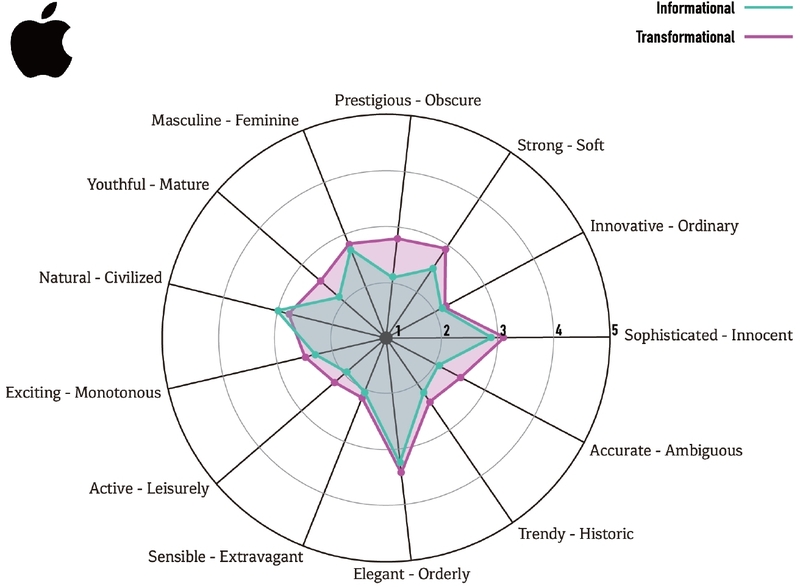
Adjective-Based Brand Image Profiles of Apple by Message StrategyNote Profiles are averaged across interactional and non-interactional conditions. Lower values indicate orientation toward the left-hand adjective, whereas higher values indicate orientation toward the right-hand adjective. Bolded adjective labels indicate axes with relatively larger differences in mean positioning. This note applies to Figures 2–9.
When collapsed across interactional conditions, notable variation in relative positioning was observed on several axes, including Prestigious–Obscure (2.10 vs. 2.82), Accurate–Ambiguous (2.09 vs. 2.57), Youthful–Mature (2.15 vs. 2.68), and Active–Leisurely (1.99 vs. 2.30). Across these axes, values under transformational conditions tended to be higher, indicating a relative shift toward the right-hand descriptors. Interactional effects were comparatively small and did not alter the overall pattern.
An LMEM revealed a significant Condition × Adjective interaction, F(36, 2703.003)=2.482, p<.001. The main effects of Condition, F(3, 2703.003)=16.680, p<.001, and Adjective, F(12, 2703.003)=26.588, p<.001, were also significant. The interaction effect size was modest (marginal R²=.114; conditional R²=.299), reflecting variation in positioning across adjective axes.
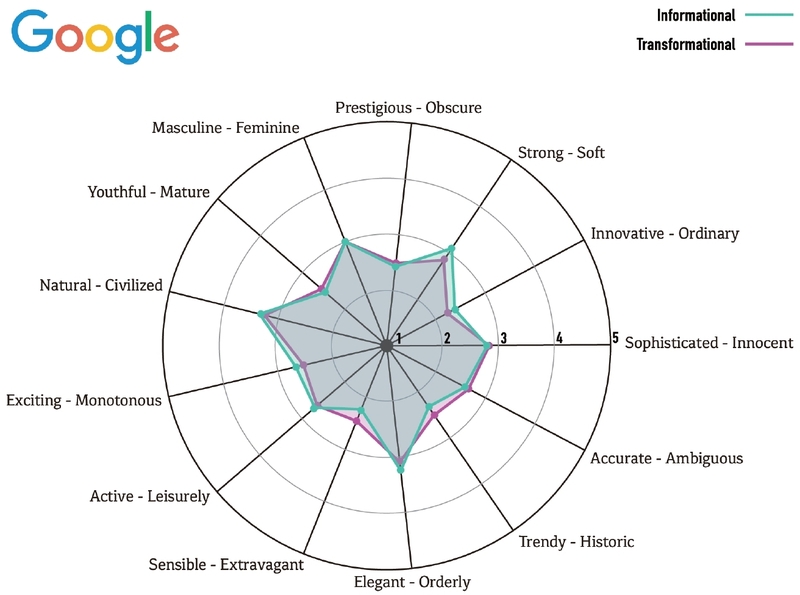
Adjective-Based Brand Image Profiles of Google by Message Strategy
When collapsed across interactional conditions, only limited differences in relative positioning were observed on several axes, including Prestigious–Obscure (2.51 vs. 2.57), Innovative–Ordinary (2.47 vs. 2.32), Accurate–Ambiguous (2.60 vs. 2.64), Active–Leisurely (2.70 vs. 2.67), and Youthful–Mature (2.53 vs. 2.62). These values indicate limited shifts in positioning between informational and transformational conditions. Interactional effects were comparatively small and did not alter the overall pattern.
TOYOTA
An LMEM revealed a significant Condition × Adjective interaction, F(36, 2703.003)=4.531, p<.001. Main effects of Condition, F(3, 2703.003)=12.620, p<.001, and Adjective, F(12, 2703.003)=10.922, p<.001, were also significant. The interaction effect size was modest (marginal R²=.088; conditional R²=.259), reflecting variation in positioning across adjective axes.
When collapsed across interactional conditions, notable variation in relative positioning was observed on several axes, including Prestigious–Obscure (2.63 vs. 2.98) and Masculine–Feminine (2.59 vs. 2.96). On these axes, values under transformational conditions tended to be higher. In contrast, Trendy–Historic (2.95 vs. 2.57) and Youthful–Mature (3.03 vs. 2.68) showed shifts in the opposite direction. On these axes, values under transformational conditions tended to be lower. These patterns indicate bidirectional variation in positioning across adjective axes rather than a uniform directional shift. Interactional effects were comparatively small and did not alter the overall pattern.
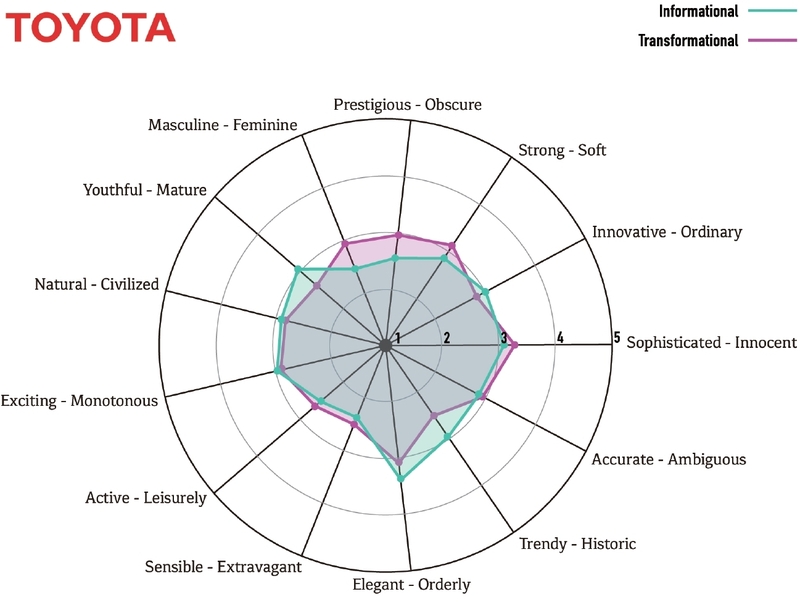
Adjective-Based Brand Image Profiles of Toyota by Message Strategy
MERCEDES-BENZ
An LMEM revealed a significant Condition × Adjective interaction, F(36, 2703.004)=5.135, p<.001. Main effects of Condition, F(3, 2703.004)=8.880, p<.001, and Adjective, F(12, 2703.004)=17.641, p<.001, were also significant. The interaction effect size was modest (marginal R²=.118; conditional R²=.216), reflecting variation in positioning across adjective axes.
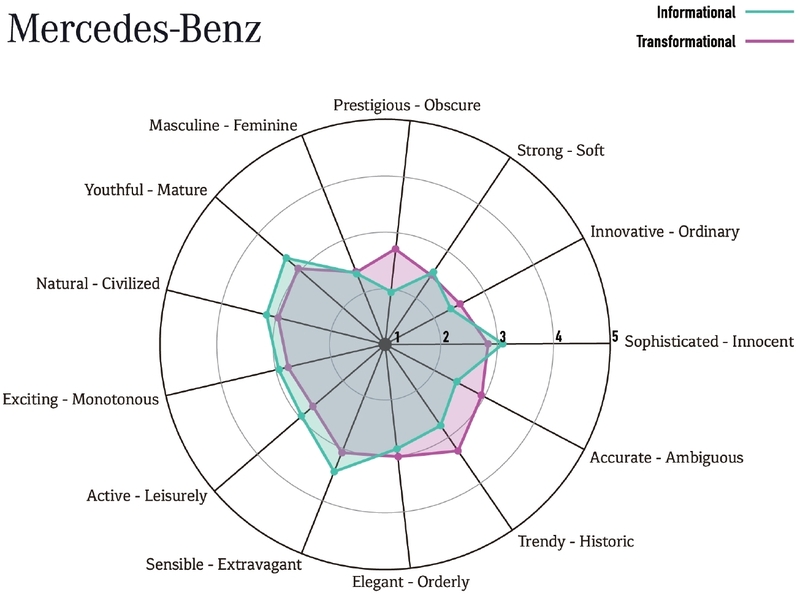
Adjective-Based Brand Image Profiles of Mercedes-Benz by Message Strategy
When collapsed across interactional conditions, notable variation in relative positioning was observed on several axes, including Prestigious–Obscure (1.94 vs. 2.74), Accurate–Ambiguous (2.46 vs. 2.97), and Trendy–Historic (2.71 vs. 3.27). On these axes, values under transformational conditions tended to be higher. In contrast, Active–Leisurely (2.94 vs. 2.74) and Youthful–Mature (3.34 vs. 3.02) showed shifts in the opposite direction. On these axes, values under transformational conditions tended to be lower. These patterns indicate bidirectional variation in positioning across adjective axes rather than a uniform directional shift. Interactional effects were comparatively small and did not alter the overall pattern.
NIKE
An LMEM revealed a significant Condition × Adjective interaction, F(36, 2703.003)=3.571, p<.001. Main effects of Condition, F(3, 2703.003)=22.207, p<.001, and Adjective, F(12, 2703.003)=35.998, p<.001, were also significant. The interaction effect size was modest (marginal R²=.155; conditional R²=.307), reflecting variation in positioning across adjective axes.
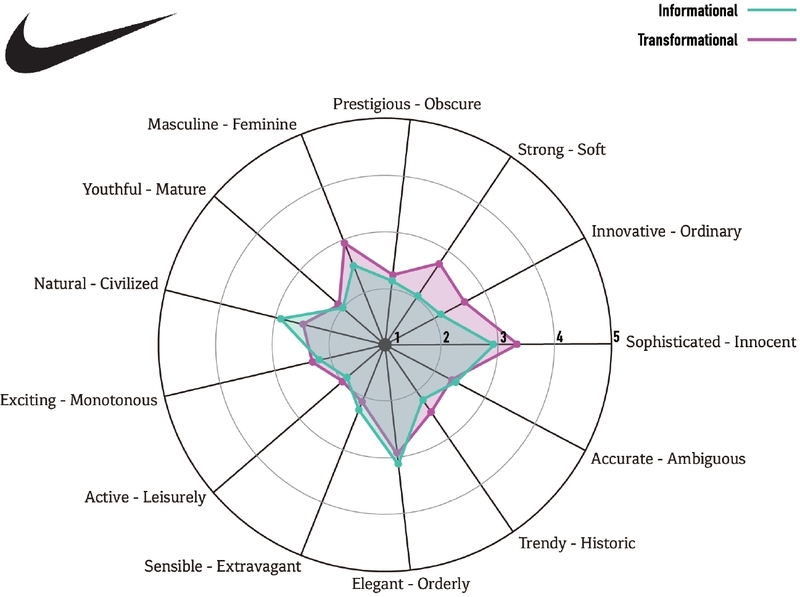
Adjective-Based Brand Image Profiles of Nike by Message Strategy
When collapsed across interactional conditions, notable variation in relative positioning was observed on several axes, including Sophisticated–Innocent (2.92 vs. 3.36) and Strong–Soft (2.08 vs. 2.73). On these axes, values under transformational conditions tended to be higher. Smaller variation was observed on other axes, including Natural–Civilized and Sensible–Extravagant, where values under transformational conditions showed slight shifts toward the left-hand descriptors. These patterns indicate a general tendency toward rightward positioning with localized variation across adjective axes. Interactional effects were comparatively small and did not alter the overall pattern.
BMW
An LMEM revealed a significant Condition × Adjective interaction, F(36, 2703.003)=8.148, p<.001. Main effects of Condition, F(3, 2703.003)=112.180, p<.001, and Adjective, F(12, 2703.003)=15.107, p<.001, were also significant. The interaction effect size was modest (marginal R²=.194; conditional R²=.327), reflecting variation in positioning across adjective axes.
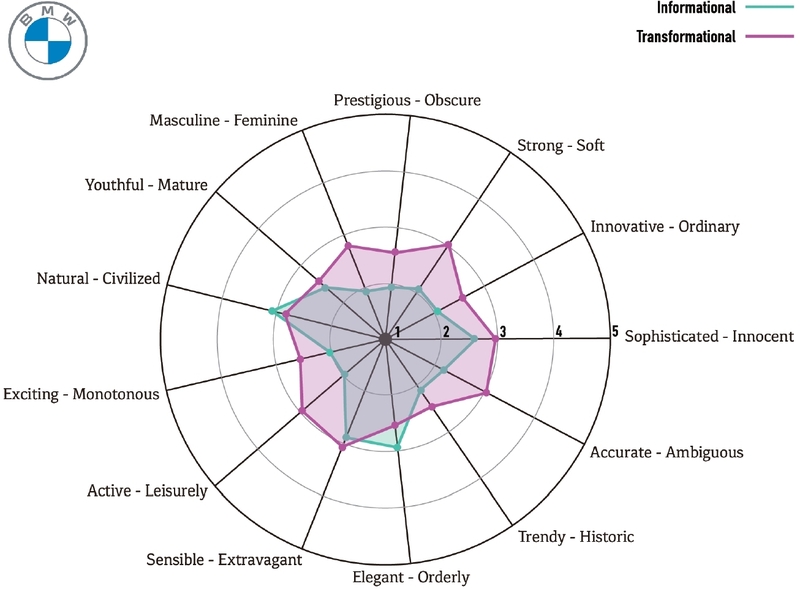
Adjective-Based Brand Image Profiles of BMW by Message Strategy
When collapsed across interactional conditions, notable variation in relative positioning was observed on several axes, including Prestigious–Obscure (1.96 vs. 2.63), Strong–Soft (2.15 vs. 3.03), Accurate–Ambiguous (2.29 vs. 3.03), Active–Leisurely (1.98 vs. 2.94), Exciting–Monotonous (2.05 vs. 2.69), and Masculine–Feminine (1.91 vs. 2.81). Across these axes, values under transformational conditions tended to be higher, indicating a general tendency toward rightward positioning across multiple adjective axes. Interactional effects were comparatively small and did not alter the overall pattern.
DISNEY
An LMEM revealed a significant Condition × Adjective interaction, F(36, 2703.003)=3.530, p<.001. Main effects of Condition, F(3, 2703.003)=30.684, p<.001, and Adjective, F(12, 2703.003)=89.136, p<.001, were also significant. The interaction effect size was modest (marginal R²=.288; conditional R²=.372), reflecting variation in positioning across adjective axes.
When collapsed across interactional conditions, notable variation in relative positioning was observed on several axes, including Trendy–Historic (2.48 vs. 3.17), Exciting–Monotonous (2.17 vs. 2.91), and Youthful–Mature (2.10 vs. 2.73). Across these axes, values under transformational conditions tended to be higher. Similar patterns were observed on other axes, including Prestigious–Obscure, Sophisticated–Innocent, and Strong–Soft. These patterns indicate a general tendency toward rightward positioning across multiple adjective axes. Interactional effects were comparatively small and did not alter the overall pattern.
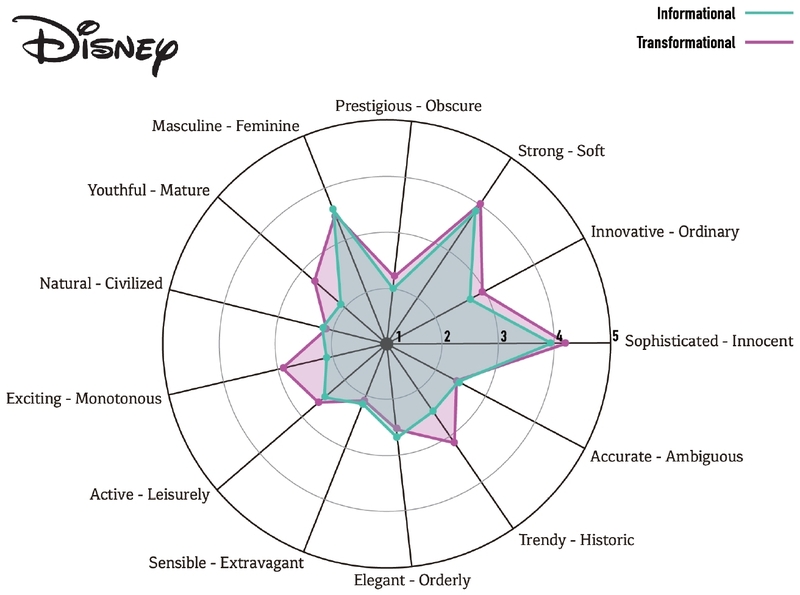
Adjective-Based Brand Image Profiles of Disney by Message Strategy
LOUIS VUITTON
An LMEM revealed a significant Condition × Adjective interaction, F(36, 2703.004)=8.425, p<.001. Main effects of Condition, F(3, 2703.004)=11.089, p<.001, and Adjective, F(12, 2703.004)=15.609, p<.001, were also significant. The interaction effect size was modest (marginal R2=.142; conditional R2=.240), reflecting variation in positioning across adjective axes.
When collapsed across interactional conditions, notable variation in relative positioning was observed on several axes, including Prestigious–Obscure (2.06 vs. 2.58), Strong–Soft (2.41 vs. 2.88), and Sophisticated–Innocent (2.73 vs. 3.12). Across these axes, values under transformational conditions tended to be higher. In contrast, Masculine–Feminine (2.89 vs. 2.41) showed variation in the opposite direction, with values under transformational conditions tending to be lower. These patterns indicate mixed directional variation across adjective axes rather than a uniform directional shift. Interactional effects were comparatively small and did not alter the overall pattern.
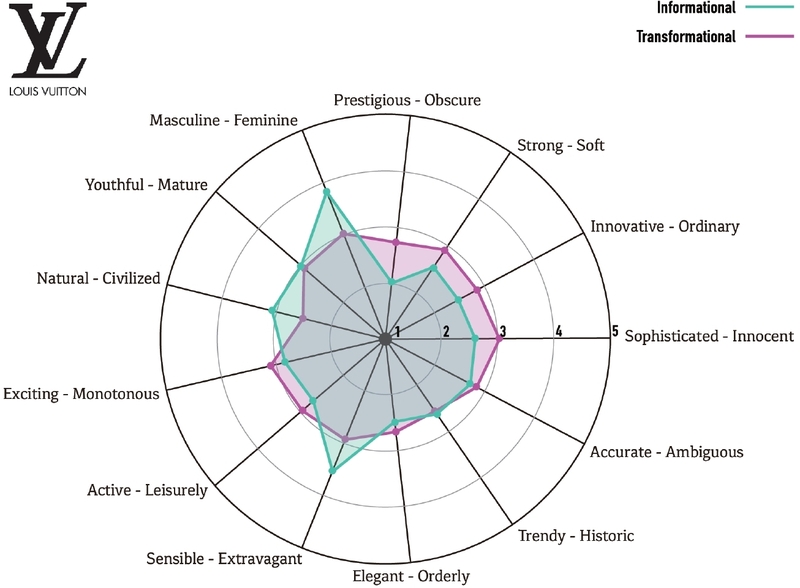
Adjective-Based Brand Image Profiles of Louis Vuitton by Message Strategy
Taken together, the brand-level models indicate that adjective-based positioning varied across conditions within each brand, with distinct directional patterns and differing magnitudes of variation across brands.
5. Discussion
The aggregate-level interaction effects indicate that message strategy is associated with variation in the relative emphasis of brand meaning across shared adjective-based dimensions, rather than indicating simple changes in mean values. These results should be understood as observable positioning differences within the present dataset.
First, the results indicate that message strategy is associated with variation in mean positioning across shared adjective axes rather than evaluative amplification alone. Prior research grounded in brand association theory (Keller, 1993), semantic differential methodology (Osgood et al., 1957), and meaning-transfer theory (McCracken, 1986) has conceptualized brand meaning as multidimensional. The present findings do not seek to revise these frameworks; rather, they apply them to show how message orientation corresponds to relative positioning across shared adjective axes in branded video communication. While statistically significant, these effects are small in magnitude and should be interpreted as subtle directional tendencies in emphasis rather than substantive shifts in brand meaning.
Second, informational and transformational strategies showed different patterns of mean positioning in brand image profiles. These patterns can be interpreted in relation to prior distinctions associated with message orientation, although the underlying cognitive or interpretive mechanisms are not examined in this study. Informational conditions were associated with positioning tendencies toward descriptors aligned with product attributes and rational evaluative cues, such as Accurate and Sensible, consistent with informational message theory (Puto & Wells, 1984; Laskey et al., 1989). Transformational conditions, by contrast, were more frequently associated with positioning tendencies along axes related to symbolic or experiential interpretations, including Prestigious–Obscure, Youthful–Mature, and Innovative–Ordinary.
These findings are interpreted as variation in relative emphasis across shared dimensions rather than as evidence of underlying processing mechanisms or causal pathways.
Third, interactional message elements functioned primarily as contextual modifiers rather than primary determinants of variation in mean positioning across adjective axes. Although the Adjective × Interactional and three-way interaction effects reached statistical significance at the aggregate level, associated effect sizes were substantially smaller than those observed for orientation-related effects, and the main effect of interactional presence was not significant. These patterns indicate that interactional elements contributed comparatively limited variation in mean positioning across adjective axes. Interactional cues therefore appear to adjust emphasis within orientation-based tendencies rather than independently determining variation in positioning. This interpretation is limited to the present dataset and does not imply broader generalization beyond the examined stimuli. Although stimulus-level variance cannot be separated in the present design, stimuli were selected through an expert-based procedure to maximize within-brand contrast in message orientation. Accordingly, these findings should be interpreted as stimulus-bound patterns within the present dataset, rather than as generalizable effects of message strategy.
Taken together, the findings indicate that message strategy is associated with variation in mean positioning across shared adjective axes. Informational strategies tend to emphasize functional and attribute-based interpretations, whereas transformational strategies are associated with positioning tendencies along axes related to symbolic or experiential interpretations. Interactional elements operate within these tendencies rather than redefining them. Within these bounds, the findings provide descriptive insight into how message orientation is associated with variation in the relative emphasis of brand meaning across shared descriptive dimensions. By focusing on relative positioning across shared descriptive dimensions, this study offers a way to examine how message strategies are associated with the expression of brand meaning beyond evaluative outcomes.
From a communication design perspective, these results indicate that message orientation functions not only as a classificatory distinction but also as a design consideration related to how brand image is weighted and positioned across shared adjective-based dimensions. Rather than altering underlying associative structures, message orientation is associated with the relative emphasis of brand meaning within a shared descriptive framework. This suggests a basis for more deliberate brand communication design, in which message orientation can be considered when selectively emphasizing aspects of brand image across consistent descriptive dimensions in social media environments.
6. Conclusion
This study shows that message strategy in social media branded video communication is associated with variation in positioning across shared adjective-based dimensions. Informational and transformational orientations correspond to different patterns of positioning along predefined adjective axes, reflecting variation in relative emphasis within a shared measurement framework. Interactional elements operate as secondary adjustments rather than primary determinants of this variation.
From a communication design perspective, branded video communication can be understood as a context in which selected aspects of brand image are emphasized and positioned across shared dimensions. Rather than altering underlying associative structures, message orientation is associated with differences in how brand image is expressed within these dimensions. Accordingly, the contribution of this study lies in identifying how message orientation is associated with observable variation in the relative emphasis of brand meaning within a shared descriptive framework, rather than establishing generalizable or causal relationships.
Several limitations should be noted. First, the experimental design relied on a single video stimulus per condition for each brand. This design does not allow the separation of message strategy effects from stimulus-specific characteristics such as visual style, narrative structure, or production quality. The observed variation may therefore reflect properties of specific video stimuli rather than message strategy alone and should be interpreted as stimulus-bound rather than generalizable across executions. Second, the cross-sectional design and measurement approach do not support causal inference. The findings indicate associations between message orientation and mean positioning across adjective-based dimensions, but no causal conclusions can be drawn regarding the causal effect of message strategy. Third, the observed effects are statistically reliable but small in magnitude and should be interpreted as indicative tendencies rather than substantive shifts in brand meaning. Finally, adjective-based measurement, while systematically derived, remains interpretive and context-dependent. Because the adjective axes were used as descriptive reference points rather than as indicators of a validated latent scale, further validation is needed to examine their applicability across additional brands, product categories, and communication contexts.
Future research may address these limitations by incorporating multiple stimulus exemplars per condition and modeling stimuli as random effects to better separate message strategy effects from stimulus-specific characteristics. Controlled experimental designs may further clarify causal relationships, while longitudinal and cross-platform analyses could provide insight into how these patterns evolve over time and across communication contexts. Future studies may also refine the adjective-based measurement framework through additional validation procedures and examine whether similar positioning patterns appear across different media formats and cultural settings.
Notes
Copyright : This is an Open Access article distributed under the terms of the Creative Commons Attribution Non-Commercial License (http://creativecommons.org/licenses/by-nc/3.0/), which permits unrestricted educational and non-commercial use, provided the original work is properly cited.
References
-
Aaker, J. L. (1997). Dimensions of brand personality. Journal of Marketing Research, 34(3), 347–356.
[https://doi.org/10.1177/002224379703400304]

-
Ashley, C., & Tuten, T. (2015). Creative strategies in social media marketing: An exploratory study of branded social content and consumer engagement. Psychology & Marketing, 32(1), 15-27.
[https://doi.org/10.1002/mar.20761]
-
Bruns, D., Kopka, J. F., Borgmann, L., Prior, S., & Langner, T. (2025). Measuring gaining and holding attention to social media ads with viewport logging: A validation study using mobile eye-tracking. Journal of Advertising, 54(5), 655-672.
[https://doi.org/10.1080/00913367.2025.2524186]
-
Cretu, A. E., & Brodie, R. J. (2007). The influence of brand image and company reputation where manufacturers market to small firms: A customer value perspective. Industrial Marketing Management, 36(2), 230-240.
[https://doi.org/10.1016/j.indmarman.2005.08.013]
-
De Vries, L., Gensler, S., & Leeflang, P. S. (2012). Popularity of brand posts on brand fan pages: An investigation of the effects of social media marketing. Journal of Interactive Marketing, 26(2), 83-91.
[https://doi.org/10.1016/j.intmar.2012.01.003]
-
Divakaran, P. K. P., & Xiong, J. (2022). Eliciting brand association networks: A new method using online community data. Technological Forecasting and Social Change, 181, 121769.
[https://doi.org/10.1016/j.techfore.2022.121769]
-
Escalas, J. E. (2004). Narrative processing: Building consumer connections to brands. Journal of Consumer Psychology, 14(1-2), 168-180.
[https://doi.org/10.1207/s15327663jcp1401&2_19]
-
Faul, F., Erdfelder, E., Lang, A. G., & Buchner, A. (2007). G*Power 3: A flexible statistical power analysis program for the social, behavioral, and biomedical sciences. Behavior Research Methods, 39(2), 175-191.
[https://doi.org/10.3758/BF03193146]
-
Galle, P., & Kovács, L. B. (1996). Replication protocol analysis: A method for the study of real-world design thinking. Design Studies, 17(2), 181-200.
[https://doi.org/10.1016/0142-694X(95)00039-T]
-
Ge, J., Sui, Y., Zhou, X., & Li, G. (2021). Effect of short video ads on sales through social media: The role of advertisement content generators. International Journal of Advertising, 40(6), 870-896.
[https://doi.org/10.1080/02650487.2020.1848986]
-
Geise, S., & Baden, C. (2015). Putting the image back into the frame: Modeling the linkage between visual communication and frame-processing theory. Communication Theory, 25(1), 46-69.
[https://doi.org/10.1111/comt.12048]
-
Gwinner, K. P., & Eaton, J. (1999). Building brand image through event sponsorship: The role of image transfer. Journal of Advertising, 28(4), 47-57.
[https://doi.org/10.1080/00913367.1999.10673595]
-
Hwang, I. K., & Lee, H. (2025). Brand identity visualization to enhance brand awareness contingent on the message strategy for social media video communication. Archives of Design Research, 38(3), 51-75.
[https://doi.org/10.15187/adr.2025.08.38.3.51]
- Interbrand. (2023). Best Global Brands 2023. Retrieved from https://interbrand.com/best-global-brands/global/2023-report/.
-
Johansson, J. K., Dimofte, C. V., & Mazvancheryl, S. K. (2012). The performance of global brands in the 2008 financial crisis: A test of two brand value measures. International Journal of Research in Marketing, 29(3), 235-245.
[https://doi.org/10.1016/j.ijresmar.2012.01.002]
- Kapferer, J.-N. (2008). The new strategic brand management: Creating and sustaining brand equity long term (4th ed.). London: Kogan Page Publishers.
-
Keller, K. L. (1993). Conceptualizing, measuring, and managing customer-based brand equity. Journal of Marketing, 57(1), 1-22.
[https://doi.org/10.1177/002224299305700101]
-
Kim, B., Hong, S., & Lee, H. (2021). Brand communities on Instagram: Exploring fortune 500 companies' Instagram communication practices. International Journal of Strategic Communication, 15(3), 177-192.
[https://doi.org/10.1080/1553118x.2020.1867556]
-
Laskey, H. A., Day, E., & Crask, M. R. (1989). Typology of main message strategies for television commercials. Journal of Advertising, 18(1), 36-41.
[https://doi.org/10.1080/00913367.1989.10673141]
-
Lawson, B. (2005). How designers think: The design process demystified (4th ed.). London; New York: Routledge.
[https://doi.org/10.4324/9780080454979]
- Leaver, T., Highfield, T., & Abidin, C. (2020). Instagram: Visual social media cultures. Cambridge: Polity Press.
-
Liu, J., Li, C., Ji, Y. G., North, M., & Yang, F. (2017). Like it or not: The fortune 500's Facebook strategies to generate users' electronic word-of-mouth. Computers in Human Behavior, 73, 605-613.
[https://doi.org/10.1016/j.chb.2017.03.068]
-
Madden, T. J., Fehle, F., & Fournier, S. (2006). Brands matter: An empirical demonstration of the creation of shareholder value through branding. Journal of the Academy of Marketing Science, 34(2), 224-235.
[https://doi.org/10.1177/0092070305283356]
-
McCracken, G. (1986). Culture and consumption: A theoretical account of the structure and movement of the cultural meaning of consumer goods. Journal of Consumer Research, 13(1), 71-84.
[https://doi.org/10.1086/209048]
-
Nandan, S. (2005). An exploration of the brand identity-brand image linkage: A communications perspective. Journal of Brand Management, 12(4), 264-278.
[https://doi.org/10.1057/palgrave.bm.2540222]
- Osgood, C. E., Suci, G. J., & Tannenbaum, P. H. (1957). The measurement of meaning. Urbana: University of Illinois Press.
-
Park, C. W., Jaworski, B. J., & MacInnis, D. J. (1986). Strategic brand concept-image management. Journal of Marketing, 50(4), 135-145.
[https://doi.org/10.1177/002224298605000401]
-
Perreault, W. D., & Leigh, L. E. (1989). Reliability of nominal data based on qualitative judgments. Journal of Marketing Research, 26(2), 135-148.
[https://doi.org/10.1177/002224378902600201]
- Puto, C. P., & Wells, W. D. (1984). Informational and transformational advertising: The differential effects of time. Advances in Consumer Research, 11(1), 638-643.
-
Rageh Ismail, A., & Spinelli, G. (2012). Effects of brand love, personality and image on word of mouth: The case of fashion brands among young consumers. Journal of Fashion Marketing and Management: An International Journal, 16(4), 386-398.
[https://doi.org/10.1108/13612021211265791]
-
Riffe, D., Lacy, S., Watson, B. R., & Lovejoy, J. (2023). Analyzing media messages: Using quantitative content analysis in research (5th ed.). New York: Routledge.
[https://doi.org/10.4324/9781003288428]
-
Shim, S. I., & Lee, Y. (2017). Developing a scale to measure brand image attributes of fashion brands: Focused on attribute symbolism. Journal of the Korean Society of Clothing and Textiles, 41(6), 977-993.
[https://doi.org/10.5850/jksct.2017.41.6.977]
-
Tafesse, W., & Wien, A. (2017). A framework for categorizing social media posts. Cogent Business & Management, 4(1), 1284390.
[https://doi.org/10.1080/23311975.2017.1284390]
-
Taylor, R. E. (1999). A six-segment message strategy wheel. Journal of Advertising Research, 39(6), 7-17.
[https://doi.org/10.1080/00218499.1999.12466442]
-
Veloutsou, C., & Ballester, E. (2025). A typology of brand knowledge associations projected in brand-generated signals. Journal of Product & Brand Management, 34(3), 376-397.
[https://doi.org/10.1108/JPBM-03-2024-5022]
-
Voorveld, H. A. M., van Noort, G., Muntinga, D. G., & Bronner, F. (2018). Engagement with social media and social media advertising: The differentiating role of platform type. Journal of Advertising, 47(1), 38-54.
[https://doi.org/10.1080/00913367.2017.1405754]
- We Are Social, & Meltwater. (2024). Digital 2024: October Global Statshot Report. Retrieved from https://www.meltwater.com/en/blog/digital-2024-october-global-statshot-report.
-
Yang, E. K., Kho, J. M., & Li, R. (2025). Affective qualities in virtual fashion: Exploring designer perceptions of core design elements and emotional resonance. Archives of Design Research, 38(3), 107-129.
[https://doi.org/10.15187/adr.2025.08.38.3.107]
-
Yang, S., & Kim, J. (2024). Consumer reactions to YouTube humor ads by type. Archives of Design Research, 37(1), 319-337.
[https://doi.org/10.15187/adr.2024.02.37.1.319]