
Toward Holistic Evaluation of Senior House Services: Integrating Empathy-Driven Approaches with AHP
Abstract
Background With the rapid aging of populations in East Asia, senior houses have emerged as an important intermediate care model that balances independence and support for older adults. However, existing evaluation approaches tend to focus primarily on functional aspects, with limited consideration of emotional experience and managerial constraints. This results in a lack of holistic and structured frameworks for service assessment and optimization. This study aims to develop a comprehensive evaluation framework by integrating empathy-driven qualitative insights with the analytic hierarchy process (AHP), in order to support multi-dimensional decision-making in senior house services.
Methods A mixed-method approach was adopted. First, empathy maps were constructed based on field observations and semi-structured interviews to capture of residents lived experiences across typical service scenarios, including admission, dining, and hygiene activities. Cross-scenario thematic clustering was then conducted to abstract emotional dimensions. In parallel, management-related issues were identified through caregiver interviews and analyzed using Pareto analysis to derive key managerial dimensions. Functional indicators were derived from prior research grounded in Universal Design. These dimensions were integrated into an AHP hierarchical model, and pairwise comparison data were collected from 10 experts. The geometric mean method was applied to construct group judgment matrices, and weights were calculated with consistency tests.
Results The results indicate that the managerial dimension (42.6%) holds the highest importance, followed by the functional (31.4%) and emotional (26.0%) dimensions. Within the managerial dimension, Service Process Coordination ranks highest, highlighting the critical role of process integration in service quality. In the functional dimension, Supportiveness & Assistive Fit slightly outweighs other indicators, reflecting a shift toward personalized service provision. Within the emotional dimension, Safety Perception ranks highest, followed by Privacy and Service Responsiveness, revealing a hierarchical structure of emotional needs. The integration of empathy-based insights with AHP enables the translation of qualitative experience into quantifiable priorities.
Conclusions This study proposes a holistic evaluation framework that integrates empathy-driven methods with AHP, bridging the gap between qualitative user experience research and quantitative decision-making tools. The framework provides a structured basis for prioritizing service improvements in senior housing and highlights the foundational role of management, the growing importance of personalization, and the irreplaceable value of emotional experience. Future research should focus on expanding stakeholder participation, validating the framework in practice, and examining its applicability across different cultural contexts.
Keywords:
Senior House, Service Evaluation, Empathy Map, AHP, Service Design, Elderly Care1. Research background
The growing aging population in East Asia has created an increasing demand for innovative care models that extend beyond traditional nursing homes and home-based care. According to the United Nations Department of Economic and Social Affairs and the Asian Development Bank (Li, 2024), the share of people aged 65 and above in East Asia continues to rise rapidly, placing unprecedented pressure on existing long-term care systems.
In this context, senior houses have emerged as a promising alternative, providing integrated services that combine accommodation, daily care, and opportunities for social participation. Market and policy analyses show that this model has gained traction in East Asian societies as a way to balance independence and support for older adults (Savills, 2023; Ismail et al., 2020).
The quality and sustainability of such services depend on multiple dimensions. Existing studies on senior house services have largely focused on functional aspects, such as improving accessibility, optimizing service processes, or upgrading facilities (Wang et al., 2024). However, these studies provide limited insights into seniors’ lived experiences, including dignity, belonging, and psychological security (Bergqvist, 2019).
At the same time, managerial perspectives—such as caregiver workload and cost-effectiveness—have received relatively limited attention, even though studies show that these factors strongly influence service quality and sustainability (Maghsoud et al., 2022). As long-term care institutions face increasing operational complexity, decision-makers are often required to balance competing priorities among functionality, emotional satisfaction, and managerial feasibility. This multi-criteria nature of senior housing management has led scholars to seek structured decision-support tools that can translate qualitative insights into quantifiable priorities.
Conventional evaluation approaches tend to emphasize either qualitative insights or quantitative measures in isolation. Qualitative methods—such as empathy mapping, emotional journey analysis, and participatory design—generate deep insights into user experiences (Cole et al., 2022; Lane., 2017), but they lack systematic prioritization mechanisms. Quantitative methods, notably the Analytic Hierarchy Process (AHP) introduced by Saaty , provide structured frameworks for weighting and comparing evaluation criteria and have been widely applied in healthcare decision-making (Liberatore & Nydick, 2008). However, AHP alone depends heavily on expert judgment and cannot fully capture the nuanced emotional dimensions of senior service experiences.
To address this methodological gap, this study seeks to integrate empathy-driven qualitative approaches with AHP-based quantitative evaluation, aiming to establish a holistic framework that balances functionality, emotional well-being, and managerial feasibility in senior house service design and assessment.
2. Research objective
In the preceding study, universal design principles were integrated into service processes to formulate preliminary guidelines for improving senior house services. While this work helped clarify the functional aspects of the service environment, it also revealed limitations in capturing emotional experiences and in prioritizing managerial decision-making.
Building on these findings, the present study ultimately aims to develop a multi-dimensional evaluation framework for senior house services based on the Analytic Hierarchy Process (AHP). This framework integrates service experience elements derived from empathy-based research with weight values calculated through AHP, constructing a hierarchical set of evaluation criteria and corresponding priorities. The framework is intended to inform service optimization, managerial decision-making, and subsequent evaluation.
Specifically, this study seeks to extract key service dimensions from qualitative research methods—such as narrative interviews, observations, and empathy maps—including functional accessibility, emotional support, social participation, and managerial efficiency. These dimensions are first organized into a preliminary hierarchical structure suitable for systematic evaluation. Subsequently, an AHP model is constructed and applied, enabling experts and practitioners to compare these dimensions, assign relative weights, and reveal trade-offs among usability, empathy, and managerial constraints.
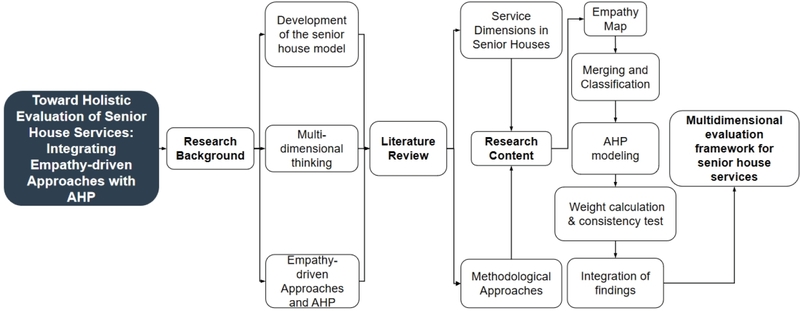
Through this process, the study provides practical guidance for improving senior house services, supports decision-making by managers and designers, and offers a methodological reference for future interdisciplinary research. The overall research process is illustrated in Figure 1.
Research flow chart
3.Literature review
3. 1. Service Dimensions in Senior Houses
Research on senior houses has expanded as East Asia faces accelerated population aging and diversification of care demands. Studies have explored senior housing from functional, emotional, and managerial perspectives. Functionally, much attention has been devoted to spatial accessibility and universal design. For instance, Jolanki described senior housing as a supportive environment that promotes autonomy and safety (Jolanki, 2021). Recent research has extended this view to emphasize spatial usability and intergenerational inclusiveness (Mahmood et al., 2022; Li., 2025). These studies collectively highlight the significance of physical and environmental factors in maintaining independence and preventing social isolation among older adults.
Beyond functional usability, scholars have increasingly focused on emotional and social well-being as core dimensions of quality living in senior housing. Zhang and Goza discussed the psychosocial consequences of China’s one-child policy, emphasizing the need for emotional support and community belonging among the elderly (Zhang & Goza, 2006). Similarly, Sanders and Stappers argued that empathy and participatory co-design approaches are critical for revealing users’ deeper values and feelings (Sanders & Stappers, 2008). In the service design field, Stickdorn demonstrated that emotional journey mapping can serve as a tool to visualize and improve user experiences across service touchpoints (Stickdorn et al. 2012). These works collectively indicate that emotional satisfaction is not secondary to functional accessibility but equally vital for well-being and service engagement.
Managerial perspectives, though less frequently discussed, have emerged as another crucial dimension. Studies in health and care management have reported the growing strain on caregiving staff and the challenge of maintaining cost-efficiency. Huang examined care aides’ working experiences in long-term care settings, revealing that emotional fatigue and workload imbalance often compromise service quality (Huang et al. 2024). Likewise, Workforce studies also highlight that organizational structures, turnover, and capacity planning significantly affect care sustainability and quality (Boamah et al., 2025; Dieleman et al., 2022). Together, these studies highlight that sustainable senior housing services depend on balancing functional design, emotional support, and managerial feasibility.
3. 2. Methodological Approaches and Their Limitations
Existing research has adopted diverse methodological frameworks, yet most remain confined within either qualitative or quantitative paradigms. Qualitative approaches—such as ethnography, participatory design, and human-centered research—are widely used to capture seniors’ lived experiences and contextual needs (Gaber et al., 2024; Bate & Robert, 2006; Steen, 2011; ). However, these methods typically produce descriptive findings and lack explicit mechanisms for determining the relative priority of service criteria.
Quantitative models, in contrast, provide structured and measurable means of evaluation. Among them, the Analytic Hierarchy Process (AHP) has been extensively applied to support decision-making across health and service contexts (Saaty,2001; Vaidya & Kumar, 2006). AHP offers a systematic approach for comparing complex criteria and constructing transparent weighting structures. Recent studies have also applied AHP to smart eldercare evaluation, confirming its suitability for multi-criteria assessments (Chen et al., 2023).
Nonetheless, quantitative frameworks such as AHP rely heavily on predefined indicators and expert scoring, which may overlook subjective, emotional, or contextual aspects of older adults’ lived experiences. Scholars have argued that integrating human-centered qualitative insights with structured multi-criteria decision-making remains a methodological challenge that limits comprehensive and empathetic evaluation of senior house services (Schmidt et al., 2015).
4.Research content
4. 1. Empathy map
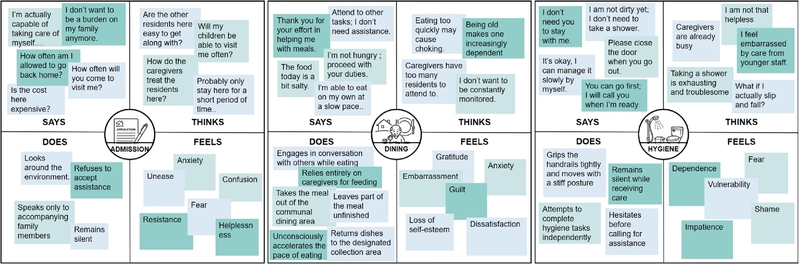
The empathy maps in this study shift attention to elderly users’ internal experiences in key service situations. Instead of explaining how services operate, they explore how services are perceived — what residents see, say, think, and feel during everyday encounters (Gibbons,2018). Three typical service scenarios were selected due to their high emotional intensity and operational relevance. The selected scenarios include:
Admission. The admission scenario refers to the stage in which older adults first enter a senior house. It encompasses the move-in process, adaptation to the new environment, separation from family members or previous living arrangements, and the early phase of residence in the senior house. Residents enter this scenario with diverse backgrounds: some relocate from their homes with strong emotional attachments, others move in despite maintaining a certain level of independence but facing unfavorable living conditions, and still others enter the senior house reluctantly even though they retain the ability to care for themselves.
Dining. The dining scenario broadly refers to older residents’ experiences of eating in the communal dining area, encompassing the entire process of going to the dining space, selecting food, consuming meals, and interacting with caregivers and other residents. While most residents are able to complete the dining process independently, some older adults require assistance from caregivers during meals.
Hygiene. In this study, activities such as personal washing and toileting are combined into a single service scenario referred to as “Hygiene.” Although these activities differ in operational details, they exhibit a high degree of overlap in experiential characteristics, particularly with regard to privacy exposure, safety risks, dependence on caregivers, and perceptions of dignity. Analyzing them as an integrated scenario therefore facilitates the extraction of stable emotional themes and evaluation dimensions.
Empathy map - admission / dining / hygiene
Although the physical environments and management models of senior houses may vary, the empathy maps presented above reveal recurring experiential patterns across different service scenarios. Across check-in, dining, and hygiene-related activities, similar emotional concerns—such as uncertainty, loss of autonomy, sensitivity to privacy, and anxiety about safety—emerge repeatedly. These cross-scenario consistencies suggest that emotional experiences in senior house services are not isolated to specific activities but are shaped by underlying experiential structures. To make these recurring experiential patterns analytically tractable, the findings from the empathy maps were further organized through a process of cross-scenario thematic clustering. The resulting themes and their associated experiential evidence are summarized in Table 1.

Cross-scenario thematic clustering of emotional experiences
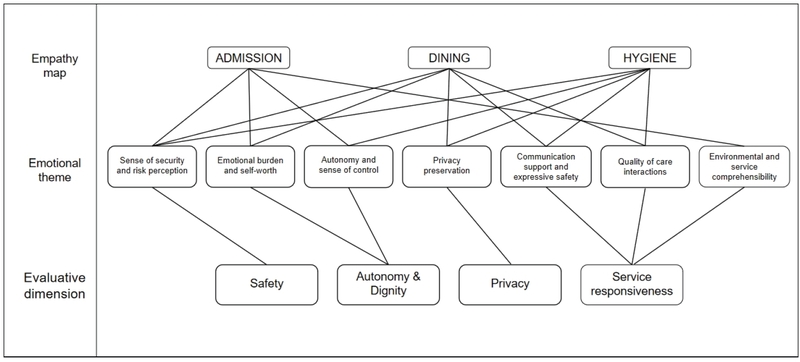
Based on these cross-scenario consistencies, the next step of the analysis involves abstracting the repeatedly observed emotional themes into a smaller set of evaluation dimensions to enable structured comparison. Through this process, the seven emotional themes identified from the empathy maps are systematically mapped onto four higher-level evaluation dimensions. The specific mapping process and its underlying rationale are presented in Table 2.
Mapping of emotional themes to AHP evaluation dimensions
The emotional constructs derived from empathy maps were abstracted into higher-level evaluation dimensions suitable for AHP modeling, based on recurring experiential patterns across different service scenarios. For instance, concerns related to physical risks were categorized under Safety.
Autonomy and Dignity were combined into a single dimension due to their strong experiential overlap, as reflected in residents’ concerns about dependence, loss of control, and self-worth (Van, 2014). Privacy-related discomfort was grouped under Privacy, while issues related to caregiver interaction and communication were categorized as Service Responsiveness.
Together, these dimensions form a structured basis for subsequent AHP-based evaluation. The overall abstraction process is illustrated in Figure 3.
Empathy-based abstraction of AHP evaluative dimensions
4. 2. Identification of Managerial Evaluation Dimensions Using Pareto Analysis
The emotional experiences identified through empathy analysis—such as anxiety, loss of control, and safety-related concerns—are closely linked to managerial factors, including resource allocation, process coordination, and support conditions. Therefore, this study further examines management-related issues from the perspective of service operation. Based on observations and semi-structured interviews with frontline caregivers (n = 10), supplemented by input from managers and operational staff, recurring difficulties in daily care practice were identified. These issues primarily reflect constraints emerging from frontline work experiences.
Caregivers frequently expressed concerns such as:
- “It has become very difficult to obtain caregiver certification, and there are not enough truly qualified professionals.”
- “People often resign because they cannot cope with residents’ deliberate provocations.”
- “Once something goes wrong during care, the responsibility pressure is enormous.”
- “...”
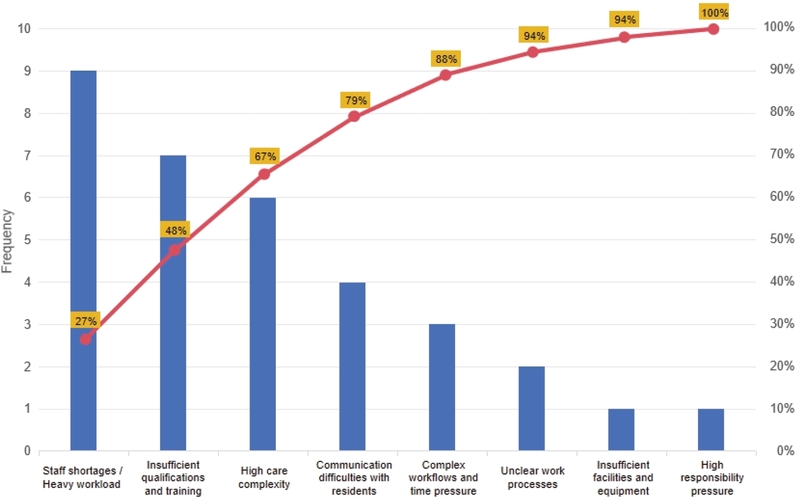
These statements reveal the operational pressures and constraints embedded in service delivery, providing an empirical basis for identifying key managerial issues. To systematically organize these issues, Pareto analysis was applied to examine the frequency distribution of reported problems, enabling the identification of dominant managerial themes (Alkiayat, 2021). The results are presented in Table 3.
Frequency distribution of management-related issues
From Table 3 and the Pareto chart derived from its results (Figure 4), it can be observed that high-frequency issues are primarily concentrated on staffing levels and professional competence, constituting the most immediate and fundamental operational constraints in care practice. Medium-frequency issues mainly involve service processes and coordination mechanisms, reflecting the coherence and stability of the service system in daily operation. In contrast, relatively low-frequency issues are largely related to facility conditions and supportive environments; their impact typically functions as a background constraint but may become amplified under specific risk situations.
Pareto analysis of management-related issues
Supported by the results of the Pareto analysis, a further integrative analysis and conceptual consolidation of high-frequency managerial issues was conducted. The frequently occurring managerial issues can be synthesized into the following three relatively stable managerial evaluation dimensions:
(1) Human Resource Adequacy
This dimension primarily derives from issues such as “Staff shortages,” “Heavy workload,” and “insufficient professional qualifications and training,” and is also closely associated with the high-risk characteristics of care recipients themselves (e.g., fragile skin and high care complexity). It reflects whether the existing scale of human resources and level of professional competence are sufficient to support actual care demands, constituting a fundamental managerial condition for the operation of senior house services.
(2) Service Process Coordination
This dimension is abstracted from issues including “communication difficulties,” “complex workflows,” “time pressure” and “unclear work process,” and reflects the degree of coordination in the actual operation of service processes. Although service procedures may be formally designed at the institutional level, their executability and stability in real care settings remain highly dependent on process clarity, staff collaboration, and the capacity to respond to exceptional situations.
(3) Facility and Risk Aversion Support
This dimension corresponds to issues such as “insufficient facilities and equipment” and “high responsibility pressure,” reflecting the level of physical and infrastructural support for care practice. Inadequate facilities not only limit care efficiency but also increase caregivers’ responsibility pressure by elevating operational risk. This dimension emphasizes the role of infrastructure in supporting care safety and risk control.
These dimensions do not exist independently of the service experience; rather, by influencing the service execution process, they indirectly shape older residents’ emotional experiences and perceptions of service quality.
5.Empathy-Integrated AHP Framework
5. 1. Construction of the AHP Hierarchical Model
This study identifies and abstracts the key elements required for evaluating services in senior housing across three dimensions: functional experience, emotional experience, and management practice. These findings are integrated into three primary evaluation dimensions and further specified into a set of secondary indicators, with the composition of each dimension defined as follows:
Functional criteria (C1): This dimension emphasizes the accessibility, operability, and informational support capacity of services in actual use. It mainly includes:
C1-1: Accessibility & Convenience
C1-2: Supportiveness & Assistive Fit
C1-3: Information Clarity
Emotional criteria (C2): This dimension focuses on the stability and structure of residents’ emotional experiences during service encounters. It mainly includes:
C2-1: Autonomy & Dignity
C2-2: Privacy
C2-3: Service Responsiveness
C2-4: Safety Perception
Managerial criteria (C3): This dimension highlights the influence of resources, processes, and support conditions in service operation on care quality and sustainability. It mainly includes:
C3-1: Human Resource Adequacy
C3-2: Service Process Coordination
C3-3: Facility and Risk Aversion Support
On this basis, in order to further clarify the relative importance of the above multidimensional evaluation elements in the overall assessment of service quality, and to provide a weighting foundation for the subsequent development of an operable comprehensive evaluation model, the Analytic Hierarchy Process (AHP) is introduced for quantitative analysis. The hierarchical structure model constructed in this study is shown in the Figure 5 below:
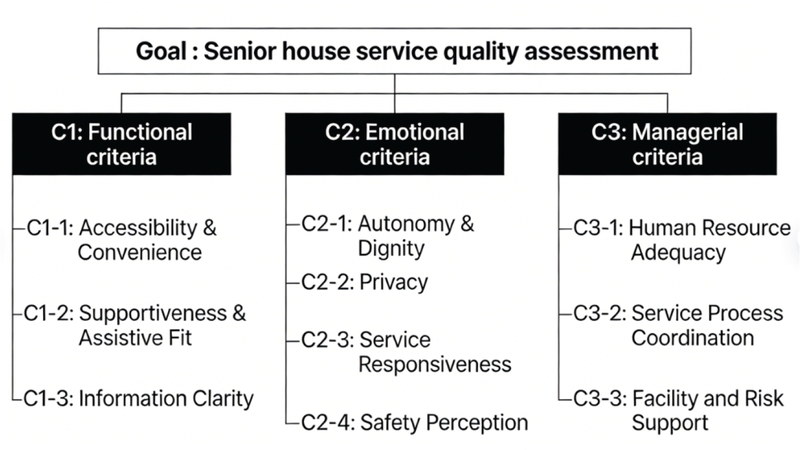
AHP hierarchical structure for senior house service quality assessment
In this study, AHP is not employed to select the optimal alternative among multiple options, but rather to construct an evaluation index system for senior housing services and to determine the relative weights of each indicator. Therefore, the hierarchical structure in this study consists of the goal layer, the criteria layer, and the indicator layer, without introducing an additional alternative layer.
5. 2. Expert Survey and Pairwise Comparison Data Collection
Based on Saaty’s 1–9 scale, this study develops an AHP expert questionnaire, transforming the relative importance among evaluation dimensions into structured judgment matrices. The questionnaire covers comparison tasks across three hierarchical levels. First, pairwise comparisons are conducted among the three criteria-level dimensions—functional, emotional, and managerial (C1–C3). Second, within each criterion layer, pairwise comparisons are performed among the corresponding sub-dimensions to form a complete set of judgment matrix inputs. The detailed format of the questionnaire is illustrated as follows:
Example format in criteria-level comparison
AHP studies commonly adopt expert panels ranging from 5 to 15 participants when the experts possess substantial domain expertise (Saaty, 2013). A total of 10 experts in the fields of elderly care and service design participated in this survey. The expert panel comprised service design researchers, practitioners in elderly care services, and operational/managerial personnel with practical experience in senior housing, ensuring that the judgment results are supported by both theoretical perspectives and practical expertise. To obtain a group-level aggregated judgment, all pairwise comparison results collected from the questionnaires are converted into the values a_ij in the AHP judgment matrix. This study adopts the geometric mean method to aggregate the judgments of multiple experts, and the calculation is expressed as follows:
In this formula, denotes the judgment value given by the k expert for indicator i relative to indicator j, and N represents the number of experts. Based on this, a group judgment matrix is constructed. To ensure the reliability of the judgment matrix, a consistency test is performed on the criteria-level matrix. The maximum eigenvalue λmax is calculated, from which the Consistency Index (CI) and Consistency Ratio (CR) are derived as follows:
5. 3. Weight Derivation and Consistency Test Results
The judgments of the 10 experts are aggregated using the geometric mean method to construct pairwise comparison matrices at each hierarchical level. The weight vectors are calculated using the sum-product method, and consistency tests are conducted for each matrix. Finally, through hierarchical synthesis, the global weights of all sub-criteria with respect to the overall goal are obtained. For the goal level, pairwise comparisons are conducted among the three primary dimensions—functional (C1), emotional (C2), and managerial (C3). The aggregated judgment matrix and the corresponding calculation results are presented in Table 5.
Pairwise Comparison Matrix and Weights of Primary Dimensions
Consistency test results: λmax = 3.004, CI = 0.002, CR = 0.38% < 0.1, indicating that the matrix passes the consistency test.
Under the functional dimension (C1), the aggregated judgment matrix and the corresponding weights are presented in Table 6.
Sub-criteria Weights under Functional Dimension
Consistency test results: λmax = 3.029, CI = 0.0145, and CR = 2.79% < 0.1, indicating that the matrix passes the consistency test.
Under the emotional dimension (C2), the aggregated judgment matrix and the corresponding weights are presented in Table 7.
Sub-criteria Weights under Emotional Dimension
Consistency test results: λmax = 4.082, CI = 0.0273, and CR = 3.07% < 0.1, indicating that the matrix passes the consistency test.
Under the managerial dimension (C3), the aggregated judgment matrix and the corresponding weights are presented in Table 8.
Sub-criteria Weights under Managerial Dimension
Consistency test results: λmax = 3.015, CI = 0.0075, and CR = 1.44% < 0.1, indicating that the matrix passes the consistency test.
The global weights of all sub-criteria with respect to the overall goal are obtained by multiplying the local weights across hierarchical levels. The global weights and the ranking are presented in Table 9.
Global Weights and Overall Ranking of Sub-criteria
The sum of all global weights is 1.0006, with the calculation error remaining within an acceptable range.
5. 4. Sensitivity Analysis
To examine the robustness of the AHP results, a leave-one-out sensitivity analysis was conducted. The judgments of each expert were excluded one at a time, and the weights of the three primary dimensions were recalculated using the remaining expert evaluations.
The results showed only minor variations in the weight values across different scenarios. The managerial dimension consistently remained the highest-ranked criterion, while the relative positions of the functional and emotional dimensions remained largely stable. Only one scenario produced a slight interchange between the functional and emotional dimensions, with the difference between their weights remaining very small.
Overall, the findings suggest that the proposed evaluation framework demonstrates satisfactory robustness and is not overly dependent on the judgment of any single expert.
Results of Leave-one-out Sensitivity Analysis
5. 5. Analysis of Results
Based on the weight calculation results, the managerial dimension (42.6%) ranks highest, followed by the functional (31.4%) and emotional (26.0%) dimensions. This indicates that management is perceived as the foundational condition for service quality, supporting both functional performance and emotional experience. The functional dimension remains essential as the basis of service provision, while the emotional dimension, despite its lower weight, still represents a substantial and independent component of service quality.
Within the managerial dimension, Service Process Coordination ranks first (36.1%), highlighting the importance of process integration and cross-functional coordination in complex service environments. Human Resource Adequacy (33.3%) follows, reflecting the labor-intensive nature of elderly care services and the critical role of staffing and professional competence. Facility and Risk Aversion Support (30.7%) also contributes to ensuring safety and operational stability.
In the functional dimension, the three sub-criteria show a relatively balanced distribution. Supportiveness & Assistive Fit ranks highest (35.2%), indicating the growing importance of aligning services with individual needs. Accessibility & Convenience (33.6%) and Information Clarity (31.3%) remain fundamental in supporting usability and effective communication.
Within the emotional dimension, Safety Perception ranks highest (31.2%), suggesting that a sense of safety forms the core of emotional experience. Privacy (26.5%) and Service Responsiveness (25.6%) further reflect essential service expectations related to respect and timely support. Autonomy & Dignity (16.6%) ranks lowest, which may indicate that higher-level emotional needs are often contingent upon the fulfillment of more basic conditions such as safety and responsiveness. However, this does not mean they are less important; it simply reflects that experts prioritize basic needs such as safety and service responsiveness. As basic needs are met, the importance of autonomy and dignity for the quality of life of older adults may further increase.
Overall, the results suggest that while managerial and functional improvements can be systematically implemented, emotional experience remains a critical but more context-dependent aspect of service quality, requiring sustained attention in practice.
6. Conclusion
This study develops a comprehensive evaluation framework for senior house services by integrating empathy-driven approaches with the Analytic Hierarchy Process (AHP). By combining empathy mapping, Pareto analysis, and AHP, the study constructs a multi-dimensional evaluation system encompassing functional, emotional, and managerial aspects, and determines their relative importance through expert-based weighting.
The results indicate that the managerial dimension plays a dominant role in service optimization, followed by the functional and emotional dimensions. This suggests that effective management, including process coordination, human resource adequacy, and risk support, serves as the foundation for overall service quality. Within the functional dimension, the slightly higher weight of Supportiveness & Assistive Fit reflects a shift toward personalized service provision. In the emotional dimension, Safety Perception emerges as the most critical factor, followed by Privacy and Service Responsiveness, indicating a structured hierarchy of emotional needs.
Methodologically, this study demonstrates that empathy-driven qualitative insights can be systematically translated into quantifiable evaluation criteria, providing a bridge between user experience research and multi-criteria decision-making. This integrated approach offers a structured basis for both service assessment and design optimization.
In practice, the findings suggest that senior housing services should prioritize improvements in service process coordination and staffing capacity, while simultaneously enhancing personalized functional support. At the emotional level, ensuring safety should be regarded as a fundamental prerequisite, upon which higher-level needs such as privacy, responsiveness, and autonomy can be progressively addressed. Overall, the study provides a practical and extensible framework for supporting decision-making and improving service quality in senior housing contexts.
7. Limitations and future directions
Despite its contributions, several limitations should be acknowledged.
First, although the evaluation framework was developed through the integration of empathy mapping, Pareto analysis, and AHP, the weighting process relied on a relatively small expert panel consisting of ten specialists. Furthermore, while older adults’ experiences informed the construction of the emotional evaluation dimensions through empathy-based research, older adults and their family members did not directly participate in the AHP weighting stage. As a result, the final weights primarily reflect expert and practitioner perspectives. Future studies may broaden stakeholder participation by incorporating residents, family members, caregivers, managers, and external experts into the evaluation process, thereby establishing a more comprehensive and representative weighting structure.
Second, the present study focuses primarily on framework construction and weight determination, the proposed framework has not yet been systematically validated through real-world implementation. Future research may further assess the robustness of the framework through sensitivity testing and apply the model in actual senior house settings to evaluate its effectiveness in supporting service improvement, operational management, and user satisfaction.
Finally, the findings should be interpreted within the specific context of East Asian senior house services. Cultural expectations regarding aging, family support, caregiving practices, and institutional living arrangements may differ substantially across regions. Therefore, the transferability of the framework to other cultural contexts remains uncertain and requires further investigation through comparative studies.
Acknowledgments
This work was supported by the Ministry of Education of the Republic of Korea and the National Research Foundation of Korea (NRF-2024S1A5A2A01023564).
Notes
Copyright : This is an Open Access article distributed under the terms of the Creative Commons Attribution Non-Commercial License (http://creativecommons.org/licenses/by-nc/3.0/), which permits unrestricted educational and non-commercial use, provided the original work is properly cited.
References
- Li, S. (2024, May 9-11). Population Aging and Living Arrangements in Asia: Facts, Observations, and Responses. In International Conference on "Projections/Analyses of Households and Living Arrangements, and Applications in Healthy Aging and Sustainable Developmental Studies", Peking, National School of Development, Peking University, Beijing, China.
- Savills. (2022). Korea Senior Housing Report 2022. Savills Research. Retrieved from https://pdf.savills.asia/asia-pacific-research/korea-research/korea-spotlight/2022-2h-korea-senior-housing-report-en-final.pdf.
-
Ismail, H., Halil, F. M., Abidin, A. W. Z., & Hasim, M. S. (2020). The elderly (senior) housing preferences among generations in Malaysia. Environment-Behaviour Proceedings Journal, 5(13), 145-154.
[https://doi.org/10.21834/e-bpj.v5i13.2102]

-
Wang, Y., Wang, Y., Liu, Y., Xu, W., Yang, Z., Xu, Z., & Zhong, Y. (2024). Factors influencing senior care and living preferences among older adults in Jiangsu, China: a cross-sectional survey study. BMC Health Services Research, 24(1), Article 723.
[https://doi.org/10.1186/s12913-024-11168-9]
- Bergqvist, M. (2019). Designing for Empathy in Elderly Care: Exploration of Opportunities to Deliver Behaviour Change Interventions through mHealth Applications, to Promote Empathic Behaviour in Elderly Home Care Nursing Assistants. Linköping University, Sweden.
-
Maghsoud, F., Rezaei, M., Asgarian, F. S., & Rassouli, M. (2022). Workload and quality of nursing care: the mediating role of implicit rationing of nursing care, job satisfaction and emotional exhaustion by using structural equations modeling approach. BMC nursing, 21(1), 273.
[https://doi.org/10.1186/s12912-022-01055-1]
-
Cole, A. C., Adapa, K., Khasawneh, A., Richardson, D. R., & Mazur, L. (2022). Codesign approaches involving older adults in the development of electronic healthcare tools: a systematic review. BMJ open, 12(7), e058390.
[https://doi.org/10.1136/bmjopen-2021-058390]
-
Lane, P. (2017). Empathy the first step in design thinking. In ICERI2017 Proceedings (pp. 4956-4962). IATED.
[https://doi.org/10.21125/iceri.2017.1308]
-
Liberatore, M. J., & Nydick, R. L. (2008). The analytic hierarchy process in medical and health care decision making: A literature review. European Journal of Operational Research, 189(1), 194-207.
[https://doi.org/10.1016/j.ejor.2007.05.001]
-
Jolanki, O. H. (2021). Senior housing as a living environment that supports well-being in old age. Frontiers in public health, 8, 589371.
[https://doi.org/10.3389/fpubh.2020.589371]
-
Mahmood, A., Seetharaman, K., Jenkins, H. T., & Chaudhury, H. (2022). Contextualizing innovative housing models and services within the age-friendly communities framework. The Gerontologist, 62(1), 66-74.
[https://doi.org/10.1093/geront/gnab115]
-
李冬羽. (2025). 基于代际融合的老旧社区公共空间弹性设计策略研究. 建筑与设计, 1(7).
[https://doi.org/10.63887/jad.2025.1.7.22]
-
Zhang, Y., & Goza, F. W. (2006). Who will care for the elderly in China?: A review of the problems caused by China's one-child policy and their potential solutions. Journal of aging studies, 20(2), 151-164.
[https://doi.org/10.1016/j.jaging.2005.07.002]
-
Sanders, E. B. N., & Stappers, P. J. (2008). Co-creation and the new landscapes of design. Co-design, 4(1), 5-18.
[https://doi.org/10.1080/15710880701875068]
- Stickdorn, M., & Schneider, J. (2012). This is service design thinking: Basics, tools, cases. John Wiley & Sons.
-
Huang, H. C., Hsu, C. Y., Shih, C. I., Huang, H. C., Yang, H. F., & Fan, S. Y. (2024). Working Experiences of Care Aides in Long-Term Care Institutions Following the Relaxation of COVID-19 Regulations in Taiwan: A Qualitative Study. Gerontology and Geriatric Medicine, 10, 23337214241260147.
[https://doi.org/10.1177/23337214241260147]
-
Boamah, S. A., Akter, F., Karimi, B., & Havaei, F. (2025). Navigating Workforce Challenges in Long-Term Care: A Co-Design Approach to Solutions. International Journal of Environmental Research and Public Health, 22(4), 520.
[https://doi.org/10.3390/ijerph22040520]
-
Dieleman, N. A., Buitink, M., Bekker, R., & Moeke, D. (2023). A three-step framework for capacity planning in a nursing home context. Health Systems, 12(3), 299-316.
[https://doi.org/10.1080/20476965.2022.2062461]
-
Gaber, S. N., Guerrero, M., & Rosenberg, L. (2024). Participatory research approaches in long-term care facilities for older adults: A meta-ethnography. International Journal of Qualitative Studies on Health and Well-Being, 19(1), 2431449.
[https://doi.org/10.1080/17482631.2024.2431449]
-
Bate, P., & Robert, G. (2006). Experience-based design: from redesigning the system around the patient to co-designing services with the patient. BMJ quality & safety, 15(5), 307-310.
[https://doi.org/10.1136/qshc.2005.016527]
-
Steen, M. (2011). Tensions in human-centered design. CoDesign, 7(1), 45-60.
[https://doi.org/10.1080/15710882.2011.563314]
-
Saaty, T. L., & Vargas, L. G. (2001). Models, methods, concepts & applications of the analytic hierarchy process. Kluwer Academic Publishers.
[https://doi.org/10.1007/978-1-4615-1665-1]
-
Vaidya, O. S., & Kumar, S. (2006). Analytic hierarchy process: An overview of applications. European Journal of Operational Research, 169(1), 1-29.
[https://doi.org/10.1016/j.ejor.2004.04.028]
-
Chen, H., Zhang, Y., & Wang, L. (2023). A study on the quality evaluation index system of smart home care for older adults in the community—based on Delphi and AHP. BMC public health, 23(1), 411.
[https://doi.org/10.1186/s12889-023-15262-1]
-
Schmidt, K., Aumann, I., Hollander, I., Damm, K., & von der Schulenburg, J. M. G. (2015). Applying the Analytic Hierarchy Process in healthcare research: A systematic literature review and evaluation of reporting. BMC medical informatics and decision making, 15(1), 112.
[https://doi.org/10.1186/s12911-015-0234-7]
- Gibbons, S. (2018, January 14). Empathy mapping: The first step in design thinking. Nielsen Norman Group. https://www.nngroup.com/articles/empathy-mapping/.
-
Van Brussel, L. (2014). Autonomy and dignity: A discussion on contingency and dominance. Health care analysis, 22(2), 174-191.
[https://doi.org/10.1007/s10728-012-0217-0]
-
Alkiayat, M. (2021). A practical guide to creating a Pareto chart as a quality improvement tool. Global Journal on Quality and Safety in Healthcare, 4(2), 83-84.
[https://doi.org/10.36401/JQSH-21-X1]
-
Saaty, T. L. (2013). Analytic hierarchy process. In S. I. Gass & M. C. Fu (Eds.), Encyclopedia of operations research and management science (pp. 52-64). Springer.
[https://doi.org/10.1007/978-1-4419-1153-7_31]