
Designing for Naturalness: Insights from Processing Fluency and Visual Processing
Abstract
Background Naturalness has long been defined in contrast to artificiality across philosophical, environmental-ethical, and Korean aesthetic traditions. Yet in contemporary digital environments, the notion of naturalness must be reconsidered in cognitive and perceptual terms. Despite their artificial origins, design artifacts are often experienced as natural, a phenomenon not fully explained by traditional perspectives.
Methods This study applies insights from processing fluency theory to design research. Processing fluency suggests that stimuli processed with ease are often judged as more pleasing, a response closely associated with the perception of naturalness. By translating this framework into the context of design, the study establishes a conceptual basis for understanding naturalness beyond its metaphysical or normative definitions.
Results Naturalness can be understood in two complementary forms: perceptual naturalness, arising from unfelt fluency in effortless sensory processing, and conceptual naturalness, emerging from relative fluency in coherent meaning integration. Accordingly, two corresponding design strategies are proposed: enhancing perceptual fluency by reducing visual disruption and reinforcing conceptual fluency by strengthening contextual coherence, each illustrated through examples from UX/UI, product, and spatial design.
Conclusions This paper reframes naturalness not as an abstract essence but as a cognitive and aesthetic response grounded in processing fluency theory. The study provides theoretical clarification for explaining experiences of naturalness in artificial contexts and proposes domain-sensitive strategies for design, thereby contributing to ongoing discussions in design research and practice.
Keywords:
Naturalness, Processing Fluency Theory, Design Strategy, Aesthetic Experience, Neuroaesthetics1. Introduction
Design grounded in contemporary digital technology inherently produces artificial artifacts, which makes the design of natural experiences for users a critical concern. For example, in automobile design, radical changes to the “face” of a model, such as enlarging the front grille, have often been criticized by users as awkward or unnatural. Similarly, while some humanoid robots and works of science fiction evoke a sense of naturalness, others elicit the uncanny valley effect. These cases raise fundamental questions about what counts as natural and how consumers perceive naturalness in artifacts.
Traditionally, naturalness has been understood in opposition to artificiality. Philosophically, the notion is rooted in the Daoist concept of wu wei zi ran (無爲自然), referring to what emerges unselfconsciously, without coercion or deliberate manipulation (Laozi, 2018). In environmental discourse, naturalness denotes what originates in nature and remains untouched by human intervention, standing in contrast to the artificial or engineered (Siipi, 2008). In addition, Korean aesthetics situates naturalness as a visual value, expressed through principles such as sobakmi (the beauty of simplicity) and mugigyo-ui gigyo (the art of concealing artistry), which emphasize subtle balance and restraint while avoiding visual intrusion (Cho, 2016).
However, understanding naturalness merely as the opposite of artificiality cannot fully capture the complexity of natural experiences in designed artifacts. To address this gap, the present study examines the cognitive basis of naturalness through the framework of processing fluency theory, which holds that the ease of information processing shapes aesthetic experience. This framework provides a basis for interpreting naturalness as grounded in both perceptual and conceptual fluency.
Accordingly, this study aims to clarify the cognitive foundations of naturalness experience and to propose design principles that evoke a sense of naturalness in digital and artificially constructed environments. Based on this aim, the following research questions are posed:
- 1. What cognitive processes underlie the perception of naturalness?
- 2. How can perceptual and conceptual naturalness be distinguished, and under what conditions is each form evoked?
- 3. Based on these distinctions, what strategies can be proposed to guide the design of naturalness in digital environments?
2. Theoretical Framework
2. 1. Multidisciplinary Perspectives on Naturalness
The concept of naturalness has been interpreted in diverse ways across disciplines, typically as an ideal state contrasted with artificiality, intervention, or manipulation. In Daoist philosophy, it is captured by wu wei zi ran (無爲自然), often translated as “effortless action in accordance with nature” (Slingerland, 2007). Wu wei refers to non-coercive action that follows the inherent flow of things, while zi ran signifies a state in which nothing is imposed, forced, or restrained. From this perspective, what is considered natural emerges without cognitive resistance, embodying a state free from imposed control or effortful adjustment (Laozi, 2018).
In environmental ethics, naturalness has also been defined concerning human intervention (Ridder, 2007), but Siipi (2008) offers a more nuanced account. Their tripartite model distinguishes history-based, property-based, and relation-based perspectives. The first emphasizes origin, whether something emerged without human involvement, while the second evaluates conformity to natural characteristics, such as ecological or chemical properties. Crucially, the relation-based account highlights contextual appropriateness: hay is natural for horses but not for humans. In line with this relational view, the author further observes that both excessive and insufficient satisfaction of needs may be judged unnatural, underscoring that naturalness involves an optimal cognitive fit where stimuli are neither overwhelming nor deficient (Siipi, 2008). Thus, even in environmental discourse, naturalness is not only about origin or substance but also about the absence of cognitive strain in human perception.
Korean aesthetics similarly frames naturalness in terms of perceptual ease. It is often expressed through sobakmi (the aesthetics of modesty) and mugigyo-ui gigyo (the art of concealing artistry) (Kwon, 2005; Cho, 2016). These principles value balance, restraint, and visual modesty. For example, this is achieved by preserving the raw texture of materials (Hong, 2016), using balanced proportions, and integrating built forms with the surrounding landscape (Yeon & Lee, 2003). Such sensibilities minimize visual intrusion and support a sense of effortless perception. Contemporary culture reflects this same logic. The popularity of “no-makeup makeup” in South Korea illustrates how naturalness remains associated with enhancing appearance without drawing conscious attention to the act of enhancement (Russon, 2018).
Despite its significance in Korean aesthetics, naturalness has rarely been treated as an independent object of study. Within digital media, the concept has only been explored sporadically, with Lee (2021) offering one of the few dedicated analyses in the context of animation and the uncanny valley. The study contrasts unnaturalness, marked by expectancy violation, uncertainty, and heightened attentional focus, with naturalness, characterized by plausibility and the absence of conscious awareness. From this perspective, naturalness is not a metaphysical essence but a perceptual state in which characters or phenomena are accepted “as they are,” without disrupting cognitive flow.
In sum, philosophy conceives naturalness as a state aligned with the flow of things without coercion, environmental thought frames it as the opposite of artificial intervention, Korean aesthetics views it as a state free from intrusive visual attention, and digital media treats it as a state without cognitive disruption, as summarized in Table 1. Together, these perspectives converge on naturalness as an experiential condition grounded in cognitive ease.

Multidisciplinary perspectives on naturalness
2. 2. Naturalness and Processing Fluency
Naturalness has often been regarded as a positively valenced quality, contrasted with artificiality or manipulation (Ridder, 2007; Siipi, 2008). Unnatural experiences, by contrast, disrupt perceptual or cognitive processing and draw undue attention, eliciting unease (Lee, 2021). In this sense, naturalness can be understood as the positive experience that arises when stimuli are processed without disruption or effortful attention. This account positions naturalness as an experiential state that emerges from fluent processing.
This conceptualization aligns closely with processing fluency theory, which posits that stimuli that are easier to process elicit more favorable responses (Reber et al., 2004). For example, people are generally drawn to symmetrical shapes and landscapes (Bertamini et al., 2019) and tend to prefer prototypical features in faces and consumer products (Rhodes et al., 2007; Winkielman et al., 2006). Repeated exposure to objects such as brands, artworks, or faces also increases familiarity and likability over time (Baker,1999; Cutting, 2003; Zajonc, 1968). These features illustrate how easily processed stimuli tend to elicit positive affect, exemplifying the hedonic effect of fluency.
More recently, researchers have extended the fluency framework by integrating predictive processing models to explain how f luent processing elicits hedonic effects. Yoo and colleagues (2023) emphasize the role of prediction in generating hedonic responses to fluent experiences. In predictive processing models, the brain constructs internal representations of the external world and compares predicted input with sensory input to detect errors. The central function of this comparison is the minimization of prediction error, regarded as a core goal of cognition because it supports adaptive and energy-efficient functioning (Friston, 2010). When sensory information matches expectations, cognitive load is reduced, and the experience is more likely to be positively evaluated (Brielmann & Dayan, 2022).
More importantly, Brouillet and Friston (2023) argue that it is not fluency itself, but rather relative fluency, that evokes affective responses. Ordinarily, fluent processing operates beneath conscious awareness (unfelt fluency), whereas relative fluency becomes salient when a stimulus is processed more easily than expected. For instance, when an initially unfamiliar stimulus suddenly becomes comprehensible through contextual cues. Such moments elicit surprise and draw attention, prompting the brain to update predictive models by assimilating unfamiliar stimuli into familiar categories (Yoo et al., 2024). Empirical findings further support this account: people sometimes misattribute fluently processed but unfamiliar stimuli as familiar (Whittlesea & Williams, 1998). From a computational perspective, prediction-error minimization not only refines internal models but also produces a reward signal, such that the refinement itself is experienced as intrinsically pleasurable (Brielmann & Dayan, 2022). Together, these processes show how relative fluency informs cognitive updating and shapes affective experience. Figure 1 presents a schema of these processes.
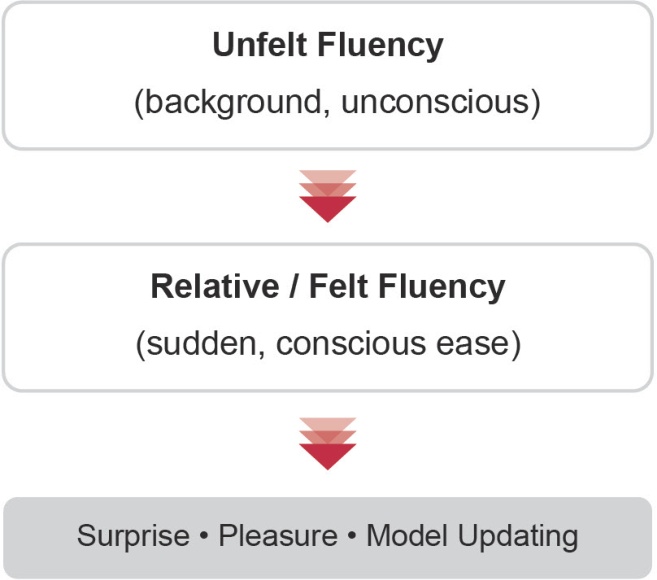
Flow from unfelt fluency to relative fluency and its experiential outcomes
Beyond theoretical accounts, recent empirical work has begun to examine the relationship between fluency and naturalness (Hwang & Cho, 2025). This study investigated AI-generated spatial imagery, measuring fluency via response times and naturalness via subjective ratings. Its findings showed that familiarity was the strongest predictor of perceived naturalness, while naturalness in turn predicted aesthetic pleasure. Importantly, this effect was amplified when responses were faster, suggesting that processing fluency indirectly contributes to the aesthetic impact of naturalness.
Taken together, these accounts suggest that processing fluency serves as the underlying cognitive mechanism of naturalness, whereas naturalness denotes the experiential state that emerges from it. Importantly, this framework also allows us to distinguish two levels of naturalness: one arising from unfelt fluency—automatic, unconscious processing (perceptual naturalness)—and the other from relative fluency that becomes salient and consciously recognized (conceptual naturalness). This distinction, further elaborated in Section 4, provides a basis for explaining their different aesthetic consequences. While perceptual naturalness may result from effortless processing without necessarily leading to aesthetic pleasure, conceptual naturalness, often experienced as unexpectedly fluent, has a greater potential to elicit positively valenced aesthetic experiences.
3. The Cognitive Basis of Fluency
3. 1. Predicted Features in Visual Processing Streams
Fluency reflects the ease with which the brain processes stimuli, which, in predictive processing terms, corresponds to the degree to which sensory input matches internal predictions. A critical question then arises: What kinds of sensory input are most directly predicted by the brain? This section addresses this question by focusing on visual input, examining how the brain processes and anticipates visual stimuli through hierarchical pathways in the visual cortex, which extend from V1 to higher-order areas. As illustrated in Figure 2, the visual process is largely organized into two streams: the ventral stream, responsible for object recognition, and the dorsal stream, specialized in motion and spatial processing.
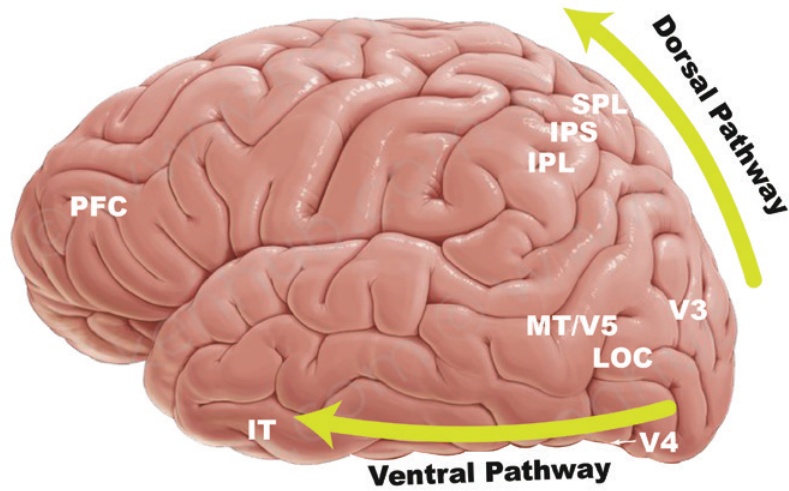
Ventral and dorsal visual pathways. Adapted from Kenhub (2025, August 25)
Visual information in the ventral occipitotemporal pathway is progressively refined along a hierarchical stream. Early in this pathway, area V4 detects contour orientation and curvature, providing the basis for pattern recognition (Connor et al., 2007). The lateral occipital cortex (LOC) then integrates size, depth, color, and shape into abstract object representations, responding more strongly to intact stimuli than to scrambled ones (Grill-Spector et al., 1999; Kourtzi & Kanwisher, 2001; Konen & Kastner, 2008). At higher stages, the inferior temporal (IT) cortex further refines recognition by selectively responding to familiar objects, thereby optimizing fluency through experience-dependent tuning (Freedman et al., 2005).
The dorsal stream complements the ventral stream by analyzing dynamic and spatial information, which is essential for inferring the three-dimensional structure of objects (Erlikhman et al., 2016). Key components include the V3A region, which processes dynamic forms including optic flow (McKeefry et al., 2008), and the middle temporal area (MT/V5), which is specialized for global motion patterns such as radial expansion and rotation (Wall et al., 2008). Higher up, the intraparietal sulcus (IPS) within the posterior parietal cortex (PPC) encodes depth and spatial configuration, contributing to coherent 3D representations (Freud et al., 2016; Freud et al., 2018; Ayzenberg & Behrmann, 2022). The superior and inferior parietal lobules (SPL, IPL) are also involved in mental rotation tasks, with activity increasing in proportion to rotational demands, supporting perceptual constancy across viewpoints (Gauthier et al., 2002).
In summary, visual fluency depends on the brain’s predictive capacity across specialized regions. The ventral stream abstracts object features like shape and identity, while the dorsal stream encodes motion and spatial structure. These pathways operate interactively to generate visual experiences that match predictions. When stimuli align with such predictions, they are processed more efficiently and interpreted as natural, underscoring the perceptual foundation of naturalness. A summary of visual information types and their associated brain regions is provided in Table 1 below.
Visual features and functions across processing stream
3. 2. Mechanisms of efficient visual processing
The previous section examined hierarchical visual processing, but the visual system does not treat every stimulus as a new, sequential input. Instead, it processes information through recurrent interactions across multiple regions within and between the visual pathways. This enables the system to bypass unnecessary processing routes for familiar or predictable input, thereby improving efficiency. To understand fluency in the visual system, it is essential to examine how the pathways interact with each other and higher-level cognitive areas.
The ventral pathway, specialized in detailed object identification, often operates slowly and with high resource demands due to its reliance on fine-grained visual information (Kravitz et al., 2013). Its efficiency, however, can be enhanced for object categories that are either biologically predisposed (e.g., faces or bodies) or strongly reinforced through learning. In such cases, ventral stream processing is guided by top-down category templates, reducing reliance on exhaustive bottom-up detail extraction (Freedman et al., 2005). This efficiency reflects the joint contribution of innate predispositions and learned experience, allowing natural and everyday objects to be recognized fluently and with minimal effort.
In contrast, the dorsal stream excels at rapidly processing motion, contrast, and coarse structural cues from the magnocellular system, which is tuned to low spatial frequencies and transient changes (Freud et al., 2015). Low spatial frequency inputs are rapidly processed through early visual areas and may be relayed to higher-order regions such as the prefrontal cortex, where initial interpretations of objects and scenes are formed based on coarse structure (Bar, 2004; Hochstein & Ahissar, 2002). These top-down predictions are thought to constrain detailed analysis in the ventral stream, facilitating recognition by integrating coarse and fine information in the IT cortex (Hegdé, 2008). Supporting this view, recent EEG research shows that the dorsal stream contributes to object recognition by transmitting coarse identity cues to the ventral stream at early stages of processing (Ayzenberg et al., 2023).
Furthermore, the recurrent processing mechanism in the visual system suggests that higher-level cognitive processes, such as semantic knowledge and prior experiences, interact with and modify signals at lower levels of the visual system (O’Reilly et al., 2013). Studies have shown that this interplay facilitates object identification and leads to faster responses through learning and familiarity (Ahissar & Hochstein, 1993; Hochstein & Ahissar, 2002). In addition, empirical evidence suggests that conceptual knowledge can influence the perception of visual categories, making them appear more similar or different, regardless of their actual visual similarities (Lupyan & Spivey, 2008; Lupyan, 2012). The blue dashed lines in Figure 3 schematically indicate these mechanisms of efficient visual processing.
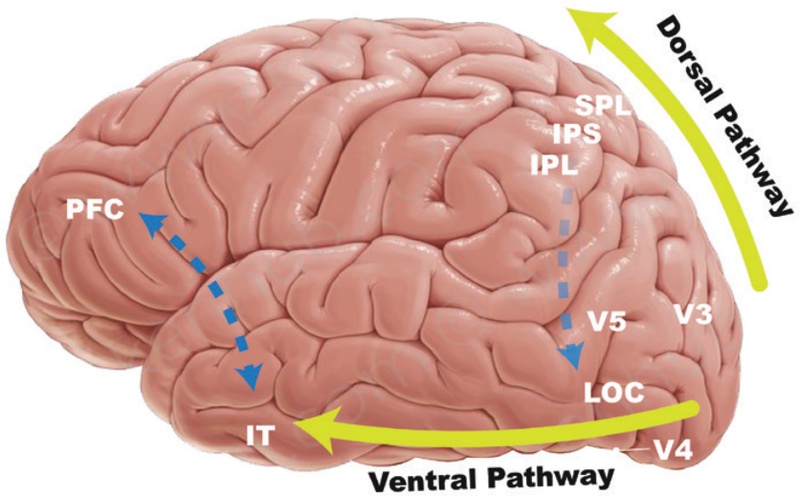
Dorsal-ventral interactions with recurrent processing. Adapted from Kenhub (2025, August 25)
Taken together, these findings suggest that the brain often prioritizes categorical familiarity, global structural cues, and contextual coherence before analyzing local details. From this perspective, the perception of naturalness reflects not the mere outcome of precise visual analysis, but the experience that arises when sensory input aligns with structural and contextual expectations, enabling meaning to be processed more rapidly and fluently. Categorical familiarity and structural cues foster perceptual fluency, while contextual coherence enables conceptual fluency. This distinction clarifies how naturalness can arise at both the perceptual and conceptual levels, a theme further elaborated in the following chapter.
4. Discussion
4. 1. Perceptual and Conceptual Naturalness
The account of visual processing outlined above suggests two primary routes to processing fluency. First, perceptual fluency arises when a stimulus contains perceptual cues that the visual system can readily process. Second, conceptual fluency occurs when a stimulus is conceptually easy to interpret, allowing recognition to bypass or guide detailed visual analysis. In this study, experiences based on perceptual fluency are defined as perceptual naturalness, whereas those grounded in conceptual fluency are defined as conceptual naturalness. Table 3 provides a schematic overview of how these two forms of fluency contribute to the experience of naturalness through distinct processing routes.
Perceptual and conceptual routes to naturalness in design
Perceptual naturalness often arises from stimuli grounded in salient perceptual cues. Prototypical features that signal categorical familiarity (e.g., feathers, wings, and a beak for a bird) are processed efficiently in the ventral pathway (Kravitz et al., 2013), while global attributes such as motion and coarse structural patterns are rapidly registered in the dorsal pathway (Freud et al., 2015; Ayzenberg et al., 2023). Together, these cues enhance fluency and support efficient object identification. The perceptual cues are often experienced directly, without conscious awareness of the category, and can evoke what feels like an ontological sense of necessity that things must appear in this way. Conversely, deviations from such expectations frequently lead to awkwardness or negative aesthetic judgments. (Halberstadt & Winkielman, 2014).
By contrast, conceptual naturalness arises from stimuli that maintain contextual coherence. Visual artworks, digital environments, or science fiction films, though unrealistic, can still be experienced as natural when conceptually integrated. This process aligns with predictive coding accounts, whereby novel inputs are assimilated into familiar categories through top-down predictions from the prefrontal cortex. Such integration refines predictive models and is proposed to generate reward signals that are experienced as intrinsically pleasurable (Yoo et al., 2024; Brielmann & Dayan, 2022). Unlike perceptual naturalness, which conveys necessity, conceptual naturalness conveys plausibility and is grounded in interpretability and coherence.
Taken together, the distinction between perceptual and conceptual naturalness not only clarifies the cognitive basis of naturalness but also provides a bridge to traditional discourses. Korean aesthetics has understood naturalness as the enhancement of appearance without drawing conscious attention. This view resonates with the implicit and automatic qualities of perceptual naturalness. Because perceptual naturalness refers to an unconscious mode of perception, it provides a basis for understanding the ontological sense of naturalness discussed in philosophy and environmental ethics. More importantly, by introducing the notion of conceptual naturalness, the present study broadens this framework to explain aesthetic experiences of naturalness in artificially constructed contexts, particularly within the arts and design.
4. 2. Applying Naturalness to Design Strategies
Designing for naturalness becomes particularly relevant when users encounter unnaturalness, that is, when stimuli disrupt perceptual processing or clash with contextual expectations. In such cases, naturalness can be restored through two complementary strategies: (a) enhancing perceptual fluency by reducing visual disruption and minimizing attentional load, and (b) enhancing conceptual fluency by strengthening semantic coherence so that even physically implausible stimuli feel appropriate within context.
Designers should first identify whether the sense of unnaturalness stems from perceptual disfluency or conceptual disfluency, and which type of fluency is more likely to be disrupted in each domain. Perceptual disfluency arises when ventral-stream processing is overloaded with excessive local detail or inconsistency; in such cases, reinforcing ventral-stream cues such as prototypical features, along with dorsal-stream cues such as holistic proportion and structural coherence, helps restore perceptual naturalness. By contrast, conceptual disfluency typically occurs in novel or artificial contexts where meaning or function fails to align with perceptual realism, for instance, in domains such as robotics and animation. When new stimuli are successfully reinterpreted within a coherent semantic framework, relative fluency is achieved, transforming disfluency into a sense of plausibility that may even lead to aesthetic pleasure.
In practice, naturalness is challenged in different ways across domains, and design strategies must therefore be adapted accordingly. The following cases illustrate how these principles can be applied.
- • UX/UI design: In task-oriented interfaces, conceptual fluency (clarity of meaning and function) is more critical than perceptual richness. Apple’s shift away from the “liquid glass” UI, characterized by excessive transparency and glossy refraction, illustrates how visual richness can compromise naturalness. The frosted interface reduced perceptual distraction, reinforced semantic coherence, and restored a more natural user experience.
- • Product design (automobiles): BMW’s radical resizing of the radiator grille disrupted perceptual f luency by drawing ventral-stream attention to disproportionate local features. A better approach is to reinforce dorsal-stream cues, balanced structural proportions, through design elements such as surface treatments, lighting, and material contrasts that accentuate holistic form. Such strategies restore a sense of naturalness without overburdening local detail processing.
- • Product design (humanoid robots and robotics): Pursuing excessive perceptual realism in robotic faces can overload ventral-stream processing and trigger the uncanny valley. Boston Dynamics’ robotic dog Spot exemplifies a more effective balance: it maintains conceptual fluency by clearly signaling a non-human identity, while enhancing perceptual fluency through dorsal-stream cues such as globally coherent, dog-like motion. Together, these qualities make its behavior feel intuitively natural.
- • Digital spatial design (e.g., cinematic worlds): In Avatar, the novel design of planet Pandora draws upon structural analogies to the Earth’s flora and fauna. Their forms are further reinforced through dorsal-stream cues such as bioluminescence and global motion, which enhance perceptual fluency at a holistic level. At the same time, narrative context provides conceptual fluency, enabling viewers to perceive even physically implausible environments as “natural” within the film’s fictional logic.
Taken together, these examples demonstrate that naturalness is not achieved by adhering to a single, universal rule but by diagnosing the source of disfluency and selectively applying perceptual or conceptual strategies depending on the context.
4. 3. Limitations and Future Research
This study has two main limitations that also indicate directions for future research. First, although we refer to recent empirical work linking fluency and naturalness, the current study relies primarily on conceptual reasoning. More systematic empirical research, employing diverse behavioral (e.g., response time), physiological (e.g., EEG, skin conductance), and user-centered methods (e.g., surveys, interviews), is needed to validate and extend the proposed framework across different contexts.
Second, while this study acknowledges the ethical risks of naturalness in design, it does not examine them in depth. Because natural experiences often feel effortless and persuasive, they may reduce users’ critical distance and blur the boundary between authenticity and manipulation. Future research should investigate these ethical implications more systematically, so that design strategies informed by fluency theory are applied responsibly.
5. Conclusion
This study reinterprets naturalness not as an abstract concept but as a cognitive experience shaped by processing fluency. While earlier traditions framed naturalness as a philosophical or normative value (e.g., Daoism, environmental ethics) or as a sensory aesthetic in Korean thought, this study extends the concept into artificial contexts such as digital environment design.
Across traditions and practices, what is perceived as “natural” often coincides with what is processed fluently, whether perceptually or conceptually. Drawing on predictive processing and fluency theory, we argue that naturalness emerges when sensory input or meaning aligns efficiently with internal expectations, thereby reducing cognitive effort and heightening affective salience.
More specifically, we distinguish perceptual fluency, arising from unconscious processing that makes stimuli feel effortless, from conceptual fluency, arising from consciously recognized ease of meaning integration. Accordingly, two design strategies follow: (1) enhancing perceptual fluency by emphasizing easily processed cues, and (2) reinforcing conceptual fluency by strengthening semantic coherence over physical realism.
By reframing naturalness as a cognitive construct, this study clarifies its underlying mechanisms and offers practical design strategies. It suggests that perceptual and conceptual fluency should be prioritized in creating experiences that feel both natural and aesthetically engaging in contemporary digital and technological contexts.
Notes
Copyright : This is an Open Access article distributed under the terms of the Creative Commons Attribution Non-Commercial License (http://creativecommons.org/licenses/by-nc/3.0/), which permits unrestricted educational and non-commercial use, provided the original work is properly cited.
References
-
Ahissar, M., & Hochstein, S. (1993). Attentional control of early perceptual learning. Proceedings of the National Academy of Sciences, 90(12), 5718-5722.
[https://doi.org/10.1073/pnas.90.12.5718]

-
Ayzenberg, V., & Behrmann, M. (2022). The dorsal visual pathway represents Object-Centered spatial relations for object recognition. Journal of Neuroscience, 42(23), 4693-4710.
[https://doi.org/10.1523/jneurosci.2257-21.2022]
-
Ayzenberg, V., Simmons, C., & Behrmann, M. (2023). Temporal asymmetries and interactions between dorsal and ventral visual pathways during object recognition. Cerebral Cortex Communications, 4(1).
[https://doi.org/10.1093/texcom/tgad003]
-
Baker, W. E. (1999). When can affective conditioning and mere exposure directly influence brand choice? Journal of Advertising, 28(4), 31-46.
[https://doi.org/10.1080/00913367.1999.10673594]
-
Bar, M. (2004). Visual objects in context. Nature Reviews. Neuroscience, 5(8), 617-629.
[https://doi.org/10.1038/nrn1476]
-
Bertamini, M., Rampone, G., Makin, A. D., & Jessop, A. (2019). Symmetry preference in shapes, faces, flowers and landscapes. PeerJ, 7, e7078.
[https://doi.org/10.7717/peerj.7078]
-
Brielmann, A. A., & Dayan, P. (2022). A computational model of aesthetic value. Psychological review, 129(6), 1319.
[https://doi.org/10.1037/rev0000337]
-
Brouillet, D., & Friston, K. (2023). Relative fluency (unfelt vs felt) in active inference. Consciousness and Cognition, 115, 103579.
[https://doi.org/10.1016/j.concog.2023.103579]
-
Cho, B. S. (2016). A study of Korean naturalistic beauty through Yi-Seak's "ChunInMuGan" ideology. Dongyang Yesul, 32, 333-357.
[https://doi.org/10.19078/ea.2016.32.13]
-
Connor, C. E., Brincat, S. L., & Pasupathy, A. (2007). Transformation of shape information in the ventral pathway. Current Opinion in Neurobiology, 17(2), 140-147.
[https://doi.org/10.1016/j.conb.2007.03.002]
-
Cutting, J. E. (2003). Gustave Caillebotte, French impressionism, and mere exposure. Psychonomic Bulletin & Review, 10(2), 319-343.
[https://doi.org/10.3758/BF03196493]
-
Erlikhman, G., Gurariy, G., Mruczek, R. E., & Caplovitz, G. P. (2016). The neural representation of objects formed through the spatiotemporal integration of visual transients. NeuroImage, 142, 67-78.
[https://doi.org/10.1016/j.neuroimage.2016.03.044]
-
Freedman, D. J., Riesenhuber, M., Poggio, T., & Miller, E. K. (2005). Experience-Dependent sharpening of visual shape selectivity in inferior temporal cortex. Cerebral Cortex, 16(11), 1631-1644.
[https://doi.org/10.1093/cercor/bhj100]
-
Freud, E., Ganel, T., Shelef, I., Hammer, M. D., Avidan, G., & Behrmann, M. (2015). Three-Dimensional Representations of Objects in Dorsal Cortex are Dissociable from Those in Ventral Cortex. Cerebral Cortex, 27(1), 422-434.
[https://doi.org/10.1093/cercor/bhv229]
-
Freud, E., Plaut, D. C., & Behrmann, M. (2016). 'What' is happening in the dorsal visual pathway. Trends in Cognitive Sciences, 20(10), 773-784.
[https://doi.org/10.1016/j.tics.2016.08.003]
-
Freud, E., Robinson, A. K., & Behrmann, M. (2018). More than Action: The Dorsal Pathway Contributes to the Perception of 3-D Structure. Journal of Cognitive Neuroscience, 30(7), 1047-1058.
[https://doi.org/10.1162/jocn_a_01262]
-
Friston, K. (2010). The free-energy principle: a unified brain theory? Nature Reviews. Neuroscience, 11(2), 127-138.
[https://doi.org/10.1038/nrn2787]
-
Gauthier, I., Hayward, W. G., Tarr, M. J., Anderson, A. W., Skudlarski, P., & Gore, J. C. (2002). BOLD Activity during Mental Rotation and Viewpoint-Dependent Object Recognition. Neuron, 34(1), 161-171.
[https://doi.org/10.1016/s0896-6273(02)00622-0]
-
Grill-Spector, K., Kushnir, T., Edelman, S., Avidan, G., Itzchak, Y., & Malach, R. (1999). Differential processing of objects under various viewing conditions in the human lateral occipital complex. Neuron, 24(1), 187-203.
[https://doi.org/10.1016/S0896-6273(00)80832-6]
-
Halberstadt, J. (2006). The generality and ultimate origins of the attractiveness of prototypes. Personality and Social Psychology Review, 10(2), 166-183.
[https://doi.org/10.1207/s15327957pspr1002_5]
-
Halberstadt, J., & Winkielman, P. (2014). Easy on the eyes, or hard to categorize: Classification difficulty decreases the appeal of facial blends. Journal of Experimental Social Psychology, 50, 175-183.
[https://doi.org/10.1016/j.jesp.2013.08.004]
-
Hegdé, J. (2008). Time course of visual perception: Coarse-to-fine processing and beyond. Progress in Neurobiology, 84(4), 405-439.
[https://doi.org/10.1016/j.pneurobio.2007.09.001]
-
Hochstein, S., & Ahissar, M. (2002). View from the Top. Neuron, 36(5), 791-804.
[https://doi.org/10.1016/s0896-6273(02)01091-7]
- Hong, J. S. (2016). A study on the reinterpretation and transformation of traditional Buncheong in Korean contemporary ceramics after 1990s. Journal of Basic Design & Art, 17(5), 613-627.
-
Hwang, Y. J., & Cho, T. Y. (2025). How Familiarity and Fluency Shape Perceived Naturalness and Aesthetic Pleasure in Digital Spatial Images. Archives of Design Research, 38(3), 131-147.
[https://doi.org/10.15187/adr.2025.08.38.3.131]
-
Konen, C. S., & Kastner, S. (2008). Two hierarchically organized neural systems for object information in human visual cortex. Nature neuroscience, 11(2), 224-231.
[https://doi.org/10.1038/nn2036]
-
Kourtzi, Z., & Kanwisher, N. (2001). Representation of perceived object shape by the human lateral occipital complex. Science, 293(5534), 1506-1509.
[https://doi.org/10.1126/science.1061133]
-
Kravitz, D. J., Saleem, K. S., Baker, C. I., Ungerleider, L. G., & Mishkin, M. (2013). The ventral visual pathway: an expanded neural framework for the processing of object quality. Trends in Cognitive Sciences, 17(1), 26-49.
[https://doi.org/10.1016/j.tics.2012.10.011]
- Kwon, Y. P. (2005). Hangug-ui mi-reul dasi ilgeunda: 12in-ui mihakjadeul-eul tonghae bon Hangug miron 100-nyeon [Rereading Korean aesthetics: A hundred years of discourse through twelve aestheticians]. Dolbegae.
-
Laozi. (2018). Dao de jing (W. Kim, Trans.). Hyeonamsa.
[https://doi.org/10.2307/j.ctvq4c02h]
-
Lee, D. (2021). Exploring the concept of naturalness. The Korean Journal of Animation, 17(2), 86-108.
[https://doi.org/10.51467/asko.2021.06.17.2.86]
-
Lupyan, G. (2012). Linguistically Modulated Perception and Cognition: the Label-Feedback hypothesis. Frontiers in Psychology, 3.
[https://doi.org/10.3389/fpsyg.2012.00054]
-
Lupyan, G., & Spivey, M. J. (2008). Perceptual processing is facilitated by ascribing meaning to novel stimuli. Current Biology, 18(10), R410-R412.
[https://doi.org/10.1016/j.cub.2008.02.073]
-
McKeefry, D. J., Burton, M. P., Vakrou, C., Barrett, B. T., & Morland, A. B. (2008). Induced deficits in speed perception by transcranial magnetic stimulation of human cortical areas V5/MT+ and V3A. Journal of Neuroscience, 28(27), 6848-6857.
[https://doi.org/10.1523/jneurosci.1287-08.2008]
-
O'Reilly, R. C., Wyatte, D., Herd, S., Mingus, B., & Jilk, D. J. (2013). Recurrent Processing during Object Recognition. Frontiers in Psychology, 4.
[https://doi.org/10.3389/fpsyg.2013.00124]
-
Reber, R., Schwarz, N., & Winkielman, P. (2004). Processing fluency and aesthetic pleasure: Is beauty in the perceiver's processing experience? Personality and Social Psychology Review, 8(4), 364-382.
[https://doi.org/10.1207/s15327957pspr0804_3]
-
Rhodes, G., Maloney, L. T., Turner, J., & Ewing, L. (2007). Adaptive face coding and discrimination around the average face. Vision Research, 47(7), 974-989.
[https://doi.org/10.1016/j.visres.2006.12.010]
-
Ridder, B. (2007). An exploration of the value of naturalness and wild nature. Journal of Agricultural and Environmental Ethics, 20(2), 195-213.
[https://doi.org/10.1007/s10806-006-9025-6]
- Russon, M.-A. (2018, October 20). K-beauty: The rise of Korean make-up in the West. BBC News. https://www.bbc.com/news/business-45820671.
-
Siipi, H. (2008). DIMENSIONS OF NATURALNESS. Ethics & the Environment/Ethics and the Environment, 13(1), 71-103.
[https://doi.org/10.2979/ete.2008.13.1.71]
- Slingerland, E. (2007). Effortless action: Wu-wei as conceptual metaphor and spiritual ideal in early China. Oxford University Press.
-
Unkelbach, C., & Greifeneder, R. (2013). A general model of fluency effects in judgment and decision making. In The experience of thinking (pp. 11-32). Psychology Press.
[https://doi.org/10.4324/9780203078938]
-
Wall, M. B., Lingnau, A., Ashida, H., & Smith, A. T. (2008). Selective visual responses to expansion and rotation in the human MT complex revealed by functional magnetic resonance imaging adaptation. European Journal of Neuroscience, 27(10), 2747-2757.
[https://doi.org/10.1111/j.1460-9568.2008.06249.x]
-
Whittlesea, B. W., & Williams, L. D. (1998). Why do strangers feel familiar, but friends don't? A discrepancy-attribution account of feelings of familiarity. Acta Psychologica, 98(2-3), 141-165.
[https://doi.org/10.1016/s0001-6918(97)00040-1]
-
Winkielman, P., Halberstadt, J., Fazendeiro, T., & Catty, S. (2006). Prototypes are attractive because they are easy on the mind. Psychological Science, 17(9), 799-806.
[https://doi.org/10.1111/j.1467-9280.2006.01785.x]
- Yeon, T. G., & Lee, Y. S. (2003). An analysis of aesthetic characteristics of Gyeongbokgung from a viewpoint of relationship. Journal of the Korean Institute of Interior Design, 38, 38-47.
-
Yoo, J., Jasko, K., & Winkielman, P. (2023). Fluency, prediction and motivation: how processing dynamics, expectations and epistemic goals shape aesthetic judgements. Philosophical Transactions of the Royal Society B Biological Sciences, 379(1895).
[https://doi.org/10.1098/rstb.2023.0326]
-
Yoon, J. Y., & Jang, J. Y. (2019). The aesthetic characteristics of Korean paintings from the view of natural beauty: Focused on the paintings from the late Joseon dynasty to modern Korean paintings. The Korean Society of Science & Art, 37(5), 249-263.
[https://doi.org/10.17548/ksaf.2019.12.30.249]
-
Zajonc, R. B. (1968). Attitudinal effects of mere exposure. Journal of personality and social psychology, 9(2p2), 1.
[https://doi.org/10.1037/h0025848]