
Developing a Narrative-Centric Spiral Model for Digital Fashion Design in Metaverse Entertainment
Abstract
Background As digital fashion design evolves within the metaverse entertainment industry, the need for structured process models for narrative content planning and implementation becomes more apparent. Accordingly, this study aims to develop a systematic digital fashion design process model tailored to the metaverse context, with a focus on integrating narrative-driven design elements.
Methods This study introduces the Narrative-Centric Spiral Digital Fashion (NSDF) Design Process Model, specifically developed to address the unique elements and stages of digital fashion design within the metaverse environment. The model was validated through expert evaluation interviews and comparative case analysis, assessing its systematization and applicability.
Results The NSDF Design Process Model is expected to foster the development of immersive, aesthetically distinct digital fashion content, guided by a consistent narrative framework. The model also supports risk analysis, timely decision-making, and promotes collaborative interactions, resulting in stable, executable outcomes within the metaverse.
Conclusions This study proposes the Narrative-Centric Spiral Digital Fashion (NSDF) Design Process Model, specifically optimized for metaverse entertainment through the systematic integration of narrative-driven planning, iterative prototyping, and collaborative workflows grounded in 3D production processes. The study lays a foundation for both theoretical advancement and practical application in digital fashion design. This research presents a systematic process model that synthesizes diverse perspectives, highlighting an interdisciplinary approach to digital fashion design in metaverse entertainment.
Keywords:
Digital Fashion, Metaverse Entertainment, Narrative, Design Process Model, Spiral Process1. Introduction
In the metaverse entertainment industry, digital fashion design serves as both digital narrative content and an asset, offering users new experiences while maintaining an independent process structure and interactive elements for planning and technological implementation (Makryniotis, T., 2018; Joy, A., et al., 2022; Mogaji et al., 2024). The domain of digital fashion holds significant potential for expansion, driven by advancements in the metaverse entertainment environment (Makryniotis, T., 2018; Särmäkari, N., 2023).
As digital fashion design in the metaverse entertainment sector involves a highly collaborative process integrating multiple disciplines, it requires enhanced cooperation and communication among stakeholders. To ensure an efficient and stable workflow, a set of guidelines is necessary for the visual standardization of complex processes. Moreover, in the metaverse, narrative plays a crucial role in shaping the user’s experience, as it connects virtual identities, storytelling, and immersive experiences (Frasca, G. 2001; Tekinbaş, K. S, & Zimmerman, E. 2003; Schell, J. 2008; Wendy, D. 2014). Therefore, the integration of narrative elements into the design process is essential for creating deeper, more meaningful interactions between users and digital fashion.
Despite these industrial transformations and emerging needs, digital fashion design has predominantly been examined from the perspective of technological utility within the fashion industry (Makryniotis, 2015; Porterfield & Lamar, 2021). As the metaverse entertainment sector continues to evolve, further research on digital fashion design processes from an entertainment perspective is essential.
Accordingly, the objective of this study was to develop and propose a systematic digital fashion design process tailored to the metaverse entertainment environment by deriving digital fashion design outcomes as digital content and emphasizing the integration of narrative-driven design elements. Based on the previous studies, we developed a process model and refined it through expert interviews and case analyses, ultimately proposing the final Model for Digital Fashion Design in Metaverse Entertainment. The findings of this study serve as foundational research for narrative-driven digital fashion design within the metaverse entertainment industry and contribute to exploring new possibilities for digital fashion design content.
2.Literature Review
2. 1. Digital Narrative and Persona Design
With advancements in media technology, narratives are integrated with digital elements such as sound, graphic motion, and interactive features, offering immersive and emotionally engaging experiences across various genres (Novak, J. 2022). In particular, digital narratives in games serve as a core element that determines the overall direction, linking technology, aesthetics, and mechanics to establish a unique narrative structure. Based on this, characters are developed to help players understand the game and experience immersive enjoyment (Frasca, G. 2001; Tekinbaş, K. S. and Zimmerman, E. 2003; Schell, J. 2008; Wendy, D. 2014).
In narrative-based design, designers are not merely creators but also storytellers, playing a crucial role in visually implementing narratives (Meggs, 1992; Meron, 2024). Narrative in the design process helps provide memorable information, empathy, and delight, enriching the user experience. It follows a three-step process focusing on narrative elements, types of narrative use, and functions in design (Grimaldi et al., 2013). With the advancement of media, narrative design has spread as a metaphorical mode of communication that closely integrates storytelling and design elements, offering consumers a consistent emotional experience and lasting memories. However, the narrative design method is rarely used in the digital fashion design process. Therefore, this study adopted the narrative design method to develop the digital fashion design process model based on narrative for the metaverse entertainment environment.
Personas are virtual prototypes that articulate design direction, foster user empathy, and support user-centered design by focusing on clearly defined target users. (Cooper, 1999; Pruitt and Adlin, 2010). Their configuration shifts according to design objectives, and when integrated with narrative scenarios, they enhance character realism and extend usability from immersive storytelling to brand communication (Chang et al., 2008; Herskovitz and Crystal, 2010).
Thus, personas translate abstract user needs into tangible outcomes, supporting a coherent design process. However, their use in fashion design remains limited, indicating a need for methodological development (Lee et al., 2024). In the metaverse entertainment context, a systematic persona-based design framework that integrates diverse domains and perspectives is essential to support a coherent and structured development process.
2. 2. Metaverse Entertainment and Digital Fashion
The metaverse, a 3D internet-based virtual space connecting physical and digital worlds, enables new forms of self-expression and immersive media experiences (Smart et al., 2007; Hackl & Buzzell, 2021; Park & Lim, 2023). This emerging technology has profoundly shaped the entertainment industry, which has historically evolved through art and media (Dyer, 2005; Vogel, 2020). With the advancement of internet-based digital media content, the entertainment industry has undergone significant transformations in content creation (Van & Poe, 2012; Vogel, 2020). The metaverse entertainment industry, offering diverse content, has expanded its unique scope and position while maintaining a symbiotic relationship with the fashion industry, providing new content and experiences. Moreover, the metaverse entertainment environment serves as a new space that validates the value of digital fashion design, establishing a communication structure and stakeholder distinct from those of the fundamental fashion industry (Joy et al., 2022; Mogaji et al., 2024). Therefore, digital fashion design within the metaverse must be treated as a unique form of content, necessitating a specialized process model tailored to its characteristics.
2. 3. Digital Fashion Design Process
Digital fashion design processes have evolved to accommodate contemporary demands, introducing various approaches beyond linear workflows. The fashion visualization process in digital fashion design involves overlapping stages, including avatar creation, 2D pattern development, and material texturing (Makryniotis, 2015). Alternatively, some processes adopt a circulation model, where stages such as design confirmation, garment functionality and fit assessment, and design decision-making are structured to facilitate rapid concept realization (Porterfield & Lamar, 2021). Additionally, a divergent and circulation process has been proposed, where key concepts guide the iterative expansion and refinement of process stages (Lee et al., 2023). These iterative interactions with stakeholders enable continuous modifications and enhancements to garment design, while the integration of 3D virtual fitting technology optimizes the prototyping stage, reducing material consumption and enhancing efficiency. As digital fashion design continues to expand across a broad spectrum—from 3D wear simulation to digital fashion content—its domains have become increasingly specialized (Sayem, 2022). While optimized design process models have been proposed, there remains a lack of a narrative-driven digital fashion design management model that can be effectively implemented within the metaverse entertainment environment, where complex and dynamic content demands must be met.
2. 4. 3D modeling production
The production process of entertainment content based on 3D modeling, which effectively constructs 3D object structures using polygon meshes(Russo, 2006; Klawonn, 2012), is categorized into three stages: pre-production, production, and post-production. Each stage is interlinked with the previous one, encompassing a detailed implementation process and specific components, from polygon mesh creation to animation rigging (Beane, 2012). Subsequently, a texturing process enhances the realism of the developed 3D model by applying digital textures that closely resemble actual materials (Luna, 2012; Ahearn, 2014). At this stage, normal mapping, derived from normal vector calculations and lighting computations, improves the realism and dimensionality of models created with a minimal number of polygons meshes (Unity, 2025). Furthermore, based on anatomical references, body segmentation is performed on objects, followed by rigging, which substitutes for skeletal structures, generating dynamic motion data such as selection, movement, and rotation through animation and rigging processes (Beane, 2012). Since each stage of modeling development serves as a source for subsequent processes, these stages are independently executed yet closely interlinked in a collaborative workflow. Additional elements such as special effects and sound effects are incorporated to refine the final output.
2. 5. Spiral Development Process
The Spiral model is a recent software development approach emphasizing continuous risk assessment and iterative prototyping, which enhances flexibility and adaptability throughout the process (Boehm, 1988) (Figure 1). It comprises four stages: goal setting and requirements analysis, iterative risk management, development and verification, and client review. Each stage builds on the previous one, enabling adaptive responses when goals or requirements are unclear. The model’s structure, defined by two linear function axes forming four positioning areas, allows for systematic goal setting and outcome generation.
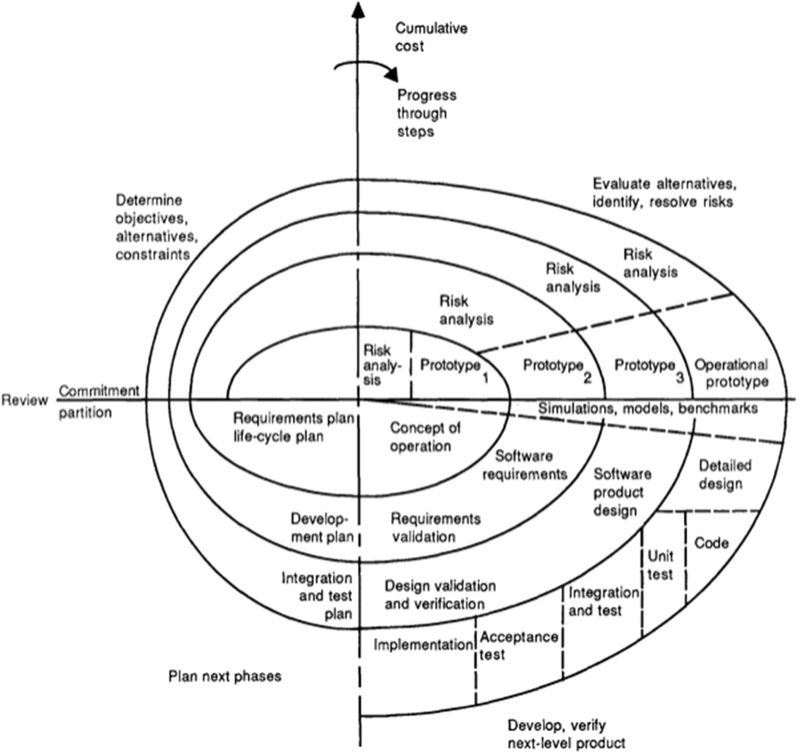
Spiral Software Development Process (Boehm, B. W., 1988)
Previous case studies show that the Spiral model effectively minimizes risks and manages quality in complex, large-scale projects requiring substantial time and resources (Hendrix & Schneider, 2002; Andersson & Runeson, 2007). Its iterative feedback loops facilitate timely revisions and informed decisions, making it well-suited for collaborative environments. However, the model works best when initial requirements are relatively clear; if requirements are highly uncertain or frequently changing, the overall structure may become unstable (Boehm, 1988). Furthermore, estimating costs and schedules accurately in complex, long‑term projects remains challenging (Mizell & Malone, 2007).
For developing a digital fashion design process in metaverse entertainment, this study adopts the Spiral model due to its capacity for stable execution in large-scale, collaborative projects through continuous prototyping and risk validation.
3. Development of NSDFβ Process Model
3. 1. NSDFβ Process Model design methods
The development of the NSDFβ Process Model involved designing the process model structure, process model stages, and the steps within each process stage. First, the structure of the process model was designed based on a literature review encompassing digital fashion, entertainment production modeling, software development processes, and narrative design processes. Second, the stages of the process model were structured by applying a spiral process model framework. The three-dimensional conceptual model was developed, integrating narrative design concepts with 3D modeling processes for the implementation of a metaverse entertainment environment. Third, the content of each process stage was composed by converging digital fashion design processes with entertainment and 3D modeling development processes.
3. 2. Objectives of Process Model Design
This study analyzed key elements, including the metaverse, entertainment, digital fashion design, computer-based processes, narrative, and persona. Based on the analysis of previous studies, it organized the objectives of process model development into structural and functional components tailored to the metaverse entertainment environment. The structural aspects included a 3D digital modeling process with repetitive structures for avatar fashion design, integrating elements like polygon mesh, texture, and animation. Experts in modeling, texturing, animation, and rigging collaborated through overlapping processes to create cumulative results. The model also incorporated a spiral structure for prototype production, risk analysis, and refinement, allowing for iterative improvements. Additionally, it expanded based on narrative to visualize consistent personas and characters. Functionally, dynamic animation and 3D modeling processes were designed for stable implementation within the metaverse environment, considering technical dynamics (Table 2)

Objectives and Structure of Process Model Development
NSDFβ Process Model Description
3. 3. Framework of the NSDFβ Process model based on the spiral model
The spiral three-dimensional framework of the NSDFβ Process Model is described as follows: First, the narrative setup is established along the vertical axis, with the character, story, and background extending through stages 1 to 4. All design elements maintain coherence and unity, guided by the narrative. Second, stages 2, 3, and 4 focus on prototype planning and visualization. Third, the process follows a spiral structure and expansion pattern, with prototype creation and refinement repeating across stages, influenced by the dynamics of the expanding narrative. Finally, the stages form a multi-layered, cumulative structure, with each stage building upon previous results and collaborative steps accumulating as the process advances from stage 1 to stage 4.
3. 4. Stage development of the NSDFβ Process Model
The tasks of the NSDFβ Process Model are organized into narrative establishment, character narrative planning, and the visual implementation of the character narrative, all based on a cumulative and multilayered structure (Figure 2). The stages and detailed tasks were structured based on previous studies, comprising a total of 22 tasks across four stages (Table 2), (Figure 3).
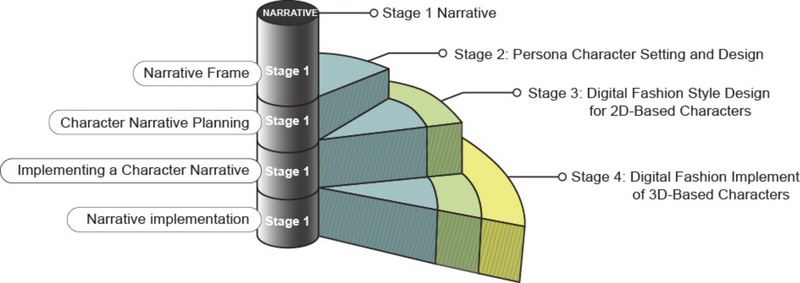
Cumulative and Multilayered Narrative Setup in the NSDFβ Process Model
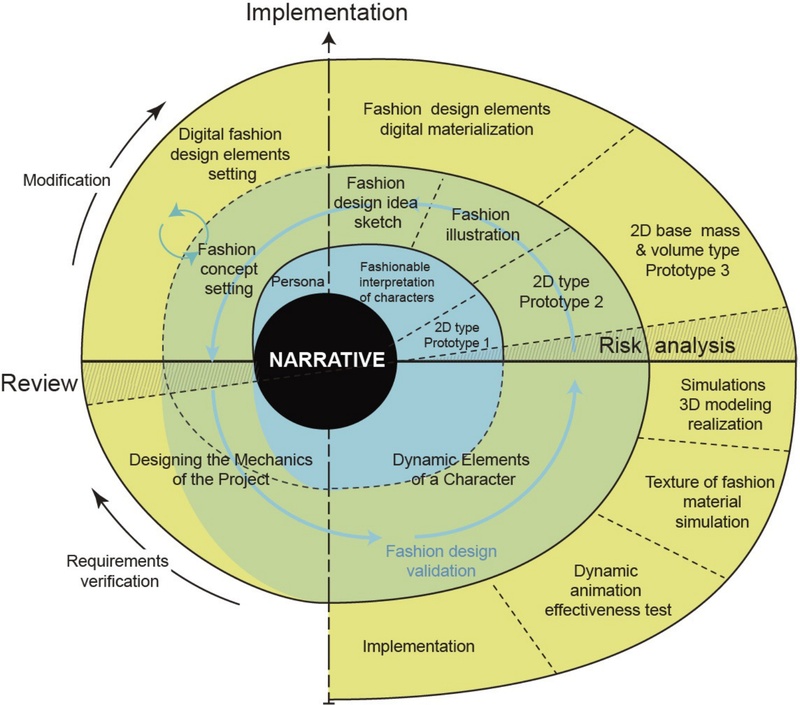
Top view of NSDFβ process model’s stage
The initial stage is focused on narrative setup, consisting of a single narrative step. The second stage is the persona character design planning phase, which is made up of six tasks. The third stage consists of seven steps for planning 2D-based digital fashion design. The fourth stage is composed of eight tasks for the 3D-based implementation of digital fashion. Unlike fundamental digital fashion design development stages, stages 1 and 2 reflect the objective that the final product must function as content within the metaverse entertainment environment, emphasizing narrative and persona planning. Additionally, stages 3 and 4 were designed to ensure stable technical implementation and execution as immersive digital fashion design content, incorporating the 2D-to-3D modeling-based digital fashion design process and entertainment production, which includes 3D modeling and 3D character modeling.
The NSDFβ Process Model visualizes the concept of narrative through digital fashion. This progression parallels how narrative texts in literature are interconnected with plausibility (verisimilitude), persuading the reader through the coherence of the story. Similarly, design elements are linked to the characteristics of the narrative’s characters, which, in turn, are connected to the established narrative’s background and key events.
The first narrative step is structured as a pre-planning step, aiming for the final digital fashion design outcome to be utilized as immersive content in the metaverse entertainment environment. This pre-planning step distinguishes itself from fundamental digital fashion design processes by systematically incorporating narrative elements from the initial design stage, enabling the creation of storytelling-based immersive digital fashion design content.
The second stage focuses on constructing the character narrative. This stage interprets fashion design based on narrative and persona, distinguishing it from fundamental digital fashion design processes. Additionally, unlike the production phase in conventional 3D production, this stage places the persona-based fashion design interpretation process before prototyping, facilitating the integrated aesthetic development of character design.
This stage focuses on developing digital fashion design for 2D-based characters. Unlike fundamental digital fashion design processes, this stage incorporates dynamic effects tailored to the metaverse entertainment environment, ensuring that the final output delivers an engaging and immersive experience. Additionally, before creating 2D prototypes, the fashion design concept is implemented through Fashion Design Idea Sketch and Fashion Illustration steps. This approach enables the development of cohesive visual identity and detailed design elements, ensuring that the fashion concept is fully realized before advancing to the next step. Additionally, the fashion design validation task considers both the aesthetic and technical aspects through repeated review and refinement in a micro-cycle process.
The fourth stage focuses on finalizing and implementing digital fashion design.
In this stage, prototypes are created based on the materialization elements of digital fashion design to ensure the stable implementation and execution of the final output. Using these prototypes, key technical elements such as textures and animations for 3D modeling are simulated and tested.
4. Evaluation Methods for the NSDFβ Process Model
The NSDFβ Process Model, developed through a review of existing literature, was first validated by digital fashion design experts to assess whether the key stages of the fashion design process were appropriately incorporated. Subsequently, a case study was conducted to identify gaps between the proposed process model and practical applications, and to evaluate its real-world applicability. Finally, interviews with metaverse entertainment planning experts were conducted to evaluate the structure of the NSDFβ Process Model and its feasibility and applicability within the context of metaverse entertainment production. To ensure the safety and ethical compliance of human subject research, the expert evaluation was conducted after obtaining approval from the Yonsei University Institutional Review Board (IRB, Approval Number: 7001988-202403-HR-2212-02). Based on these evaluations, the final NSDF Process Model was proposed (Figure 4).
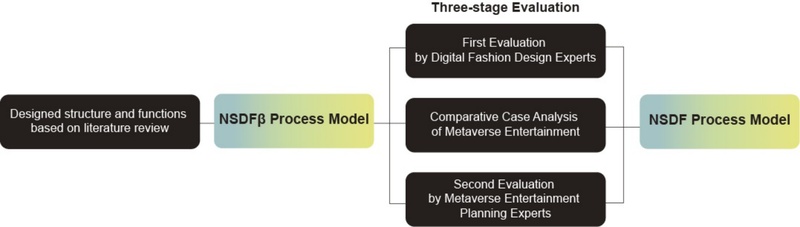
Evaluation Process for the NSDFβ Process Model
4. 1. First Expert Evaluation by Digital Fashion Design Experts
To assess the suitability of the NSDFβ Process Model from the perspective of digital fashion design, interviews were conducted with digital fashion design experts. The interview participants were selected as two fashion design professionals—doctoral degree holders with over seven years of experience in digital fashion design education and research, aged in their 40s (Table 1). The interviews were conducted in a semi-structured format through remote written responses. The interview questions evaluated the systematic structure of the NSDFβ Process Model’s stages and the extent to which its detailed steps faithfully reflect the digital fashion design development process.
4. 2. Second Expert Evaluation by Metaverse Entertainment Planning Experts
A second round of expert evaluation was conducted on the NSDFβ Process Model, focusing on both metaverse entertainment and digital fashion design. The objective of the interviews was to assess the systematic structure of the proposed process model and its applicability within the metaverse entertainment environment.
For this evaluation, five experts were recruited: two professionals with over three years of experience in metaverse entertainment production and three digital fashion designers with at least three years of industry experience (Table 3). All participants were selected based on their expertise in design processes and education. The interviews were conducted in a remote written format using semi-structured questions and consisted of both common questions and field-specific expert inquiries.
Profiles of the interviewed participants
To extract recurring patterns and structured insights from the interview responses, thematic analysis was employed using an inductive approach (Braun & Clarke, 2006). The modifications derived from the three-stage evaluation were comprehensively incorporated, which led to the finalization of the NSDFβ Process Model.
4. 3. Comparative Case Analysis with NSDFβ Process Model
A comparative case analysis was conducted by applying the NSDFβ Process Model to a case of character digital fashion design development within a metaverse entertainment environment. The study selected Avatar Dream, a metaverse virtual music show in Korea, which aired on TV Chosun on October 3, 2022 (Figure 5). The case was selected based on projects where digital fashion designers had access to both the planning process and the resulting digital fashion design outcomes, as they were actively involved in planning, production, and narrative development. This case exemplifies the meaningful application of narrative as a design development tool in character creation. The project was completed through 3D modeling and stage production, utilizing motion capture and advanced metaverse technologies, including augmented reality (Shin & Lee, 2023; TV Chosun, 2025).

Comparative case analysis of a Metaverse Virtual Music Show (TV Chosun, 2025).
In this study, the development process of one of the 24 virtual celebrity characters created for the metaverse music show was analyzed based on the NSDFβ Process Model, focusing on four implemented prototypes, as well as design development materials from digital fashion designers and digitally recorded meeting data among stakeholders. Additionally, character planning documents, idea research materials, design concept sketches, fashion illustrations, and the final broadcast footage were used as case analysis data.
The case analysis method involved segmenting the overall planning process, step-by-step tasks, and the roles and participation scope of digital fashion designers. Furthermore, it identified the collaborative relationships between stakeholders at each stage. The study also conducted a comparative analysis between the narrative development stages of the NSDFβ Process Model and those of the case study, identifying differences in stages, roles, and scope
5. Results of the NSDFβ Process Model evaluation
5. 1. Results of the First Expert Evaluation
To assess the NSDFβ Process Model from a digital fashion design perspective, experts evaluated its overall structure, sequential tasks, and integration of digital fashion design elements. The evaluation positively confirmed that the model reflects the digital fashion design development process and ensures systematic progress at each stage.
However, two suggestions for improvement were made:
First, it was suggested that the dynamic and mechanical aspects of stages 2 and 3 should be clarified further for each stage. Additionally, the overlapping steps, ‘Dynamic Elements of a Character’ and ‘Designing the Mechanics’ in stages 2 and 3 need to be differentiated.
- E1: ‘I think there is a need for revision and supplementation of the details in the Dynamic Elements of a Character/Designing the Mechanics step’.
- E2: ‘Since Stages 2 and 3 are cyclically linked, it seems necessary to organize and systematize the details of each process more distinctly’.
Second, experts proposed the inclusion of a design research stage that reflects the characteristics of the digital fashion design process.
- E2: ‘Steps typically included in the design process, such as problem recognition and goal setting, are omitted or absent. There is a lack of tasks generally covered in the fashion design process, such as topic analysis and prior research’.
Therefore, based on expert evaluation results, the process model needed to clearly define the content and goals to be addressed in each stage. This could help establish the conditions and standards for progressing to the next stage, ensuring that tasks in each stage are accurately recognized and facilitating a smooth transition. Such clarity would reduces confusion and unnecessary duplication, while enabling consistent development. Additionally, structuring well-defined fashion design research tasks in each stage could support the systematic progress of digital fashion design.
5. 2. Result of a Comparative Case Analysis and Evaluation
Through a case analysis of the detailed process, including narrative development, character persona creation, fashion design concepts, prototype expression styles, and modifications identified during the risk analysis stage, areas for improvement in the NSDFβ Process Model were identified. A comparative case analysis, based on the spiral structure and narrative-centric design process of the NSDFβ Process Model, as well as its stage composition and tasks, revealed key differences in the implicit final decision point and the recursive validation of the narrative (Figure 6).
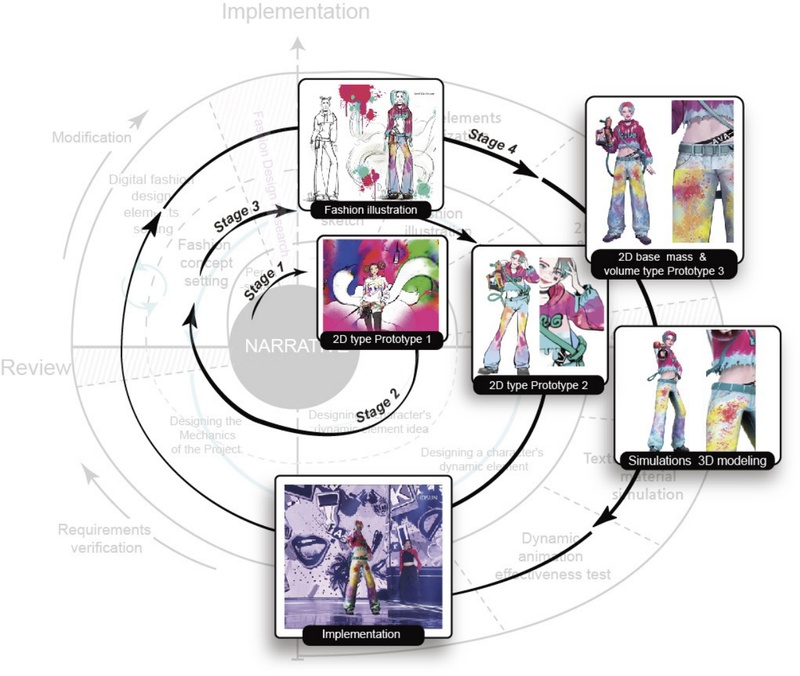
Comparative Case Analysis Based on the Stages of the NSDFβ Process Model
During the iterative process of continuous revisions and refinements guided by the narrative, an implicit final decision line was observed after the prototype modifications in Stage 4, beyond which further revisions were no longer feasible. This stage marked the transition from the final 2D-based prototype to the commencement of 3D modeling, where modifications became increasingly difficult. This recognition was established among the development stakeholders, leading them to revert to the initial narrative stage to reassess its integration before making the final determination of the design’s external form.
The analysis revealed the need to explicitly define the final decision point within the NSDFβ Process Model, ensuring clarity in the transition from 2D prototypes to 3D modeling. Additionally, integrating a structured feedback loop at this stage would enhance the recursive validation process, allowing for more effective adjustments before finalizing the design.
5. 3. Results of the Second Expert Evaluation for Metaverse Entertainment Planning
The results of the thematic analysis of expert interview evaluations of the NSDFβ Process Model are as follows:
The digital fashion design process was designed with a systematic and collaborative structure and was positively evaluated for its applicability in the metaverse environment. The narrative-centered process model was recognized for its organically connected structure, integrating essential elements from various fields such as digital fashion design, 3D modeling, and animation.
- E1: ‘Narrative-driven process plan, E2: Each stage appears to be organically well-connected, E3: ‘The design process is highly systematic, E4: Considering the various digital environments, we hope to capture new possibilities in fashion design. E5: It is impressive that the feedback loop at each stage is well-designed and allows for continuous improvement’.
And Experts evaluated The model aids in developing immersive character stories and aesthetic identity.
- E2: ‘The Model is designed with a narrative framework, allowing for emotional connections with characters and stories’.
Furthermore, regarding whether it reflects the aesthetic and technical implementation of digital fashion design, it was evaluated that the model includes the essential stages of digital fashion design.
- E1: ‘It includes several essential stages for realizing the aesthetic and technical aspects of digital fashion design, such as narrative integration’.
- E3: ‘It seems that the aesthetic quality can be enhanced through stage-by-stage illustrations and prototype work that emphasize the visual elements of fashion design’.
It was also positively evaluated for its potential to facilitate efficient progress by managing development stages and clearly defining role responsibilities among team members.
- E3: ‘The Model helps to identify the main components of the design work’.
- E5: ‘Collaboration can proceed smoothly because each team member can clearly understand their role and scope of work. Additionally, the model provides mechanisms for mutual review and feedback, allowing active interaction among team members.’
However, some experts suggested that a fixed response and correction stage should be introduced after risk factor analysis to ensure the stable progression of the project. This highlights the importance of balancing technical implementation with aesthetic expression in 3D modeling development, as well as effectively managing ongoing risks.
- E1: ‘I think that the divergent and convergent feedback process in the form of a micro-loop can enrich the stages, E4: It is believed that the completion level of Stage 4 will determine the quality of the result, and an evaluation stage for this seems necessary’.
NSDFβ Process Model was positively evaluated for its systematic and collaborative structure, as well as its applicability in the metaverse environment. However, to ensure stable project progression, the establishment of a fixed response and correction stage after risk factor analysis and the implementation of iterative feedback were identified as necessary improvements.
5. 4. The final NSDF Process Model
The final model has been refined by addressing five key aspects based on evaluation (Figure 7,8,9).
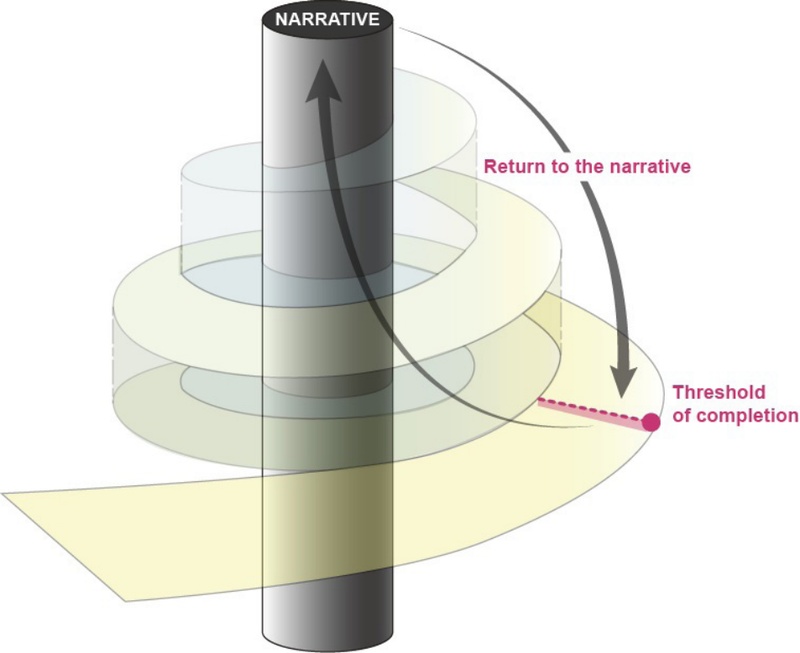
Structural Overview of NSDF Process Model[Threshold of Completion. Return to the Narrative]
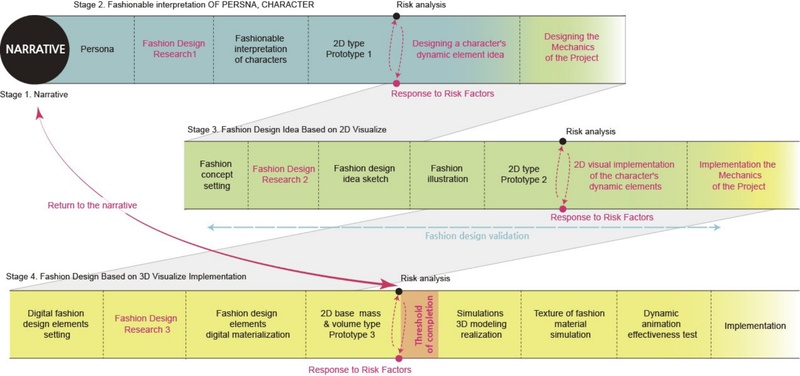
Exploded view of NSDF Process Model
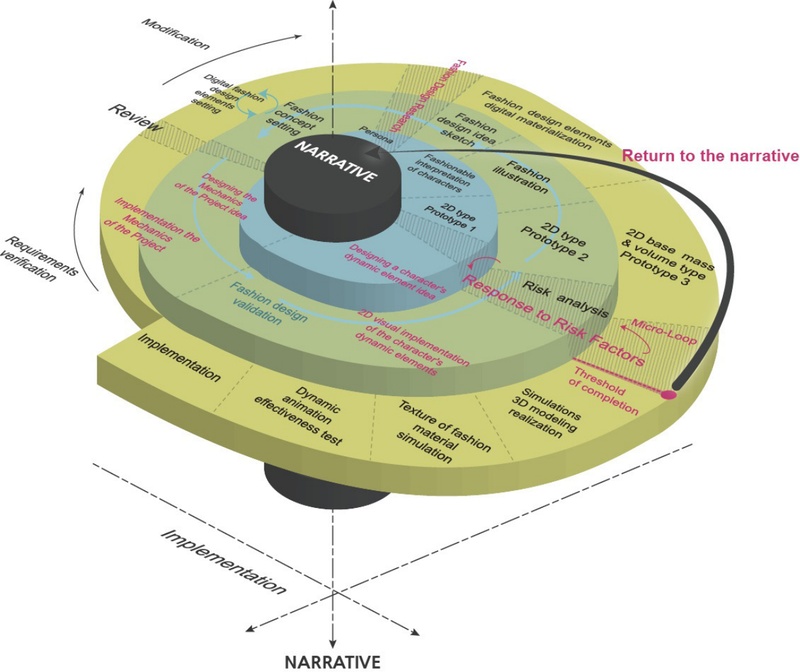
Isometric view of NSDF Process Model
First, the ‘Dynamic Elements of a Character’ and ‘Designing the Mechanics’ stages were differentiated in Stages 2 and 3. Stage 2 focuses on idea generation, while Stage 3 emphasizes implementation. Stage 2 was redefined as ‘Designing a Character’s Dynamic Element Idea’ and ‘Designing a Character’s Dynamic Element,’ while Stage 3 was further split into ‘2D Visual Implementation of Dynamic Elements’ and ‘Implementation of Project Mechanics.’
Second, a ‘Fashion Design Research’ stage was added to Stages 2, 3, and 4 to ensure a systematic approach to fashion design research, following the Persona (Stage 2), Fashion Concept (Stage 3), and Digital Fashion Design Elements (Stage 4) stages.
Third, the ‘Threshold of Completion’ stage was added to Stage 4. This stage marks the final decision-making point in the design process (Figure 7). At this stage, team members implicitly acknowledge that further modifications beyond this point will be challenging, and they conduct a final inspection of the design. This ensures that the team makes firm and timely decisions regarding any necessary revisions. Additionally, it facilitates the efficient management of resources, time, and budget within the given deadline, while preventing confusion caused by last-minute changes.
Fourth, a ‘Return to the Narrative’ step was added at the border of the ‘Threshold of Completion’ stage. This step reinforces narrative consistency. It revisits the initial narrative phase to verify whether the current design aligns with the originally established narrative framework (Figure 7). By reviewing and confirming the narrative-driven design elements, the process ensures that the final model adheres to its intended storytelling structure, helping maintain coherence throughout the design process despite various evolving variables.
Fifth, the ‘Response to Risk Factors’ step was added after the risk analysis stage to address and mitigate any identified issues. The ‘Response to Risk Factors’ step, along with the iterative ‘Micro-Loop’ (a cyclical problem analysis and feedback process), verifies whether the modifications made after the risk analysis for the prototype have been properly implemented. This step also aims to prevent and identify potential issues from arising, thereby ensuring the stability of the process and improving the completeness of the result.
6. Discussion
The expected effects of the NSDF Process Model are as follows:
First, the narrative-based process may enable the development of consistent and immersive fashion design content. According to the evaluation feedback from E1 in the second expert evaluation, from the perspective of metaverse entertainment planning, the narrative-driven process plan is considered an organically integrated and systematic approach. The traditional Spiral Model has been noted for its limitations in effectively managing the escalation of uncertainty in long-term, complex projects, which may potentially lead to diminished control over design consistency and project trajectory (Boehm, 1988; Hendrix & Schneider, 2002; Andersson & Runeson, 2007), To address these limitations, the NSDF Process Model offers a means to guide design development under consistent narrative-driven control. By centrally integrating the narrative framework throughout the project, design elements may maintain coherence with the established narrative, potentially enhancing the completeness of entertainment content.
Second, the model may support the establishment of aesthetic identity. According to the evaluation feedback from E1 and E3 in the second expert evaluation, experts noted that by incorporating unique expressive elements aligned with the narrative, the process could facilitate the creation of differentiated designs and possibly reinforce the identity of the content beyond mere visual representation.
Third, it may ensure the production of stable and executable outcomes. According to the evaluation feedback from E5 and E3 in the second expert evaluation, through iterative prototyping and validation at each stage, the model could optimize content for the metaverse environment by incorporating dynamic, mechanical, and animation elements to enhance stability. The stage-by-stage prototype development and risk factor analysis, as discussed in the comparative case analysis, appear to contribute to the stable execution of the final product within the metaverse entertainment environment.
Fourth, it would likely be well-suited for long-term projects. As shown in <Figure 5> and the case analysis presented in this study, the process plan, grounded in a narrative-driven approach, utilizes a spiral structure characterized by iterative and incremental steps. This structure may systematically manage complex projects while effectively responding to uncertainties and diverse requirements.
Fifth, the model may assist in risk analysis and decision-making. According to the evaluation feedback from E1 and E4 in the second expert evaluation regarding “managing ongoing risks,” the improved ‘Response to Risk Factors’ and iterative Micro-Loop (a cyclical problem analysis and feedback process) may facilitate stage-by-stage risk assessments and iterative refinements. In addition, the “Threshold of Completion” stage addresses decision-making confusion often caused by the long-term and complex structural nature of the traditional Spiral Model (Andersson & Runeson, 2007; Mizell & Malone, 2007). This could help minimize potential risks and optimize decision-making timing, ultimately leading to reduced project duration and costs.
Sixth, it could facilitate collaboration and interaction among team members. According to the evaluation feedback from E3 and E5 in the second expert evaluation regarding “role and scope of work,” the process model is considered effective in clearly defining role responsibilities. The cumulative layer structure may strengthen interconnections among collaborators, while the risk analysis processes may encourage regular communication, potentially fostering a cooperative working environment.
7. Conclusions
The objective of this study was to develop a narrative-based digital fashion design process model optimized for the metaverse entertainment environment. Based on prior research, the Narrative-Centric Spiral Digital Fashion Design Process Model (NSDF Process Model) was developed and refined through expert evaluation and case analysis to present the final model.
The NSDF Process Model designed for digital fashion design in the metaverse entertainment environment, integrates key elements such as basic graphic components, narrative-centered design planning, staged prototyping, iterative risk analysis, overlapping gradual development, and recursive flexible thinking.
This study holds academic significance as foundational research that systematically structures the digital fashion design process through narrative perspectives and frameworks within the metaverse entertainment domain. Furthermore, it contributes to the industry by proposing a digital fashion design process based in the 3D production industry, emphasizing collaborative workflows.
However, this study has limitations, including the model’s restricted applicability depending on project scale and nature, its validation through a single case analysis in metaverse music broadcasting, and the involvement of a limited group of experts for interviews.
Future research should empirically evaluate the validity and effectiveness of this narrative-based model by comparing it with divergent approaches such as visual-first or user-centered models. In addition, apply and validate the model across diverse metaverse entertainment content to enhance its generalizability and contribute to the theoretical advancement of digital fashion design.
Additionally, this study is expected to serve as a foundation for research on the digital fashion design process in metaverse entertainment, as well as on the roles and competencies of digital fashion designers. It also aims to provide a framework for narrative-based digital fashion content planners and designers. Furthermore, it is anticipated to serve as a key resource for developing educational programs on narrative-based digital fashion design and as a guide to fostering a collaborative approach to metaverse entertainment content creation.
Acknowledgments
This work was supported by the Yonsei University Research Grant of 2024.
This paper was written based on a doctoral dissertation completed in 2025.
Notes
Copyright : This is an Open Access article distributed under the terms of the Creative Commons Attribution Non-Commercial License (http://creativecommons.org/licenses/by-nc/3.0/), which permits unrestricted educational and non-commercial use, provided the original work is properly cited.
References
-
Ahearn, L. (2014). 3D game textures: Create professional game art using Photoshop. CRC Press.
[https://doi.org/10.4324/9781315733449]

-
Andersson, C., & Runeson, P. (2007). A spiral process model for case studies on software quality monitoring-method and metrics. Software Process: Improvement and Practice, 12(2), 125-140.
[https://doi.org/10.1002/spip.311]
- Beane, A. (2012). 3D animation essentials. John Wiley and Sons.
-
Boehm, B. W. (1988). A spiral model of software development and enhancement. Computer, 21(5), 61-72.
[https://doi.org/10.1109/2.59]
-
Braun, V., & Clarke, V. (2006). Using thematic analysis in psychology. Qualitative Research in Psychology, 3(2), 77-101.
[https://doi.org/10.1191/1478088706qp063oa]
-
Chang, Y.-N., Lim, Y.-K., & Stolterman, E. (2008). Personas: From theory to practices. In Proceedings of the 5th Nordic Conference on Human-Computer Interaction: Building Bridges (pp. 439-442).
[https://doi.org/10.1145/1463160.1463214]
-
Cooper, A. (1999). The inmates are running the asylum. B.G. Teubner.
[https://doi.org/10.1007/978-3-322-99786-9_1]
- DeJonge, J. O. (1984). Forward: The design process. In S. M. Watkins (Ed.), Clothing: The portable environment (pp. 7-1). Iowa State University Press.
-
Dyer, R. (2005). Only entertainment. Routledge.
[https://doi.org/10.4324/9780203993941]
-
Grimaldi, S., Fokkinga, S., & Ocnarescu, I. (2013). Narratives in design: A study of the types, applications and functions of narratives in design practice. In Proceedings of the 6th International Conference on Designing Pleasurable Products and Interfaces (pp. 201-210).
[https://doi.org/10.1145/2513506.2513528]
- Hackl, C., & Buzzell, J. (2021). The augmented workforce: How artificial intelligence, augmented reality, and 5G will impact every dollar you make. Renown Publishing.
-
Hendrix, T. D., & Schneider, M. P. (2002). NASA's TReK project: A case study in using the spiral model of software development. Communications of the ACM, 45(4), 152-159.
[https://doi.org/10.1145/505248.506004]
-
Herskovitz, S., & Crystal, M. (2010). The essential brand persona: Storytelling and branding. Journal of Business Strategy.
[https://doi.org/10.1108/02756661011036673]
-
Joy, A., Zhu, Y., Peña, C., & Brouard, M. (2022). Digital future of luxury brands: Metaverse, digital fashion, and non-fungible tokens. Strategic Change, 31(3), 337-343.
[https://doi.org/10.1002/jsc.2502]
-
Lee, J. H., Lee, E., Huh, J., Kim, M. L., & Kim, J. (2024). Persona/Scenario (P/S) toolkit enhancing inclusive fashion design education. Fashion and Textiles, 11(1), 5.
[https://doi.org/10.1186/s40691-024-00373-z]
-
Lee, J. H., Lee, E., Lee, C. H., Huh, J., & Kim, J. (2023). Cyclic inclusive fashion design process based on an FEA model for inclusive fashion education. International Journal of Fashion Design, Technology and Education, 1-12.
[https://doi.org/10.1080/17543266.2023.2218400]
-
Luna, F. (2012). Introduction to 3D game programming with DirectX 11. Mercury Learning and Information.
[https://doi.org/10.1515/9781937585952]
-
Makryniotis, T. (2018). Fashion and costume design in electronic entertainment-Bridging the gap between character and fashion design. Fashion Practice, 10(1), 99-118.
[https://doi.org/10.1080/17569370.2017.1417338]
- Meggs, P. B. (1992). A history of graphic design. Van Nostrand Reinhold.
-
Meron, Y. (2024). Looking at things strangely: Defamiliarisation as a design approach for media literacy education. The Design Journal, 27(6), 1122-1141.
[https://doi.org/10.1080/14606925.2024.2397213]
- Mizell, C., & Malone, L. (2007). A software development simulation model of a spiral process (No. KSC-2007-055). NASA. https://ntrs.nasa.gov/citations/20120003465.
-
Mogaji, E., Dwivedi, Y. K., & Raman, R. (2024). Fashion marketing in the metaverse. Journal of Global Fashion Marketing, 15(1), 115-130.
[https://doi.org/10.1080/20932685.2023.2249483]
- Novak, J. (2022). Game development essentials: An introduction. NOVY Publishing.
- Orlando, J. Y. (1979). Objectifying apparel design. In Combined Proceedings, Association of College Professors of Textiles and Clothing, Inc., Eastern, Central and Western Regional Meetings, Williamsburg, October (pp. 127-132).
-
Park, H., & Lim, R. E. (2023). Fashion and the metaverse: Clarifying the domain and establishing a research agenda. Journal of Retailing and Consumer Services, 74, 103413.
[https://doi.org/10.1016/j.jretconser.2023.103413]
-
Porterfield, A., & Lamar, T. A. (2021). A framework for incorporating virtual fitting into the costume design and production process. International Journal of Fashion Design, Technology and Education, 14(1), 91-100.
[https://doi.org/10.1080/17543266.2020.1864484]
- Pruitt, J., & Adlin, T. (2010). The persona lifecycle: Keeping people in mind throughout product design. Elsevier.
- Russo, M. (2006). Polygonal modeling: Basic and advanced techniques. Jones and Bartlett Learning.
-
Särmäkari, N. (2023). Digital 3D fashion designers: Cases of Atacac and The Fabricant. Fashion Theory, 27(1), 85-114.
[https://doi.org/10.1080/1362704X.2022.2034470]
-
Sayem, A. S. M. (2022). Digital fashion innovations for the real world and metaverse. International Journal of Fashion Design, Technology and Education, 15(2), 139-141.
[https://doi.org/10.1080/17543266.2022.2055791]
- Shin, M, R., & Lee, J, H. (2023). Research on the Development of Digital Fashion Design for Entertainment in Metaverse Environment : A Case Study of Fashion Design for Avatar Characters in TV Chosun's Virtual Music Show 'Avatar Dream'. KSDS Conference Proceeding, 24-25.
- Frasca, G. (2001). Videogames of the oppressed: Videogames as a means for critical thinking and debate [Master's thesis, Georgia Institute of Technology]. School of Literature, Communication, and Culture.
-
Klawonn, F. (2012). Introduction to computer graphics: Using Java 2D and 3D. Springer.
[https://doi.org/10.1007/978-1-4471-2733-8]
- Schell, J. (2008). The art of game design: A book of lenses. CRC Press.
- Smart, J., Cascio, J., Paffendorf, J., Bridges, C., Hummel, J., Hursthouse, J., & Moss, R. (2007). A cross-industry public foresight project. In Proc. Metaverse Roadmap Pathways 3DWeb (pp. 1-28).
- Tekinbaş, K. S., & Zimmerman, E. (2003). Rules of play: Game design fundamentals. MIT Press.
- TV Chosun. (2025). AVA Dream. https://broadcast.tvchosun.com/broadcast/program/2/C202200147.cstv.
- Unity3D. (2025). Unity documentation. https://docs.unity3d.com/Manual/StandardShaderMaterialParameterNormalMap.html.
-
Van Tassel, J., & Poe-Howfield, L. (2012). The media industries: Segments, structures, and similarities. In Managing electronic media (pp. 1-28). Routledge.
[https://doi.org/10.4324/9780080927800-5]
-
Vogel, H. L. (2020). Entertainment industry economics: A guide for financial analysis. Cambridge University Press.
[https://doi.org/10.1017/9781108675499]
- Despain, W. (2014). 100 principles of game design (1st ed.). New Riders.