
Establishing a Senior House Service Design Guideline: Applied Universal Design Theory on a Rural Senior House in Northern Anhui, China
Abstract
Background With the rapid aging of rural populations, senior houses play an increasingly important role in delivering semi-independent care. However, many lack structured service systems, resulting in unmet user needs. This study aims to explore how universal design (UD) theory can inform the development of a service design guideline, focusing on the context of rural senior houses in Anhui, China, in order to address these gaps that support safe, accessible, and dignified living environments for elderly users.
Methods The study employed a mixed-method approach. First, 20 service elements relevant to daily life in rural senior houses were identified through service blueprinting and literature review. These were then evaluated through expert consultation using the Content Validity Ratio (CVR) method and mapped against the seven universal design principles (P1–P7). To assess user perception and to prioritize service improvement, a Kano model-based questionnaire was conducted among residents and caregivers. The findings were analyzed to categorize service attributes and to guide practical recommendations for design enhancement.
Results The integration of the Kano model with CVR evaluation revealed significant differences in how users perceive various service elements. Several “Must-be” and “One-dimensional” attributes emerged, indicating essential baseline services versus optional offerings. The mapping with UD principles highlighted priority areas where accessibility and usability could be improved. Findings suggest that strategic alignment of UD with service design enables more dignified, effective care delivery in rural settings and supports informed decision-making for resource-limited senior house operators.
Conclusions This research bridges universal design methods with practical elderly care needs, contextualized within rural senior houses in Anhui, China, and offers an exploratory guideline derived from a limited case study. The study helps providers to prioritize interventions under limited resources and to improve the overall service experience. Future studies should focus on validation through long-term field testing and explore interdisciplinary and technological enhancements.
Keywords:
Universal Design, Service Design, Senior House, Kano, CVR1. Research background
In East Asia, the issue of aging is becoming increasingly severe, exerting a profound impact on social and economic development (National Bureau of Statistics of China, 2021). As the pressure on elderly care continues to grow, traditional elderly care models such as home care and nursing homes are gradually failing to meet the rising demands (Zhang et al., 2006). Amid efforts to explore and innovate new elderly care models, the Senior House concept has emerged. Senior Houses have long been adopted in Western and some Asian nations (such as Japan and Korea). Broadly defined, they refer to facilities providing accommodation, care, and services for older adults, aiming to offer suitable living environments and care solutions tailored to different financial capacities and health conditions (Jolanki, 2021). However, as the aged population increases and the demand for elderly care diversifies, optimizing the service model of Senior Houses to enhance their sustainability, inclusivity, and efficiency has become a pressing challenge.
Against this backdrop, Service Design and Universal Design have gradually become key approaches to improving the quality of elderly care services. Service Design focuses on user experience, service process optimization, and interdisciplinary collaboration to enhance the operational efficiency of senior care institutions and improve user satisfaction (Stickdorn, 2018). Meanwhile, Universal Design aims to create products and environments that are accessible and convenient for everyone, including older adults and individuals with disabilities, ensuring equity in service accessibility (Design U, 1997).
Currently, successful cases of Senior House service optimization have gradually emerged. For instance, Sunrise Senior Living, headquartered in Virginia, USA, has become an industry benchmark by emphasizing human-centered and thoughtful design in senior living facilities (https://www.sunriseseniorliving.com/). However, research on this topic remains limited in developing countries, particularly in rural and township areas. Existing Senior House service designs often suffer from inefficient service processes, inadequate accessibility features, and a lack of standardized care protocols, resulting in poor living experiences for older adults and low operational efficiency for facilities (Glinskaya, 2019). In particular, there is still a lack of a comprehensive theoretical framework and practical guidelines on systematically applying Universal Design principles to enhance elderly care services.
Therefore, this study takes rural senior houses as the research object and proposes a set of practical senior house service design guidelines in combination with universal design principles to optimize the elderly living experience, improve service quality, and provide standardized service improvement solutions for the elderly care industry.
2. Research objectives
The purpose of this study is to establish a service design guideline for rural senior houses. The guideline integrates universal design elements into practical service processes and responds to the diverse care needs of elderly users. The study focuses on the following objectives:
Understand the structure and flow of daily care services in rural senior houses and identify existing or hidden service touchpoints.
Place specific service components under the guidance of corresponding universal design principles, and determine their priority for improvement through user research.
Provide service design guidelines to improve service quality and support long-term service planning. The study will be conducted in accordance with the process shown in Figure 1:
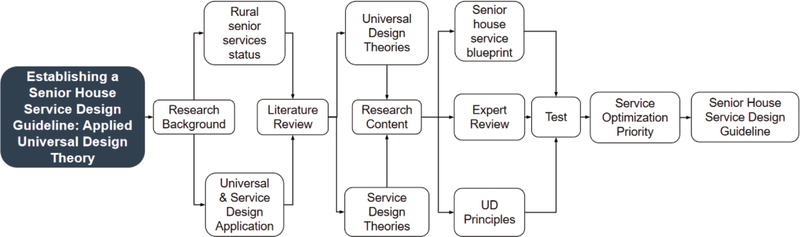
Research flow chart
3. Literature review
3. 1. Senior houses require unique service design
The Senior House model has become a viable alternative to traditional elderly care models, offering greater independence, community support, and personalized services (Lahti, 2021). Compared with other elderly care models in Table 1, service design in Senior Houses places greater emphasis on sustainability, systematic integration, and user experience. Because it not only involves the living environment of seniors, but also covers various aspects such as nursing, health management, and life services.

Comparison of different elderly care models
Under the senior house elderly care model, as per Karol’s (2016) definition, service design should cover both “tangible” and “intangible” aspects. On the one hand, it considers the physical environment (such as barrier-free facilities and public space layout); on the other hand, it focuses on the seniors’ emotional needs, social interaction, and other social aspects. For example, how to better promote interaction between residents and create a service experience conducive to physical and mental health requires intangible elements of “service” to be included in the design scope (National Academies of Sciences, et al., 2020). Senior House emphasizes providing independent and personalized services for seniors. In this model, service design is not passive but dynamically adjusted according to the needs and feedback of the seniors. This dynamic adjustment aligns with the service-dominant logic (Vargo & Lusch, 2004), where value is co-created through resource integration. Here, a designated Service Coordinator acts as the integrator of tangible and intangible resources, translating seniors feedback into environmental and procedural adaptations (Grönroos, 2008). Through service design thinking (Stickdorn, 2018), various touchpoints and links of the service can be systematically considered to ensure that the quality of life and care needs of the older adults are effectively met.
Senior Houses provide a more flexible and cost-effective solution, particularly for seniors who require varying levels of assistance (Kemper, 1991). Despite these advantages, existing studies reveal significant gaps in service design, including inadequate attention to user needs, lack of universal facilities, and insufficient consideration of emotional well-being. (Park et al., 2020). These shortcomings underscore the need for a more inclusive and adaptable approach to service design.
3. 2. The necessity of universal design for senior house service design
Universal Design (UD) has emerged as a critical framework for addressing the aforementioned service design gaps. Rooted in the principle of equitable access, UD aims to create environments and services usable by all people, regardless of age, ability, or status (Story, 1998). In the context of Senior Houses, UD ensures that services are accessible to residents with varying physical and cognitive abilities, thereby reducing friction and enhancing user experience (Fisk et al., 2009). For instance, UD-based senior housing improves quality of life and promotes social inclusion—a key factor in successful aging (Carr et al., 2013). Additionally, UD’s emphasis on flexibility and simplicity aligns with the diverse needs of elderly residents, from daily care to emergency response.
Moreover, UD addresses the psychological barriers often associated with elderly care. Studies have shown that seniors’ self-esteem and mental health are significantly influenced by their living environment (Sare et al., 2021). When elderly individuals transition from independent living to assisted care, they often experience heightened vulnerability due to environmental changes, decreased sense of security, and social pressure (Lotvonen et al., 2018). By integrating accessibility features seamlessly into the design, UD minimizes stigmatization and lowers the psychological threshold for accepting care services, and this is particularly relevant in senior houses, where residents often face significant life transitions. The importance of UD in senior care is further supported by its application in other contexts. For example, a study from Opole University of Technology highlighted that UD-based senior housing is an adequate response to the growing demand of an aging society, and the “design for all” concept has been considered a key strategy for creating social inclusion (Malik et al., 2019). Participatory design needs to be integrated throughout the research process and involve seniors, families, service providers, and designers in the design process to achieve designs that meet user needs and actual situations (Niezabitowski, 2020). Participatory design framework grounded in human-centered methodologies (IDEO, 2015) implementing co-creation workshops with rural seniors to identify emotional needs (e.g., isolation), contextual inquiry in existing facilities, and iterative prototype testing based on lived experiences. This approach actively converts UD principles into solutions addressing psychosocial well-being beyond physical accessibility barriers.
In summary, integrating Universal Design methods into Senior House service design is essential and well-founded. By addressing both tangible aspects (e.g., physical accessibility) and intangible elements (e.g., emotional well-being), UD offers a holistic framework for developing inclusive, efficient, and user-centered services. This study aims to establish service design guidelines specifically tailored to the unique needs of senior house residents, with a particular emphasis on rural facilities. By seamlessly incorporating UD principles into the physical environment and the service experience, this research seeks to enhance accessibility, optimize care processes, and improve the overall quality of life for elderly residents.
4. Research content
This study focuses on a rural senior house in northern Anhui, China, characterized by small-scale facilities (typically accommodating 20-100 residents), integration with local healthcare resources, and government-subsidized occupancy for low-income seniors. These facilities prioritize community engagement and adaptive service design to address diverse needs.
4. 1. Senior house daily service blueprint
The field study was conducted over a three-week period (July 22 to August 12, 2024) at the aforementioned rural senior house, with formal written consent obtained from the facility administration, caregivers, and participating elderly residents. All participants were informed of the research scope and their unconditional right to withdraw at any stage; verbal consent was reaffirmed during each interaction. Research activities comprised structured observation of daily routines (e.g., meal schedules, social interactions), shadowing caregivers during work shifts, interviews with residents and staff members, and analysis of supplementary archival materials provided by senior house operators and local eldercare communities. The synthesizes data obtained from visual documentation, interviews, and observations was organized to develop the daily service blueprint presented in Figure 2, and Visual documentation adopted pixelation for facial anonymity:
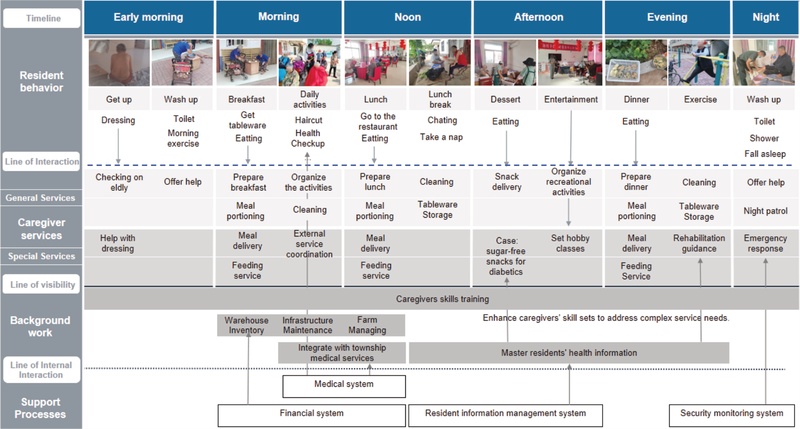
Senior house daily service blueprint
From this blueprint, many clear and hidden service content items can be identified, and preliminary optimization suggestions can be given:
Daily care and Hygiene:
The process where caregivers check the physical condition of seniors in the morning is a critical touchpoint. More personalized services can be designed during this process, such as adjusting the level of assistance provided for getting up based on the seniors’ health condition. Since many of the work contents in the morning and evening are homogeneous and common in daily life (washing, going to the toilet, etc.), other care contents that may be involved in daily life are collectively called “daily care and hygiene”.
Service content items: Daily care and Hygiene services; Personalized Health Check-up
Dining Services:
Dining services are the most labor-intensive because they are repeated three times a day and involve multiple links before and after meals, including food procurement, cooking, and cleaning after meals. They are an indispensable part of the daily lives of the seniors. The blueprint shows multiple links in catering services, including breakfast, lunch, and dinner delivery and distribution.
Service content items: Meal Delivery & Feeding Support
Daily Activities and Entertainment:
The daily activities and afternoon dessert entertainment depicted in the blueprint offer various social and recreational activities, which present many great opportunities to promote social interaction among seniors.
Service content items: Social & Recreational Activities; Mental Health Support Services; Intergenerational Interaction Program; Set up Senior School
Nursing and Back-end Support:
The skills and experience of caregivers directly affect service quality. The blueprint shows advanced training for some senior caregivers.
Service content item: Caregiver Skills Training
Night Security:
Nighttime security and medical monitoring are crucial parts of senior housing.
Service content item: Night Security
4. 2. Universal design principles guide service design
As has been explored in the literature, above, Universal Design principles are crucial in optimizing senior house services by ensuring accessibility, usability, and inclusivity for all residents. Based on existing research and in-depth interviews with senior house residents, administrators, and caregivers, after completing the existing service blueprint, this study then applied UD principles to guide service improvements in rural senior houses. While the field study was conducted at a single rural senior house, its deliberate selection as a paradigmatic example of township-level facilities (Government-subsidized operation, Small-scale residency and Integrated local healthcare access) enables theoretical insights transferable to similar institutional and operational environments (Flyvbjerg, 2006). Future validation across diverse contexts is warranted. This study draws on the seven widely cited principles of Universal Design, originally proposed by the Center for Universal Design, to evaluate and contextualize service element (Story, 2001). These principles are not intended as universally fixed commandments but as a reference framework to guide inclusive design. They require adaptation depending on context and user diversity. Each UD principle corresponds to specific service attributes requiring optimization:
P1.Equitable Use: ensures that essential services like daily care and hygiene services are accessible to all residents (Sanford, 2012).
P2.Flexibility in Use: supports customized meal plans and social activities, catering to diverse elderly needs. For example, Nutritionists can introduce personalized dietary recommendations when providing food, especially for people with diabetes or who need exceptional dietary control.
Representative service contents: Diet Customization
P3.Simple and Intuitive Use: emphasizes efficiency and directness, ensuring the fastest and most simple response. Examples include one-touch emergency buttons and easily operable indoor facilities. Representative service contents: Emergency Button Setting; Smart Home Aging-friendly Transformation; Personal Hygiene Auxiliary Facilities
P4.Perceptible Information: enhances public signage and emergency response systems, aiding seniors with sensory impairments (Li, 2023). In the future, more technological support (such as virtual reality) can be introduced to expand seniors’ perception method. Representative service contents: Voice-Light Assisted system; Health Monitoring System Setting; Navigation Signal Setting
P5.Tolerance for Error: applies to risk prevention and corrective measures. In senior houses, it is reflected in caregiver skill training, night security management, and emergency button setting. At the rural senior house, there remains an insufficient number of caregivers trained in advanced nursing skills, coupled with incomplete deployment of safety equipment. To address these gaps, routine skill enhancement programs should be instituted for all caregivers, ensuring each of them can manage complex care scenarios. Concurrently, back-end medical resource reserves require strengthening, while surveillance systems warrant optimization through advanced monitoring equipment. These measures would alleviate nocturnal care burdens on caregivers while enhancing seniors’ sense of safety during night hours.
Representative service contents: Telemedicine Support
P6.Low Physical Effort: means reducing the physical exertion of the seniors, which can be achieved through delivering meals, feeding, installing automatic doors and handrails indoors, or reducing the necessary activity areas (Story, 2001).
Representative service contents: Indoor Accessibility; Automated Cleaning System; Personal Hygiene Auxiliary Facilities
P7.Size and Space for Approach and Use: based on the principles of support, acceptability, accessibility, and safety (Null, 1996), ensure that the dimensions of public activity spaces, indoor facilities, and various facilities are reasonably set so that the seniors, especially users of wheelchairs, walkers and other tools, can easily approach and operate them (Moon et al., 2014).
Representative service contents: Public Space Layout Design
4. 3. CVR Expert Review
Based on the service blueprint and relevant literature review, 20 service items with practical significance for rural senior house were identified. Combined with Universal Design Principles (P1–P7), each service item was formulated into questions and evaluated through expert review using the CVR (Content Validity Ratio) method, following the format shown in Table 2:
Example of Expert Review Form Content
Fifteen professors and doctoral researchers from design institutions in China and South Korea, who have peer-reviewed publications in the field of service design or universal design, reviewed and selected service elements that meet the CVR threshold. Consistent with Lawshe’s methodology, the critical CVR value required for statistical significance varies as a function of the number of experts (Lawshe, 1975). For panel of N = 15 experts, the critical CVR values was 0.49. The final results are as Table 3:
CVR Review Result
According to the expert review results, 11 service contents with CVR values that meet the standards were selected, and the expert opinions were summarized and matched one by one with the applicable universal design guidelines. The results are shown in Figure 3:
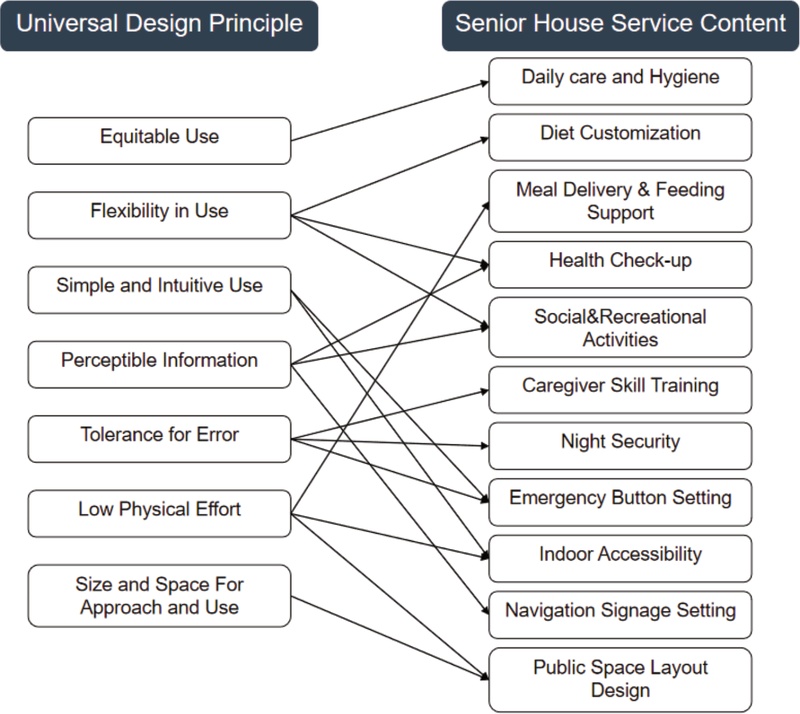
Correspondence between universal design principles and service content
The CVR analysis identified UD-compliant service items based on expert judgments of technical feasibility and safety standards. To reconcile this with seniors’ lived experience, the Kano model (Noriaki Kano, 1984) was deployed to assess how each service impacts user satisfaction, and which improvements align with elderly residents actual priorities. This sequential approach avoids the expert bias trap (Sanders, 2022), ensures service enhancements meet both professional standards (CVR) and user expectations (Kano). The specific decision logic is as follows:
Double recognition (K + high Kano): priority implementation
Technology adoption requires simultaneous fulfillment of expert-assessed feasibility (perceived ease of use) and user-perceived value (perceived usefulness). When both are high, the implementation intention is maximized (Davis, 1989).
Experts approve but the seniors are indifferent: optimize the experience
Indifferent attributes require deliberate redesign to become satisfaction drivers (Berge, 1993).
Expert veto: direct elimination
Based on the precautionary principle (UNESCO, 2005), all high-risk service contents should be eliminated.
5. Test
Testing validates research hypotheses through direct data collection, enhancing scientific rigor. This study employed a Kano questionnaire to measure senior residents’ emotional preferences toward service contents derived from the blueprint. Originally developed for product design, the Kano model captures how service features influence user satisfaction (Bandyopadhyay, 2015). By analyzing seniors’ reactions to the presence or absence of specific services, service attributes can be classified into five emotional impact categories: attractive (surprise-inducing), one-dimensional (performance-dependent), must-be (expected baseline), indifferent (neutral), and reverse (irritating). This emotional mapping allows us to strengthen high-impact services and eliminate ineffective ones, reducing staff workload.
A Kano questionnaire was designed to validate the service blueprint and prioritize improvements based on key service touchpoints identified in rural senior houses (e.g., daily care, catering services, and caregiver training). The survey targeted seniors aged 60 and above who are capable of self-care and was conducted through both on-site and online channels.
The on-site survey was carried out at the YILER AN Senior House in Sun Village, Anhui Province, where trained interviewers explained each question in detail to ensure comprehension, particularly for seniors unfamiliar with technical terms. The online survey was distributed via local elderly care service communities, and strict validity controls were applied. These included filtering responses by completion time (≥60 seconds) and performing logical consistency checks (e.g., excluding responses that expressed “very satisfied” for both the presence and absence of the same service).
A total of 233 valid responses were collected. The questionnaire consisted of 11 Kano-style questions, each corresponding to a specific service component drawn from the service blueprint. This demographic approach ensured that feedback was grounded in both direct user experience and contextual understanding of rural senior care settings.
The test objectives of this study include three aspects:
Verify the applicability of UD principles in optimizing senior house services: Through questionnaires and interviews, analyze the acceptance of UD-related designs (barrier-free facilities, guide systems, etc.) by the seniors and caregivers. The question format is as shown in Table 4:
Example of Kano Questionnaire Format
To address potential ambiguity in composite service items, the questionnaire incorporated open-ended prompts for specific improvement suggestions, enabling participants to highlight problem directly; caregiver-assisted surveys noted behavioral cues to enrich responses.
Confirm the user demand priority of service content: Use Kano analysis to classify various services into basic type (Must-be), expected type (One-dimensional), and charm type (Attractive), and clarify the optimization direction.
Quantify how Kano results affect UD design strategies: Calculate the BETTER/WORSE coefficient to determine which functions must be optimized most and the optimal UD adaptation plan.
The test results will provide data support for the formulation of senior house service design guidelines and ensure that the final optimization plan can truly meet the seniors’ actual needs.
5. 1. Kano-UD Analysis
According to the BETTER and WORSE coefficient of specific service content, the applicability of its universal design principles can be deduced to a certain extent, as shown in Table 4. It should be noted that the applicability of this deduction is not absolute. The specific application of the principles needs to be analyzed in combination with the specific service content and the actual situation of the nursing home. The results of the analysis can also further verify whether the correspondence between universal design principles and service content is reasonable.
After processing the data and summarizing them in combination with universal design principles, the results are shown in Table 5. After processing the data and summarizing them in combination with universal design principles, the results are shown in Table 6.
Comprehensive analysis of B/W coefficient & UD principles
Kano analysis results
These results assigned Kano attributes based on the intrinsic principles of the model and analyzed their corresponding universal design principles. Combined with CVR review, they guided the development of service design guidelines. The Priority Score in the table is calculated as follows:
Priority Score = Better coefficient + | Worse coefficient |
This method is a concise and effective quantitative indicator. It can give a reasonable priority ranking by comprehensively considering service attributes’ improvement potential and loss risk. Some studies can provide theoretical support for this method. For example, Oliver believes in his study of expectation confirmation theory that the disconfirmation effect is at least as potent as the effect attributed to expectation(Oliver, 1980).
5. 2. Finding
Figure 4 shows the Kano attributes of each service content and its position in the scatter plot. Combined with the analysis of 5.1, the corresponding relationship between the principles and contents is verified:
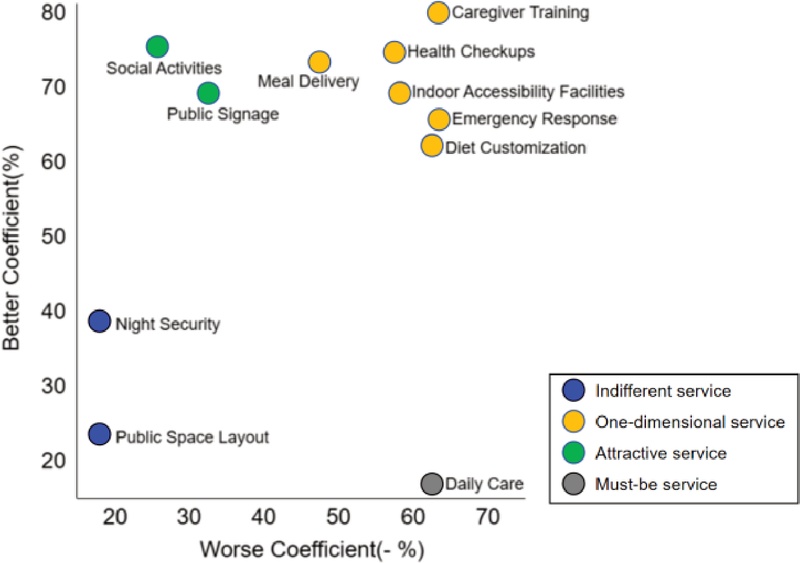
Service attribute Better–Worse coefficient distribution
Must-be services: Daily Care & Hygiene Services, in which the Better coefficient is low but the Worse coefficient is high (-62.09%), indicating that the lack of this service will seriously affect user satisfaction. Therefore, it is necessary to ensure that all seniors can enjoy nursing services equally through the principle of equitable use.
One-dimensional services: For health check-ups and diet customization, the Better coefficient is high (74.86%), indicating that users have high expectations for this service. According to the principle of flexibility in use, personalized adjustments should be provided for seniors with different needs (such as customized meals or flexible physical examinations).
Attractive services: The Better coefficient is high (74.73%) for social activities and public navigation signage, indicating that such services will bring surprises beyond expectations. It can be combined with the principle of perceptible information to improve participation through digital prompts or sound broadcasts.
Indifferent services: For example, night security and public space layout, the Better and Worse coefficients are both low, indicating that the urgency of optimization is low. However, this may also be caused by the fact that users find it difficult to perceive the positive feedback brought by the service. Seniors may undervalue environmental factors until deficiencies cause harm, aligning with observed low risk-awareness in elderly populations (SONG, 2010); Reasonable optimization is still needed based on the principles of tolerance for error and low physical effort, such as introducing an intelligent monitoring system to improve the efficiency of night patrols.
Final ranking integrated the Kano-derived priority score ranking with UD strategic categories defined in Table 5, the preliminary senior house service design guidelines were obtained in Table 7.
Optimization Priorities and Guidelines for Senior House Services
Resources and time were operationalized as key parameters because they represent the two most binding constraints for rural senior houses in implementing services guided by universal design principles. Resource scarcity dictates what improvements are feasible, Time sensitivity determines when interventions yield maximal impact (Glinskaya, 2019; Park et al., 2020).
From the resource allocation perspective, preference should be given to projects with a higher optimization priority. This includes enhancing support for caregiver training, establishing closer connections with township medical systems, ensuring the effectiveness of emergency alarm systems, and investing in upgrading indoor accessibility facilities. For daily services and spatial layout, gradual optimization should be pursued while ensuring comprehensive coverage.
From a time-planning perspective, the enhancement of attractive and certain One-dimensional services (such as dining and social activities) can be initiated immediately, as they can significantly improve service satisfaction quickly. In contrast, projects requiring resource investment or structural adjustments, such as caregiver training and infrastructure upgrades, should undergo long-term optimization, with continuous problem identification and resolution throughout planning and implementation.
6. Conclusion
This study establishes a service design guideline for rural senior houses by integrating universal design theory with service processes through a mixed methods. While derived from a focused case study, the study was sufficiently in-depth (three weeks of field research and numerous interviews). The guideline synthesizes expert validated needs via CVR and user priorities via Kano modeling. This approach categorizes service elements by satisfaction impact and implementation feasibility, ensuring practical relevance to resource limited rural environments and proposes targeted improvement strategies. These strategies aim to enhance both the accessibility and effectiveness of services, enabling senior houses to deliver safer, more convenient, and dignified environments under resource constraints.
The findings have both theoretical and practical implications. Theoretically, this study enriches the application of universal design in the context of service design, offering a framework by mapping universal design theory to concrete service elements through a expert-user validation process (CVR filtering → Kano prioritization). This framework connects abstract design principles with operational service components, demonstrating how UD can be systematically translated into elderly care service practice. Practically, it provides a feasible tool for rural senior house operators to prioritize service enhancements, improve user satisfaction, and support inclusive care delivery.
However, several limitations remain. First, as a single-site case study conducted at a rural senior house in Anhui, China, the findings require validation across diverse contexts before broader application. Second, challenges in data collection due to limited participation from seniors and caregivers may affect data accuracy and generalizability. For example, participants often selected the most positive responses, which reduced the distinguishing power of the survey results. For this, survey biases from overly positive responses could minimized by triangulating questionnaire data with observational records (e.g., correlating stated satisfaction with observed participation rates in activities). Third, contextual differences among senior houses—such as cultural, managerial, and resource variations—may affect the applicability and scalability of the proposed guideline. To mitigate this, operators should conduct a UD-Principles Audit using Table 3 as a checklist before implementation and Localize Kano surveys with context-specific service items. Moreover, the implementation of universal design theory may encounter barriers such as budget constraints or lack of technical support. Therefore, modular upgrades are required, with priority given to the “high optimization priority” services listed in Table 7.
Future studies should focus on a longitudinal evaluation of the proposed guideline to assess its long-term impact. Comparative research between rural and urban senior houses is also encouraged to examine contextual adaptability. Furthermore, interdisciplinary collaboration—combining design, healthcare, and technology—and the integration of innovative technologies hold promise for optimizing care quality and service delivery in senior living environments. In this regard, combine the latest research trends, adopt, test embedded IoT systems for real-time UD compliance monitoring (e.g., sensors tracking P6 ‘Low Physical Effort’ adherence), or Develop AR training tools helping caregivers visualize UD principles in situ can be considered (Shirvanian et al., 2025 ). These align with interdisciplinary priorities while respecting rural resource constraints.
Acknowledgments
This research was supported by BK21 Four Service Design based Global Social innovation Educational Research Team in Dongseo University.
Notes
Copyright : This is an Open Access article distributed under the terms of the Creative Commons Attribution Non-Commercial License (http://creativecommons.org/licenses/by-nc/3.0/), which permits unrestricted educational and non-commercial use, provided the original work is properly cited.
References
-
Bandyopadhyay, N. (2015). Classification of service quality attributes using Kano's model: a study in the context of the Indian banking sector. International Journal of Bank Marketing, 33(4), 457-470.
[https://doi.org/10.1108/IJBM-02-2014-0029]

- Berger, C., Blauth, R., Boger, D., Bolster, C., & Walden, D. (1993). Kano's Methods for Understanding Customer-defined Quality.
-
Carr, K., Weir, P. L., Azar, D., & Azar, N. (2013). Universal design: A step toward successful aging. Journal of Aging Research, 2013(1), 324624.
[https://doi.org/10.1155/2013/324624]
-
Davis, F. D. (1989). Perceived usefulness, perceived ease of use, and user acceptance of information technology. Mis Quarterly, 13(3), 319-340.
[https://doi.org/10.2307/249008]
- Design, U. (1997). The Principles of universal design. Recuperado de www.design.ncsu.edu/cud, 3.
- Fisk, A. D., Rogers, W. A., Charness, N., Czaja, S. J., & Sharit, J. (2009). Designing for older adults: Principles and creative human factors approaches. CRC Press.
-
Flyvbjerg, B. (2006). Five misunderstandings about case-study research. Qualitative inquiry, 12(2), 219-245.
[https://doi.org/10.1177/1077800405284363]
- Glinskaya, E. [葛蔼灵]. (2019). China's policy choice for elderly care services: Building an efficient and sustainable system [中国养老服务的政策选择:建设高效可持续的中国养老服务体系]. China Financial & Economic Publishing House.
-
Grönroos, C. (2008). Service logic revisited: who creates value? And who co-creates?. European business review, 20(4), 298-314.
[https://doi.org/10.1108/09555340810886585]
- IDEO. (2015). Human-Centered Design Toolkit.
-
Jolanki, O. H. (2021). Senior housing as a living environment that supports well-being in old age. Frontiers in Public Health, 8, 589371.
[https://doi.org/10.3389/fpubh.2020.589371]
-
Karol, E. (2016). Tangible and intangible elements of design for well-being in the home. Gerontechnology, 15(4), 227-232.
[https://doi.org/10.4017/gt.2016.15.4.007.00]
-
Kemper, P., & Murtaugh, C. M. (1991). Lifetime use of nursing home care. New England Journal of Medicine, 324(9), 595-600.
[https://doi.org/10.1056/NEJM199102283240905]
-
Lahti, A. M., Saajanaho, M., Mikkola, T. M., & Rantanen, T. (2021). Mental, physical and social functioning in independently living senior house residents and community-dwelling older adults. International Journal of Environmental Research and Public Health, 18(23), 12299.
[https://doi.org/10.3390/ijerph182312299]
-
Lawshe, C. H. (1975). A quantitative approach to content validity. Personnel Psychology, 28(4), 563-575.
[https://doi.org/10.1111/j.1744-6570.1975.tb01393.x]
- Lee, H. S. (2012). Residence consciousness of the elderly residing in apartments. Journal of the Korea Institute of Healthcare Architecture, 18(1), 25-33.
-
Li, C., Wang, W., Yang, W., & Chen, Y. (2023). A systematic review of factors influencing signage salience in indoor environments. Sustainability, 15(18), 13658.
[https://doi.org/10.3390/su151813658]
-
Lotvonen, S., Kyngäs, H., Koistinen, P., Bloigu, R., Elo, S., & Välimäki, T. (2018). Mental well-being of older people in Finland during the first year in senior housing and its association with physical performance. International Journal of Environmental Research and Public Health, 15(7), 1331.
[https://doi.org/10.3390/ijerph15071331]
-
Malik, K., & Mikołajczak, E. (2019). Senior housing universal design as a development factor of sustainable-oriented economy. Sustainability, 11(24), 7093.
[https://doi.org/10.3390/su11247093]
-
Moon, J. Y., & Nam, K. S. (2014). A study on the application of universal design principles to collective housing for senior citizens who live alone-Focused on the 'Carnation House' in Gyeonggi-do area. Korean Institute of Interior Design Journal, 23(6), 95-104.
[https://doi.org/10.14774/JKIID.2014.23.6.095]
- National Academies of Sciences, Engineering, and Medicine. (2020). Social isolation and loneliness in older adults: Opportunities for the health care system. National Academies Press.
- National Bureau of Statistics of China. (2021). Interpretation of the seventh national population census bulletin.
- National Investment Center. (2025). Senior Housing Posts Highest NCREIF Property Type Return in First Quarter 2025.
-
Niezabitowski, M. (2020). Universally designed residential environment for senior citizens-Some guidelines for practice according to chosen research. Zeszyty Naukowe. Organizacja i Zarządzanie/Politechnika Śląska.
[https://doi.org/10.29119/1641-3466.2020.148.39]
- Null, R. L., & Cherry, K. F. (1996). Universal design: Creative solutions for ADA compliance. Professional Publications, Inc.
-
Oliver, R. L. (1980). A cognitive model of the antecedents and consequences of satisfaction decisions. Journal of Marketing Research, 17(4), 460-469.
[https://doi.org/10.1177/002224378001700405]
-
Park, S., Kim, B. R., Kwon, E., & Kim, J. (2020). Influence of senior housing types on cognitive decline and nursing home admission among lower-income older adults. Aging & Mental Health, 24(10), 1579-1588.
[https://doi.org/10.1080/13607863.2019.1650888]
- Sanders, E. B. (2002). From User-Centered to Participatory Design Approaches.
-
Sanford, A. M., Orrell, M., Tolson, D., Abbatecola, A. M., Arai, H., Bauer, J. M., ... & Vellas, B. (2015). An international definition for "nursing home." Journal of the American Medical Directors Association, 16(3), 181-184.
[https://doi.org/10.1016/j.jamda.2014.12.013]
- Sanford, J. A. (2012). Universal design as a rehabilitation strategy: Design for the ages. Springer Publishing Company.
-
Šare, S., Ljubičić, M., Gusar, I., & Marčac, M. (2021). Self-esteem, anxiety, and depression in older people in nursing homes. In Healthcare (Vol. 9, No. 8, p. 1035). MDPI..
[https://doi.org/10.3390/healthcare9081035]
-
Shirvanian, N., Shams, M., Rahmani, A. M., Lansky, J., Mildeova, S., & Hosseinzadeh, M. (2025). The Internet of Things in Elderly Healthcare Applications: A systematic review and future directions. IEEE Access..
[https://doi.org/10.1109/ACCESS.2025.3562147]
- Son, J. W., Han, G. J., & Lee, T. K. (2001). A study on the improvement directions and conditions of spatial composition according to location style of silver towns. Journal of the Korea Institute of Healthcare Architecture, 7(1), 7-14.
- Stickdorn, M., Hormess, M. A., Lawrence, A., & Schneider, J. (2018). This is service design doing: Applying service design thinking in the real world. Sebastopol, CA: O'Reilly Media.
- SONG, Z., & SHI, Y. (2010). 中老年人体育锻炼风险认知的实证研究 [An empirical study on risk perception of physical exercise in middle-aged and elderly adults]. 体育科学 (China Sport Science), 30(05), 25-32+48.
-
Story, M. F. (1998). Maximizing usability: The principles of universal design. Assistive Technology, 10(1), 4-12.
[https://doi.org/10.1080/10400435.1998.10131955]
- UNESCO (2005). The Precautionary Principle. World Commission on the Ethics of Scientific Knowledge.
-
Vargo, S. L., & Lusch, R. F. (2004). Evolving to a New Dominant Logic for Marketing. Journal of Marketing, 68(1), 1-17.
[https://doi.org/10.1509/jmkg.68.1.1.24036]
- Story, M. F. (2001). Principles of universal design. Universal Design Handbook, 2.
-
Zhang, Y., & Goza, F. W. (2006). Who will care for the elderly in China?: A review of the problems caused by China's one-child policy and their potential solutions. Journal of Aging Studies, 20(2), 151-164.
[https://doi.org/10.1016/j.jaging.2005.07.002]