
Cultural Influences on Cognition: How Visual Density Affects Perceived Legibility of Signage
Abstract
Background Visual density is a critical factor in typographic design, influencing legibility, clarity, and cognitive effort, particularly in public signage and information-dense environments. This study examines how variations in typographic visual density affect perceptual responses, with a specific focus on cross-cultural differences in attentional processing. While prior research has examined the perceptual effects of dense visual information, limited attention has been given to how these effects vary across culturally associated cognitive tendencies.
Methods This study compares East Asian and Western participants’ responses to low-, medium-, and high-density typographic layouts. Perceived legibility, visual clarity, density tolerance, and cognitive effort were measured using quantitative rating scales, and group differences were analysed statistically using SPSS 27.0.
Results Western participants rated low-density layouts more favourably and showed a more marked decline in perceived typographic legibility as visual density increased. In contrast, East Asian participants maintained comparatively stable perceived legibility across density levels and reported higher subjective density tolerance and lower cognitive strain than Western participants under the high-density condition.
Conclusions The findings suggest that culturally associated attentional tendencies influence the perception of typographic density. Analytic attentional tendencies appear more sensitive to spatial crowding, whereas holistic tendencies demonstrate comparatively greater perceptual stability under visually dense conditions. This study contributes to cross-cultural visual communication research and suggests that low-context and structurally explicit design strategies may improve perceptual accessibility and signage usability in multicultural environments.
Keywords:
Visual Density, Cultural Cognition, Typographic Legibility, Cross-Cultural Perception, Public Signage Design1. Introduction
In multicultural urban environments, public signage functions as a vital medium of non-verbal communication, enabling efficient navigation through complex spaces. Effective signage must accommodate diverse users who differ not only in language but also in cultural factors and perceptual tendencies. Cultural cognition, shaped by an individual’s self-construal and the way one understands oneself in relation to others, influences attentional focus and subsequently shapes information-processing patterns. An individual’s perception of the world is fundamentally shaped by the social and cultural contexts in which they are embedded, resulting in distinct frameworks for interpreting their surroundings (Nisbett, 2003). Masuda and Nisbett (2001) attributed these differences to variations in cognitive and perceptual orientation and categorised them as holistic and analytic. While prior research has frequently associated East Asian and Western cultural contexts with holistic and analytic cognitive tendencies, these tendencies should not be understood as fixed or deterministic traits. Cognitive orientations vary within cultural groups and may also be shaped by situational, educational, and environmental factors. In the present study, cultural background is therefore used as a proxy for culturally associated cognitive tendencies reported in prior literature, rather than as a direct measure of cognitive style.
In fast-paced contemporary environments, rapid and intuitive visual cognition is crucial, particularly in wayfinding contexts where design mediates human–environment interaction and shapes the conditions of user experience (Smith, 2008). An individual’s eco-cultural environment influences their degree of field dependence, which determines the extent to which object perception is influenced by its surrounding context. These perceptual tendencies have been discussed in relation to broader distinctions reported between many East Asian and Western cultural contexts, shaped by historical and socio-cultural influences. Rather than implying fixed cognitive traditions, the present study draws on this literature to examine whether culturally associated differences in attentional tendencies may be reflected in how individuals process typographic information.
While signage design traditionally focuses on visual clarity and legibility, existing design guidelines often assume a universal model of visual perception, overlooking the crucial role of cultural cognition in shaping how users interpret visual information. Consequently, research on wayfinding and signage provides limited insight into how cognitive styles may influence users’ experience of visual density and typographic legibility. This study addresses this gap by examining how culturally associated cognitive tendencies may influence perceived typographic legibility, density tolerance, and cognitive effort across low-, medium-, and high-density typographic layouts. It aims to identify how cultural background, used here as a proxy for cognitive orientation reported in prior literature, may condition users’ perceptual responses to typographic density, including perceived clarity, subjective density tolerance, and cognitive effort, thereby contributing to the development of more culturally adaptive and perceptually accessible signage systems.
2. Literature Review
2. 1. Cognitive Foundations of Cultural Perception
Cognitive processing may vary across cultural contexts, influenced by differences in social practices, environmental exposure, and learnt patterns of attention. Rather than being universal, these processes are culturally constructed and profoundly shaped by individuals’ social environments (Chua et al., 2005). Nisbett et al. (2001) further proposed that differences in social organisation and cultural practices contribute to distinct systems of thought, shaping habitual patterns of attention and the way individuals interpret their surrounding environments. These culturally grounded processes may consequently influence how individuals select, organise, and interpret perceptual information (Nisbett, 2003; Nisbett et al., 2001). Markus and Kitayama (1991) further argued that cultural differences in cognition are closely associated with variations in self-construal. Individuals from many Western cultural contexts are more likely to develop independent self-construals that emphasise personal autonomy and object-focused perception, whereas individuals from many East Asian contexts are more likely to develop interdependent self-construals that emphasise relational context and interconnectedness. These culturally shaped orientations may contribute to broader differences in attentional allocation and perceptual organisation reported in prior cross-cultural cognition research. These perspectives suggest that cultural context can contribute to systematic differences in attentional orientation, providing a cognitive foundation for examining how individuals perceive and organise complex visual information.
Based on evidence that social factors influence perceptual habits, Witkin (1965) proposed that some individuals exhibit perceptual patterns that make them less likely to separate an object from its surrounding environment, a dimension termed ‘field dependence’. Individuals who exhibit field dependence tend to rely on information derived from the external environment and surrounding context, forming cognition based on the overall perceptual field (Witkin, 1965). This framework continues to be supported by more recent research as a valid dimension of cognitive processing influencing how individuals process and organise information (Guisande et al., 2007). More recent research on such perceptual organisation further indicates that the way individuals attend to visual information may vary depending on attentional allocation and the level of visual complexity (Behrmann & Kimchi, 2003). From this perspective, the field dependence–independence (FDI) framework remains relevant in accounting for how variations in attentional allocation are associated with differences in sensitivity to contextual information within the visual field. Such field-dependent perceptual tendencies may influence how individuals organise and interpret visually dense information, potentially enabling greater reliance on contextual cues during visual processing. As visual elements become more densely arranged, reduced spatial separation can make individual elements increasingly difficult to isolate, thereby increasing the relevance of global and contextual information to perceptual organisation (Whitney & Levi, 2011). Given their greater reliance on external contextual cues and the overall perceptual field (Witkin, 1965), field-dependent individuals may organise dense visual information differently from those who rely more strongly on the segregation of focal elements. Such differences in perceptual organisation may therefore influence how effectively increasing visual density is managed, particularly when individual elements become more difficult to perceptually segregate. This distinction becomes particularly relevant to visual density when increasing spatial compression makes neighbouring elements more difficult to perceptually segregate. Under such conditions, individuals may differ in the extent to which they rely on the isolation of focal elements or on broader contextual organisation when processing dense visual information. According to perceptual load theory (Lavie, 1995, 2005), attentional resources are limited, and the level of perceptual load imposed by a visual environment determines the extent to which these resources are consumed. Subsequent developments of load theory further emphasise that increasing perceptual demands constrain attentional selection and may shift selection towards earlier stages of perceptual processing as available attentional resources are increasingly consumed (Lavie, 2010; Murphy et al., 2016). In visually dense typographic settings, reduced spacing brings neighbouring elements into closer spatial proximity, increasing perceptual competition and placing greater demands on attentional processing. Under such conditions, selective attention becomes increasingly important as relevant information must be prioritised while competing stimuli are suppressed (Lavie et al., 2004). While this load is largely stimulus-driven, differences in perceptual organisation may influence how efficiently it is managed. Increasing visual density may therefore not only intensify perceptual demand but also make individual differences in attentional organisation more consequential for how visual information is processed and interpreted. Individuals with field-dependent tendencies may be better able to utilise contextual information to organise perceptual input, whereas field-independent individuals, who rely more on isolating focal elements, may experience greater difficulty under conditions of high visual density. However, it is important to note that FDI tendencies do not reduce the inherent cognitive demands imposed by high typographic density. Instead, they may shape how such demands are perceived and managed, affecting whether dense visual information is experienced as overwhelming or as processable through perceptual organisation.
Perceptual load theory therefore explains how increasing visual density places greater demands on limited attentional resources, while FDI provides a framework for understanding how individuals may differ in organising and responding to the same dense visual input. A complementary perceptual mechanism relevant to visual density is visual crowding. Visual crowding, as described by Whitney and Levi (2011), refers to the difficulty in recognising objects in peripheral vision when they are surrounded by dense elements. This phenomenon arises from the pooling of visual features across adjacent stimuli, resulting in a failure to individuate discrete elements, whereby objects become less perceptually salient (Whitney & Levi, 2011). In typographic layouts, this reduction in perceptual separability is particularly relevant because decreased spacing can make neighbouring visual elements more difficult to distinguish and process independently. Crowding may therefore intensify the perceptual demands described by perceptual load theory, especially when successful processing depends on the clear isolation of focal information from its surrounding context. Together, FDI, perceptual load theory, and visual crowding provide an individual-level theoretical account of how differences in perceptual organisation may influence the processing of increasingly dense visual information.
While FDI and analytic–holistic cognition are not equivalent constructs, they describe conceptually related differences in attentional organisation (Nisbett, 2003; Witkin, 1965). FDI concerns individual variation in the organisation of focal and contextual information, whereas Nisbett’s analytic–holistic cognition framework situates related attentional patterns within broader socio-cultural contexts. Cultures that exhibit holistic cognition, commonly observed in East Asian contexts characterised by interdependent social orientations, emphasise contextual relationships and the perception of the environment as an integrated whole (Heine & Ruby, 2010; Varnum et al., 2010). Individuals within such contexts tend to distribute attention broadly across the visual field and interpret objects in relation to their surroundings, a pattern conceptually aligned with field-dependent processing tendencies (Nisbett, 2003; Varnum et al., 2010). In contrast, analytic cognition, typically associated with Western cultural contexts, emphasises object-centred attention, whereby individuals separate focal objects from their surrounding context and attend to salient features, a pattern conceptually aligned with field-independent processing tendencies (Nisbett, 2003). These differences in attentional allocation provide a critical theoretical basis for understanding how variations in visual density are processed differently across culturally associated attentional orientations, particularly under conditions where increased density elevates perceptual load and limits the isolation of visual elements.
From this perspective, the interaction between field-dependent tendencies and culturally shaped attentional styles may operate in a complementary manner in shaping perceptual responses, thereby influencing individuals’ tolerance of typographic density. Given the perceptual constraints associated with visual crowding, which affect reading, visual search, and object recognition, their impact may vary depending on an individual’s perceptual organisation and attentional tendencies shaped by culturally influenced cognitive patterns. Crowding may set perceptual limits on the ability to isolate focal elements in visually dense environments, which is especially relevant for individuals associated with analytic, object-focused processing. A previous study by Guisande et al. (2007) indicates that as this mode of processing relies on the clear segregation of focal elements from the surrounding contexts, disruptions to individuation may lead to increased perceptual difficulty and reduced tolerance for visual density. Conversely, individuals with more context-oriented and field-dependent tendencies, who rely less on precise individuation and more on global perceptual organisation (Guisande et al., 2007), may be better able to utilise contextual cues to interpret visually dense information, resulting in comparatively higher tolerance under such conditions. Accordingly, the cultural-level distinction between analytic and holistic attentional tendencies provides a basis for expecting systematic differences in both perceptual responses to increasing visual density and subjective tolerance of dense typographic information.
However, while Witkin and Nisbett’s frameworks provide a useful foundation for understanding cross-cultural differences in cognition, it is important to acknowledge several limitations surrounding rigid interpretations of East–West cognitive distinctions. Henrich et al. (2010) argued that a substantial proportion of psychological research has relied heavily on WEIRD (Western, Educated, Industrialised, Rich, and Democratic) populations, raising concerns regarding the generalisability of broad cultural cognitive claims across diverse populations. In addition, research on cultural priming suggests that analytic and holistic attentional tendencies may not represent fixed or biologically determined traits, but rather flexible cognitive orientations that can be situationally activated depending on contextual and social conditions (Oyserman & Lee, 2008). Increasing globalisation, multicultural exposure, and transnational mobility have also contributed to growing within-culture variability, particularly among bicultural and internationally exposed individuals, further complicating rigid East–West cognitive classifications.
Accordingly, the present study infers cognitive orientation based on participants’ cultural backgrounds rather than directly measuring individual cognitive styles. Cultural background is therefore used as a proxy for culturally associated attentional tendencies reported in prior literature, rather than as a deterministic indicator of cognitive processing. The findings should therefore be interpreted cautiously as reflecting probabilistic tendencies rather than universally fixed cognitive characteristics. Future research may benefit from incorporating individual-level measures, such as the Analytic–Holistic Scale (Choi et al., 2007) or the Self-Construal Scale (Singelis, 1994), to more precisely capture variation in attentional tendencies and cognitive processing.
2. 2. Cultural Differences in Perceptual Attention
The cognitive distinctions outlined above demonstrate that individuals associated with different FDI tendencies attend to different aspects of visual information, influencing how perceptual input is organised and interpreted. Such differences have been observed in both children and adults (Guisande et al., 2007; Tsakanikos, 2006). Cross-cultural research similarly indicates that individuals associated with more holistic attentional tendencies attend more broadly to contextual information and relationships within the visual field, whereas those associated with more analytic tendencies focus more strongly on focal objects and their attributes (Kitayama et al., 2003; Masuda & Nisbett, 2001). These findings provide an empirical basis for examining how differences in focal and contextual attention are expressed across specific perceptual tasks. On this basis, prior empirical studies on analytic and holistic attention provide a useful framework for illustrating these attentional differences.
Research in cultural psychology consistently demonstrates that analytic and holistic tendencies are reflected in distinct patterns of visual attention. These culturally associated differences in visual attention are demonstrated particularly clearly through the Framed-Line Test (FLT) (Kitayama et al., 2003), which requires individuals to reproduce a line either based on its absolute length or relative to a surrounding frame. Absolute tasks emphasise attention to a focal element whilst disregarding contextual information (field-independent processing), whereas relative tasks require integrating contextual information and adjusting judgements based on contextual relationships (field-dependent processing) (Nisbett et al., 2001). In this study, American participants (of European descent) performed more accurately in the absolute condition, while native Japanese participants showed higher accuracy in the relative conditions (Kitayama et al., 2003), reflecting differences in focal versus context-based attentional processing. These findings demonstrate that differences in attentional allocation can be observed even in simple perceptual tasks. Such differences become particularly relevant under visually dense typographic conditions, where multiple visual elements compete simultaneously for limited attentional resources. Individuals who rely more strongly on isolating focal elements may experience greater perceptual disruption under dense conditions, whereas individuals who distribute attention more broadly across contextual relationships may be better able to maintain perceptual organisation despite increased visual complexity.
Empirical findings by Hedden et al. (2000, as cited in Nisbett, 2003) further demonstrate underlying differences in attentional allocation between analytic and holistic tendencies. In a word recall task, Chinese and American participants were asked to recall words presented against varying pictorial backgrounds. While both groups showed similar performance when words appeared on non-social or neutral backgrounds, Chinese participants recalled significantly more words when contextual social cues were present, suggesting greater sensitivity to relational and contextual information in the visual field (Nisbett, 2003). This broader allocation of attention towards contextual relationships may also influence how individuals process dense typographic environments, where information must often be interpreted in relation to surrounding visual structures rather than through isolated focal elements alone. Similarly, Nisbett’s subsequent research using animated underwater scenes proposed that Asians have been described as tending to perceive the world through a wide-angle lens, whereas Westerners have been described as tending to adopt a more focused, tunnel-like perspective. Japanese and American participants were shown animated underwater scenes featuring focal fish and various background elements such as plants, rocks and other less rapidly moving animals (Masuda & Nisbett, 2001; Meyer, 2014; Nisbett, 2003). Japanese participants made substantially more references (60%) to background details and nearly twice as many references to relationships between elements, while American participants focused primarily on the salient foreground objects (Meyer, 2014; Nisbett, 2003). Such differences suggest that individuals may vary in how they distribute attention across multiple visual elements within complex scenes. The ability to allocate attention broadly across background relationships and contextual structures may parallel the ability to process densely arranged typographic information without losing perceptual coherence. In visually dense environments, where individual elements become increasingly compressed and difficult to isolate, broader attentional allocation may facilitate the integration and perceptual organisation of complex visual information.
Taken together, these findings provide convergent empirical evidence that culturally associated attentional tendencies are reflected in systematic differences in patterns of visual organisation and perceptual processing. In visually dense environments, such differences may become increasingly consequential, as perceptual organisation depends on both the isolation of salient elements and the integration of relationships among surrounding information. Individuals associated with more analytic, object-focused tendencies may rely more strongly on isolating salient elements, whereas those with more holistic, context-oriented tendencies may distribute attention more broadly across the visual field and integrate contextual relationships. Accordingly, culturally associated differences in attentional organisation may influence how effectively dense visual information is processed, as competing visual elements must be prioritised, integrated, or suppressed, providing an empirical basis for expecting variation in perceived legibility across density levels, subjective density tolerance under high-density conditions, and perceived cognitive effort as visual density increases.
2. 3. Cultural Communication Context and Cognitive Expression
Cultural differences in perceptual attention are often reflected in communication styles. Hall’s (1976) distinction between high- and low-context communication illustrates how cognitive orientations are associated with different patterns of information exchange. High-context cultures, such as many cultures in East Asia, rely on implicit cues, relational context, and shared understanding, reflecting a holistic attentional style. In contrast, low-context cultures, commonly associated with the West, emphasise explicit, direct, and decontextualised communication, consistent with analytic cognition (Hall, 1976). High-context communication requires the integration of multiple implicit cues distributed across the environment, whereas low-context communication presents information in a more explicit and segmented form (Meyer, 2014). This distinction parallels differences in information density, as high-context communication involves processing information embedded within complex contextual relationships, while low-context communication reduces the need for contextual inference. Consequently, communicative frameworks not only structure social interaction but also provide a conceptual basis for understanding how individuals process visual information. When translated into visual design contexts, individuals accustomed to high-context communication may demonstrate comparatively greater tolerance for visually dense layouts that require integration across multiple elements, whereas those from low-context communication backgrounds may prefer clearer segmentation and lower visual density.
On this basis, the present study hypothesises that participants associated with analytic, low-context tendencies will show a more marked decline in perceived typographic legibility as visual density increases, whereas those associated with holistic, high-context tendencies will demonstrate greater subjective tolerance under the high-density condition.
3. Research Design and Methodology
Building upon the theoretical foundation established in the previous sections, this study adopts a quantitative experimental approach to examine how culturally associated cognitive tendencies influence perceptual responses to typographic information under varying levels of visual density. Prior research suggests that analytic and holistic cognitive orientations shape perceptual attention, information processing, tolerance for visual complexity, and perceived cognitive effort, thereby providing the basis for the current investigation. This section outlines the methodological framework of the study, including the research purpose, research questions, hypotheses, participant characteristics, experimental stimuli, research procedures, and analytical strategy.
3. 1. Research Purpose and Objectives
The purpose of this study is to examine how cultural cognitive orientations may influence perceptual responses to typographic information under varying levels of visual density, including perceived legibility, visual clarity, density tolerance, and cognitive effort. Adopting a survey-based quantitative approach, the study investigates whether individuals from cultural contexts broadly associated in prior literature with holistic and analytic cognitive tendencies differ in these perceptual responses across low-, medium-, and high-density typographic layouts. Specifically, the study aims to: 1) examine whether changes in perceived typographic legibility across low-, medium-, and high-density layouts differ between cultural groups; 2) compare subjective density tolerance between participants associated with holistic and analytic attentional tendencies under the high-density condition; 3) examine whether perceived cognitive effort differs between participants associated with holistic and analytic attentional tendencies as visual density increases; and 4) identify design implications for culturally adaptive typographic and signage systems.
3. 2. Research Questions
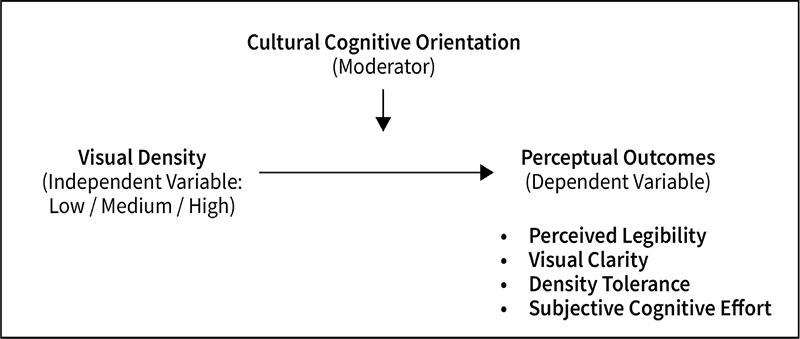
This study investigates how cultural cognitive orientations influence perceptual responses to typographic information under varying levels of visual density. Building on distinctions between holistic and analytic cognition, the study examines whether individuals from different cultural backgrounds vary in their subjective evaluations of legibility, visual clarity, tolerance for visual complexity, and perceived cognitive effort. A preliminary conceptual model (Figure 1) positions visual density as the independent variable affecting four perceptual outcomes – typographic legibility, visual clarity, density tolerance, and cognitive effort, while cultural grouping, used as a proxy for culturally associated cognitive tendencies, was treated as the grouping variable in the analysis. The analysis therefore examines whether culturally associated attentional tendencies are related to differences in perceived legibility, density tolerance, and cognitive effort across visual density conditions. Accordingly, the study addresses three core questions: 1) how changes in perceived typographic legibility across visual density levels differ between participants associated with holistic and analytic attentional tendencies; 2) to what extent participants associated with holistic and analytic attentional tendencies differ in subjective density tolerance under the high-density condition; and 3) to what extent individuals associated with analytic and holistic attentional tendencies differ in perceived cognitive effort as visual density increases. The four perceptual constructs — legibility, visual clarity, density tolerance, and cognitive effort operationalise the research questions. Together, they capture how visual density is perceived and allow testing whether these perceptual responses differ according to culturally associated attentional tendencies.
Preliminary Conceptual Model
3. 3. Research Hypotheses
Three hypotheses are proposed.
Analytic attentional tendencies place greater emphasis on focal-object segregation (Nisbett, 2003), while reduced spatial separation increases visual crowding and makes focal elements more difficult to perceptually isolate (Whitney & Levi, 2011). Consequently, increasing visual density is expected to have a stronger disruptive effect on perceived legibility among individuals associated with analytic attentional tendencies than among those associated with more context-oriented holistic attentional tendencies.
H1: As visual density increases, perceived typographic legibility is expected to decline more markedly among individuals associated with analytic attentional tendencies than among those associated with holistic attentional tendencies.
Holistic attentional tendencies involve broader allocation of attention across contextual relationships and less reliance on the precise isolation of focal elements (Nisbett, 2003; Varnum et al., 2010), which may facilitate greater subjective tolerance when visual information is presented under high-density conditions.
H2: Individuals associated with holistic attentional tendencies are expected to demonstrate a higher subjective tolerance under the high-density condition than individuals associated with analytic attentional tendencies.
Perceptual Load Theory proposes that increasing perceptual demand consumes limited attentional resources (Lavie, 1995, 2005). As analytic attentional tendencies place greater emphasis on focal-element segregation, the increased perceptual demands associated with visual density are expected to impose greater perceived cognitive effort on analytic than holistic perceivers (Nisbett, 2003).
H3: As visual density increases, individuals associated with analytic attentional tendencies are expected to report greater perceived cognitive effort than individuals associated with holistic attentional tendencies.
Together, these hypotheses examine complementary perceptual manifestations of the broader proposition that culturally associated attentional tendencies shape responses to increasing visual density.
3. 4. Participants
Participants were recruited from two broad cultural groupings: an East Asian group (China, Japan, and South Korea) and a Western group (the United States, the United Kingdom, and Canada). A total of 221 participants completed the survey, including 116 participants in the East Asian group and 105 in the Western group.
The study was administered online through a structured survey. Each participant completed demographic questions and a brief screening procedure to verify their cultural background. A detailed summary of participant characteristics, including nationality distribution, age range, mean age, age-group distribution, and gender distribution, is provided in Table 1.

Participant Demographics
While participants were grouped based on self-reported cultural background, cross-cultural exposure (e.g., residence abroad or intercultural experience) was not directly measured. Given the prevalence of multicultural environments, individuals within the same cultural group may vary in the extent to which their attentional tendencies align with those typically associated with that context. In addition, factors such as education level and prior design-related expertise were not controlled for and may have influenced participants’ evaluation of typographic layouts. These variables are therefore acknowledged as potential confounding factors in the interpretation of the results.
3. 5. Materials, Stimuli and Procedure
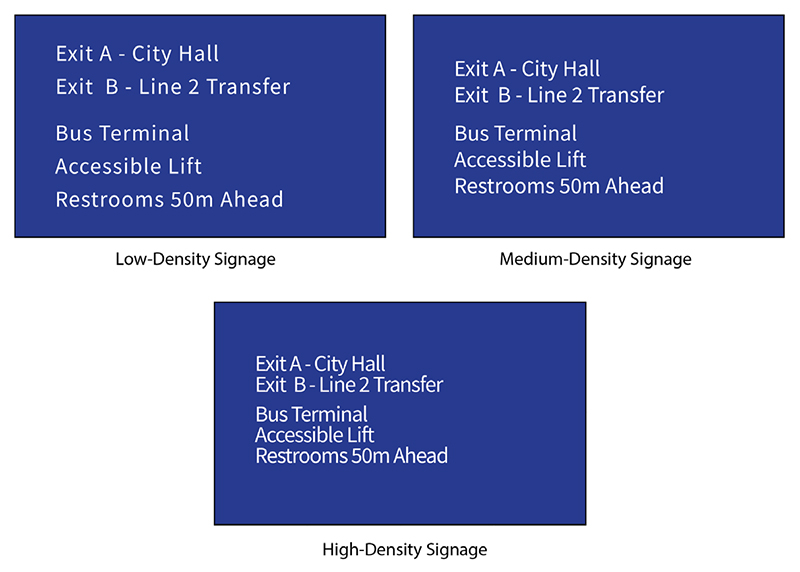
In this study, visual density was operationalised through spatial typographic parameters and conceptually distinguished from information load. Information load refers to the total amount of textual content, which remains constant across all conditions, whereas visual density refers to the spatial arrangement and proximity of typographic elements within a fixed information set. The experimental stimuli comprised typographic signage layouts (Figure 2) representing three levels of visual density: low, medium, and high.
Typographic Signage Stimuli by Visual Density
Across all conditions, key visual attributes, including typeface, font size, colour, alignment, and overall layout dimensions, were held constant to ensure that only visual density varied. The detailed typographic specifications for each condition are summarised in Table 2. A sans-serif typeface (Noto Sans KR) was selected for its neutral and highly legible characteristics, while font size and weight were kept constant to maintain consistent baseline readability. Colour and figure–ground contrast were standardised using a high-contrast scheme (light text on a dark background), with reversed polarity applied uniformly across all stimuli. Accordingly, adjustments were limited to spacing-related parameters, ensuring that any observed differences could be attributed to variations in visual density rather than typographic styling.
Typographic Specifications Across Density Conditions
Visual density was systematically manipulated through controlled adjustments to typographic spacing parameters, including line spacing (leading), intergroup spacing, and letter spacing (tracking). These manipulations resulted in variations in local density, whilst overall information quantity and layout area remained constant. Outer margins and the distribution of white space were maintained as part of the density structure, contributing to perceived density across conditions.
The spacing parameters were adjusted to create perceptually distinct levels of density while maintaining realistic typographic conditions commonly used in signage design, thereby ensuring ecological validity. Importantly, the high-density condition did not reduce the overall field of view, as the display area remained constant; rather, it reflected increased spatial compression of visual elements within the same visual field.
Following each stimulus, participants rated perceived legibility, visual clarity, density tolerance, and subjective cognitive effort using Likert-type scales. These measures were designed to capture variations in perceptual response attributable to differences in typographic density.
All stimuli were presented in English to maintain consistency across cultural groups and to control for differences in the intrinsic visual structure of writing systems. However, English may not be the native language for many East Asian participants, and language proficiency was not directly measured. As such, variation in language comprehension may have influenced perceived legibility and cognitive processing. Writing systems differ in their visual structure and processing characteristics, with logographic scripts relying on more complex visual configurations and direct form–meaning mappings, compared to alphabetic systems that emphasise phonological decoding (Perfetti et al., 2005). In addition, the visual forms of writing systems reflect underlying perceptual constraints, resulting in variation in feature density and spatial structure across scripts (Changizi et al., 2006). While English standardised the stimulus format, differences in script familiarity and processing demands remain potential confounding factors.
As the study was administered online, experimental conditions such as screen size, display resolution, ambient lighting, and viewing distance were not standardised and are acknowledged as a limitation. Participants completed the survey in their own environments, which may have introduced variability in visual perception. The presentation order of the stimuli was randomised across participants to reduce potential order effects. However, participants’ visual acuity and fatigue levels were not formally assessed and may have influenced the results.
4. Results and Discussion
A two-way analysis of variance (ANOVA) was conducted to examine the effects of visual density (low, medium, and high) and cultural group (East Asians vs Westerners) on four perceptual outcomes: perceived legibility, visual clarity, density tolerance, and perceived cognitive effort. The measurement scales demonstrated good internal consistency (Cronbach’s α = 0.852), while construct validity was supported by a satisfactory Kaiser–Meyer–Olkin (KMO) value of 0.868 and a significant Bartlett’s Test of Sphericity (χ2 = 5166.548, df = 630, p < 0.001).
4. 1. Effect of Visual Density on Perceived Legibility and Visual Clarity
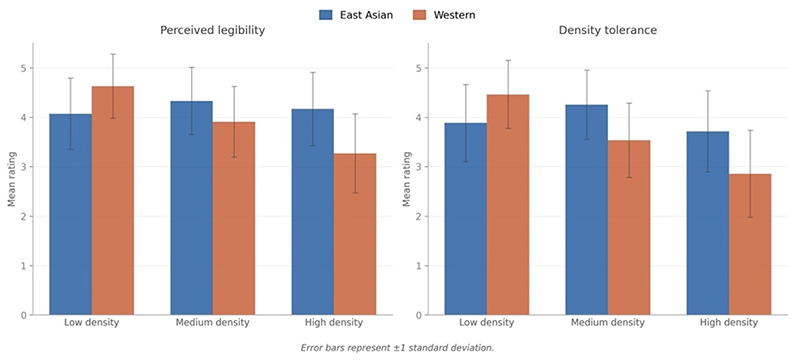
Across the full sample, perceived typographic legibility decreased as visual density increased (Table 3), with the low density layout receiving the highest ratings (M = 4.336), followed by the medium density layout (M = 4.133), and the high density layout (M = 3.742). This pattern indicates a clear main effect of visual density, suggesting that increased typographic compression reduces perceptual accessibility and reading ease regardless of cultural background. Such findings are consistent with perceptual load theory and visual crowding, suggesting that denser visual environments increase competition among adjacent visual elements, limiting attentional allocation and reducing perceptual discriminability.
Descriptive Statistics and Cultural Comparisons Across Density Conditions
Despite this overall decline, the magnitude of the effect differed between cultural groups. Western participants reported significantly higher perceived legibility (M = 4.629) under low-density conditions, but perceived legibility declined to M = 3.911 under the medium-density condition and M = 3.270 under the high-density condition. In contrast, East Asian participants demonstrated comparatively stable perceived legibility across the low- (M = 4.072), medium- (M = 4.333), and high-density (M = 4.170) conditions. Similar patterns were observed for visual clarity, where East Asian participants reported higher clarity ratings under denser typographic conditions compared to Western participants, suggesting a greater perceptual adaptability to dense typographic arrangements. These cross-cultural differences across density conditions are visually summarised in Figure 3. Post-hoc comparisons using the LSD method further confirmed significant directional differences between the two cultural groups across density conditions, with Western participants demonstrating higher perceptual ratings under low-density conditions, while East Asian participants reported comparatively higher ratings under medium- and high-density conditions (Table 3).
Cross-Cultural Differences in Perceived Legibility and Density Tolerance
The observed group differences were accompanied by moderate to large partial η2 effect sizes across several density conditions (Table 3), suggesting that the influence of cultural grouping on typographic perception was not only statistically significant but also practically meaningful. The observed pattern of perceived legibility across density levels is consistent with H1, as Western participants associated with analytic attentional tendencies exhibited a more marked decline in perceived legibility as visual density increased, whereas East Asian participants associated with holistic attentional tendencies maintained comparatively stable ratings across density levels. The density tolerance results relevant to H2 are examined in detail in Section 4.2.
The observed differences align closely with theoretical accounts of analytic and holistic cognition reported in prior literature. Patterns observed among participants interpreted within a holistic attentional framework appear to be associated with context-integrative processing and broader attentional allocation to buffer against the disruptive effects of increased visual density. Conversely, Western participants, characterised by analytic, object-focused perceptual styles, have greater sensitivity to spatial separation, making reductions in spacing and increases in visual crowding more disruptive to perceptual organisation. Taken together, the findings suggest that density perception is not solely determined by spatial arrangement but is mediated by culturally associated attentional strategies that influence how visual information is organised, interpreted, and tolerated under dense visual conditions.
4. 2. Cultural Differences in Density Tolerance
Cultural differences were evident in participants’ tolerance for visual density across typographic conditions. Western participants demonstrated stronger preferences for low-density layouts, whereas East Asian participants exhibited relatively greater tolerance towards medium- and high-density conditions, with the clearest group difference observed under the high-density condition. Under this condition, East Asian participants reported significantly higher density tolerance (M = 3.716) than Western participants (M = 2.857), F = 45.626, p < .001, partial η2 = .172.
These findings suggest that density perception is influenced not only by the physical arrangement of typographic elements but also by culturally associated attentional tendencies. These findings align with theoretical distinctions in field dependence–independence (FDI). Analytic attentional tendencies associated with field-independent processing emphasise object-focused attention and spatial separation, making dense layouts more likely to be perceived as cluttered or visually overwhelming. In contrast, holistic attentional tendencies associated with field-dependent processing involve broader attentional allocation and greater integration of contextual relationships, which may reduce perceptual disruption under increased visual density.
Taken together, the significantly higher density-tolerance ratings reported by East Asian participants under the high-density condition support H2, indicating greater subjective tolerance among participants associated with holistic attentional tendencies than among those associated with analytic attentional tendencies.
4. 3. Cultural Differences in Perceived Cognitive Effort
Perceived cognitive effort followed different patterns across visual density levels between the two cultural groups. Western participants reported a marked increase from the low-density condition to the medium- and high-density conditions, whereas East Asian participants showed a non-linear pattern across low-, medium-, and high-density. These results indicate that the relationship between visually dense layouts and perceived cognitive effort differed between the two cultural groups. However, the magnitude of such an increase differed systematically between East Asian and Western participants. Under the medium-density condition, Western participants already reported substantially higher cognitive effort (M = 3.394) compared to East Asians (M = 2.667), and this divergence remained pronounced in the high-density condition (Westerners: M = 3.714; East Asians: M = 3.106) (Table 3). Under the medium- and high-density conditions, Western participants reported greater perceived cognitive effort than East Asian participants, consistent with the predicted difference between analytic and holistic attentional tendencies as visual density increased. Under conditions of increased density, the efficient allocation of attention becomes increasingly critical. Holistic attentional tendencies of East Asian participants involve broader attentional allocation and greater integration of contextual relationships, which explains the comparatively lower cognitive strain imposed by visually dense information. In contrast, analytic attentional tendencies of Western participants exhibited heightened sensitivity to spatial crowding and object-level interference, leading to greater perceived cognitive effort as typographic density increased. These findings provide qualified support for H3: participants associated with analytic attentional tendencies reported greater perceived cognitive effort under the medium- and high-density conditions, although the opposite pattern observed under low-density indicates that this difference was not uniform across all density levels. The effect size observed under the high-density cognitive effort condition was moderate (partial η2 = .084), indicating meaningful differences in perceived cognitive strain between cultural groups. An exception to this pattern was observed under the low-density condition, where East Asian participants reported substantially higher perceived cognitive effort than Western participants (East Asian: M = 3.316; Western: M = 1.806), accompanied by a notably large effect size (partial η2 = .684). While the underlying cause of this reversal pattern remains unclear, it may suggest that perceptual processing advantages associated with holistic attentional tendencies become more prominent under conditions of increased visual complexity rather than under sparse visual conditions. Future research may benefit from further investigating how cultural attentional tendencies interact with extremely low-density visual environments.
5. Discussion
5. 1. Interpretation of Cultural Differences in Typographic Perception
The findings suggest that cultural differences in typographic perception may be associated with culturally patterned attentional tendencies reported in prior literature. Western participants, interpreted in this study through a cultural framework broadly associated with analytic attention, indicated a clear preference for low-density layouts and a more marked decline in perceived typographic legibility as visual density increased. They also reported lower subjective density tolerance under the high-density condition and greater perceived cognitive effort under the medium- and high-density conditions. This pattern is broadly consistent with theoretical accounts of field-independent processing, in which attention is directed towards salient elements and visual clarity is achieved through object separation. The tunnel-like allocation of visual attention often associated with analytic attention may heighten sensitivity to spatial crowding, resulting in greater perceptual disruption and higher perceived cognitive effort under compressed typographic conditions. In contrast, East Asian participants demonstrated comparatively greater perceptual stability as visual density increased. Their comparatively stable perceived legibility across density levels, higher subjective tolerance under the high-density condition, and lower perceived cognitive effort under medium- and high-density conditions are consistent with holistic cognition and field-dependent processing. Rather than isolating focal elements, participants interpreted within a holistic attentional framework appear to distribute attention more broadly across the visual field, interpreting typographic elements in relation to surrounding structure and groupings. This wide-angle attentional orientation may facilitate the integration of dense information, reducing the subjective impact of typographic compression.
These findings support the view that attentional orientation influences how perceptual input is organised and how cognitive resources are allocated under increasing visual density. Analytic attentional tendencies, as described in prior literature, are associated with clarity through separation, whereas holistic attention emphasises relational structure and contextual integration. Consequently, equivalent increases in typographic density may yield systematically different perceptual outcomes across cultural groups. Overall, the more marked decline in perceived legibility among Western participants relative to the comparatively stable East Asian pattern is consistent with H1. The higher subjective density tolerance reported by East Asian participants under the high-density condition supports H2, while the cognitive-effort results provide qualified support for H3, with Western participants reporting greater effort under medium- and high-density conditions despite the opposite pattern under low-density.
Beyond these empirical patterns, the study makes two theoretical contributions. First, it extends cultural cognition research from established demonstrations in scene perception (Masuda & Nisbett, 2001) and context-sensitive perceptual tasks (Kitayama et al., 2003) to the domain of typographic density and information design, suggesting that culturally associated attentional tendencies may also shape responses to spatial compression in visual communication. Second, the study brings Perceptual Load Theory into dialogue with cultural cognition by proposing that the perceptual demands generated by increasing visual density may be experienced differently according to culturally associated patterns of attentional organisation. In this respect, the study provides an initial conceptual bridge between stimulus-driven perceptual load and culturally patterned differences in focal and contextual attention within typographic communication.
5. 2. Implications for Cross-Cultural Visual Communication
The present findings have important implications for cross-cultural visual communication design and cross-cultural signage usability. Under the high-density condition, participants associated with holistic attentional tendencies demonstrated higher subjective density tolerance than those associated with analytic attentional tendencies. Participants associated with analytic attentional tendencies also showed a more marked decline in perceived legibility as visual density increased and greater perceived cognitive effort under denser conditions. Consequently, visual communication designed primarily around dense or context-dependent information structures may reduce perceptual accessibility for certain user groups in multicultural environments. When communication must address both cultural groups simultaneously, designing exclusively for either holistic or analytic perceptual preferences risks excluding part of the audience. More specifically, the present findings suggest that the medium-density configuration may provide a practical reference point for typographic compression in multicultural signage. At the scale used in this study, this configuration corresponded to a leading value of 127 pt and tracking of 0, compared with 100 pt leading and −45 tracking in the high-density condition. Western participants showed a marked decline in perceived legibility as visual density increased, whereas East Asian participants maintained comparatively stable ratings across the three conditions. Accordingly, signage intended for culturally diverse users may benefit from maintaining spacing no tighter than the medium-density configuration, with leading of at least 127 pt and tracking of 0 or greater at the scale examined in this study. These values should be interpreted as study-specific design reference points rather than universal typographic thresholds.
In line with Meyer’s argument that multicultural communication functions most effectively through low-context and explicit forms of information exchange (Meyer, 2014), the present findings suggest that visual communication in multicultural contexts should prioritise explicit structure, clear hierarchy, and unambiguous separation of information to maximise perceptual accessibility. Low-context visual strategies, such as increased spacing, strong figure-ground contrast and reduced reliance on contextual inference, may improve perceptual accessibility across culturally diverse user groups by minimising misinterpretation and cognitive effort, particularly for individuals associated with analytic attentional tendencies.
Accordingly, effective multicultural visual communication should adopt a clarity-first design logic that favours explicitness over contextual subtlety. By foregrounding information structure and reducing reliance on culturally specific perceptual assumptions, designers can create wayfinding systems that remain legible, interpretable and cognitively manageable across cultural boundaries, enhancing perceptual accessibility and cross-cultural signage usability in multicultural environments.
6. Conclusion
This study demonstrates that perceptual responses to typographic visual density may vary according to culturally associated attentional tendencies. Western participants showed a more marked decline in perceived legibility and greater cognitive effort as visual density increased, whereas East Asian participants maintained comparatively stable legibility and demonstrated greater subjective tolerance under the high-density condition. These findings extend cultural cognition research into typographic and information-design contexts, while recognising that the observed differences represent culturally associated tendencies rather than fixed cognitive characteristics.
The practical relevance of these findings is particularly apparent in multicultural wayfinding environments such as airports, hospitals, subway systems, transportation hubs, shopping centres, and public facilities, where users from diverse cultural and linguistic backgrounds must rapidly process visual information under conditions of time pressure and cognitive load. In such contexts, multicultural signage systems may benefit from low- to medium-density typographic layouts that prioritise explicit hierarchy, sufficient spacing, strong figure-ground contrast, and clear grouping of information. This recommendation is consistent with Meyer’s (2014) argument that multicultural communication functions more effectively through low-context and explicit forms of communication exchange. More broadly, visual communication systems intended for culturally diverse users should account for variation in perceptual responses rather than assume a universal mode of visual processing, thereby supporting more perceptually accessible and inclusive information design. Future research should extend this work through direct measures of individual attentional orientation and by examining typographic density across different writing systems, viewing conditions, and real-world visual communication contexts.
6. 1. Limitations and Future Research
Several limitations should be acknowledged. First, cognitive orientation was not directly measured at the individual level, as participants’ cultural backgrounds were used as a proxy for culturally associated attentional tendencies reported in prior literature. As such, the findings should be interpreted as reflecting culturally associated patterns rather than fixed or universal cognitive traits, while recognising that individual variability within each cultural group is likely to exist due to factors such as education, cross-cultural exposure, and situational context. Future research is therefore encouraged to incorporate individual-level measures of cognitive style, such as the Analytic–Holistic Scale (AHS) or the Self-Construal Scale (SCS), to more directly examine the relationship between cognition and typographic perception.
Second, the study relied on controlled, survey-based stimuli and self-reported perceptual measures, which may not fully capture real-world navigational behaviour in complex environments. In addition, environmental variables associated with the online survey administration, including screen size, viewing distance, and lighting conditions, could not be fully standardised across participants, while visual acuity and fatigue levels were not formally assessed. These factors may have contributed to individual variability in perceptual ratings. More broadly, future research may also benefit from incorporating behavioural performance measures and a wider range of visual design variables to further examine typographic perception across multilingual and multicultural communication environments.
Acknowledgments
This work was supported by 2026 Hongik University Innovation Support Program Fund.
Notes
Copyright : This is an Open Access article distributed under the terms of the Creative Commons Attribution Non-Commercial License (http://creativecommons.org/licenses/by-nc/3.0/), which permits unrestricted educational and non-commercial use, provided the original work is properly cited.
References
-
Behrmann, M., & Kimchi, R. (2003). What does visual agnosia tell us about perceptual organization and its relationship to object perception? Journal of Experimental Psychology: Human Perception and Performance, 29(1), 19-42.
[https://doi.org/10.1037/0096-1523.29.1.19]

-
Changizi, M. A., Zhang, Q., Ye, H., & Shimojo, S. (2006). The structures of letters and symbols throughout human history are selected to match those found in objects in natural scenes. The American Naturalist, 167(5), E117-E139.
[https://doi.org/10.1086/502806]
-
Choi, I., Koo, M., & Choi, J. A. (2007). Individual differences in analytic versus holistic thinking. Personality and Social Psychology Bulletin, 33(5), 691-705.
[https://doi.org/10.1177/0146167206298568]
-
Chua, H. F., Boland, J. E., & Nisbett, R. E. (2005). Cultural variation in eye movements during scene perception. Proceedings of the National Academy of Sciences of the United States of America, 102(35), 12629-12633.
[https://doi.org/10.1073/pnas.0506162102]
- Guisande, M. A., Páramo, M. F., Tinajero, C., & Almeida, L. S. (2007). Field dependence-independence (FDI) cognitive style: An analysis of attentional functioning. Psicothema, 19(4), 572-577.
- Hall, E. T. (1976). Beyond culture. Garden City, N.Y.: Anchor Press.
-
Heine, S. J., & Ruby, M. B. (2010). Cultural psychology. WIREs Cognitive Science, 1(2), 254-266.
[https://doi.org/10.1002/wcs.7]
-
Henrich, J., Heine, S. J., & Norenzayan, A. (2010). The weirdest people in the world? Behavioral and Brain Sciences, 33(2-3), 61-83.
[https://doi.org/10.1017/S0140525X0999152X]
-
Kitayama, S., Duffy, S., Kawamura, T., & Larsen, J. T. (2003). Perceiving an object and its context in different cultures: A cultural look at new look. Psychological Science, 14(3), 201-206.
[https://doi.org/10.1111/1467-9280.02432]
-
Lavie, N. (1995). Perceptual load as a necessary condition for selective attention. Journal of Experimental Psychology: Human Perception and Performance, 21(3), 451-468.
[https://doi.org/10.1037//0096-1523.21.3.451]
-
Lavie, N. (2005). Distracted and confused?: Selective attention under load. Trends in Cognitive Sciences, 9(2), 75-82.
[https://doi.org/10.1016/j.tics.2004.12.004]
-
Lavie, N. (2010). Attention, distraction, and cognitive control under load. Current Directions in Psychological Science, 19(3), 143-148.
[https://doi.org/10.1177/0963721410370295]
-
Lavie, N., Hirst, A., de Fockert, J. W., & Viding, E. (2004). Load theory of selective attention and cognitive control. Journal of Experimental Psychology: General, 133(3), 339-354.
[https://doi.org/10.1037/0096-3445.133.3.339]
-
Markus, H. R., & Kitayama, S. (1991). Culture and the self: Implications for cognition, emotion, and motivation. Psychological Review, 98(2), 224-253.
[https://doi.org/10.1037/0033-295X.98.2.224]
-
Masuda, T., & Nisbett, R. E. (2001). Attending holistically versus analytically: Comparing the context sensitivity of Japanese and Americans. Journal of Personality and Social Psychology, 81(5), 922-934.
[https://doi.org/10.1037/0022-3514.81.5.922]
- Meyer, E. (2014). The culture map: Breaking through the invisible boundaries of global business. New York: PublicAffairs.
-
Murphy, G., Groeger, J. A., & Greene, C. M. (2016). Twenty years of load theory–Where are we now, and where should we go next? Psychonomic Bulletin & Review, 23(5), 1316-1340.
[https://doi.org/10.3758/s13423-015-0982-5]
- Nisbett, R. E. (2003). The geography of thought: How Asians and Westerners think differently... and why. New York: Free Press.
-
Nisbett, R. E., Peng, K., Choi, I., & Norenzayan, A. (2001). Culture and systems of thought: Holistic versus analytic cognition. Psychological Review, 108(2), 291-310.
[https://doi.org/10.1037/0033-295X.108.2.291]
-
Oyserman, D., & Lee, S. W. S. (2008). Does culture influence what and how we think? Effects of priming individualism and collectivism. Psychological Bulletin, 134(2), 311-342.
[https://doi.org/10.1037/0033-2909.134.2.311]
-
Perfetti, C. A., Liu, Y., & Tan, L. H. (2005). The lexical constituency model: Some implications of research on Chinese for general theories of reading. Psychological Review, 112(1), 43-59.
[https://doi.org/10.1037/0033-295X.112.1.43]
-
Singelis, T. M. (1994). The measurement of independent and interdependent self-construals. Personality and Social Psychology Bulletin, 20(5), 580-591.
[https://doi.org/10.1177/0146167294205014]
- Smith, D. C. (2008). Finding the way: A non-fiction narrative concerning the case study of visual cues in communication design (Doctoral dissertation). Union Institute & University, Cincinnati, OH. Available from ProQuest Dissertations and Theses database.
-
Tsakanikos, E. (2006). Associative learning and perceptual style: Are associated events perceived analytically or as a whole? Personality and Individual Differences, 40(3), 579-586.
[https://doi.org/10.1016/j.paid.2005.07.014]
-
Varnum, M. E. W., Grossmann, I., Kitayama, S., & Nisbett, R. E. (2010). The origin of cultural differences in cognition: The social orientation hypothesis. Current Directions in Psychological Science, 19(1), 9-13.
[https://doi.org/10.1177/0963721409359301]
-
Whitney, D., & Levi, D. M. (2011). Visual crowding: A fundamental limit on conscious perception and object recognition. Trends in Cognitive Sciences, 15(4), 160-168.
[https://doi.org/10.1016/j.tics.2011.02.005]
-
Witkin, H. A. (1965). Psychological differentiation and forms of pathology. Journal of Abnormal Psychology, 70(5), 317-336.
[https://doi.org/10.1037/h0022498]