
From Quantification to Atmosphere: A Somaesthetic Design Framework for Atmospheric Pacing Interfaces in VR
Abstract
Background Many user-facing virtual reality (VR) biofeedback interfaces rely on symbolic dashboards that can shift attention toward interpretation, and in relaxation contexts, undermine sustained bodily attunement. This study frames respiratory guidance through Atmospheric Pacing, treating rhythm as an inhabitable perceptual condition rather than information to be read.
Methods Using a Research through Design (RtD) approach, we developed a proof-of-concept VR prototype (Breath Ring) that externalizes breathing pace through pre-symbolic abstraction and ambient enclosure. To maintain a stable pacing condition, the system used a fixed 6 BPM (Beats per Minute) pacer, allowing the study to focus on pacing-oriented guidance rather than signal mirroring.
Results In a formative heuristic inspection with five specialists (N = 5), experts reported strong perceptual coherence and rhythm readability, while perceptions of agency were lower and more variable.
Conclusions Qualitative interpretation suggested an Embodiment Gap, where visually legible rhythm did not consistently translate into perceived bodily ownership. Some accounts also indicate a relational comfort stance, which is cautiously framed as Atmospheric Empathy as a preliminary design hypothesis. These findings point to a design opportunity—from instrumental monitoring toward atmospheric inhabitation—while underscoring the need for comparative and summative validation.
Keywords:
Virtual Reality (VR), Atmospheric Pacing, Somaesthetic Design, Atmospheric Empathy, Embodiment Gap1. Introduction
1. 1. Background: The Somatic Turn in Immersive Media
The convergence of immersive technology and psychophysiology is increasingly shaping digital approaches to mental health and wellness, extending interventions beyond traditional clinical settings toward accessible, technology-mediated formats (Lüddecke & Felnhofer, 2022). In this context, Virtual Reality (VR) is often used because it can reduce external distractions and provide a multisensory context in which bodily cues may become more salient (Blum et al., 2020). Prior studies suggest that a strong sense of presence (“being there”) can support engagement and may facilitate the continued use of relaxation strategies beyond the VR session, although outcomes depend on content and protocol design. In parallel, digital art and media theory has framed VR as a phenomenological medium capable of altering how embodied perception is organized, rather than as a display technology alone. This position resonates with somaesthetic HCI, which treats felt bodily experience—and the cultivation of somatic awareness—as an explicit design goal. From this perspective, technology is not only a means to monitor biological variables but may also function as an experiential scaffold that supports attention, regulation, and reflective bodily awareness.
Despite the potential of VR for relaxation-oriented applications, a practical mismatch persists between immersive embodiment at the medium level and information-centric design at the interface level. Many current biofeedback interfaces inherit representational conventions from desktop computing, emphasizing graphs, numerical readouts, and gauge-like indicators to communicate physiological change (Rockstroh et al., 2019). While such representations can convey explicit values efficiently, they may introduce two limitations when the goal is stress regulation. First, information-centric displays can encourage an analytic attentional mode and impose extraneous cognitive load, shifting attention toward evaluation (e.g., “am I doing this correctly?”) rather than toward the felt quality of breathing and bodily state (Wenk et al., 2023). Such an orientation may conflict with non-judgmental attentional stances emphasized in several relaxation and mindfulness-based protocols. Second, externalized metrics can reinforce a third-person stance toward the body, positioning physiology as an object of monitoring (Körper) rather than as lived experience (Leib). Work in embodied interaction has critiqued this tendency, noting that representational strategies may fragment bodily experience and weaken experiential continuity. For engineering-oriented design and evaluation, this mismatch can be reflected in practical issues such as increased task-related cognitive effort, reduced visual comfort, lower perceived agency, or weaker rhythmic attunement during paced-breathing experiences. Accordingly, a key design challenge is to reframe regulation tools as experiential environments that support rhythmic attunement, rather than as metric-driven monitoring interfaces that primarily require visual interpretation.
1. 2. Research Purpose
To address these limitations, this study proposes an alternative framework termed Atmospheric Pacing—a pacing-oriented approach that treats bodily rhythm itself as the referent, embedded within an inhabitable perceptual environment rather than acquired through bio-sensing technology. Using a Research-through-Design (RtD) methodology, a proof-of-concept prototype, Breath Ring, was developed to materialize breathing rhythm as a continuous spatial phenomenon through pre-symbolic abstraction and ambient enclosure (Pousman & Stasko, 2006). A distinct feature is the deliberate use of a fixed rhythmic model (6 BPM) as a pacing guide, instead of relying on real-time biometric acquisition (Lehrer & Gevirtz, 2014). This pacing-only configuration is detailed in Section 4.1. Accordingly, this paper is positioned as an engineering and design contribution that specifies an implementable VR pacing pipeline and a reproducible formative inspection protocol as groundwork for future comparative evaluation. The prototype functioned as a situated design probe and was evaluated through a formative inspection with a multidisciplinary specialist panel (N = 5), combining heuristic ratings and qualitative feedback to assess design logic and experiential coherence prior to subsequent summative evaluation.
2. Related Work and Theoretical Background
2. 1. From Quantification to Embodiment: The Evolution of VR Biofeedback
Biofeedback emerged in clinical psychology during the 1960s as a technique for autonomic self-regulation (Schwartz & Andrasik, 2003). Early implementations prioritized accurate mirroring of physiological signals—such as heart rate and galvanic skin response (GSR)—through numerical and graphical displays (Frank et al., 2010). While scientifically rigorous, this approach helped consolidate an instrumental paradigm in which the body is treated as a system to be monitored and adjusted. In such settings, the user’s role can become aligned with interpretive control—reading values, judging progress, and correcting performance—rather than with sustained attention to the felt qualities of breathing or tension. This concern has been discussed in prior critiques of quantification-driven self-regulation, where the representational form of feedback may shape the stance a user adopts toward their own body and performance.
The advent of immersive Virtual Reality (VR) offered a departure from screen-based quantification by enabling somatic signals to be situated and spatialized (Prpa et al., 2020). In some artistic and experimental precedents, breathing has been treated less as a value to be displayed and more as a structuring condition for perception and action. Char Davies’s Osmose (1995), for instance, framed breathing as a navigational ontology, where breath modulates buoyancy within a virtual space (Davies, 1995). More recently, the game DEEP (n.d.) embedded breathing rhythms into environmental dynamics, supporting meditative pacing through immersion rather than continuous analytic checking. These precedents suggest that rhythm can be experienced as a temporal organization of the environment rather than as a value to be checked.
Recent VR breathing research has further diversified this design space and has also clarified the methodological difference between immersive breathing guidance, standardized paced breathing, and closed-loop biofeedback. A recent scoping review of breathing in VR for mental health mapped 18 studies and showed that VR-based breathing interventions have been used to support relaxation, breathing awareness, and mental-health-related outcomes, while also emphasizing methodological heterogeneity and the need for further work on long-term effects and user experience (Pancini et al., 2025). In contrast, a systematic review and meta-analysis of randomized controlled trials found no clear evidence that VR breathing interventions are more effective than non-VR breathing interventions in improving mental health outcomes, heart rate, or heart-rate variability, underscoring the need for careful comparative validation (Cortez-Vázquez et al., 2024). At the level of mechanism, Weibel et al. (2023) further demonstrated that VR-supported HRV biofeedback and standardized paced breathing are not experientially or physiologically equivalent: HRV biofeedback produced stronger increases in low-frequency HRV and cardiac coherence than standardized paced breathing, while HMD-based delivery increased cardiac coherence relative to desktop presentation. These developments are important because they show that VR breathing systems differ not only in visual style, but also in whether they rely on bio-sensing, closed-loop mirroring, standardized pacing, narrative interaction, or self-representational cues.
Table 1 maps Breath Ring against five selected precedents across seven design dimensions. Osmose and DEEP demonstrate how breathing can be embedded into immersive environments as a navigational or regulatory mechanism, while Weibel et al. (2023) clarify the distinction between VR-supported HRV biofeedback and standardized paced breathing through a controlled comparative design. Chittaro et al. (2024) further illustrates a recent direction in which breathing and relaxation training are integrated with multiple physiological measurements and narrative-based VR interaction. MindFlow (Yang et al., 2025) extends this trajectory by combining breathing biofeedback with a full-body self-avatar and progressive muscle relaxation. Against these precedents, Breath Ring occupies a more deliberately constrained position: it removes bio-sensing entirely, replaces closed-loop mirroring with a fixed external pacer, and uses pre-symbolic abstract geometry with egocentric enclosure rather than naturalistic metaphor, narrative progression, or self-avatar representation. This comparison clarifies that the contribution of Breath Ring does not lie in improved physiological feedback accuracy, but in isolating an atmospheric pacing condition as a somaesthetic design probe.

Comparative overview of VR breathing systems
2. 2. Theoretical Background: Phenomenology and Somaesthetics
The analysis follows the phenomenological distinction between Körper (the body as an object of description) and Leib (the body as lived from the first-person perspective) (Husserl, 1952/1989). In many biofeedback systems, physiological change is externalized into measurable representations, which can orient attention toward the Körper as something to be observed and evaluated. By contrast, a Leib-oriented perspective frames regulation as a mode of situated experience, where sensing and meaning-making unfold within ongoing perception rather than through detached inspection.
Merleau-Ponty’s account of embodied perception is relevant here because bodily understanding is not limited to explicit representation; it is enacted through continuous sensorimotor engagement and perceptual organization (Merleau-Ponty, 1945/2002). For paced-breathing interfaces, this implies that design can shape not only what is shown but how rhythm is encountered as part of the user’s embodied situation. Importantly, rhythm is inherently temporal: it is experienced as patterned change over time, not as a static attribute. This temporal character makes it possible to frame pacing guidance as an experiential condition—something the body can attune to—rather than solely as a value to be read.
Shusterman’s somaesthetics emphasizes practices and conditions that cultivate somatic awareness and reflective bodily attention (Shusterman, 2008). In HCI, Soma Design has adapted this orientation into design strategies that support felt experience, often using defamiliarization to disrupt habitual perception and invite renewed sensory attention (Höök, 2018). Rather than removing guidance or structure from regulation tasks, somaesthetic and soma-design accounts commonly discuss shifting how guidance is delivered—from explicit metric reading toward perceptual scaffolding that can be followed without continuous semantic decoding.
In the context of breathing guidance, familiar medical graphs can prompt performance monitoring and judgment, whereas alternative representational forms may encourage exploratory sensing of rhythm and comfort. One approach discussed in soma-design accounts is to use pre-symbolic, perceptual cues that preserve a followable pacing structure while reducing reliance on numeric or graph decoding (Höök, 2018). This line of work supports treating such cues as a viable way to materialize an otherwise intangible rhythm without defaulting to dashboard-style framing.
Interoception—the sensing of internal bodily states—has been linked to affective experience and regulation, making it a relevant target for breathing-oriented interfaces (Farb et al., 2015). However, VR is typically vision-dominant, and designs that foreground visual inspection can keep attention externally anchored, which may reduce access to felt bodily cues during regulation tasks (Mehling et al., 2012). One response discussed in prior work is to construct sensory loops that couple exteroceptive cues with plausible bodily rhythms, so that cadence can be followed through perceptual attunement with reduced reliance on continuous symbolic decoding.
In the augmented embodiment literature, interoceptive–exteroceptive coupling is often operationalized through time-locked feedback, where environmental signals are synchronized with bodily rhythms. Such coupling has been reported to modulate aspects of bodily self-experience and to support the integration of internal and external cues (Riva et al., 2019). Related work in calm and ambient interaction has also argued that feedback can be presented in peripheral or atmospheric forms, enabling attention to shift between environmental change and felt experience with reduced emphasis on explicit value reading (Pousman & Stasko, 2006). For example, ambient biofeedback systems have used subtle environmental modulation (e.g., light dynamics) as a guidance channel for breathing-related regulation and relaxation assistance, suggesting that rhythmic cues can be embedded into the surroundings. Somaesthetic design research similarly emphasizes subtle, body-resonant feedback loops that invite inquiry and sustained bodily attention without overloading users with explicit representational demands.
3. Methodology and Design Rationale
3. 1. Methodological Approach: Research–through–Design (RtD)
To probe both the design logic and the felt coherence of a VR pacing interface, this study adopts a Research-through-Design (RtD) approach (Zimmerman et al., 2007). RtD is well suited here because the artifact can carry the theoretical idea and show how it behaves once instantiated in a concrete interaction setting. Within HCI and design research, RtD has been used to articulate design knowledge through making, where the artifact itself functions as an accountable embodiment of the research proposition.
Accordingly, the evaluation framing in this work is positioned as formative and design-oriented. The prototype was developed with reference to Slow Technology (Hallnäs & Redström, 2001)—specifically its emphasis on designing for reflection through sustained exposure rather than immediate utility—treating the pacing interface less as a performance-monitoring display and more as a context for stable cadence over time. This orientation directly informed the decision to use a fixed 6 BPM pacer (P2) and an infinite void background (P3), both of which reduce task-like urgency and foreground temporal dwelling. The overall workflow—progressing from theoretical grounding, to design principle derivation, to prototype development, and to a formative expert inspection (N = 5)—is summarized in Figure 1.
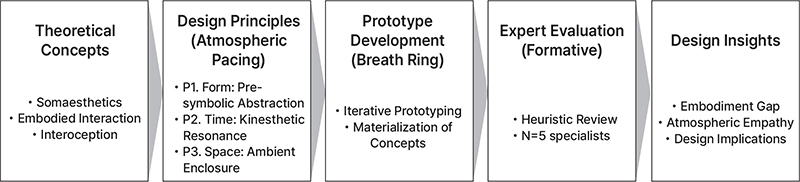
Overview of the Research-through-Design (RtD) workflow
3. 2. Design Principles for Atmospheric Pacing
Building on the critique of instrumental biofeedback and the somaesthetic framing, three design principles were derived to support a shift from information-centric feedback to experience-centric pacing. The conceptual transition and the role of the three principles (P1–P3) are summarized in Figure 2.
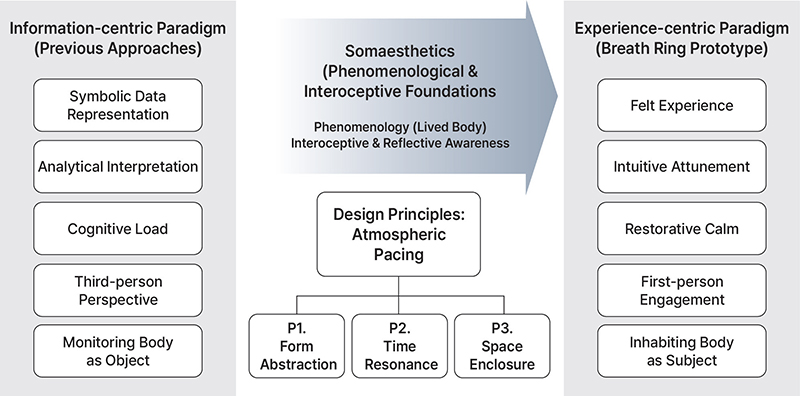
Conceptual framework structured through somaesthetics and three design principles (P1-P3)
• P1. Form: Pre-symbolic Abstraction (Materializing the Intangible)
Conventional biofeedback interfaces frequently rely on symbolic representations (e.g., numbers, graphs) that can prompt analytic evaluation and, in some contexts, increase performance-oriented attention (Kober et al., 2017). To avoid pushing users into semantic decoding, the design adopts Pre-symbolic Abstraction (Pousman & Stasko, 2006). Instead of discrete metrics, breathing is rendered as continuous circular geometry with organic surface qualities. This strategy is intended to give an intangible rhythm a perceivable material presence, enabling pacing cues to be engaged without requiring users to interpret values explicitly.
• P2. Time: Rhythmic Scaffolding (From Mirroring to Pacing)
Traditional biofeedback often aims to mirror real-time physiology. In relaxation-oriented biofeedback use, moment-to-moment respiratory variability can be experienced as unstable or distracting for some users, which can complicate sustained pacing attention (Lüddecke & Felnhofer, 2022). Accordingly, rather than emphasizing mirroring accuracy, the temporal design in this work prioritizes a stable external cadence that can be followed as a pacing reference over time, termed Rhythmic Scaffolding (Lehrer & Gevirtz, 2014). A fixed 6 BPM rhythm is presented with eased, non-linear motion so that the system functions primarily as a guide rather than a mirror. This framing is consistent with somaesthetic discussions of kinesthetic resonance, where bodily rhythm is approached through felt continuity.
• P3. Space: Atmospheric Enclosure (From Observation to Inhabitation)
In many VR interfaces, feedback is presented as a distinct visual object to be inspected, which can preserve a third-person stance toward the signal and maintain perceptual distance (Gorisse et al., 2017). To reduce this representational distance, the prototype implements Atmospheric Enclosure using an egocentric spatial configuration. Visual elements are scaled and positioned to surround the user so that pacing is perceived less as an object to watch and more as an ambient presence (Pousman & Stasko, 2006) to inhabit. This spatial move aims to support relaxation-oriented self-regulation by placing pacing in the surrounding field—so users can stay attuned without slipping into detached, evaluative inspection.
Taken together, P1–P3 specify how form, temporal guidance, and spatial configuration are combined to deliver pacing as an inhabitable VR condition. The concrete system configuration and implementation choices that operationalize these principles are described in Section 4.
Conceptual Shift from Dashboard-style Biofeedback to Atmospheric Pacing Interfaces
4. Prototype Implementation
4. 1. System Architecture
The prototype, Breath Ring, was implemented as a situated design probe to examine the experiential characteristics of rhythmic pacing under stable rendering conditions. The system follows a unidirectional pipeline: Time-driven Input → Temporal Stabilization →Atmospheric Rendering. A deliberate architectural choice was to exclude closed-loop bio-sensing in this prototype. Instead, a fixed pacing cadence at 0.1 Hz (6 BPM) was used to avoid common sources of instability in consumer sensing (e.g., latency and noise) and to keep the visual pacing cue temporally consistent. This design allows the study to focus on users’ attunement to an external pacer rather than on real-time monitoring of variable physiology. The mapping from design principles to implementation is summarized in Figure 3, and the system architecture is shown in Figure 4.
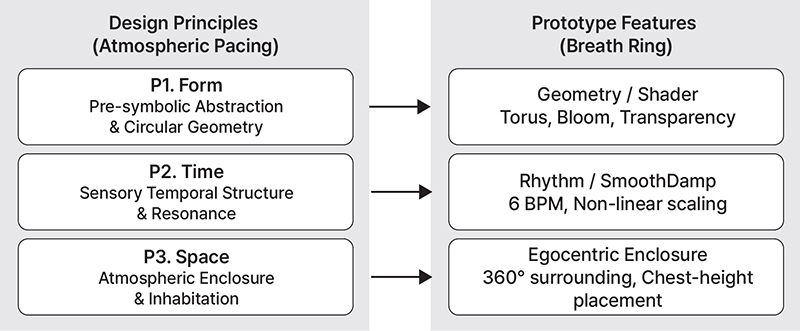
Somaesthetic concepts into technical implementations
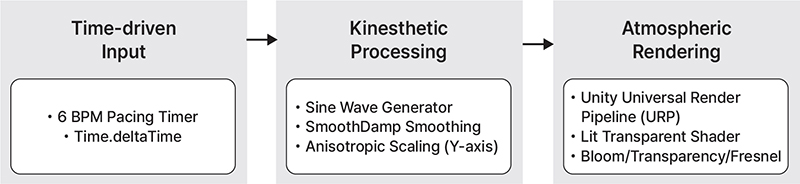
Unidirectional system architecture of the Breath Ring prototype
4. 2. Rhythmic Scaffolding: Temporal Guidance Implementation
The pacing rhythm is generated by a sine wave fixed at 0.1 Hz (6 BPM). This frequency was used as a standardized pacing condition (0.1 Hz; 6 BPM) to keep the temporal input consistent and reproducible across sessions, while remaining within a commonly discussed range in paced-breathing literature (Lehrer & Gevirtz, 2014).
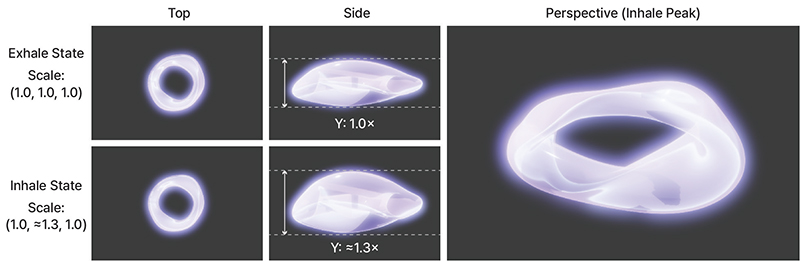
Exhale (contraction) and inhale (expansion) states
To implement P2 as a temporal guidance strategy, two mechanisms were applied to map the rhythmic input into a perceptually continuous motion cue. The temporal stabilization logic used to generate a smooth pacing cue is summarized in Algorithm 1.
Anisotropic scaling was used as a mapping choice so that deformation was applied primarily along the vertical (Y) axis, producing a consistent expansion–contraction profile aligned with the gross mechanics of inhalation (De Troyer & Boriek, 2011). To further stabilize the pacing cue over time, the system implemented damping-based temporal smoothing using Unity’s Mathf.SmoothDamp (Unity Technologies, n.d.). This approach was selected to reduce abrupt transitions that can occur with time-varying targets; compared with simple linear interpolation (Lerp), SmoothDamp is commonly characterized as a spring–damper-like method that converges quickly while helping to minimize overshoot and oscillation.
4. 3. Visual Construction: Materializing the Intangible
The primary geometry is an organic, asymmetrical ring modeled with a NURBS-based torus topology. The visuals avoid medical iconography and context-dependent symbols to reduce interpretive bias and to keep attention on the pacing cue. Its open center supports an unobstructed visual sense of expansion, aligning with the intended pacing cue as a continuous spatial phenomenon.
The material system uses a URP Lit Transparent shader with low alpha to create a soft, volumetric appearance. A desaturated, cool-toned glow was selected as a pragmatic strategy for sustained viewing comfort; prior research on color–emotion associations suggests that cooler hues tend to be appraised as less arousing and more calming, and evidence from VR environments similarly indicates that environmental hue can modulate perceived and physiological arousal, which informed this choice (Wilms & Oberfeld, 2018). To provide depth cues without computationally expensive volumetric fog, the prototype applies Fresnel-based illumination, modulating edge luminance as a function of view angle.
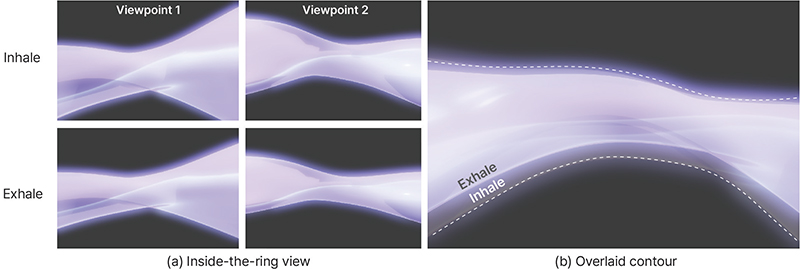
(a) Two inside-the-ring viewpoints, (b) Overlaid contours between inhale and exhale. Captured from the HMD-based viewpoint during the evaluation session
4. 4. Spatial Design for Inhabitation
The spatial layout was designed to support a shift from watching an object to inhabiting a pacing field (Egocentric Enclosure, P3), as illustrated in Figure 7.
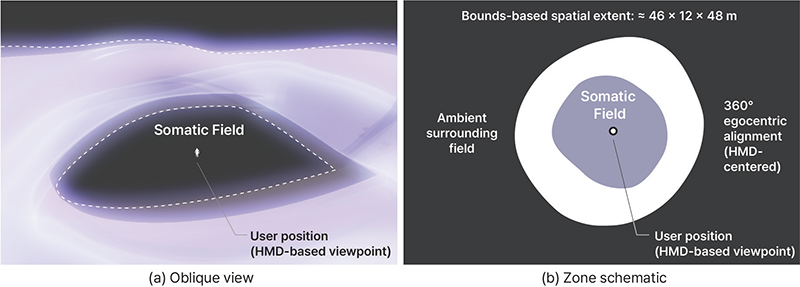
Spatial organization of the Somatic Field around the user viewpoint
Figure 7 Spatial organization of the Somatic Field around the user viewpoint. (a) Oblique view illustrating phase-dependent deformation: the dashed contours indicate the inhale and exhale boundaries, while the upper dashed line indicates the surrounding field boundary; arrows mark the relative displacement. (b) Zones schema showing a 360° egocentric layout centered on the HMD-based viewpoint, with the bounds-based spatial extent (≈ 46 × 12 × 48 m).
The prototype was designed around an ambient enclosure strategy in which the ring is scaled to approximately 46 m × 12 m × 48 m and aligned to an egocentric, HMD-centered reference frame, so that the user is embedded within the breathing volume rather than viewing it from a distance. The scene uses an infinite void background—implemented as a solid monochromatic field without horizon lines or textures—to reduce spatial anchoring cues and support a horizonless perception consistent with the intended atmospheric presentation.
4. 5. Rendering Optimization and Experiential Stability
To support stable operation on standalone Meta Quest 3 hardware, the prototype was designed under a constrained rendering budget. The system uses URP Single-Pass Instanced Rendering and targets a fixed 90 FPS, a common recommendation for reducing visually induced motion sickness (VIMS) risk in VR (Saredakis et al., 2020). A global Bloom effect (Threshold 1.0, Intensity 15) was applied to soften high-frequency contrast and sustain gentle visual engagement, aligning with the notion of Soft Fascination in restorative-environment theory (Kaplan, 1995) while leaving attentional resources available for bodily awareness. Key configuration parameters are summarized in Table 3. A fixed 0.1 Hz (6 BPM) cadence was used as the controlled pacing condition (Section 4.1) to improve reproducibility.
Configuration parameters of the Breath Ring prototype
5. Formative Expert Inspection
5. 1. Expert Panel: Purposive Sampling for Formative Inspection
Given the study aim—examining the design logic and experiential coherence of a pacing-oriented VR interface—a formative expert inspection was conducted rather than a summative clinical evaluation. This choice follows heuristic inspection guidance, where a compact panel can reveal a substantial proportion of usability and design issues (Nielsen & Molich, 1990).
Purposive sampling broadened diagnostic coverage across lenses relevant to the prototype: (i) real-time XR implementation and rendering constraints, (ii) interaction and embodied experience interpretation, and (iii) applied wellness or performance-regulation contexts. Experts were anonymized as A–E, and all results are reported at the individual level to characterize cross-case variation.
- • Expert A (XR Technology Specialist, 10 years): system stability, latency sensitivity, and perceptual fidelity under standalone VR constraints.
- • Expert B (XR/Media Artist, 5 years): aesthetic coherence, visual rhythm perception, and affective tone.
- • Expert C (HCI Researcher, 5 years): interaction logic, first-person somatic framing, and interpretive clarity.
- • Expert D (Environmental Design & Somatic Practice Specialist, 15 years): spatial enclosure, embodied comfort, and situated wellbeing interpretation.
- • Expert E (Sports Psychology & VR Specialist, 8 years): pacing plausibility, perceived regulation affordances, and potential utility in wellness-oriented use scenarios.
5. 2. Evaluation Procedure and Measures
The prototype was deployed on a standalone Meta Quest 3 headset. Experts stood at the center of the play area and were allowed to rotate freely(360°) to explore the egocentric enclosure. To reduce interaction-related distraction, hand controllers were removed, and no interactive input was required beyond head movement (viewpoint orientation). The application was built using Unity 2022.3 LTS and URP 14.0 and targeted 90 FPS. Fixed Foveated Rendering (FFR) was set to High, and the display frequency was locked via the OVR Manager. To standardize the visual condition across sessions, Bloom post-processing was fixed.
The rating items were not administered as validated psychometric scales. Instead, they were custom formative inspection items developed to evaluate the design logic and experiential coherence of the Breath Ring prototype. The items were informed by concepts from embodied interaction, presence, and visual comfort research, but they were used only as diagnostic prompts for expert inspection rather than as standardized measurement instruments. To improve methodological transparency, the full item set is provided in Table 4. Each item was rated on a five-point Likert scale, where 1 indicated “strongly disagree” and 5 indicated “strongly agree.”
Full item set used for the formative expert inspection
In addition to the Likert items, experts responded to two open-ended questions: (1) which elements of Breath Ring v1 were most effective or memorable, and (2) which aspects required improvement or should be considered in subsequent versions. A written interview guide was also used to elicit more detailed responses regarding rhythm perception, 360° spatial embodiment, materiality and visual elements, weaknesses and improvements, and future potential.
Open-ended interview prompts used for qualitative feedback
5. 3. Quantitative Results
Individual ratings are reported in Table 6 as descriptive observations at the expert level (A–E). Given the formative scope and small panel size, no cross-dimensional comparisons or inferential interpretations are drawn from these scores. Instead, the ratings serve as a structured prompt for qualitative discussion, and are interpreted in light of each expert’s evaluative focus and domain background.
Results of the formative expert inspection(N = 5)
Rather than treating these distributions as evidence of group differences, the spread is interpreted as cross-case variation reflecting expert-specific evaluative focus. For example, Expert B and Expert E foregrounded rhythmic comfort and visual naturalness, while Expert A and Expert D raised questions about agency attribution and volumetric depth. Expert C described a relational mode of engagement. These individual-level differences—shaped by each expert’s domain background—inform the exploratory observations reported in Section 5.4.
The five evaluation dimensions (Perceptual Coherence, Rhythmic Guidance, Sense of Agency, Spatial Presence, Visual Comfort) were developed as custom constructs for this formative inspection, informed by established questionnaires including the Sense of Embodiment questionnaire (Gonzalez-Franco & Peck, 2018) and the Igroup Presence Questionnaire (Schubert et al., 2001), but were not administered as validated instruments. Scores are reported as individual-level descriptive observations only.
5. 4. Qualitative Analysis: Exploratory Observations
Expert narratives were iteratively coded by the author and consolidated into exploratory observations following a reflexive thematic analysis approach (Braun & Clarke, 2006). Coding was conducted in two passes (initial open coding and subsequent refinement), and observations were retained when they captured recurring patterns across multiple expert accounts, or when singular but evocative accounts provided significant design hypotheses (e.g., Atmospheric Empathy). Given the panel size (N = 5), saturation was not claimed; the resulting observations are treated as design hypotheses to be examined in future comparative studies rather than as established constructs. The author’s background in somaesthetic design informed the interpretive lens, a reflexive position acknowledged as a limitation of individual analysis. The analysis yielded three exploratory observations that structure the qualitative findings below: Visual Scaffolding for Calm, the Embodiment Gap, and Atmospheric Empathy. Table 7 provides an illustrative trace from excerpts to codes, subcategories, and final observations.
Illustrative coding pathway from expert excerpts to codes, sub-categories, and final observations
Exploratory Observation 1: Visual Scaffolding for Calm (Low-Effort Attunement)
Across several individual accounts, the prototype’s visual configuration was interpreted as providing a stable perceptual scaffold that supports rhythmic attunement with relatively low interpretive effort. Rather than prompting analytic checking of performance, the environment was described as comfortable to watch and easy to remain with, suggesting that non-metric visualization can reduce evaluative monitoring during pacing.
This observation was primarily supported by experts who foregrounded comfort, rhythm naturalness, and enclosure as design strengths. For example, Expert B described the expansion–contraction speed as resembling “comfortable breathing” and noted that being surrounded by the ring increased immersion, which suggested that enclosure can function as attentional support rather than as informational display. Expert E similarly reported overall visual comfort and emphasized that the stable rhythm contributed to psychological calm and temporal absorption, including a sense of time distortion. These individual narratives suggest—tentatively, given the small panel—that pre-symbolic, stable pacing cues may sustain engagement without requiring continuous semantic decoding. This observation warrants further examination in comparative studies with broader participant samples. At the same time, this observation does not imply that comfort necessarily equates to strong bodily ownership. Instead, it characterizes a design condition in which attention can remain gently engaged with a rhythmic scaffold, forming a basis for calm attunement in pacing-oriented use contexts.
Exploratory Observation 2: The Embodiment Gap (Agency Ambiguity and Spatial Disconnect)
A second observation captured a recurring constraint: a visually coherent rhythm can coexist with limited clarity about bodily ownership or causal agency. Multiple experts described uncertainty about whether the ring was reflecting personal breathing or instructing adjustment, and one expert highlighted limits in perceived volumetric depth. These reports are consolidated as a preliminary design observation termed the Embodiment Gap—a tentative characterization, based on two expert accounts, of a potential divergence between visual attunement and somatic agency in pacing-oriented VR. Formal validation of this construct requires comparative studies with physiological measures and broader participant samples.
Expert A explicitly noted that the ring’s pattern felt natural yet it was difficult to determine whether the visualization was responding to personal breathing or guiding regulation. This was coded as agency ambiguity and interpretive uncertainty, suggesting that, when closed-loop mirroring is intentionally removed, users may lack cues for attributing agency. Expert D reported that the pacing felt natural but the imagery appeared “somewhat 2D,” and that insufficient volume limited immersion; this negative case indicated a spatial disconnect that can weaken the felt causality of enclosure.
Importantly, the Embodiment Gap is not treated as a universal usability failure. In a pacing-oriented design, moderated agency can function as a trade-off that shifts the interaction stance from active control toward receptive following. However, the individual reports suggest that this constraint should be acknowledged explicitly in framing, onboarding, and comparative evaluations—especially when positioning pacing-based guidance alongside mirroring-based biofeedback.
Exploratory Observation 3: Atmospheric Empathy (Relational Framing of Comfort)
A third exploratory observation, drawn primarily from a single expert account (Expert C), describes a possible alternative experiential mode. This observation does not constitute a theme in the full Braun & Clarke sense, as it lacks corroboration across multiple informants (Braun & Clarke, 2006); it is retained here as a design hypothesis that future studies may examine under varied interface conditions and participant backgrounds. Instead, comfort was sometimes framed relationally: the environment was experienced as a co-present, supportive context rather than as an instrument to operate. This pattern was summarized as Atmospheric Empathy.
Expert C stated that the experience did not feel synchronized with the body, yet it felt as if “another breathing object” was surrounding the user, and over time it resembled “breathing together.” This account was coded as relational sensation and co-presence, and it was interpreted as indicating that a pacing field can be perceived as an affective partner rather than as a self-controlled mechanism. In this framing, calm attunement may emerge through yielding to an enclosing rhythm rather than through maximizing control.
This observation must be interpreted with particular caution. It rests on a single expert’s account and therefore cannot be treated as evidence of a generalizable experiential pattern. It is positioned here solely as a hypothesis— that pacing-oriented enclosure may, under certain conditions, be experienced as a co-present relational comfort rather than a self-controlled mechanism—to be tested in future comparative and summative studies. Accordingly, Atmospheric Empathy is treated as a possible outcome under certain interface conditions and user interpretations, rather than as a general effect. Future comparative studies are required to clarify when relational comfort is more likely to arise and how it interacts with perceived agency and enclosure fidelity.
6. Results and Discussion
6. 1. Evaluation of Rhythmic Scaffolding: The Case for Pacing over Mirroring
Following the pacing-only configuration described in Section 4.1, the formative expert inspection suggests that a fixed rhythm can operate as a usable guidance signal in a VR pacing interface. Individual ratings on perceived rhythmic alignment were generally positive, suggesting that the temporal profile was perceived as intelligible and stable rather than restrictive. Qualitative remarks further suggest that rhythm stability may support a low-effort perceptual following stance without eliciting the performance concern that can accompany metric-based monitoring.
Taken together, the findings suggest that pacing-oriented guidance can work for relaxation-oriented use cases—especially when the goal is to offer a stable external temporal scaffold. At the same time, because the system does not mirror a live signal, the interaction is not about continuous, signal-contingent updating. Rather, breathing guidance is experienced as repeated exposure to an externally structured rhythm.
6. 2. The Embodiment Gap: Re-evaluating Agency in Restorative Design
Across the inspection results, a consistent divergence was observed between visually legible rhythm and perceived bodily ownership. This Embodiment Gap is reflected in the individual-level rating pattern: Expert A and Expert D, whose evaluative focus foregrounded system contingency and spatial depth, reported lower ownership scores, while experts emphasizing experiential comfort reported higher values. This cross-case variation suggests that domain background and evaluative stance shape how pacing-without-mirroring is interpreted.
This discrepancy can be interpreted through Slater’s distinction between Place Illusion and Plausibility Illusion (Slater, 2009). The prototype appears to support Place Illusion in the sense that the ring is accepted as a spatial entity; however, reduced sensorimotor contingency can weaken Plausibility Illusion, particularly the Sense of Agency (Tsakiris et al., 2006). Importantly, the Embodiment Gap is not treated here as a universal defect. Within anxiety-regulation contexts, high agency demands can shift attention toward evaluation and self-correction, potentially reintroducing performance pressure. The current findings suggest that moderated agency—when paired with a stable pacer—may support perceived rhythmic alignment for some users by enabling a receptive following mode rather than an operating mode. This interpretation is treated as a design hypothesis rather than an established finding.
Accordingly, agency is treated as a context-dependent design variable rather than a requirement to be maximized in all cases. This conditional interpretation also provides a basis for examining what experiential stance emerges when ownership is reduced but engagement remains present.
6. 3. From Ownership to Relationship: The Emergence of Atmospheric Empathy
Notably, lower perceived ownership did not necessarily coincide with disengagement in the expert reports. Instead, some descriptions indicated a reframing of the interaction from operating a tool toward being supported by an environment, consistent with the Atmospheric Empathy observation. While technically oriented feedback highlighted ambiguity in agency, experts emphasizing experiential aspects described a sense of affective connection, including language suggesting a co-breathing presence.
This interpretation aligns with accounts of atmosphere as a shared spatial quality that can shape affect and perception (Böhme, 2017). Within the limits of formative evaluation, the expert narratives suggest a mode in which the environment was sometimes experienced as an autonomous, stabilizing context rather than as an instrument to be controlled. As a design implication, VR pacing interfaces may be framed not only as self-monitoring systems but also as supportive containers that structure attention and regulation through rhythmic enclosure—particularly when the target outcome is calm attunement rather than performance optimization.
6. 4. Materiality and the Aesthetics of Calm
Several expert accounts described Visual Comfort positively and their qualitative comments suggest that organic, non-numeric visualization can function as a sustained viewing condition for calm pacing. Remarks also imply that perceived relaxation may arise from cross-modal associations between visual fluidity and bodily ease, rather than from explicit confirmation of physiological correctness. Within this setup, aesthetics functions as a practical scaffold: it can hold attention without forcing analytic decoding. Soft Fascination (Kaplan, 1995) is a useful lens here: atmospheric visuals can hold attention gently and may reduce the fatigue that comes with continuous evaluation. Because the interface does not foreground performance, it can encourage a shift from active monitoring to simply dwelling within a stable rhythm. For somaesthetic wellness interfaces, this implies that aesthetic quality and functional design should be considered together—particularly when the goal is sustained, low-effort attentional engagement.
7. Conclusions and Future Work
7. 1. Conclusions
This study contributes not by claiming physiological efficacy, but by articulating and testing a design framework for VR respiratory guidance in which breathing rhythm is rendered as an inhabitable atmospheric condition rather than as a metric to be monitored. This study examined a pacing-oriented approach to respiratory guidance in VR through an Atmospheric Pacing framework. Instead of presenting symbolic metrics or relying on closed-loop biometric mirroring, a proof-of-concept prototype (Breath Ring) implemented a fixed 6 BPM rhythm and rendered it as an enclosing, pre-symbolic spatial condition.
Within the bounds of a formative expert inspection (N = 5), experts reported that the stable, non-metric rhythmic cue was generally easy to follow and was associated with a low-effort attentional stance. Qualitative thematic interpretation (Table 7) further suggested that the prototype’s visuals were perceived as a visual scaffolding for calm, supporting sustained viewing and rhythm tracking with minimal need for ongoing semantic decoding. At the same time, the inspection indicated a recurring constraint summarized as the Embodiment Gap: rhythm readability and perceptual coherence can coexist with reduced clarity of bodily ownership or agency. This pattern was reflected in expert narratives describing agency ambiguity and, in one case, limited volumetric depth.
Importantly, reduced ownership did not uniformly correspond to disengagement. Some accounts reflected a relational framing in which comfort arises through yielding to a stable enclosing rhythm (Atmospheric Empathy). Taken together, the findings suggest that VR pacing interfaces can be framed as inhabitable atmospheric conditions, where agency may be treated as a context-dependent design variable rather than a universally maximized target. However, these interpretations remain bounded by the formative scope of the evaluation and the prototype’s pacing-only configuration.
7. 2. Limitations & Future Work
The present findings should be interpreted within several constraints. The evaluation was formative and conducted with a small expert panel, which is appropriate for early-stage design inspection but does not support claims about clinical efficacy or generalization to broader populations. In addition, the prototype intentionally excluded real-time bio-sensing and closed-loop adaptation to isolate pacing-oriented guidance; accordingly, the results address the experiential characteristics of externally structured pacing rather than the comparative effectiveness of mirroring-based biofeedback. This limitation is particularly important in light of recent review evidence: while VR-based breathing interventions show promising potential for mental-health-related outcomes, systematic comparisons have not yet established clear superiority over non-VR breathing interventions, and methodological heterogeneity remains substantial (Cortez-Vázquez et al., 2024; Pancini et al., 2025). Expert interpretations may also have been influenced by domain background, prior VR familiarity, and expectations regarding what constitutes feedback, which may account for variation across cases. Additionally, the fixed 6 BPM pacing rate, while well-established in HRV resonance literature (Lehrer & Gevirtz, 2014), is considerably slower than typical resting respiratory rates (12–20 BPM); individual tolerance to this rate may vary, particularly among users without prior paced-breathing experience, and should be examined as a moderating variable in future studies. Furthermore, the expert panel was Korea-based, and VR embodiment experiences are known to be modulated by cultural context, prior meditation or somatic practice experience, and individual differences in interoceptive sensitivity (Mehling et al., 2012)—variables that were not controlled and may have influenced the reported findings. Finally, the implementation prioritized stable performance on standalone hardware, and perceived volumetric legibility and interaction contingency were constrained by rendering decisions and performance budgets.
Future work will extend the present formative findings toward condition-specific validation and comparative testing. A controlled study will compare Atmospheric Pacing (fixed or gently adaptive pacing) with dashboard-style metric feedback and closed-loop respiratory mirroring. Key outcomes will include perceived agency/ownership, workload, rhythm clarity, visual comfort, and presence-related measures; where sensing is introduced, physiological indicators may be included to triangulate subjective reports. Subsequent prototypes will examine pacing strategies that converge toward a user’s respiration without abrupt mirroring, and will assess whether subtle multimodal cues (e.g., spatial audio or haptics) improve temporal alignment and interoceptive noticeability over longer exposures. Beyond ambient enclosure, the pacing principles will also be tested across spatial composition variables such as layout continuity, depth/occlusion patterns, horizon anchoring, and layered environmental motion. Sensitivity analyses across visual tempo, modulation amplitude, and scene-scale parameters will further support refinement of design thresholds for comfort, volumetric legibility, and perceived rhythmic naturalness.
Acknowledgments
This work was supported by INHA UNIVERSITY Research Grant.
Notes
Copyright : This is an Open Access article distributed under the terms of the Creative Commons Attribution Non-Commercial License (http://creativecommons.org/licenses/by-nc/3.0/), which permits unrestricted educational and non-commercial use, provided the original work is properly cited.
References
-
Blum, J., Rockstroh, C., & Göritz, A. S. (2020). Development and pilot test of a virtual reality respiratory biofeedback approach. Applied Psychophysiology and Biofeedback, 45(3), 153-163.
[https://doi.org/10.1007/s10484-020-09468-x]

-
Böhme, G. (2017). Atmospheric architectures: The aesthetics of felt spaces (A.-C. Engels-Schwarzpaul, Ed. & Trans.). Bloomsbury Academic.
[https://doi.org/10.5040/9781474258111]
-
Braun, V., & Clarke, V. (2006). Using thematic analysis in psychology. Qualitative Research in Psychology, 3(2), 77-101.
[https://doi.org/10.1191/1478088706qp063oa]
-
Chittaro, L., Serafini, M., & Vulcano, Y. (2024). Virtual reality experiences for breathing and relaxation training: The effects of real vs. placebo biofeedback. International Journal of Human-Computer Studies, 188, Article 103275.
[https://doi.org/10.1016/j.ijhcs.2024.103275]
-
Cortez-Vázquez, G., Adriaanse, M., Burchell, G. L., Ostelo, R., Panayiotou, G., & Vlemincx, E. (2024). Virtual reality breathing interventions for mental health: A systematic review and meta-analysis of randomized controlled trials. Applied Psychophysiology and Biofeedback, 49(1), 1-21.
[https://doi.org/10.1007/s10484-023-09611-4]
- Davies, C. (1995). Osmose. Immersence. https://www.immersence.com/osmose/.
- DEEP. (n.d.). DEEP VR. https://www.exploredeep.com/.
-
De Troyer, A., & Boriek, A. M. (2011). Mechanics of the respiratory muscles. Comprehensive Physiology, 1(3), 1273-1300.
[https://doi.org/10.1002/cphy.c100009]
-
Farb, N., Daubenmier, J., Price, C. J., Gard, T., Kerr, C., Dunn, B. D., Klein, A. C., Paulus, M. P., & Mehling, W. E. (2015). Interoception, contemplative practice, and health. Frontiers in Psychology, 6, Article 763.
[https://doi.org/10.3389/fpsyg.2015.00763]
- Frank, D. L., Khorshid, L., Kiffer, J. F., Moravec, C. S., & McKee, M. G. (2010). Biofeedback in medicine: Who, when, why and how? Mental Health in Family Medicine, 7(2), 85-91.
-
Gonzalez-Franco, M., & Peck, T. C. (2018). Avatar embodiment. Towards a standardized questionnaire. Frontiers in Robotics and AI, 5, Article 74.
[https://doi.org/10.3389/frobt.2018.00074]
-
Gorisse, G., Christmann, O., Amato, E. A., & Richir, S. (2017). First- and third-person perspectives in immersive virtual environments: Presence and performance analysis of embodied users. Frontiers in Robotics and AI, 4, Article 33.
[https://doi.org/10.3389/frobt.2017.00033]
-
Hallnäs, L., & Redström, J. (2001). Slow technology-Designing for reflection. Personal and Ubiquitous Computing, 5(3), 201-212.
[https://doi.org/10.1007/PL00000019]
-
Höök, K. (2018). Designing with the body: Somaesthetic interaction design. The MIT Press.
[https://doi.org/10.7551/mitpress/11481.001.0001]
- Husserl, E. (1989). Ideas pertaining to a pure phenomenology and to a phenomenological philosophy: Second book: Studies in the phenomenology of constitution (R. Rojcewicz & A. Schuwer, Trans.). Kluwer Academic Publishers. (Original work published 1952).
-
Kaplan, S. (1995). The restorative benefits of nature: Toward an integrative framework. Journal of Environmental Psychology, 15(3), 169-182.
[https://doi.org/10.1016/0272-4944(95)90001-2]
-
Kober, S. E., Reichert, J. L., Schweiger, D., Neuper, C., & Wood, G. (2017). Does feedback design matter? A neurofeedback study comparing immersive virtual reality and traditional training screens in elderly. International Journal of Serious Games, 4(3), 45-57.
[https://doi.org/10.17083/ijsg.v4i3.167]
-
Lehrer, P. M., & Gevirtz, R. (2014). Heart rate variability biofeedback: How and why does it work? Frontiers in Psychology, 5, Article 756.
[https://doi.org/10.3389/fpsyg.2014.00756]
-
Lüddecke, R., & Felnhofer, A. (2022). Virtual reality biofeedback in health: A scoping review. Applied Psychophysiology and Biofeedback, 47(1), 1-15.
[https://doi.org/10.1007/s10484-021-09529-9]
-
Mehling, W. E., Price, C., Daubenmier, J. J., Acree, M., Bartmess, E., & Stewart, A. (2012). The multidimensional assessment of interoceptive awareness (MAIA). PLOS ONE, 7(11), Article e48230.
[https://doi.org/10.1371/journal.pone.0048230]
-
Merleau-Ponty, M. (2002). Phenomenology of perception (C. Smith, Trans.; 2nd ed.). Routledge. (Original work published 1945).
[https://doi.org/10.4324/9780203994610]
-
Nielsen, J., & Molich, R. (1990). Heuristic evaluation of user interfaces. In Proceedings of the SIGCHI Conference on Human Factors in Computing Systems (CHI '90) (pp. 249-256). Association for Computing Machinery.
[https://doi.org/10.1145/97243.97281]
-
Pancini, E., Di Natale, A. F., & Villani, D. (2025). Breathing in virtual reality for promoting mental health: A scoping review. Virtual Reality, 29(1), Article 29.
[https://doi.org/10.1007/s10055-024-01096-8]
-
Pousman, Z., & Stasko, J. (2006). A taxonomy of ambient information systems: Four patterns of design. In Proceedings of the Working Conference on Advanced Visual Interfaces (AVI '06) (pp. 67-74). Association for Computing Machinery.
[https://doi.org/10.1145/1133265.1133277]
-
Prpa, M., Stepanova, E. R., Schiphorst, T., Riecke, B. E., & Pasquier, P. (2020). Inhaling and exhaling: How technologies can perceptually extend our breath awareness. In Proceedings of the 2020 CHI Conference on Human Factors in Computing Systems (CHI '20) (pp. 1-15). Association for Computing Machinery.
[https://doi.org/10.1145/3313831.3376183]
-
Riva, G., Wiederhold, B. K., & Mantovani, F. (2019). Neuroscience of virtual reality: From virtual exposure to embodied medicine. Cyberpsychology, Behavior, and Social Networking, 22(1), 82-96.
[https://doi.org/10.1089/cyber.2017.29099.gri]
-
Rockstroh, C., Blum, J., & Göritz, A. S. (2019). Virtual reality in the application of heart rate variability biofeedback. International Journal of Human-Computer Studies, 130, 209-220.
[https://doi.org/10.1016/j.ijhcs.2019.06.011]
-
Saredakis, D., Szpak, A., Birckhead, B., Keage, H. A. D., Rizzo, A., & Loetscher, T. (2020). Factors associated with virtual reality sickness in head-mounted displays: A systematic review and meta-analysis. Frontiers in Human Neuroscience, 14, Article 96.
[https://doi.org/10.3389/fnhum.2020.00096]
-
Schubert, T., Friedmann, F., & Regenbrecht, H. (2001). The experience of presence: Factor analytic insights. Presence: Teleoperators and Virtual Environments, 10(3), 266-281.
[https://doi.org/10.1162/105474601300343603]
- Schwartz, M. S., & Andrasik, F. (Eds.). (2003). Biofeedback: A practitioner's guide (3rd ed.). Guilford Press.
-
Shusterman, R. (2008). Body consciousness: A philosophy of mindfulness and somaesthetics. Cambridge University Press.
[https://doi.org/10.1017/CBO9780511802829]
-
Slater, M. (2009). Place illusion and plausibility can lead to realistic behaviour in immersive virtual environments. Philosophical Transactions of the Royal Society B: Biological Sciences, 364(1535), 3549-3557.
[https://doi.org/10.1098/rstb.2009.0138]
-
Tsakiris, M., Prabhu, G., & Haggard, P. (2006). Having a body versus moving your body: How agency structures body-ownership. Consciousness and Cognition, 15(2), 423-432.
[https://doi.org/10.1016/j.concog.2005.09.004]
- Unity Technologies. (n.d.). Mathf.SmoothDamp. Unity Scripting API. Retrieved February 26, 2026, from https://docs.unity3d.com/2022.3/Documentation/ScriptReference/Mathf.SmoothDamp.html.
-
Van Rooij, M., Lobel, A., Harris, O., Smit, N., & Granic, I. (2016). DEEP: A biofeedback virtual reality game for children at-risk for anxiety. In Proceedings of the 2016 CHI Conference Extended Abstracts on Human Factors in Computing Systems (pp. 1989-1997). Association for Computing Machinery.
[https://doi.org/10.1145/2851581.2892452]
-
Weibel, R. P., Kerr, J. I., Naegelin, M., Ferrario, A., Schinazi, V. R., La Marca, R., Hoelscher, C., Nater, U. M., & von Wangenheim, F. (2023). Virtual reality-supported biofeedback for stress management: Beneficial effects on heart rate variability and user experience. Computers in Human Behavior, 141, Article 107607.
[https://doi.org/10.1016/j.chb.2022.107607]
-
Wenk, N., Penalver-Andres, J., Buetler, K. A., Nef, T., Müri, R. M., & Marchal-Crespo, L. (2023). Effect of immersive visualization technologies on cognitive load, motivation, usability, and embodiment. Virtual Reality, 27(1), 307-331.
[https://doi.org/10.1007/s10055-021-00565-8]
-
Wilms, L., & Oberfeld, D. (2018). Color and emotion: Effects of hue, saturation, and brightness. Psychological Research, 82(5), 896-914.
[https://doi.org/10.1007/s00426-017-0880-8]
-
Yang, H., Chan, Y.-A., Yu, B., Hung, Y.-P., Markopoulos, P., & Liang, R.-H. (2025). MindFlow: Breathing-integrated progressive muscle relaxation with a full-body self-avatar in virtual reality. In Proceedings of the 2025 ACM Designing Interactive Systems Conference (DIS '25) (pp. 1658-1673). Association for Computing Machinery.
[https://doi.org/10.1145/3715336.3735713]
-
Zimmerman, J., Forlizzi, J., & Evenson, S. (2007). Research through design as a method for interaction design research in HCI. In Proceedings of the SIGCHI Conference on Human Factors in Computing Systems (CHI '07) (pp. 493-502). Association for Computing Machinery.
[https://doi.org/10.1145/1240624.1240704]