
Authorship in AI-Enhanced Design: Insights from Design Students’ Authorship Perception in AI-assisted Visualization During the Refinement Phase
Abstract
Background Designers’ perceptions of authorship over artificial intelligence (AI)-generated outputs—especially when those outputs are conditioned on their own work used as image prompts—remain underexplored. This study examines how design students perceive authorship when using an AI tool, Vizcom, during the refinement phase of the design process.
Methods In an AI-and-design workshop delivered three times across two universities, design students used Vizcom to generate variations of their studio projects by adjusting the image-prompt influence from 100% to 0%. Participants (n = 60; Industrial Design = 40, Interior Architecture = 18, Graphic Design = 2) then completed a survey rating their perceived authorship at each influence level and open-written responses.
Results The mean authorship threshold was 55.7%, with a median of 60%. 78.3% of participants reported considering AI-generated images their own creations at an image-prompt influence level of up to 50%. 60% of students chose original research or findings as their primary reason for authorship, more than visible contributions (e.g., personal design style). These students still claimed authorship at lower thresholds (mean 49.4% vs 54% for visible contributions), suggesting that conceptual agency can persist even when visual similarity is diminished.
Conclusions AI tools, such as Vizcom, can support refinement while preserving students’ sense of authorship, particularly when human contribution beyond surface aesthetics is foregrounded. These findings suggest that perceived authorship is anchored in conceptual agency, including problem framing, research-informed rationale, and design direction, rather than visual contribution alone. These findings highlight the importance of making non-visible human inputs legible in AI-assisted workflows to sustain authorship perceptions and inform pedagogical approaches in design education.
Keywords:
Authorship Perception in AI-assisted Design, Design Education, Creative Collaboration, Human-AI Collaboration1. Introduction
Artificial Intelligence (AI) is revolutionizing the design process by providing insights that enhance creativity and innovation (McCormack et al., 2014; Zhang, 2022), yet it also raises significant ethical challenges. While AI tools can boost human creativity (Zhou & Lee, 2024), they risk overreliance on technology and complicate issues of authorship, which could diminish human creativity (Darewych, 2023). Additionally, AI’s role in design education (Kaljun, Harih, & Dolsak, 2014) and the shifting perception of designers’ and artists’ roles from creators to curators are crucial areas of ongoing research (Cheng, 2022). While tools, including Vizcom AI exemplify AI’s impact on image thinking in design (Payne Morgan, Kilbourn Barber, & Howell, 2024), further exploration is needed to understand the implications for authorship and creativity in human-AI collaboration in design education.
1. 1. AI’s role in design
AI provides insights that humans might overlook, leading to innovation in design (McCormack et al., 2014; Zhang, 2022). A recent study highlighted that text-to-image AI tools can improve work efficiency, and peer artists tend to evaluate the quality of the outcomes more favorably, regardless of its originality (Zhou & Lee, 2024).
Accordingly, recent publications, articles, and case studies (Improbable Future, 2023; Lin and Kim, 2023; Payne Morgan, Kilbourn Barber, & Howell, 2024; Thai, 2023; Vohra, 2023; Williams, 2023) demonstrate the increasing experimentation with AI tools in design and creative processes. However, there are limited studies exploring designers’ experiences regarding integrating AI tools, particularly when image prompts serve as the primary source of influence.
1. 2. Challenges surrounding AI in art and design
The advancement of AI technology has underscored complex challenges. One concern is the risk of technological overreliance, which could lead to the loss of human skills and capabilities (Torresen, 2018). Also, one of the most debatable challenges in the art and design is the authorship of AI-generated outcomes (Caramiaux, 2020). The authorship of AI-generated images is a critical consideration (Darewych, 2023). In other words, it becomes essential to determine who holds the rights to AI-generated images. There is a recent case regarding the decision made by the United States Copyright Office’s (USCO) regarding the images generated by an AI tool called “Creativity Machine” (Yavuz, 2023). USCO decided that the generated AI images do not qualify for copyright protection because they lack a “guiding human hand” in their creation, meaning they lack significant human involvement. Another case is shown in a Canadian artist, Jon Rafman, who mixes AI-generated art with his hand-painting (Calla, 2022). Based on USCO’s decision regarding the “Creativity Machine” case and “guiding human hand”, his way of working might be acceptable for owning the rights because he adds his “own touch” to the AI’s work. However, how do we decide who owns copyright/authorship over AI-generated works? How do we determine the appropriate level of human involvement in AI-collaboration that qualifies the human creator for authorship? This recognition often depends on ‘human judgment’ (Hutson, 2023).
1. 3. Perception and authorship in AI-assisted art and design
Exploring how people perceive and judge design and artworks generated by human-AI collaboration remains relatively unexplored in research. A study by Darewych (2023) investigated the impact of authorship—whether human or AI—on audiences’ perception of aesthetic appreciation of art. This research found that awareness of an artwork’s human authorship notably elevates its perceived aesthetic value compared to works known to be generated by AI. When audiences are aware of the human authorship behind a piece, their cognitive engagement and appreciation can be influenced, shaping their overall evaluation, interpretation, and perhaps the work’s price. This underscores the importance of authorship awareness in the audience’s reception and understanding of creative outputs.
However, there is a gap in the existing research regarding the perspective of human collaborators’ perception in creating AI-assisted design outcomes. Understanding how the creators — designers, and artists — perceive the authorship of such collaborative works is crucial. The use of AI tools significantly shifts the role of designers and artists from creators to curators, as some are now asked to focus more on selecting and refining AI-generated outputs rather than creating from scratch (Cheng, 2022). The transition may affect job satisfaction, as designers and artists may feel a loss of creative autonomy, fulfilment, and accomplishment. This reduction in creative control can lead to diminished satisfaction derived from producing original works. Understanding the appropriate level of AI tool involvement in design and artistic processes, while preserving designers’ and artists’ sense of authorship, can ensure that creators and their clients are satisfied with the creative outcomes.
1. 4. AI Tools in Design Education
In design education, AI tools have emerged as powerful tools for assisting the design process. Previous studies have explored the impact of AI tools in design education from various angles. Research has demonstrated how AI-driven tools facilitate collaboration, exploration of design alternatives, and informed decision-making (Linsey et al., 2010). Studies have also shown that students using AI tools experience enhanced user satisfaction and usability outcomes compared to those without AI assistance, and are rated highly by teachers for originality, diversity, and visualization quality (Kaljun, Harih, & Dolsak, 2014). More recently, a technology-driven design workshop found that industrial design (ID) students with no prior experience in furniture design could successfully generate seating design ideas using an AI-assisted tool. They also rated the AI tool highly for inspiring new future design development (Lin & Kim, 2024).
However, few studies have investigated design students’ perceptions of authorship regarding AI-assisted design outcomes. This gap is especially significant because design students develop their ethical perspectives and professional identities during their education. Understanding the authorship perception at this stage of career development is crucial for helping students develop a sense of ownership and agency over their AI-assisted work while also learning how to use these tools effectively in their design process. Furthermore, examining students’ perceptions provides valuable insights into creating a framework for educators to guide students effectively and ethically when using AI-assisted tools.
1. 5. Image thinking and Vizcom AI
Image thinking involves reconstructing new images formed during visual information processing (Kosslyn, 1996). Visual thinking offers several advantages over verbal thinking within the cognitive system of the creative process and is utilized in various design fields (Gonçalves, Cardoso & Badke-Schaub, 2013), including fashion (Kim, 2024), industrial design (Lin & Kim, 2024), and more, particularly during the idea exploration and refinement phases (Kim, 2024).
While different AI tools support visual thinking, Vizcom AI, developed by Vizcom Technologies, Inc. (2023), has been widely used across various design fields. The tool is known for generating outcomes through a combination of image- and text-based prompts. The tool allows users to set a range of influence, from entirely user-sketched (100% influence of the image prompt and nearly 0% of the text prompt) to fully AI-generated (0% influence of the image prompt and close to 100% of the text prompt), for AI-generated outcomes. The impact of the Vizcom AI tool on design was explored in a previous study (Kaljun & Kaljun, 2024), which highlighted the tool’s positive impact in the ID field. However, few studies document artists’ or designers’ perceptions of authorship of design outcomes when collaborating with AI tools during the image-thinking phase, such as during idea exploration and refinement.
As shown above, although previous studies have examined public audiences’ responses to AI-authored work and broader ethical/legal debates around AI-generated images, few studies have investigated how creators themselves perceive authorship when producing AI-assisted visual outcomes in educational settings. This gap is critical because design education is where professional identity, ethical norms, and expectations of creative agency are actively formed. To address this need, this study offers an exploratory, classroom-based investigation of design students’ perceived authorship across systematically varied levels of sketch influence using Vizcom AI. This work is explicitly positioned as exploratory research intended to establish initial methods for capturing authorship thresholds in an AI-assisted design context, where established approaches remain limited. It proposes an initial approach for exploring authorship thresholds that can be extended in future, more controlled studies.
1. 6. Purpose of this study
This study aims to understand design students’ perceptions of AI and human collaboration during the image thinking phase, such as the idea refinement phase. More specifically, this study explores industrial design (ID) and interior architecture (IA) students’ perceptions of authorship regarding the image outcomes collaborating with the Vizcom AI tool. In the study, the students set varying degrees of influence for their original design renderings (image prompts) on the final outcome refinement.
The study examines how different levels of their image prompts influence the perceived authorship of the resulting AI-generated outcomes. Below are the main research questions of this study.
- • When participants are presented with AI-generated outcomes from their original sketches, with the level of influence from their sketches ranging from 100% (fully based on their sketch) to close to 0% (almost entirely AI-generated based on text prompt), at what point do they perceive the AI-generated images as their own creation, and what factors contribute to this perception?
- • What is the comfort level of design students when co-designing with AI?
2. Method
This study utilized a mixed-methods approach. Three AI-aided design workshops were delivered to ID and IA students in Kansas State University (K-State) and North Carolina State University (NCSU) in the U.S. During the workshops, participants were instructed to generate different images using the Vizcom AI tool. A survey was then conducted to gather quantitative and qualitative data. The study plan was reviewed and approved by the Institutional Review Board (IRB) at K-State.
2. 1. Workshop
A 50-minute AI-aided design workshop was conducted with 60 participants who completed the full survey (82 students attended: Industrial Design (ID) students = 52, Graphic Design (GD) students who took the 2025 ID studio = 2, and Interior Architecture (IA) students = 28) in Fall 2023, Spring 2025, and Fall 2025. All three workshops followed an identical protocol to ensure consistency across sessions. The Vizcom AI tool was selected to be introduced to the workshop participants. Vizcom AI could enable the design students to initiate visual design directions with their own sketches, unlike generating images heavily driven by text prompts, such as Midjourney.
The main feature of Vizcom AI was introduced to the participants during the first 20 minutes of the workshop. The introduction session covered the creation of new files and the utilization of text and image prompts for design generation. After the introduction section, participants were asked to use their studio project outcomes as image prompts to practice using the AI tool for 20 minutes (see student work examples in Figure 1-Left).
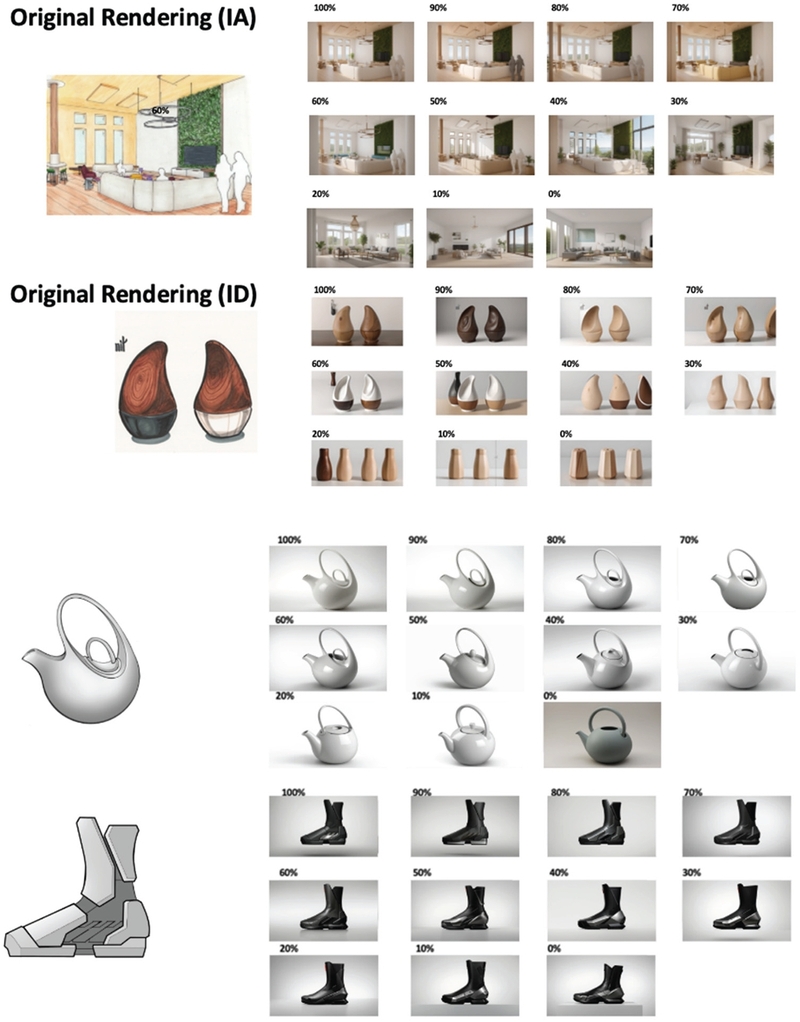
Student outcome example: Left- original hand-rendered studio project outcome, Right- AI-generated images with different % of image prompt influences
The participants’ image prompts were from the outcomes of their studio projects, hand-rendered design sketches in perspective view. For the studio projects, the ID and GD student participants completed instructor-designed assignments, such as designing a salt-and-pepper grinder set, wearable products, or a teapot. Each was a solo project lasting four to six weeks. The IA students focused on designing the public spaces of an interior dormitory, an eight-week project conducted in teams of two.
During the practice session, participants were asked to feed one of the hand-rendered outcomes that showcase their design features the most (ID/GD students: perspective view of the designed products, IA: perspective view of the designed space) and generate a series of 11 AI-generated images, adjusting the image prompt influence from 100% to 0% in 10% decrements (see the student work example in Figure 1-Right). Participants were instructed to use the suggested written prompts along with their original hand-rendered sketches. Student participants were suggested to use auto-generated text prompt, such as “modern design of a salt and pepper grinder” or “a modern and sleek house exterior/interior.”
2. 2. Survey design
After the AI tool practice session, participants were asked to complete the between-subjects design survey in 10 minutes. The survey included the following questions, starting with collecting their prior experience with AI tools, such as participants’ familiarity with AI tools (Q1). Q1 employed a Likert scale ranging from 1 (not familiar with AI tools at all) to 5 (very familiar and have frequently used AI tools).
After Q1, two survey questions (one quantitative and one qualitative) were included to understand participants’ perception of authorship of the AI-generated outcomes: Q2) At what point, starting from 100% of the image prompt influence on the AI-generated outcomes to 0%, they consider an AI-generated image to be their creation; and Q3) The main reason for their response to Q2. Q2 was based on the 11 AI-generated images from the workshop; the image prompt influence ranged from 100% to 0% in 10% decrements. The purpose of Q2 is to gauge at what level of AI contribution the participants still consider the work their own creation. Q3-1 was designed as a categorical variable with the following options: evidence of personal style, contribution to innovation, core functionality, original research, and the option to type their own answers.
Next, Q4 was developed to ask participants’ comfort level in co-designing with AI and their consideration of giving credit to the AI tool after the workshop experience. Q4 utilized a Likert scale ranging from 1 (Very uncomfortable, would not give credit) to 5 (Very comfortable, would give credit). Finally, the survey ended with an open-ended question, Q5, their overall thoughts on using the Vizcom AI tool.
After the survey was distributed at K-State in Fall 2023 and Q3-1 responses were collected, the researchers found that participants did not provide typed responses. This provided a limited insight into participants’ reasoning in their own words. Therefore, Q3-2 was added as a qualitative-only question in the Spring 2025 and Fall 2025 workshops so participants could type their reasons, which were then used for thematic analysis.
2. 3. Data analysis
Descriptive statistics were used to summarize frequencies and percentages for each survey question, revealing notable trends. Because some participants did not complete every item (and because one open-ended item was added/updated), analyses were conducted using an item-level valid N approach. In other words, percentages were calculated using the number of responses available for each question.
For the closed-ended questions, Q1 and Q4 were treated as ordinal categorical variables, and response distributions were summarized with counts and percentages.
Q2 was measured on a 0%–100% scale in 10% increments and analyzed as an ordinal percentage variable. Its distribution was clustered across percentage points and summarized using central tendency and dispersion metrics (e.g., median and mean) as appropriate for describing the overall pattern.
Q3-1 (“select all that apply”) responses were first summarized by selection frequencies/percentages across reason categories. Then, an exploratory comparison was conducted by linking selections to Q2 thresholds. The authorship threshold distributions were summarized within each reason category (e.g., comparing typical thresholds among respondents who selected each rationale). This step was used to identify whether certain types of stated contributions (e.g., style, innovation, function/usability, research) were associated with different patterns in authorship thresholds.
Thematic analysis was conducted to analyze the responses to the open-ended questions, Q3-2 and Q5. Two researchers independently coded all responses, then met to compare coding and resolve discrepancies through discussion until consensus was reached. This process involved reading responses, coding relevant information, categorizing codes, and interpreting findings to understand overarching themes (Bryman, 2012; Saldaña, 2021).
3. Results
In total, 60 participants completed more than 80% of the survey (65% of ID students, n = 40, and 30% of IA students, n=18, 3% of GD students, n = 2) from two universities in the U.S. (participant n of K-State= 30, n of NCSU=30). Overall, 83% were beginning designers (45 sophomores and five master’s students without ID/GD/IA background). Participants were from four different majors or programs, including ID (n = 40), Interior Architecture (n = 18), and Graphic Design (n = 2). See Figure 2 for the full distribution. The overview of quantitative responses is shown in Table 1. While the total size for the other questions was n = 60, the number of responses for Q3-1 and Q4 were n = 30 and n = 48, respectively, due to incomplete responses and the addition of the updated Q3-2 question.
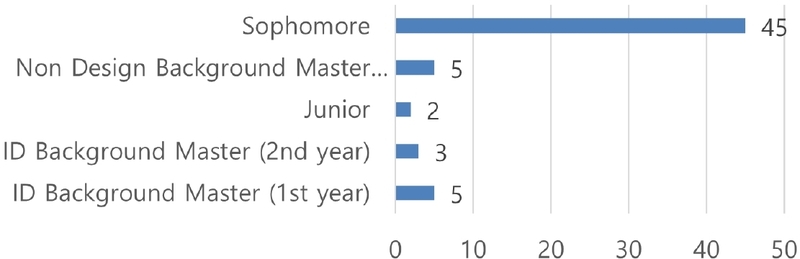
Participant distribution (Top: year level, Bottom: background)

Overview of the quantitative study results
3. 1. Familiarity with AI tools
In terms of familiarity with AI tools (Q1), nearly half of them (47%, n=28) responded that they have experience using AI tools, and within the 47%, two of them (3%) responded that they are very familiar with AI tools and frequently use them for visual communication (see Figure 3).
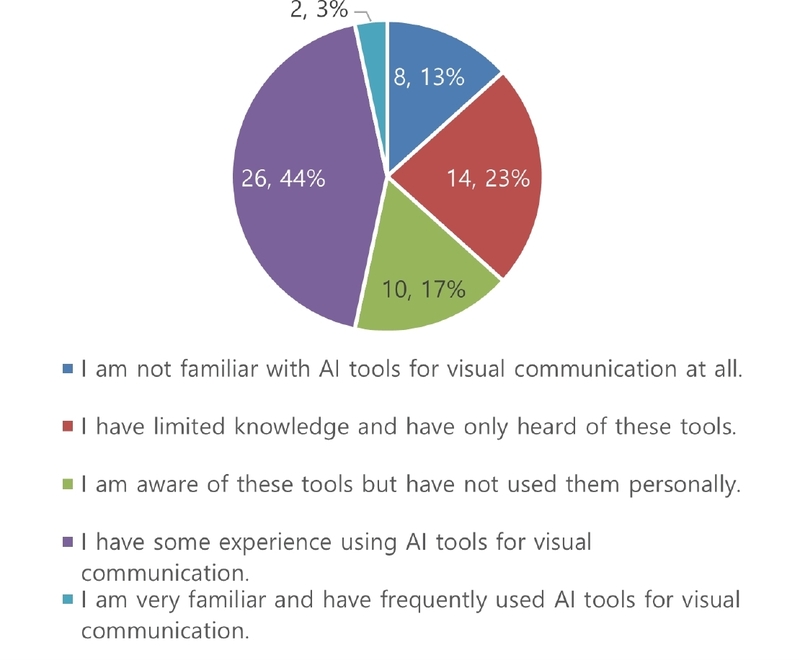
Survey results (Q1): Familiarity with AI Tools (e.g., Vizcom AI, DALLE, Midjourney, etc.)
3. 2. Perception of the authorship
Regarding Q2, “At what percentage would you still consider the AI-generated image to be your creation?”, the average authorship threshold was 55.7% (SD = 19.9), with a median of 60% and an interquartile range of 50–70%. This shows that most participants felt their original sketch needed to be contributed to at least roughly half of the prompt influence shaping the AI-aided image before they would consider the AI-generated outcome to be “their” creation. This is also reflected in the distribution. 47 out of 60 respondents (78%) selected thresholds at 50% or higher.
The distribution revealed two distinct peaks in the data distribution (see Figure 4). Notably, 16 students (26.7%) would consider an AI-generated image their own creation if it contributed up to 50%. This was followed by a preference for 60%, as indicated by 21.7% of the total respondents (n=13). These findings highlight that between 50% to 60% of image prompts’ influence on AI-generated images could be a standard threshold for nearly half of students (48.4%, n=29) to claim authorship of the AI-generated image.
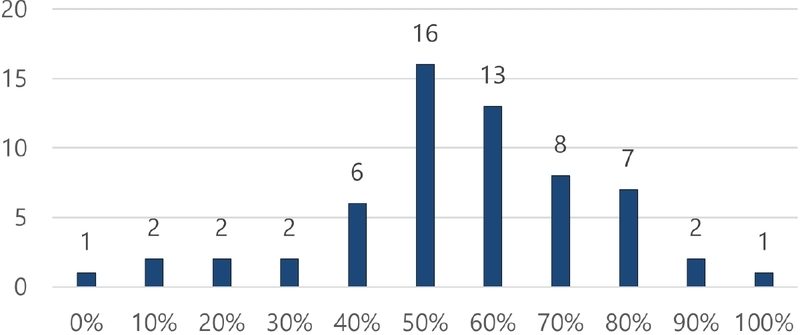
Survey results (Q2): Perception of the percentage of participants who still consider themselves as the authors of the AI-generated image
3. 3. Reasons for the perception of the authorship (quantitative data)
Regarding Q3-1, “What is the main reason for your selection (select all that apply)?”, 30 students from K-State responded to multiple-choice questions, providing reasons for their choices. 60% of the students chose “the design is still based on my original research or findings” (n=18). The second-highest responses followed this response, each selected by 50% of students (n=15) each: “my personal style is still evident in the final design” and “I still contributed to the innovative aspects or unique features” (see Figure 5).
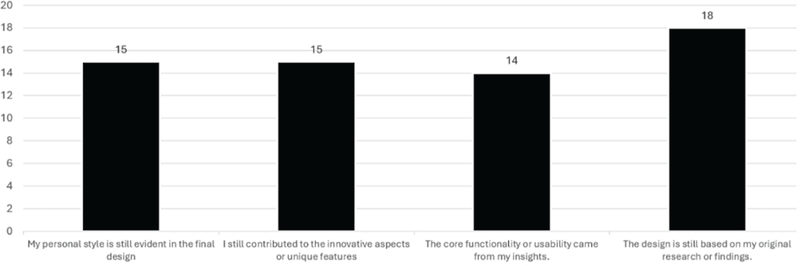
Survey results (Q3-1): Reasons for the perceived authorship
In addition to the options above, one participant provided one text input response: “The idea is mostly mine, but it can create a more readable and higher-quality image than I could.”
3. 4. Relationship between the authorship perception and reasons (Q3-1, quantitative data)
When examining the relationship between the perceived authorship threshold and the reasons participants cited for reaching it, an interesting pattern emerges. The average percentage was lowest (49.4%) when participants selected “the design is still based on my original research or findings.” In contrast, higher percentages were associated with relatively more visually apparent contributions: “I still contributed to the innovative aspects or unique features” (58.7%), “my personal style is still evident in the final design” (54%), and “the core functionality or usability came from my insights” (54%). When participants’ contributions are visibly reflected in AI-generated outcomes—such as personal style or innovative/unique features—the perceived threshold for authorship tends to be higher (55.6% on average). On the other hand, when the contribution is less visually apparent or requires more time to discern, such as underlying research or core function/usability, the perceived authorship threshold tends to be lower (49.4%). This suggests that students who ground their authorship claims in conceptual contributions (research, underlying rationale) feel ownership even when visual similarity to their original sketch is reduced. However, those who anchor authorship in visible elements require a closer resemblance of their original sketch to maintain that sense of ownership. See Figure 6 for a visual comparison of the data.
Considering the distribution of the responses (see Table 2), skewness was all negative (−0.79 to −1.16), clustering toward higher contribution levels (approximately 40–70%) with relatively few low-percentage responses. Compared across categories, Personal Style showed the strongest negative skew (−1.16), followed by Innovative/Unique Features (−1.07), indicating the greatest clustering toward higher contribution ratings; Core Functionality/Usability (−0.812) and Original Research/Findings (−0.79) were less negatively skewed. They cluster around the mid-range, with 50% functioning as the most common “authorship anchor,” with its highest (or near-highest) count at 50%, and the 60–70% range is the second-most-populated overall.
Distribution of data for the reason for perceived authorship and selected reasons
Visible contributions, such as innovation/unique features, or personal style, are associated with higher thresholds. Besides the peak at 50%, there are additional selections in the 60–70% range, lifting their averages. In other words, when participants see the visually noticeable evidence from AI-generated outcomes, such as novel features or recognizable stylistic moves, they tend to feel like it’s “theirs.” Less visually apparent contributions, such as underlying research/findings, skew lower. Besides the peak at 50%, more selections are distributed in the 40–50% band and stretch to 0%, 10, and 20%, which drags the mean down.
3. 5. Reasons for the perception of the authorship (Q3-2, qualitative data)
Thematic analysis of the 30 open-ended Q3-2 responses revealed consistent patterns across experience levels. The most frequently cited reason for authorship was sketching fidelity (Masters = 62% and Sophomores = 59%), reflecting how closely the AI-aided outcome aligns with their original design intent. Both master’s and sophomore students emphasized this aspect, stating “The accurate demonstration of my original sketch (P 60),” and “ I chose which ones most closely resembled my intent for the design (P 42).”
Aesthetic preference is the second most common theme (Masters = 38%, Sophomores = 18%). Students tied authorship to whether the output aligned with their personal style or preferred aesthetic. One student mentioned, “The closeness to my specific design style and preferences (P 36).” Notably, master’s students have a significantly higher % mentioning Aesthetic preference, which may reflect their more developed personal styles from their undergraduate design education— 68% (8 of 12) of master’s students had ID backgrounds as undergraduates.
Prompts strategy (20%), Functional Clarity (10%), and Tool Utility (10%) were additional themes. Master’s students emphasized functional clarity (23% vs 0% for sophomores), which is typically grounded in research and clear design intent. Conversely, sophomores cited tool utility (12% vs 0% for masters), suggesting they are more eager to learn and explore new tools to enhance their skills. See Table 3 for Q3-2 thematic analysis overview.
Q3-2 thematic analysis overview
3. 6. Open Ended Question (Q5)
Thematic analysis was conducted with the responses from Q5, “Please share your thoughts on using the Vizcom AI tool.” The analysis of the data (consisting of 47 participants’ comments) revealed four themes that capture the varied experiences and perspectives of the participants on the use of the AI tool during the workshop. The themes that emerged were: 1) AI as an accelerator for visualization and ideation, as long as preserving designer intent, 2) differentiating assistance from replacement, 3) unpredictability and loss of control, and 4) When to use AI and how to acknowledge it.
AI as an accelerator for visualization and ideation, as long as it preserves designer intent: Participants responded that Vizcom is an aid that saves time and supports early-stage design exploration by effectively translating sketches into more “readable,” rendered outcomes. This was often described as beneficial for “speeding up tedious processes” (P41) and for rapid exploration (“concept generation very easy… time crunch scenarios” (P48); “quick renders” (P40)). Participants also commented that the tool can compensate for a lack of skill, meaning that “even if they lack the skills,” they can produce polished visuals quickly (P52). Note that their positive comments were often tied to the ability to maintain the designer’s original intent (e.g., “as long as it keeps my original design in mind”) (P1).
This finding suggests that the perceived value of Vizcom is most substantial when AI’s role is to amplify designers’ ideas, making their design intent clearer and faster to visualize, rather than as an idea generator that drives design direction.
Differentiating assistance from replacement: Participants’ responses reveal that they actively drew moral and professional boundaries around AI use. Some participants clearly rejected AI’s “co-creator” role, as it “feels like cheating” (P 31). Some described AI-assisted outcomes as “ingenuine” (P 6). Others pointed out the risk of misuse (“people could abuse it”) (P 37). Participants also expressed concern that overreliance on Vizcom could reduce learning and effort (“slippery slope” (P 16); “worried about it making me intellectually lazy”) (P 55).
Their comments reveal a distinction between AI as support for designer agency and AI as a substitute for designer growth and authorship. This boundary work helps explain why some participants were willing to use Vizcom for visualization while resisting claims of full ownership or co-authorship.
Unpredictability and loss of control: Participants described constraints that shape how much influence they are willing to give AI. They emphasized that the AI output can be difficult to steer, heavily “dependent upon the (text) prompt and keywords” (P 56). Some mentioned that the “tool feels like gambling” (P 55), and results can drift away from the designers’ original idea (“instead of letting AI change my idea”) (P 45). Another limitation mentioned was the loss of precision and nuance from the original sketch, especially in terms of geometry (“lose nuance… precise angles & alignments”) (P 50). These constraints highlight an agency–control tradeoff. While the tool can increase design speed and variation, it can reduce control and fidelity, which directly affect perceived authorship because they determine whether the final output still “reads” as the designer’s intention.
When to use AI and how to acknowledge it: Instead of adopting all AI-generated outcomes or taking a nothing stance, many participants suggested a context-dependent approach. They mentioned that Vizcom is acceptable for early ideation/visualization, but less acceptable for final work or refinement (“not… final projects or refinement… would give it credit though” (P 43); “only feel comfortable… idea generation and quick visualizations” (P 49)). Several comments also raised concern regarding the attribution uncertainty (“unsure how and when to give credit to AI”) (P 35). They proposed a rule to give contingent credit, such as citing the tool when it supports visualization, but treating it more like a collaborator only when it meaningfully contributes to the design (“consider citing it… if someone used AI to create the majority… labelling it as a ‘collaborator’ may be more appropriate”) (P 53).
These comments show participants developing norms for AI-assisted design, anchored in the degree of AI influence and the stage of the process, which strengthen the points made in this paper about the importance of authorship perception and how students interpret authorship in human–AI workflows. See Table 4 for the overview of Q5 results.
Q4 thematic analysis overview
4. Discussions
This study revealed several key insights into design students’ perceptions of authorship in AI-assisted design. Despite differences in discipline, ID, and IA, student participants shared consistent views on AI familiarity, authorship perception, and comfort with collaboration, likely influenced by their shared educational context. The findings emphasize the importance of human contributions—especially original research and personal insights—in shaping students’ sense of authorship. This highlights the need for design curricula to strengthen research skills and effectively emphasize students’ conceptual contributions in AI-assisted workflows. Promote storytelling strategies that help students connect their contributions to AI-generated outcomes.
4. 1. Perceptual Salience and Authorship Judgments
The findings from “Relationship between the authorship perception and reasons” imply that authorship judgments can be sensitive to the visibility of a designer’s contribution. For instance, when inputs were perceptually noticeable (e.g., recognizable style or novel features), participants tended to set higher authorship thresholds. On the other hand, when contributions were abstract or non-visible (e.g., research foundations and insights), thresholds dropped (see Table 2). This pattern suggests two practical considerations. First, to get fair credit in human–AI work, designers should make their own contributions clear—both the visible and the behind-the-scenes parts (for example, notes on process, sketches, version history, short decision logs based on research findings). Second, reviewers and educators should look past surface cues so they don’t give too much credit to visible style while overlooking less visible but equally important inputs.
4. 2. Importance of human contribution elements in design education
The survey’s varied responses indicate the need to strike a balance between AI and human contributions in the AI-aided design process. Student participants were more likely to feel a sense of authorship if their work integrated both AI-generated and human-driven elements, such as original research/findings, personal style, and the designer’s insights applied in the core functionality.
60% of students chose “original research or findings” as their primary authorship reason, and because these students maintained authorship claim even when their original sketch contributed less visual influence to the AI output (mean 49.4% compared to 55.6% for visible contributions). Therefore, design educators should emphasize a research-driven design process that helps students anchor their creative work in evidence, such as problem identification, user insights, and design rationale. Importantly, educators should also teach students to document and articulate these non-visible contributions through process documentation, design reflection journals, research analysis, decision logs, and make conceptual agency clear alongside visual execution. This approach will help design students maintain a sense of authorship and creative agency.
While designers’ contributions (e.g., research, style, and functionality) shape perceived authorship, perceived authorship also influences how engaged designers remain throughout the AI-aided design process. Perceived authorship is associated with engagement in AI-aided design (Xu et al., 2024) because psychological ownership is linked to higher engagement (Pierce et al., 2001). Identifying an authorship-perception threshold matters because it can inform how design educators guide sustained engagement across the process. In this study, 78% of participants selected an authorship threshold of ≥50% of their original sketch, and nearly half clustered around 50–60% as a typical cutoff for claiming authorship. This range likely reflects the point at which participants felt their effort remained visible in AI-generated outcomes. Students who maintain ~50% (or more) “original sketch influence” (and/or “human decision influence”) may be more likely to preserve control and visible investment, thereby increasing engagement and strengthening authorship judgments.
4. 3. Visualized Intent and Conceptual Agency
One of the most interesting findings of this study is the distinction between the control of visualized design intent (e.g., visually recognizable control in AI-aided image outcomes) and conceptual agency (non-visible elements that shape design intent, including the designer’s problem framing, research-based intent, constraints, and rationale). Conceptual ownership evolves when the solution’s outward appearance shifts during iteration (Dorst & Cross, 2001), reflecting visualized design intent. Psychological ownership can develop not only through control over visible elements in the image outcomes, but also through investment in knowledge and deep understanding of the topic (Pierce et al., 2001), which aligns with research-driven intent and decision-making. Recent work on agency in generative image collaboration highlights that users’ perceived agency is anchored in their ability to direct and interpret the system, rather than merely manipulating visual elements (Rafner, 2025). This ability is possible when designers have a clear design intent that can be shaped through their research-based problem framing and design direction. These previous studies help explain why students may still claim authorship even when their influence falls below a 50% threshold. Also, the stronger negative skew for Personal Style (−1.16) and Innovative/Unique Features (−1.07) suggests that visually recognizable control, such as the aspects that remain visible in AI-generated outcomes, supports authorship perceptions in higher image prompt contribution levels. In contrast, the weaker skew for Original Research/Findings (−0.79) implies that authorship can remain high even as visual resemblance fades, when designers anchor their work in research-based intent, problem framing, constraints, and evaluative decisions rather than appearance alone.
4. 4. Emphasizing original research in AI-aided design
The survey results underscore the significant role of original research and findings, especially in the ID field. Notably, 83.33% of ID students (10 out of 12) indicated that their sense of authorship in AI-generated designs stemmed primarily from the design being based on their original research or findings (see Table 1). This highlights that, for the ID students, foundational insights from their research phase are particularly crucial in shaping their perception of authorship over AI-aided design outcomes. These findings align with a previous study on Design Thinking, emphasizing the importance of design outcomes derived from user research insights (Beckman & Barry, 2007). Given that the ID field has proactively applied the Design Thinking process (Mubin, Novoa, & Al Mahmud, 2017; Pei & Self, 2022), it explains the ID students’ response. This finding underscores the importance of continuing to teach and encourage rigorous original research within the ID design curriculum in the era of human-AI collaboration. By doing so, ID students can develop a strong foundation of insights that can be effectively leveraged during AI-assisted design processes.
5. Limitations and future works
While this study offers valuable insights, it also has limitations. The focus on beginning design students from only two disciplines (ID and IA) might not capture the perspectives of more experienced design students, designers, or those from other fields. The relatively small sample size of 60 participants means the results may not be widely generalizable.
This study is positioned as exploratory research. Few prior documented studies systematically examine perceived authorship from the creator or designer’s perspective in AI-assisted design education. Therefore, this study is framed as exploratory research, introducing initial methods for measuring authorship thresholds and aimed first at deepening understanding of the phenomenon itself before extending to related topics. These methods can be further refined and validated through future controlled experimental studies.
This study focused on the design refinement and finalization phase, where participants used AI to refine the visual communication of their ideas. This scope excluded the conceptual design phase, where creativity and ideation are more crucial. The influence of AI on the broader design process and creativity aspect remains underexplored.
Regarding the main reasons for participants’ perceptions of authorship (Q3), the survey included both pre-written options and a written-response option to reduce survey completion time. However, after the first workshop, the number of written responses was lower than expected (only one response), prompting the addition of Q3-2 as an open-ended question in subsequent workshops. This refinement allowed for more robust thematic analysis of 30 additional responses.
Also, this study did not investigate the specific types of human contributions that influenced participants’ perceptions of authorship. For instance, regarding research findings or insights, did participants associate authorship with user research and their pain points, or generating functional insights? Was personal style more about an individual’s sketching styles or aesthetic preferences? Future research should explore these distinctions to better understand how different types of contributions shape perceived ownership in human-AI collaborative design.
Using the predefined prompt was essential for controlling the experiment and achieving comparable results; however, this method may not accurately reflect a typical AI-assisted design workflow. Future research should investigate whether allowing users to generate their own prompts affects their sense of agency and ownership compared to using predetermined prompts in AI-assisted creative work.
One direction for future work to expand this study can be to test whether feeling a stronger sense of authorship actually drives deeper engagement in AI-assisted design. If designers believe the outcome is “theirs,” they may spend more time making richer revisions. This relationship likely runs through perceived agency—the sense of steering key decisions—and may vary with expertise (e.g., stronger effects for novices) and task stakes. Based on a show that there is a point up to which users can be assisted by advanced technology and still feel a sense of agency (Limerick, Coyle, Moore, 2014). The sense of agency is the felt experience, similar to the perception of authorship – high when you feel “I did that,” low when it seems the system did it and you did not contribute to the outcomes. In a future study, include a measure of perceived engagement to understand whether participants who responded to a low sense of authorship (e.g., 20%) report lower engagement after producing design collaborating with AI. Conversely, the study can reveal whether higher engagement predicts higher authorship claims. Understanding this relationship would turn authorship from just a fairness issue into a tool to boost participation and learning in human–AI work.
Future research could expand the sample size, include more diverse disciplines, and explore these neutral attitudes in greater depth. Also, future studies should aim to gain a deeper understanding of the reasons behind participants’ perceptions of authorship. This could be achieved by conducting in-depth interviews or requiring only written responses to this question. Such approaches allow for a more detailed thematic analysis.
To maintain experimental control, this study asked participants to use predefined text prompts. However, this approach may not fully reflect real-world practice, where creating and refining prompts is part of the creative process. Future studies should examine whether allowing participants to write their own prompts changes their sense of agency and ownership.
The qualitative evidence to explain why certain types of contribution (e.g., research vs. style) shape ownership could be developed further. A recent human–AI co-creation study in writing highlights distinct contribution types that affect authorship perceptions, such as fixing spelling/grammar, adjusting tone and style, elaborating ideas, adding new ideas, and synthesizing information (He et al., 2025). The breakdown from this study can be useful, as it separates content-level contributions (e.g., new ideas, synthesis) from form-level contributions (e.g., tone/style edits, spelling). In design, research and rationale often function as “deep content,” while style is treated as “surface form.” Understanding the breakdown of the contribution types and how these content- vs. form-level contributions influence ownership through interviews and focus groups would provide clearer explanations and strengthen the evidence base in this area.
6. Conclusion
While AI tools are becoming increasingly prevalent in design education, the human element—research, personal style, and innovation—remains crucial for students’ sense of authorship, satisfaction, and the value of their work. This study’s findings indicate that students associated authorship strongly with non-visible contributions, such as original research/findings (60%), even more than personal style (50%), implying that perceived authorship can be anchored in strategic intent (problem framing, evidence-based rationale, and design direction) rather than visual execution alone. The thematic analysis of participants’ feedback on using AI tools in design reveals a nuanced perspective. While there is recognition of the benefits these tools offer in enhancing visualization, there are also significant concerns about authenticity, ethical use, and AI’s limitations in fostering true creativity. Addressing these concerns will be crucial for its broader acceptance and integration into professional design practices as AI technology evolves. Design education programs should focus on helping design students leverage and document their original research, personal style, and innovative features in AI-aided workflows. By making these non-visible contributions clear, educators can help students maintain a sense of authorship and creative agency. This approach ensures a balanced and ethical approach to AI collaboration in the design field.
Notes
Copyright : This is an Open Access article distributed under the terms of the Creative Commons Attribution Non-Commercial License (http://creativecommons.org/licenses/by-nc/3.0/), which permits unrestricted educational and non-commercial use, provided the original work is properly cited.
References
-
Beckman, S. L., & Barry, M. (2007). Innovation as a learning process: Embedding design thinking. California Management Review, 50(1), 25-56.
[https://doi.org/10.2307/41166415]

- Bryman, A. (2012). Social research methods (4th ed.). Oxford University Press.
- Calla, M. (2022, December 20). Portraits of the posthuman: Jon Rafman and AI. Berlin Art Link. https://www.berlinartlink.com/2022/12/20/jon-rafman-and-ai/.
- Caramiaux, B. (2020). The use of artificial intelligence in the cultural and creative sectors (Research report). CULT Committee, European Parliament.
-
Cheng, M. (2022). The creativity of artificial intelligence in art. Proceedings, 81(1), 110.
[https://doi.org/10.3390/proceedings2022081110]
-
Darewych, T. (2023). The impact of authorship on aesthetic appreciation: A study comparing human and AI-generated artworks. Art and Society, 2(1), 67-73.
[https://doi.org/10.56397/AS.2023.02.11]
-
Dorst, K., & Cross, N. (2001). Creativity in the design process: Co-evolution of problem-solution. Design Studies, 22(5), 425-437.
[https://doi.org/10.1016/S0142-694X(01)00009-6]
-
Long, D., & Magerko, B. (2020). What is AI literacy? Competencies and design considerations. In Proceedings of the 2020 CHI Conference on Human Factors in Computing Systems (CHI '20) (pp. 1-16). Association for Computing Machinery.
[https://doi.org/10.1145/3313831.3376727]
-
Gonçalves, M., Cardoso, C., & Badke-Schaub, P. (2013). Inspiration peak: Exploring the semantic distance between design problem and textual inspirational stimuli. International Journal of Design Creativity and Innovation, 1(4), 215-232.
[https://doi.org/10.1080/21650349.2013.799309]
-
He, J.., Houde, S.., & Weisz, J. D.. (2025). Which contributions deserve credit? Perceptions of attribution in human-AI co-creation. In Proceedings of the CHI Conference on Human Factors in Computing Systems (CHI '25). Association for Computing Machinery.
[https://doi.org/10.1145/3706598.3713522]
- Hutson, J. (2023, October 26). AI and the creative process: Part three. JSTOR Daily. https://daily.jstor.org/ai-and-the-creative-process-part-three/.
- IDSYS. (n.d.). Concept refinement and the road to design perfection. https://idsys.com/concept-refinement-and-the-road-to-design-perfection/.
- Improbable Future. (2023). The role of designers in the age of AI. Innovation, Spring, 24-27.
-
Kaljun, J., Harih, G., & Dolšak, B. (2014, May). Intelligent support used for providing a pleasant user experience. In 2014 37th International Convention on Information and Communication Technology, Electronics and Microelectronics (MIPRO) (pp. 1083-1087). IEEE.
[https://doi.org/10.1109/MIPRO.2014.6859730]
-
Kaljun, K. K., & Kaljun, J. (2024, May). Enhancing creativity in sustainable product design: The impact of generative AI tools at the conceptual stage. In 2024 47th MIPRO ICT and Electronics Convention (MIPRO) (pp. 451-456). IEEE.
[https://doi.org/10.1109/MIPRO60963.2024.10569541]
-
Kim, S. J. (2024). Generative artificial intelligence in collaborative ideation: Educational insight from fashion students. IEEE Access, 12, 49261-49274.
[https://doi.org/10.1109/ACCESS.2024.3382194]
-
Kwon, E., Rao, V., & Goucher-Lambert, K. (2023). Understanding inspiration: Insights into how designers discover inspirational stimuli using an AI-enabled platform. Design Studies, 88, 101202.
[https://doi.org/10.1016/j.destud.2023.101202]
-
Limerick, H., Coyle, D., & Moore, J. W. (2014). The experience of agency in human-computer interactions: A review. Frontiers in Human Neuroscience, 8, 643.
[https://doi.org/10.3389/fnhum.2014.00643]
- Lin, C., & Kim, B. (2023, August). Study of AI-driven furniture design process. Paper presented at the IDSA Education Symposium, New York, NY, United States.
-
Linsey, J. S., Tseng, I., Fu, K., Cagan, J., Wood, K. L., & Schunn, C. (2010). A study of design fixation, its mitigation and perception in engineering design faculty. Journal of Mechanical Design, 132(4), 041003.
[https://doi.org/10.1115/1.4001110]
-
McCormack, J., Bown, O., Dorin, A., McCabe, J., Monro, G., & Whitelaw, M. (2014). Ten questions concerning generative computer art. Leonardo, 47(2), 135-141.
[https://doi.org/10.1162/LEON_a_00533]
-
Payne Morgan, A., Kilbourn Barber, G., & Howell, B. F. (2024). Co-design and artificial intelligence: A method to empower end-users in visual communication. In Proceedings of the International Conference on Engineering and Product Design Education (E&PDE 2024) (pp. 557-562). The Design Society.
[https://doi.org/10.35199/EPDE.2024.94]
-
Pei, E., & Self, J. A. (2022). Product design and the role of representation: Foundations for design thinking in practice. CRC Press.
[https://doi.org/10.1201/9781003227694]
-
Pierce, J. L., Kostova, T., & Dirks, K. T. (2001). Toward a theory of psychological ownership in organizations. Academy of Management Review, 26(2), 298-310.
[https://doi.org/10.5465/amr.2001.4378028]
-
Rafner, J. (2025). Agency in human-AI collaboration for image generation. Creativity Research Journal.
[https://doi.org/10.1080/10400419.2025.2587803]
- Saldaña, J. (2021). The coding manual for qualitative researchers (4th ed.). Sage.
- Thai, J. (2023). Adapting at the speed of AI. Innovation, Spring, 48-49.
-
Torresen, J. (2018). A review of future and ethical perspectives of robotics and AI. Frontiers in Robotics and AI, 4, 75.
[https://doi.org/10.3389/frobt.2017.00075]
- Vizcom Technologies, Inc. (2023). Vizcom. https://www.vizcom.ai/.
- Vohra, S. (2023). Why training AI models is the future of industrial design. Innovation, Spring, 50-53.
- Williams, W. (2023). Paradigm shifts: The past, present, and future of digital ID tools. Innovation, Spring, 28-33.
-
Xu, Y., Cheng, M., & Kuzminykh, A. (2024, June). What makes it mine? Exploring psychological ownership over human-AI co-creations. In Proceedings of the 50th graphics Interface conference (pp. 1-8).
[https://doi.org/10.1145/3670947.3670974]
- Yavuz, S. K. (2023, September 1). What the latest U.S. court ruling means for AI-generated art's copyright status. The Art Newspaper. https://www.theartnewspaper.com/2023/09/02/artificial-intelligence-lawsuit-decision-us-copyright-law.
-
Zhang, F. (2022). Design and implementation of industrial design and transformation system based on artificial intelligence technology. Mathematical Problems in Engineering, 2022, Article 9342691.
[https://doi.org/10.1155/2022/9342691]
-
Zhou, E., & Lee, D. (2024). Generative artificial intelligence, human creativity, and art. PNAS Nexus, 3(3), Article pgae052.
[https://doi.org/10.1093/pnasnexus/pgae052]