
Optimizing Communication Design for Robo-Advisors: The Effects of Investor Types and Information Strategies on Trust and Engagement during Financial Losses
Abstract
Background Robo-advisors offer cost-effective, artificial intelligence (AI)-driven financial guidance, but user trust and engagement often falter during market downturns. Investor psychology, particularly risk tolerance, plays a key role in responses to financial losses. This study examines how investor risk profiles (aggressive vs. conservative) and communication strategies (immediate feedback vs. long-term framing) jointly influence trust and continued usage in loss scenarios. While prior research has explored generic communication in robo-advisors, limited attention has been paid to aligning message framing with motivational orientations, particularly under stressful financial contexts.
Methods A 2×2 mixed factorial experiment was conducted with 79 adult investors, categorized by risk tolerance. Participants interacted with a simulated robo-advisor across two loss scenarios. Post-interaction measures included trust, perceived risk, performance expectancy, and continuous usage intention. Data were analyzed via repeated measures ANOVA.
Results A significant interaction effect emerged for continuous usage intention (F(1,77) = 4.874, p = .03), with conservative investors reporting higher intentions under immediate feedback. Aggressive investors showed a tendency toward long-term framing for trust, aligning conceptually with promotion-focused orientations. Perceived risk and performance expectancy showed no significant differences, suggesting these may be influenced more by broader market sentiment or personal investment history than short-term communication framing.
Conclusions Findings support tailoring robo-advisor communications to investor psychology, particularly by providing immediate, actionable feedback to conservative investors during downturns. For aggressive investors, results indicate a potential preference for long-term strategic framing. Null effects for perceived risk and performance expectancy underscore the need for multi-scenario designs and richer investor profiling in future research. Incorporating adaptive explainability into robo-advisory communication strategies could further bridge the gap between algorithmic precision and user-centered trust.
Keywords:
Robo-Advisor, Communication Design, Investor Risk Profile, Financial Loss, Trust, User Engagement1. Introduction
The proliferation of AI-driven technologies is reshaping the financial services industry, making investment tools such as robo-advisors widely accessible and cost-effective (Belanche et al., 2019; Glikson & Woolley, 2020; Jung et al., 2018; Schueffel, 2016). These platforms automate financial planning and asset allocation using algorithms that assess users’ goals and risk tolerance, offering scalable and personalized investment strategies (Fan & Swarn, 2020; Lam, 2016). As their global user base expands, with markets projected to reach over $95 billion in revenue by 2026, robo-advisors are poised to play a central role in digital wealth management (Jafri et al., 2024).
Despite their growth, a critical challenge remains: retaining user trust and engagement, particularly during volatile market conditions (Hildebrand & Bergner, 2021; Kim et al., 2008). Investors often respond emotionally to financial losses, sometimes discontinuing services when reassurance is lacking (Bach et al., 2024; Kahneman & Tversky, 2013). While robo-advisors excel at delivering data-driven recommendations, their communication strategies during downturns tend to be standardized, failing to adequately address the psychological needs of different investor profiles (Chaudhry & Kulkarni, 2021; Wang & Lin, 2017). In high-stress financial contexts, the way information is framed can be as important as the content itself.
Investor psychology—particularly risk tolerance—plays a pivotal role in shaping responses to financial loss (Jain & Raman, 2023; Kim et al., 2008). Regulatory Focus Theory (RFT) distinguishes between promotion-focused investors, who pursue long-term gains and may tolerate short-term volatility, and prevention-focused investors, who prioritize security and react more negatively to risk exposure (Cesario et al., 2008; Higgins, 1997). In principle, these motivational orientations suggest that aggressive investors may respond more favorably to communications emphasizing long-term recovery, while conservative investors may value immediate, actionable steps to mitigate losses. However, empirical evidence on the interaction between investor type and communication framing in robo-advisory contexts remains limited.
To address this gap, the present study examines how investor risk profiles (aggressive vs. conservative) and communication strategies (immediate feedback vs. long-term framing) jointly influence trust, perceived risk, performance expectancy, and continuous usage intention in financial loss scenarios. The experimental results reveal a statistically significant effect of immediate feedback on continuous usage intention among conservative investors. For aggressive investors, observed patterns suggested a possible preference for long-term framing, which should be interpreted as indicative rather than definitive. This cautious interpretation reflects the need for further empirical exploration before strong prescriptive claims can be made.
By exploring these dynamics through a controlled experimental design, this research contributes to the design of psychologically informed digital financial services. It also offers practical implications for adaptive robo-advisor interfaces that can tailor communication to user profiles in real time, enhancing trust and promoting sustained engagement during challenging market conditions.
2. Related Works
2. 1. Robo-Advisors in Digital Finance and UX Perspectives
Robo-advisors are AI-powered platforms that automate investment planning, combining big data analytics with algorithmic decision-making (Fan & Swarn, 2020; Jung et al., 2018). These services handle portfolio construction, rebalancing, and asset allocation—tasks traditionally performed by human advisors—thus making investment advice more scalable and affordable (Plotkina et al., 2024). Since their emergence around 2008, robo-advisors have experienced rapid adoption, with global assets under management exceeding $800 billion by 2024 (Schueffel, 2016). In South Korea, services such as Fint and Fount have successfully adapted to local market regulations and user contexts (Baek & Kim, 2023).
Despite their popularity, sustaining user retention remains a challenge, particularly during market downturns when emotional responses and distrust in algorithmic advice intensify (Hildebrand & Bergner, 2021; Jafri et al., 2024). From a UX and HCI perspective, this raises the need for transparent, personalized interfaces that address investor concerns beyond pure performance metrics (Fan & Swarn, 2020; Fogg, 2009). Prior studies have shown that features such as intuitive dashboards, real-time visualizations, and explainable AI components can strengthen trust and engagement (Chaudhry & Kulkarni, 2021; Hildebrand & Bergner, 2021). However, existing platforms still tend to deliver standardized messaging, with limited sensitivity to the diverse psychological needs of investors—particularly in stressful loss scenarios (Bach et al., 2024).
Recent advances in explainable AI (XAI) highlight the growing importance of aligning transparency with user decision contexts in financial services. A number of studies have reviewed and demonstrated how techniques such as SHAP, LIME, and counterfactual explanations can be applied to improve interpretability without compromising predictive performance in areas including credit scoring, portfolio management, and robo-advisory systems (Yeo et al., 2025). In the context of regulatory compliance, research has emphasized that robo-advisors operating under frameworks such as MiFID II must provide explanations that are both legally sufficient and cognitively accessible to investors (Vilone et al., 2024). Other work has shown that combining automated machine learning with model-agnostic XAI tools can enhance the transparency of financial decision-making processes while preserving accuracy (Schmitt, 2024). Collectively, these developments suggest that robo-advisors could benefit from adaptive explainability, in which the depth, framing, and delivery of explanations are tailored to an investor’s risk profile and motivational orientation.
2. 2. Investor Behavior and Communication During Loss Scenarios
Investor decision-making is shaped not only by financial objectives but also by cognitive and emotional factors, particularly during periods of loss (Jain & Raman, 2023; Kim et al., 2008). Prospect Theory posits that losses weigh more heavily than equivalent gains, often leading to reactive decision-making and elevated perceived risk (Kahneman & Tversky, 2013). Investors may attribute negative outcomes to system shortcomings, thereby undermining trust in digital platforms (Bach et al., 2024).
Investor profiles—often categorized as aggressive (risk-seeking) or conservative (risk-averse)—offer a useful lens for understanding these responses (Baek & Kim, 2023). Regulatory Focus Theory (Higgins, 1997) explains that aggressive, promotion-focused individuals are motivated by long-term growth, whereas conservative, prevention-focused individuals value short-term stability and security (Cesario et al., 2008; Higgins, 1997). Immediate feedback, offering real-time updates and corrective actions, tends to reassure conservative investors (Jung et al., 2018), while long-term strategic framing—emphasizing recovery trajectories and investment horizons—aligns more closely with the outlook of aggressive investors (Diacon & Hasseldine, 2007).
The format and transparency of information also play critical roles. Visual cues such as trend indicators, portfolio projections, and scenario simulations can reduce uncertainty and improve decision confidence (Wang & Lin, 2017). Research in XAI has shown that transparent explanations of algorithmic logic—especially when personalized—can sustain trust during volatile market conditions (Babaei et al., 2022, 2023; Giudici & Raffinetti, 2022). However, most empirical work in robo-advisory contexts has focused on generic presentation formats rather than communication strategies explicitly tailored to investor psychology under financial loss. This gap motivates the present study, which investigates the interactive effects of investor risk profiles and message framing on trust, perceived risk, performance expectancy, and continued usage intention.
3. Research Questions
Building on the literature review, this study adopts an integrated framework to investigate how investor risk profiles (aggressive vs. conservative) and communication strategies (immediate feedback vs. long-term framing) jointly shape user responses to robo-advisors in financial loss scenarios. Specifically, we examine their interactive effects on four key outcome variables—trust, perceived risk, performance expectancy, and continuous usage intention (Baek & Kim, 2023; Chaudhry & Kulkarni, 2021; Higgins, 1997). This leads to the following research questions:
- • RQ1: How do communication strategies and investor risk profiles interact to influence trust?
- • RQ2: How do communication strategies and investor risk profiles affect perceived risk?
- • RQ3: How do communication strategies and investor risk profiles impact performance expectancy?
- • RQ4: How do communication strategies and investor risk profiles influence continuous usage intention?
4. Methodology
4. 1. Experimental Design
A mixed factorial (2x2) design was employed to examine how investor type and communication strategies interactively influence users’ psychological responses (trust, perceived risk, performance expectancy, continuous usage intention) toward robo-advisors in financial loss contexts. Specifically, we investigated two independent variables: investor type (between-subjects: aggressive vs. conservative) and communication strategy (within-subjects: immediate feedback vs. long-term strategic framing), aligning directly with our research questions (RQ1-RQ4).
Investor type (aggressive vs. conservative) was assessed through the Russell Investment Investor Profile Questionnaire (IPQ) (Investor profile questionnaire, 2008), a validated tool widely used to categorize investors based on risk tolerance and investment preferences (Table 1). Participants experienced both communication conditions in a randomized order, enabling direct comparison of responses across framing strategies while controlling individual differences.

Russell Investment Investor Profile Questionnaire (IPQ)
4. 2. Participants
Seventy-nine adult participants with prior investment experience were recruited through an open call. We specifically targeted individuals with prior investment experience to ensure that participants had sufficient financial knowledge and familiarity with investment decision-making contexts, thus increasing the ecological validity and practical relevance of the findings. Participants completed the IPQ to assess individuals’ risk tolerance, investment horizons, and financial goals. Based on IPQ scores, participants were classified into two distinct investor categories:
- • Aggressive investors (n = 40): Participants scoring above the median IPQ score, demonstrating higher risk tolerance, preference for growth-oriented investments, and willingness to endure significant market fluctuations.
- • Conservative investors (n = 39): Participants scoring below the median IPQ score, reflecting lower risk tolerance, strong preference for capital preservation, and aversion to substantial market volatility.
4.3. Experimental Procedure
The experiment proceeded through five sequential phases designed to simulate realistic investor decision-making. Participants first completed the Russell Investment Investor Profile Questionnaire (IPQ) to determine their risk profile as aggressive or conservative. They then engaged in an initial investment scenario in which they received a portfolio recommendation tailored to their profile and simulated an investment of KRW 10 million. Next, they encountered a market downturn in which the portfolio value declined by 15%, creating a high-stress decision-making context. Following this, each participant was exposed to two communication strategies in randomized order to control for order effects: immediate feedback that emphasized short-term corrective actions, and long-term strategic framing that highlighted recovery trajectories and investment horizons. After experiencing each strategy, participants completed post-task surveys measuring trust, perceived risk, performance expectancy, and continuous usage intention.
4. 4. Information Strategy Conditions
Two communication strategies were implemented to reflect contrasting approaches to investor engagement and to directly address the interaction effects outlined in our research questions:
- • Immediate Feedback: Participants received real-time updates on portfolio losses accompanied by explicit short-term recommendations, such as portfolio rebalancing or minor asset shifts, to promptly mitigate risks. This condition was designed to align with prevention-focused investors’ preference for quick corrective actions and reduced uncertainty during volatile market periods.
- • Long-term Strategic Framing: Participants received loss information framed within a broader investment narrative, emphasizing historical market recoveries, long-term growth trajectories, and the potential for future gains. This approach was intended to resonate with promotion-focused investors who prioritize long-term objectives over short-term fluctuations.
All communication content—including dialogue scripts, visualizations, and strategic suggestions—was designed in accordance with UX principles such as clarity, cognitive load minimization, and emotional tone alignment, drawing on prior findings in robo-advisory communication (Chaudhry & Kulkarni, 2021). The content was further adapted to each investor profile to ensure contextual relevance (see Figure 1).
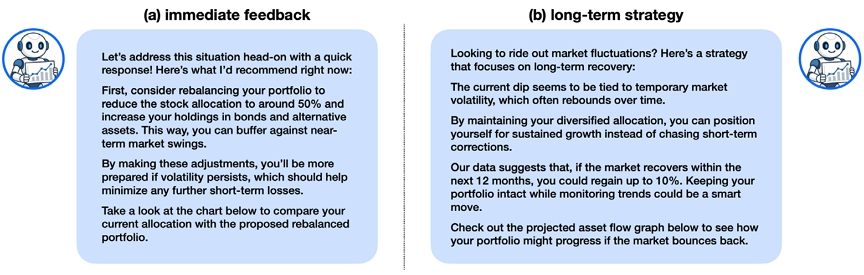
Information Provision Strategies (Example for Aggressive Investors)
4. 5. Experimental Interface
To enhance ecological validity, we developed a high-fidelity robo-advisory simulation using Figma, incorporating key interface components that replicated authentic user experiences. The simulation included a portfolio dashboard displaying real-time asset values, allocation summaries, and visualized investment fluctuations; a market overview panel presenting aggregated market data, price movements, and relevant economic news to help users contextualize their portfolio performance; and a decision panel delivering experimental messages—either immediate feedback or long-term strategic framing—paired with clearly articulated, actionable recommendations. All screens were carefully crafted to ensure realistic interaction, cognitive immersion, and decision-making fidelity, enabling participants to experience and respond to each communication strategy under conditions closely mirroring actual robo-advisory use (Figure 2).
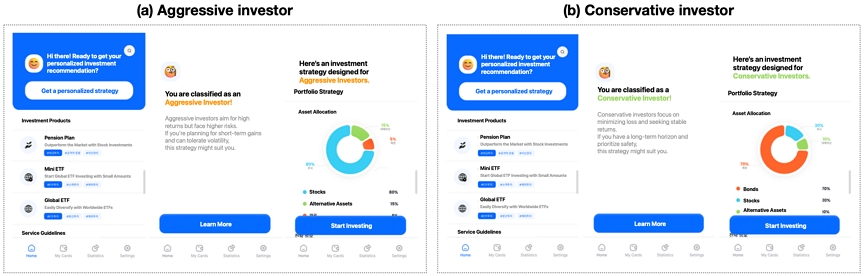
Experimental interface screen examples from Scenario 1
4. 6. Measures
After each scenario, participants completed a post-task survey assessing four dependent variables aligned explicitly with the research questions and hypotheses formulated earlier (RQ1–RQ4). Each construct was measured using validated scales frequently utilized in human-computer interaction and behavioral finance literature (George, 2003; Venkatesh et al., 2003):
- • Trust (RQ1): 4 items assessed participants’ willingness to rely on the robo-advisor under uncertainty (Hildebrand & Bergner, 2021; Kim et al., 2008).
- • Perceived Risk (RQ2): 3 items measured subjective evaluations of potential financial harm and uncertainty related to robo-advisor use (Jain & Raman, 2023; Wang & Lin, 2017).
- • Performance Expectancy (RQ3): 4 items evaluated beliefs regarding the robo-advisor’s ability to generate favorable outcomes (Baek & Kim, 2023; Venkatesh et al., 2003).
- • Continuous Usage Intention (RQ4): 4 items gauged participants’ intentions to continue using the robo-advisory platform (Fan & Swarn, 2020; Fogg, 2009).
All responses were captured on 7-point Likert scales (1 = Strongly Disagree, 7 = Strongly Agree). Reliability analyses confirmed acceptable internal consistency for each measure (Table 2). While the Cronbach’s α for Perceived Risk was relatively lower (0.611) than the conventional threshold of 0.70, it remains within the range considered acceptable for exploratory studies in behavioral and HCI research, where short scales (e.g., three items) often yield lower reliability coefficients (Cortina, 1993; Peterson, 1994). Nonetheless, future work could refine this construct by incorporating additional or more context-specific items to improve measurement precision.
Reliability Analysis of Survey Items
4. 7. Data Analysis
All collected data were analyzed using two-way repeated measures ANOVA (within-subject factor: communication strategy; between-subject factor: investor type). IBM SPSS Statistics was utilized for statistical testing, with the significance level set at p < .05. Primary interest was placed on the interaction effects between investor types and communication strategies across the four dependent variables.
5. Results
Two-way repeated measures ANOVA was conducted to examine the effects of investor type (aggressive vs. conservative) and communication strategy (immediate feedback vs. long-term framing) on the four dependent variables.
5. 1. Trust
There were no significant main effects for investor type (p = .876) or communication strategy (p = .983) (Table 3 and Table 4). However, a significant interaction effect was observed (F(1,77) = 4.090, p = .047, ηp2 = .050). Descriptively, aggressive investors tended to report higher trust under long-term framing, whereas conservative investors showed a modest preference for immediate feedback. Although post-hoc Bonferroni comparisons were not statistically significant (p = .257), this pattern suggests that trust perceptions may be shaped by the alignment between an investor’s risk orientation and the framing of loss-related information.
Mean (Standard Deviation) of Trust
Results of the Two-Way RM ANOVA for Trust
5. 2. Perceived Risk
There were no significant main effects for investor type (p = .490) or communication strategy (p = .631), and the interaction effect was also not significant (p = .136) (Table 5 and Table 6). Nevertheless, descriptive results indicated slightly lower perceived risk for aggressive investors under long-term framing and for conservative investors under immediate feedback. While these differences were not statistically reliable, they may point to subtle variations in how different investor types cognitively appraise market losses depending on message framing.
Mean (Standard Deviation) of Perceived Risk
Results of the Two-Way RM ANOVA for Perceived Risk
5. 3. Performance Expectancy
There were no significant main effects for investor type (p = .143) or communication strategy (p = .338), and the interaction effect was also not significant (p = .252) (Table 7 and Table 8).
Mean (Standard Deviation) of Performance Expectancy
Results of the Two-Way RM ANOVA for Performance Expectancy
However, aggressive investors displayed marginally higher performance expectancy under long-term framing, whereas conservative investors slightly favored immediate feedback. The near-significant trend observed in post-hoc testing (p = .052) suggests that these directional differences could become significant in studies with larger sample sizes, warranting further examination.
5. 4. Continuous Usage Intention
There were no significant main effects of investor type (p = .158) or communication strategy (p = .655). However, the interaction effect between these factors was significant (F(1,77) = 4.874, p = .030, ηp² = .060) (Table 9 and Table 10). Conservative investors expressed notably higher continuous usage intentions under immediate feedback, a difference that was statistically significant compared to aggressive investors in the same condition (p< .01). Under long-term framing, differences between investor types were not significant (p = .810). These results indicate that conservative investors may be particularly motivated to continue engagement when provided with timely, actionable guidance during market downturns.
Mean (Standard Deviation) of Continuous Usage Intention
Results of the Two-Way RM ANOVA for Continuous Usage Intention
6. Discussion
This study examined how investor risk profiles and communication strategies shape user engagement with robo-advisors during market downturns. Patterns in the data indicate that the effectiveness of a communication style depends on its alignment with investor orientation. Conservative investors responded more favorably to immediate, actionable feedback, whereas aggressive investors showed greater receptivity to long-term, future-focused framing. These patterns were most evident for continuous usage intention, while trust effects emerged only as preliminary trends. Such dynamics underscore the value of examining how motivational orientation interacts with message framing, forming the basis for the theoretical implications and design recommendations that follow.
6. 1. Aligning Communication with Investor Psychology
The significant interaction effects identified highlight the critical need for robo-advisory services to tailor communication strategies based on investor psychology, especially during market downturns (Baek & Kim, 2023; Hildebrand & Bergner, 2021). Conservative investors—who emphasize security and risk avoidance—demonstrated notably higher continuous usage intentions when receiving immediate, actionable feedback (p = .030), aligning with behavioral finance concepts such as loss aversion (Kahneman & Tversky, 2013; Tversky & Kahneman, 1992). In these cases, immediate corrective advice appears to function as a psychological “nudge” (Thaler & Sunstein, 2008), helping to reduce emotional distress and discouraging impulsive actions such as panic-driven asset withdrawals.
For aggressive investors, although the interaction effect for trust reached significance (p = .047), post-hoc tests were non-significant, indicating that this tendency should be interpreted cautiously. Nevertheless, the observed pattern is consistent with Regulatory Focus Theory (Higgins, 1997), wherein promotion-focused individuals perceive short-term downturns as manageable setbacks and remain oriented toward long-term recovery. While not conclusive, these findings suggest that strategic, future-focused communication may help maintain engagement among such investors, consistent with Construal Level Theory, which posits that future-oriented framing can shape evaluations and decisions (Trope & Liberman, 2010). Validating this effect will require larger, more diverse samples and varied market conditions, as framing effects can change under different levels of market stress.
The non-significant effects for perceived risk and performance expectancy indicate that these constructs may be shaped more by broader market conditions and personal investment history than by short-term framing. Performance expectancy, in particular, may require sustained interaction and tangible performance evidence, as described in the UTAUT model (Venkatesh et al., 2003).
From a UX perspective, these results suggest that addressing perceived risk and performance expectancy may require longitudinal design elements, such as integrating market context or showing historical performance, in line with human-centered XAI recommendations for context-rich, progressive disclosure(Liao & Varshney, 2021).
6. 2. Theoretical Implications
This research contributes theoretically by integrating Regulatory Focus Theory with the Technology Acceptance Model (TAM)—a widely applied framework for explaining user adoption and sustained use of technology (Venkatesh et al., 2003) —to examine investor behavior in AI-driven financial environments. Our findings validate the importance of regulatory fit—the alignment of communication strategies with investor motivational orientations—in enhancing trust and sustained engagement (Baek & Kim, 2023; Cesario et al., 2008). This regulatory fit appears to influence user perceptions and acceptance of robo-advisors, even when some effects (e.g., on trust) were not statistically significant, confirming the applicability of RFT within complex financial decision-making contexts (Fan & Swarn, 2020; Hildebrand & Bergner, 2021).
Furthermore, the integration of RFT and TAM in this study suggests that psychological alignment may be as influential as, or complementary to, traditional usability factors in determining continuous platform usage (Gefen et al., 2003). The significant interaction effect on continuous usage intention—and its absence for other variables—underscores the nuanced role of motivational congruence without overstating non-significant outcomes, encouraging future research into more sophisticated personalization methods in AI-driven investment services (Chaudhry & Kulkarni, 2021; Jafri et al., 2024).
6. 3. UX Design Recommendations
Translating these theoretical insights into practice, we propose design strategies for robo-advisory services that move beyond general best practices—such as universal clarity, transparency, and simplicity—toward approaches explicitly informed by regulatory focus theory and tailored to distinct investor psychological profiles. By linking behavioral finance principles with adaptive UX design, these recommendations aim to operationalize regulatory fit in real-world interfaces.
- • Adaptive Interfaces: Conservative investors in our scenarios responded more favorably to immediate, actionable feedback, while aggressive investors engaged more with future-oriented framing. Interfaces that dynamically adjust tone and content to match user risk profiles can strengthen trust and engagement, echoing prior evidence that adaptive decision-support systems aligned with user traits are more effective in high-stakes contexts (Abdul et al., 2018; Stumpf et al., 2009; Zhang et al., 2020).
- • Interactive Scenario Simulations: Scenario-based tools could help investors better understand potential outcomes, though the framing may differ depending on user orientation. For conservative investors, short-term risk mitigation scenarios may be more relevant, while aggressive investors might explore longer-term recovery paths. Studies on uncertainty visualizations and hypothetical outcome plots indicate that such tools can aid comprehension and decision-making under uncertainty (Hullman et al., 2015; Kay et al., 2016).
- • Personalized Notifications: Adjusting the timing, tone, and frequency of notifications to match investor preferences may help maintain engagement. For more risk-averse investors, concise and timely updates could provide reassurance, whereas risk-tolerant investors might respond better to periodic summaries emphasizing broader trends. Prior work on notification design warns that excessive alerts can lead to disengagement (Mehrotra et al., 2016).
- • Transparent Conversational AI: Providing explanations that are clear, relevant, and appropriately framed for different investor types may support trust, particularly during volatile market conditions. Research in explainable AI for HCI highlights the value of concise, interactive, and user-driven explanations (Cai et al., 2019; Wang et al., 2019; Zhang et al., 2020). In our context, tailoring explanation framing to investor orientation could make recommendations feel more relevant and comprehensible.
7. Conclusion
This study examined how investor risk profiles and communication strategies interact to shape user experiences with robo-advisors during financial downturns. Conservative investors tended to respond more favorably to immediate, actionable feedback, reflecting a prevention-focused orientation, while aggressive investors showed greater receptivity to long-term, future-oriented framing, consistent with a promotion-focused mindset. These patterns were most evident for continuous usage intention, whereas effects on trust appeared only as non-significant trends. Perceived risk and performance expectancy remained largely unaffected, suggesting that these perceptions may be more strongly shaped by broader market forces or prior investment experiences.
Several limitations warrant consideration. First, the sample was composed primarily of digitally adept participants, which may limit generalizability to less tech-savvy investors, older age groups, or culturally diverse populations. Second, the binary classification of investors as aggressive or conservative oversimplifies the complex, multidimensional nature of investment behavior, which can be shaped by factors such as investment experience, portfolio size, subjective loss impact, investment horizon, financial literacy, and emotional resilience. More nuanced profiling approaches, including micro-personalization strategies that integrate these diverse psychological and behavioral dimensions, could better tailor robo-advisory communication. Finally, the study employed a single simulated market downturn scenario, constraining ecological validity and excluding other types of financial stressors such as sustained losses, interest rate changes, or geopolitical events.
Addressing these limitations in future work will require recruiting more demographically and technologically diverse samples, developing richer investor profiles that incorporate the aforementioned dimensions, and employing multi-scenario or real-time market simulations to better approximate real-world volatility. Longitudinal or large-scale studies could further test the stability and replicability of observed trends, clarifying when and how communication strategies most effectively support trust, engagement, and decision quality. By extending beyond single-dimensional risk typologies and controlled laboratory settings, future research can provide more robust and ecologically valid guidance for the design of adaptive, investor-aligned robo-advisory systems.
Acknowledgments
This work was supported by the Yonsei University Research Grant of 2022 (2022-22-0425).
Notes
Copyright : This is an Open Access article distributed under the terms of the Creative Commons Attribution Non-Commercial License (http://creativecommons.org/licenses/by-nc/3.0/), which permits unrestricted educational and non-commercial use, provided the original work is properly cited.
References
-
Abdul, A., Vermeulen, J., Wang, D., Lim, B. Y., & Kankanhalli, M. (2018). Trends and trajectories for explainable, accountable and intelligible systems: An hci research agenda. Proceedings of the 2018 CHI conference on human factors in computing systems (pp. 1-18).
[https://doi.org/10.1145/3173574.3174156]

-
Babaei, G., Giudici, P., & Raffinetti, E. (2022). Explainable artificial intelligence for crypto asset allocation. Finance Research Letters, 47, 102941.
[https://doi.org/10.1016/j.frl.2022.102941]
-
Babaei, G., Giudici, P., & Raffinetti, E. (2023). Explainable fintech lending. Journal of Economics and Business, 125, 106126.
[https://doi.org/10.1016/j.jeconbus.2023.106126]
-
Bach, T. A., Khan, A., Hallock, H., Beltrão, G., & Sousa, S. (2024). A systematic literature review of user trust in AI-enabled systems: An HCI perspective. International Journal of Human-Computer Interaction, 40(5), 1251-1266.
[https://doi.org/10.1080/10447318.2022.2138826]
-
Baek, T. H., & Kim, M. (2023). Ai robo-advisor anthropomorphism: The impact of anthropomorphic appeals and regulatory focus on investment behaviors. Journal of business research, 164, 114039.
[https://doi.org/10.1016/j.jbusres.2023.114039]
-
Belanche, D., Casaló, L. V., & Flavián, C. (2019). Artificial Intelligence in FinTech: understanding robo-advisors adoption among customers. Industrial Management & Data Systems, 119(7), 1411-1430.
[https://doi.org/10.1108/IMDS-08-2018-0368]
-
Cai, C. J., Reif, E., Hegde, N., Hipp, J., Kim, B., Smilkov, D., Wattenberg, M., Viegas, F., Corrado, G. S., & Stumpe, M. C. (2019). Human-centered tools for coping with imperfect algorithms during medical decision-making. Proceedings of the 2019 chi conference on human factors in computing systems, (pp. 1-14).
[https://doi.org/10.1145/3290605.3300234]
-
Cesario, J., Higgins, E. T., & Scholer, A. A. (2008). Regulatory fit and persuasion: Basic principles and remaining questions. Social and Personality Psychology Compass, 2(1), 444-463.
[https://doi.org/10.1111/j.1751-9004.2007.00055.x]
-
Chaudhry, S., & Kulkarni, C. (2021). Design patterns of investing apps and their effects on investing behaviors. Proceedings of the 2021 ACM Designing Interactive Systems Conference (pp. 777-788).
[https://doi.org/10.1145/3461778.3462008]
-
Cortina, J. M. (1993). What is coefficient alpha? An examination of theory and applications. Journal of applied psychology, 78(1), 98.
[https://doi.org/10.1037/0021-9010.78.1.98]
-
Diacon, S., & Hasseldine, J. (2007). Framing effects and risk perception: The effect of prior performance presentation format on investment fund choice. Journal of Economic Psychology, 28(1), 31-52.
[https://doi.org/10.1016/j.joep.2006.01.003]
-
Fan, L., & Swarn, C. (2020). The utilization of robo-advisors by individual investors: An analysis using diffusion of innovation and information search frameworks. Journal of Financial Counseling and Planning, 31(1), 130-145.
[https://doi.org/10.1891/JFCP-18-00078]
-
Fogg, B. J. (2009). A behavior model for persuasive design. Proceedings of the 4th international Conference on Persuasive Technology (pp. 1-7).
[https://doi.org/10.1145/1541948.1541999]
-
Gefen, D., Karahanna, E., & Straub, D. W. (2003). Trust and TAM in online shopping: An integrated model. MIS quarterly, 51-90.
[https://doi.org/10.2307/30036519]
- George, D. (2003). SPSS for Windows step by step: A simple guide and reference. 11.0 update. Allyn &Bacon.
-
Giudici, P., & Raffinetti, E. (2022). Explainable AI methods in cyber risk management. Quality and reliability engineering international, 38(3), 1318-1326.
[https://doi.org/10.1002/qre.2939]
-
Glikson, E., & Woolley, A. W. (2020). Human trust in artificial intelligence: Review of empirical research. Academy of management annals, 14(2), 627-660.
[https://doi.org/10.5465/annals.2018.0057]
-
Higgins, E. T. (1997). Beyond pleasure and pain. American psychologist, 52(12), 1280.
[https://doi.org/10.1037/0003-066X.52.12.1280]
-
Hildebrand, C., & Bergner, A. (2021). Conversational robo advisors as surrogates of trust: onboarding experience, firm perception, and consumer financial decision making. Journal of the Academy of Marketing Science, 49(4), 659-676.
[https://doi.org/10.1007/s11747-020-00753-z]
-
Hullman, J., Resnick, P., & Adar, E. (2015). Hypothetical outcome plots outperform error bars and violin plots for inferences about reliability of variable ordering. Plos one, 10(11), e0142444.
[https://doi.org/10.1371/journal.pone.0142444]
- Investor profile questionnaire. (2008). Russell Investments. https://www.raymondjames.com/-/media/rj/advisor-sites/sites/n/a/napolitanowealthmanagement/files/ips.pdf.
-
Jafri, J. A., Amin, S. I. M., Rahman, A. A., & Nor, S. M. (2024). A systematic literature review of the role of trust and security on Fintech adoption in banking. Heliyon, 10(1).
[https://doi.org/10.1016/j.heliyon.2023.e22980]
-
Jain, N., & Raman, T. (2023). The interplay of perceived risk, perceive benefit and generation cohort in digital finance adoption. EuroMed Journal of Business, 18(3), 359-379.
[https://doi.org/10.1108/EMJB-09-2021-0132]
-
Jung, D., Dorner, V., Glaser, F., & Morana, S. (2018). Robo-advisory: digitalization and automation of financial advisory. Business & Information Systems Engineering, 60, 81-86.
[https://doi.org/10.1007/s12599-018-0521-9]
-
Kahneman, D., & Tversky, A. (2013). Prospect theory: An analysis of decision under risk. In Handbook of the fundamentals of financial decision making: Part I (pp. 99-127). World Scientific.
[https://doi.org/10.1142/9789814417358_0006]
-
Kay, M., Nelson, G. L., & Hekler, E. B. (2016). Researcher-centered design of statistics: Why Bayesian statistics better fit the culture and incentives of HCI. Proceedings of the 2016 CHI Conference on Human Factors in Computing Systems (pp. 4521-4532).
[https://doi.org/10.1145/2858036.2858465]
-
Kim, D. J., Ferrin, D. L., & Rao, H. R. (2008). A trust-based consumer decision-making model in electronic commerce: The role of trust, perceived risk, and their antecedents. Decision support systems, 44(2), 544-564.
[https://doi.org/10.1016/j.dss.2007.07.001]
- Lam, J. W. (2016). Robo-advisors: A portfolio management perspective. Senior thesis, Yale College, 20, 2023-2001.
- Liao, Q. V., & Varshney, K. R. (2021). Human-centered explainable ai (xai): From algorithms to user experiences. arXiv preprint arXiv:2110.10790.
-
Mehrotra, A., Pejovic, V., Vermeulen, J., Hendley, R., & Musolesi, M. (2016). My phone and me: understanding people's receptivity to mobile notifications. Proceedings of the 2016 CHI conference on human factors in computing systems (pp. 1021-1032).
[https://doi.org/10.1145/2858036.2858566]
-
Peterson, R. A. (1994). A meta-analysis of Cronbach's coefficient alpha. Journal of consumer research, 381-391.
[https://doi.org/10.1086/209405]
-
Plotkina, D., Orkut, H., & Karageyim, M. A. (2024). Give me a human! How anthropomorphism and robot gender affect trust in financial robo-advisory services. Asia Pacific Journal of Marketing and Logistics, 36(10), 2689-2705.
[https://doi.org/10.1108/APJML-09-2023-0939]
-
Schmitt, M. (2024). Explainable automated machine learning for credit decisions: enhancing human artificial intelligence collaboration in financial engineering. arXiv preprint arXiv:2402.03806.
[https://doi.org/10.2139/ssrn.4716847]
-
Schueffel, P. (2016). Taming the beast: A scientific definition of fintech. Journal of Innovation Management, 4(4), 32-54.
[https://doi.org/10.24840/2183-0606_004.004_0004]
-
Stumpf, S., Rajaram, V., Li, L., Wong, W.-K., Burnett, M., Dietterich, T., Sullivan, E., & Herlocker, J. (2009). Interacting meaningfully with machine learning systems: Three experiments. International journal of human-computer studies, 67(8), 639-662.
[https://doi.org/10.1016/j.ijhcs.2009.03.004]
- Thaler, R., & Sunstein, C. (2008). Nudge: Improving decisions about health, wealth and happiness. Amsterdam Law Forum; HeinOnline: Online.
-
Trope, Y., & Liberman, N. (2010). Construal-level theory of psychological distance. Psychological review, 117(2), 440.
[https://doi.org/10.1037/a0018963]
-
Tversky, A., & Kahneman, D. (1992). Advances in prospect theory: Cumulative representation of uncertainty. Journal of Risk and uncertainty, 5, 297-323.
[https://doi.org/10.1007/BF00122574]
-
Venkatesh, V., Morris, M. G., Davis, G. B., & Davis, F. D. (2003). User acceptance of information technology: Toward a unified view. MIS quarterly, 425-478.
[https://doi.org/10.2307/30036540]
-
Vilone, G., Sovrano, F., & Lognoul, M. (2024). On the explainability of financial robo-advice systems. World Conference on Explainable Artificial Intelligence.
[https://doi.org/10.1007/978-3-031-63803-9_12]
-
Wang, D., Yang, Q., Abdul, A., & Lim, B. Y. (2019). Designing theory-driven user-centric explainable AI. Proceedings of the 2019 CHI conference on human factors in computing systems (pp. 1-15).
[https://doi.org/10.1145/3290605.3300831]
-
Wang, E. S.-T., & Lin, R.-L. (2017). Perceived quality factors of location-based apps on trust, perceived privacy risk, and continuous usage intention. Behaviour & Information Technology, 36(1), 2-10.
[https://doi.org/10.1080/0144929X.2016.1143033]
-
Yeo, W. J., Van Der Heever, W., Mao, R., Cambria, E., Satapathy, R., & Mengaldo, G. (2025). A comprehensive review on financial explainable AI. Artificial Intelligence Review, 58(6), 1-49.
[https://doi.org/10.1007/s10462-024-11077-7]
-
Zhang, Y., Liao, Q. V., & Bellamy, R. K. (2020). Effect of confidence and explanation on accuracy and trust calibration in AI-assisted decision making. Proceedings of the 2020 conference on fairness, accountability, and transparency (pp. 295-305).
[https://doi.org/10.1145/3351095.3372852]