
Brand Identity Visualization to Enhance Brand Awareness Contingent on the Message Strategy for Social Media Video Communication
Abstract
Background Brands need visual representations that enable brand awareness and ensure consistency and flexibility across diverse media and platforms. Given the recent increase in brand focus on video communication on social media, it is essential to examine how brand identity, shaped by environmental elements, affects brand awareness. Brand communication on social media relies on user interaction and has increasingly shifted toward video formats because of the demand for versatile content that can overcome time and location limitations. This study explores how brand identity is visually constructed in social media video communication and examines its effect on user brand awareness.
Methods The empirical study methodology includes four steps. First, branded video posts collected from Instagram were categorized based on their message strategies. Second, brand identity visualization was analyzed using a rubric encompassing the categories of “brand identity” and “visual components of video” to identify the characteristics of each message strategy. Third, the effects of brand identity and visual components of video in branded video posts on user brand awareness were examined among Millennials and Generation Z, the principal consumer segments. Finally, this study systematically outlined key considerations for the visualization of brand identity in social media video communication.
Results This study identified brand identity and visual components of video that shaped the representation of branded video posts. The analysis was grounded in the message strategies adopted by brands, and the interactions among the visual and identity elements were confirmed. The effectiveness of brand identity visualization differed significantly depending on the message strategy employed. However, the interactional message strategy showed a slight negative effect when combined with a transformational context, suggesting a negligible impact on brand identity visualization. Furthermore, user brand awareness on Instagram decreased as the use of logos in brand identity increased, whereas the use of tone within the visual components of video positively influenced brand awareness.
Conclusions This study differs from prior research by incorporating media and platform characteristics as key elements in shaping visual identity for enhancing brand awareness. The findings underscore that effective brand communication via video requires a sophisticated and adaptive approach to brand identity visualization, one that goes beyond static symbolic elements and instead aligns with the distinct affordances of each medium. Moreover, customizing brand identity visualization according to the message strategy was found to be essential for maximizing communicative effectiveness. This study also demonstrates that flexible brand identity visualization could be extended across various media and platforms, highlighting its central role in shaping user perception and engagement in digital communication environments.
Keywords:
Brand Awareness, Brand Identity, Message Strategy, Social Media, Video Communication1. Introduction
Brand identity, first presented by Kapferer in 1986, requires a new perspective due to the advancement of information technology and the shift toward interactional communication. Recent studies of brand identity have described its crucial role in brand communication across various media. These studies have examined the uniqueness of brand identity elements (Phillips et al., 2014; Ward et al., 2020) and investigated brand identity as a marketing strategy (Elikan & Pigneur, 2019; Ianenko et al., 2020; Shams et al., 2024). However, traditional studies of brand identity have largely adopted a conceptual approach. These studies have focused on several key areas: the development of internal stakeholders’ brand identity (De Chernatony, 2010; Kapferer, 1994; Konecnik Ruzzier & Ruzzier, 2009), perspectives on brand equity and external stakeholders (Aaker, 1996a; Keller, 1993), and the process of building representation through brand identity (Aaker & Bruzzone, 1985). These studies suggest that brand identity serves as the starting point for brand components. This is because brands, as products, services, and communication strategies, inherently reflect ongoing temporal evolution (Kapferer, 2012).
Advances in information technology have ushered in an era of digital communication. This has fundamentally changed how communication occurs and has closely integrated branding with communication (Petek & Konecnik Ruzzier, 2013). Modern communication requires focusing on brand experiences across different environments and considering the role of users interacting with the brand identity (Escobar-Farfán et al., 2024). From a brand’s perspective, social media allows interaction with targeted audiences through digital tools. Simultaneously, users tend to ignore irrelevant brands and actively express their individual needs to preferred brands (Grandhi et al., 2021). This increase in brand communication through digital platforms correlates with the finding that more brand information on social media encourages interactions between brands and users, resulting in positive perceptions, evaluations, and attitudes toward the brand (Steinmann et al., 2015).
In social media communication, brand identity is crucial for enhancing the interaction and experience between brands and users. Brand information is conveyed through diverse media, including text, photographs, and videos. In traditional studies focusing on brand identity, it has been important to evaluate the visual elements because they remain among the most effective communication tools for symbolizing brands on social media. Empirical discussions of brand identity in digital communication, particularly on social media, have remained limited. This study aims to examine the phenomenon of brand identity visualization in social media video communication and to propose strategies for achieving both consistency and flexibility in cultivating brand awareness across diverse media and platforms. This will provide a theoretical foundation for the extensibility of brand identity visualization methods in social media communication and contribute to the development of brand identity strategies tailored to media and platforms.
2. Literature Review
2. 1. Brand on Social Media
From a brand’s perspective, Angelini et al. (2017) defined social media as a communication tool facilitated online networking, interaction, and collaboration, ultimately aiming to enhance branding. Social media eliminated most distribution barriers and expanded user potential through content that transcended time and space (Ng & Taneja, 2023). Brands had gained opportunities to build relationships and, consequently, increased purchase intentions by interacting with users from diverse cultural backgrounds and stimulating their interests (Pelletier et al., 2020). Users also acquired the power to influence others by disseminating ideas about specific products, services, or brands shared through commercial digital activities (Carr & Hayes, 2015).
As of October 2024, over 5.2 billion people worldwide used social media, and its growth remained robust (Digital 2024: October Global Statshot Report, 2024). Currently, Millennials and Gen. Z consumers constituted the largest consumer group of the market (Moon et al., 2025). Millennials and Gen. Z were digital natives who grew up with modern technologies, focused on social media (Berthon et al., 2011; Shatto & Erwin, 2016). Their lifestyles, emotions, and consumption patterns made them active participants who engaged with information based on personal needs.
This study used Instagram as the social media platform. Instagram facilitated information sharing primarily through its visual-oriented features (Kim et al., 2023). The platform was identified as being particularly well-suited for brand communication within communities based on preferences. According to the Digital 2024: October Global Statshot Report by We Are Social and Meltwater, Instagram was the most favored social media platform for individuals aged 16 years and above. Instagram experienced growth in Millennials and Gen. Z and led all platforms, with 62.3% of users following or researching brands and products on it. The advantage of operating a brand community on Instagram was that it served as a cost-effective and user-friendly communication platform that provided high exposure frequency (Cuevas-Molano et al., 2021). Moreover, Instagram offered practical value with features that allowed users to see how many users interacted (e.g., the number of account followers and number of likes in posts), enabling them to gauge the reliability of a brand or product (Coulter & Roggeveen, 2012). Prior research confirmed that, compared to other platforms, Instagram demonstrated higher levels of user interaction, co-creation, and engagement. Moreover, it was the most frequently used platform for users to follow brands (Phua et al., 2017). These findings underscore the effectiveness of Instagram as a channel for brand communication.
As of October 2024, video posts (41.8%) surpassed photo posts (38.4%) among all main posts on Instagram business accounts (Digital 2024: October Global Statshot Report, 2024). Videos generated more powerful emotional experiences than images, allowing brands to easily provide information about products or services to users and interact with them (Roza et al., 2022). Video content on Instagram is shared as “Posts” and “Stories”; “Posts” remain on the main feed, whereas “Stories” are shown temporarily (Yenilmez Kacar, 2024). Given that videos could quickly attract the attention of many users (Coker et al., 2017; Ge et al., 2021; Gilbert, 2019; Yu & Wu, 2024), this study assumed that Instagram brand communication primarily utilized video “Posts” to enhance consumer experience.
Instagram’s “video autoplay functionality” began playing the visual track when a user scrolled to the video, but the audio remained muted unless the user clicked “unmute this” (Harper, 2016). In September 2013, Facebook announced the initial testing of a feature to make video viewing easier, in an easier way to watch videos on Facebook; the announcement noted that upon “seeing video feeds, it came to life and started playing” (Mayes, 2013). This was based on biological phenomena, in which vision had a damping mechanism owing to the presence of eyelids. However, the ears could not selectively block or stop the reception of sound (Harper, 2016). Avoiding awkward social situations also became a key reason why silent autoplay was a desirable standard (Blattberg, 2015; Harper, 2016). As “video autoplay functionality” had been applied to Instagram, this study assumed that communication through Instagram’s branded video posts emphasized the representation of visuals. This approach aimed to build brand awareness and relationships through visual means alone, as optional auditory elements were removed.
2. 2. Brand Awareness in Brand Communication
Brand communication aimed to expose a brand to the public, thereby increasing awareness and recall. This process ultimately led to purchases and built consumer trust by enhancing brand awareness (Chinomona, 2016). Social media development allowed brands to deliver vast amounts of quantitative information to users. This provided knowledge, skills, and experiences related to products or services, and the impact of these values depended on the source’s reliability (Seo et al., 2020). Users formed brand awareness and attitudes through sensory, emotional, cognitive, and behavioral responses to brand-related stimuli (Brakus et al., 2009), leading to favorable brand outcomes (Keller & Lehmann, 2003).
Gustafson and Chabot (2007) defined brand awareness as “how aware customers and potential customers are of your business and its products.” They stated that the greater the brand awareness, the higher the purchase likelihood, highlighting the need for consistency in messages and visual representations to enhance brand awareness. However, Youn et al. (2024) suggested that for brand communication utilizing videos, increasing brand engagement and conveying storytelling were more effective than overtly persuading consumers to purchase. Users on social media were directly influenced by their experiences with products in branded video posts, which led to individual behavior (Li et al., 2021). Keller (2013) described brand awareness as the “track or crowd power” in users’ memories; users’ ability to identify a brand in diverse situations could be seen as a result of brand awareness. Therefore, building a brand identity that not only included clear symbolism that facilitated communication with consumers was essential, but also required a pleasing and relatable visual representation that provided emotional experiences through storytelling and multisensory stimuli.
2. 3. Representation Branded Post for Video Communication
Traditional advertising literature generally divides message strategies into two distinct categories: informational, which clearly presents factual product and service information, and transformational, which associates a brand’s experience and identity with desirable psychological characteristics. With the advent of social media, an interactional message strategy that focuses on ongoing relationships with users has emerged. This expansion helped explain the increasing user experience and interaction while enhancing the message strategy’s applicability in the digital age (Tafesse & Wien, 2017).
The informational message strategy used a rational appeal, emphasizing the objective or functional aspects of a product or service. This induced cognitive processing by using objective information to explain brand benefits, thereby reducing uncertainty in purchasing products or services (Stafford & Day, 1995). Conversely, the transformational message strategy used an emotional appeal, emphasizing the emotional benefits gained from using branded products and the atmosphere of the product. It increased social dissemination through emotional arousal (Berger, 2011) and induced attitude formation and consumer behavior (Bagozzi et al., 1999).
Brand identity is a set of unique associations created by a company to instill its goals within consumers (Aaker, 1996a). Therefore, brand identity expresses the tangible and intangible characteristics of a brand, requiring consistent signals to understand what lies beyond the surface in its deepest parts (Kapferer, 2012). Positive and unique brand associations fostered trust among consumers (Ghodeswar, 2008) and facilitated consumer-brand identification (Baumgarth & Schmidt, 2010). Brand identity provides functional, emotional, and self-expressive benefits that build relationships between brands and consumers (Aaker, 1996b). In other words, it serves to establish positive relationships with users as a strategic identifier that enables brand awareness. Brand identity focuses on creating a distinct image through visual elements, making the brand easily recognizable and memorable, as emphasized in the traditional literature summarized in Table 1.

Brand Identity
Traditionally, brand identity has been viewed as a static and consistent set of components created by an organization, as shown in Table 1. However, recent studies have argued for a reconstruction that emphasizes market dynamics and interactions (Da Silveira et al., 2013; Kennedy & Guzmán, 2016; Pareek & Harrison, 2020; Petek & Konecnik Ruzzier, 2013). This study examined whether the visual elements of brand identity defined in traditional literature were sufficient tools for visualizing a brand in social media video communication. Based on Table 1, “brand identity” that symbolically represented brands was defined by “Name (brand/product),” “Logo,” “Color,” “Product,” and “Slogan” in Table 4.
Videos are one of the most influential methods of communication, as they convey the atmosphere, emotions, or ideas to the users (Block, 2020). The visual components of video are expressions commonly used across all video genres (e.g., movies, TV, advertisements, and digital media) and have been communicated through visual images. Accordingly, selecting and adjusting images to align with the communication purpose and content are crucial (Choi, 2011). In Sight Sound Notion, Zettl (2011) presented a framework that classified the basic components expressing media aesthetics into five categories: Light and Color, Two-Dimensional Field, Three-Dimensional Field, Four-Dimensional Field, and Five-Dimensional Field. Block (2020) classified basic visual elements into six categories—Space, Line and Shape, Tone, Color, Movement, and Rhythm—which form the basis of expressions, including storytelling experiences in videos. Watson (1990) discussed the perceptual components of videos in the digital environment—Color, Space, and Time—and how their architecture was used in terms of independence, efficiency, and scalability. Despite some differences in classification systems or terminology in prior research, depending on the interpretations of “visual components of video” and video genre approaches, the fundamental elements remained mostly consistent, as shown in Table 2.
Visual Components of Video
Based on Zettl’s (2011) theory, this study analyzed “visual components of video” in branded video posts on Instagram. The components were classified into three categories, which were organised into seven items in Table 4: (1)Light and Color: “Tone,” (2)Space: “Depth,” “Shot Scale,” (3)Movement: “Camera Moving,” “Camera Perspective,” “Visualization Process,” and “Subjective Speed.” However, sound was excluded from the analysis, because it was assumed that brand awareness in branded video posts is focused on visual representations. A “Shot” was a component as the smallest unit of video, a definition of screen composition in (2)Space, and a measure of “Subjective Speed” in (3)Movement.
3. Methods
This present study first ensured that the empirical research was aligned with the research questions by including a literature review to establish a theoretical basis and the current status of commercial social media platforms. Subsequently, a case analysis was conducted on eight global brands on the social media platform Instagram, resulting in the collection of 388 branded video posts. The collected data were categorized based on message strategies and analyzed using “brand identity” and “visual components of videos” to determine the extent to which they influenced brand identity visualization. Finally, a survey of Millennials and Gen. Z individuals aimed to understand how brand identity visualization elements from Instagram—branded video posts were perceived in relation to brand awareness.
3. 1. Case Analysis
To select brands for the case analysis on Instagram brand communication, the Best Global Brands 2023 index from Interbrand.com was referenced. This annual brand ranking selects the top-performing global brands in various industries, providing a brand population that can generates a transparent sample (Swani et al., 2014). Eight brands were selected from the top 15 brands in Best Global Brands 2023 based on follower count and post count (Anagnostopoulos et al., 2018), which measure Instagram activity. Data were collected from these brands’ official global accounts, as shown in Table 3.
Selected Instagram Brands
Liu et al. (2017) and Kim et al. (2021) suggested that one year was a sufficient period to represent brand activity on Instagram, and recommended using the 50 most recent posts from each account as the primary analysis data. In this study, 50 of the most recent video posts from each of the eight brands were posted on Instagram between June 2023 and May 2024, and 388 videos were collected. If a brand had fewer than 50 posts within a specified period, all the available video posts are collected. In the case of Apple, only 38 posts were available for per year. Table 4 presents a step-by-step analysis to identify the message strategies and brand identity visualizations of branded video posts on social media.
Analytics Rubric of Branded Video Post
The first phase of the step-by-step analysis of branded video posts in Table 4 involved categorizing the message strategies of the brand video posts. Data collected from eight brands (N=388) were classified using a 5-point Likert scale, based on the extent to which their message strategies corresponded to informational messages and transformational messages. Subsequently, the presence or absence of an interactional message was confirmed. The second phase involved analyzing the brand identity visualization methods using the data collected from the eight brands (N=388). Based on the theoretical background, this phase distinguished between “brand identity” and “visual components of video”. To analyze brand identity visualization reflecting the characteristics of the medium, visual components of video, which express the aesthetic principles of video, were included within brand identity, which symbolically represents the brand. The five visual elements of “brand identity” were quantitatively measured by their exposure time relative to the video length using the qualitative analysis software ATLAS.ti. The seven elements within the three areas of “visual components of video”—(1)Light and Color, (2)Space, (3)Movement—were analyzed by six individuals (five brand design specialist and the researcher) using the Delphi technique with a 5-point Likert scale for each item.
In message strategy categorization and the visual components of video analysis stages, data with accurate information are consistently described to enhance qualitative reliability, and the results are shared and reviewed multiple times (Gibbs, 2007). Additionally, after the coding was completed, the reliability of the coding results was verified using Perreault and Leighs's Ir coefficient (1989).
The first phase in analyzing branded video posts (N=388) was classified based on their correspondence “informational” and “transformational” message strategies, and checked for the inclusion of an “interactional” message strategy. To ensure expertise and objectivity in message strategy categorization, three individuals with master’s degrees or higher in design and over 10 years of experience in brand practice and education were selected, as shown in Table 5. They conducted the process over three rounds from 12th to 21st July 2024, for 10 days, based on the agreed criteria.
Participating Researchers - Categorization of the Message Strategy
The second phase, brand identity visualization, continues by dividing the “brand identity” and “visual components of video”. Brand identity of video posts (N=388) was subjected to a qualitative frequency analysis of five items using ATLAS.ti version 24.1.1: “Name (brand/product),” “Logo,” “Color,” “Product,” and “Slogan.” ATLAS.ti is a software for qualitative data analysis that provides a more sophisticated method for exploring data (Ronzani et al., 2020). The researcher collected data from 11 to 18 July, 2024, to determine the frequency of shot units expressed in videos. The next, “visual components of video” of video posts (N=388) were subjected to the Delphi technique, a qualitative analysis of seven items: “Tone,” “Depth,” “Shot Scale,” “Camera Moving,” “Camera Perspective,” “Visualization Process,” and “Subjective Speed.” The Delphi technique is used to obtain the most reliable consensus of opinions from a group of experts (Dalkey & Helmer, 1963). It is useful in situations requiring expert judgement and prediction, thereby ensuring reliability (Rowe & Wright, 1999). Gustafson et al. (1973) conducted a Delphi technique analysis with a group of four members over two rounds, and Nielsen and Landauer (1993) suggested approximately five as the optimal number of evaluators to detect problems at the 85% level. Based on this study, five verified brand design specialists were selected as research participants, as shown in Table 6, and three rounds were conducted. Following in-person pre-training from 11 to 17 July 2024, the five research participants reviewed 156 of the 388 branded video posts collected from eight Instagram brands. The researcher reviewed all 388 video posts, allowing three people to conduct cross-analysis for each video. Final data were collected from the individual reviews on August 14, 2024, based on the content agreed upon for each post.
Participating Researchers - Analysis of Visual Components of Video
For (1)Light and Color’s “Tone” one of the twelve types presented in the PCCS tone concept (https://art-design-qlossary.musabi.ac.jp/tone/) was selected. For (2)Space’s “Depth,”the degree corresponding to deep and flat was distinguished; for “Shot Scale,” classifications were made according to the size of the background or objects in the frame, dividing them into Extreme Long Shot, Long Shot, Middle Shot, Close-up, and Extreme Close-up. For (3)Movement’s “Camera Moving,” the degree corresponding to linear and curvilinear was distinguished; for “Camera Perspective,” the degree corresponding to subjective and objective; for “Visualization Process,” the degree corresponding to deductive and inductive, all using a 5-point Likert scale. Finally, the “Subjective Speed” was distinguished by tempo in beats per minute (BPM) as very slow (less than 30 BPM), slow (around 60 BPM), normal (around 120 BPM), fast (around 180 BPM) or very fast (over 240 BPM) after the tempo of the “Shot” (Kuribayashi & Nittono, 2015). Metronome sounds (instruments that measure or indicate the beat of music) were played at each step of the BPM, allowing participants to select the degree felt during the editing of “Shot” by analogy to the BPM.
3. 2. Survey
The global number of Instagram users was approximately 1.6 billion, of which Millennials and Gen. Z account for approximately 1.22 billion, representing 76.4% (Digital 2024: October Global Statshot Report, 2024). For the sample estimation process to calculate an appropriate sample size, it is anticipated that a basic analysis would be possible with four groups of 216 participants, considering a 20% dropout rate, based on the 172 participants calculated using G*Power 3.1. A total of 216 Millennial and Gen. Z Instagram users were surveyed. From the branded posts analyzed in the case study, four videos representing each message strategy were selected, resulting in a total of 32 videos across eight brands. The strategies included: high transformational with interaction, high transformational without interaction, high informational with interaction, and high informational without interaction. The survey was conducted online through MBrain from 29 to 31 July 2024, and the survey questionnaire content was organized by brand. Questions regarding brand awareness were first presented for each Brand, and Instagram video posts were linked to the corresponding posts via the URL links included in the survey images. The question items for each video asked participants to respond on a 5-point Likert scale to three questions: “Understanding the Post,” asking if they understood the content of the post well: “Brand Awareness in the Post,” asking the degree of brand recognition through the post: “Brand Association in the Post,” asking if the post fits well with the brand. As four posts were provided per brand, the survey participants answered a total of 13 questions per brand, including one question asking about the degree of brand awareness for that specific brand. Participants participated in two of the eight brands. Each participant answered 31 questions, including questions on demographic information. The survey results were compiled on August 1, 2024. The demographic characteristics of the participants are presented in Table 7.
Demographic characteristics
4. Results
4. 1. Case Analysis
This section focuses on clarifying the message strategies and brand identity visualization of branded video posts. The case analysis revealed that the total duration of the 388 branded video posts was 197 min and 52 s. The total duration of videos per brand ranged from the shortest for BMW (13 min and 26 s) to the longest for Disney (44 min and 36 s). The shortest videos were 5 s for Toyota and Google, and the longest was 705 s for Louis Vuitton, indicating a significant variation in video length. The average video length was 30.35 s, with 69.8% of the posts below this average, demonstrating a high proportion of videos under 30 s.
Following the completion of the verification coding of the message strategies of 388 videos extracted from eight brands, the reliability between the three coders was measured by Perreault and Leighs's Ir coefficient, which achieved a robust level of agreement above 0.8: “transformational” (Ir=.834) and “informational” (Ir=.828). Additionally, one-way ANOVA was used to see if there were significant differences in messaging strategies by brands, where both were significantly affected for “transformational” (F=15.673, p<.001) and “informational” (F=.430, p<.05).
To examine the moderating effect of “interactional” on the effect of “brand identity” in relation to “transformational” message strategy, hierarchical regression analysis was conducted. The regression model showed statistical significance for all stages: Stage 1 (F=21.499, p<.001), Stage 2 (F=19.505, p<.001), and Stage 3 (F=13.370, p<.001). Regression coefficient significance tests showed that “Product” (β=.443, p<.001), followed by “Name_brand” (β=-.157, p<.01), were negatively significant in Stage 1. In Stage 2, “interactional” (β=-.128, p<.01) was negatively significant. In Stage 3, the interaction variable between “Product” and “interactional” was negatively significant (β=-.202, p<.001). Next, to examine the moderating effect of “interactional” on the effect of “visual components of video” in relation to “transformational” message strategy, hierarchical regression analysis was conducted. The regression model showed statistical significance for all stages: Stage 1 (F=3.883, p<.001), Stage 2 (F=3.894, p<.001), and Stage 3 (F=2.567, p<.001). The regression coefficient significance test revealed that in Stage 1, “Visualization Process” (β=.159, p<.01), followed by “Camera Moving” (β=-.140, p<.01), were negatively significant, and “Shot Scale” (β=.128, p<.05) was positively significant. In Stage 2, “interactional” did not significantly affect “transformational” message strategy. In Stage 3, the interaction variable between “Shot Scale” and “interactional” was positively significant (β=.117, p<.05). Furthermore, neither “brand identity” nor “visual components of video” significantly affected the “informational” message strategy.
First, we discuss the results of a frequency analysis of “brand identity”. To examine whether there were significant differences in key variables according to “brand” among “brand identity” in Table 4, one-way ANOVA was conducted. The results showed that the “Name_brand” (F=8.065, p<.001), “Name_product” (F=5.672, p<.001), “Color” (F=8.597, p<.001), “Logo” (F=14.453, p<.001), and “Product” (F=25.355, p<.001) showed significant differences according to “brand.” In Table 4, brand identity element “Slogan” was utilized only by Nike, with an average of 0.13%, whereas the average exposure frequency for the remaining brands was 0%. Therefore, it was determined that “Slogan” did not pertain to the brand identity shown in branded video posts and was deleted before analysis.
Multiple linear regression analysis was performed to examine the effect between “brand identity” elements. Analyzing the effect of brand identity on “Name_brand” showed that the regression model was statistically significant (F=24.744, p<.001), and it was verified that “Logo” (β=.285, p<.001, Variance Inflation Factor (VIF) =1.114), “Name_product” (β=.232, p<.001, VIF=1.032), “Color” (β=.225, p<.001, VIF=1.035), and “Product” (β=-.109, p<.05, VIF=1.110) were effected in that order. Analyzing the effect of brand identity on “Name_product” showed that the regression model was statistically significant (F=9.578, p<.001), and it was verified that “Name_brand” (β=.266, p<.001, VIF=1.181), and “Color” (β=.102, p<.05, VIF=1.087) were effected in that order. Analyzing the effect of brand identity on “Color” showed that the regression model was statistically significant (F=9.417, p<.001), and it was verified that “Name_brand” (β=.257, p<.001, VIF=1.186), and “Name_product” (β=.102, p<.05, VIF=1.089) were affected in that order. Analyzing the effect of brand identity on “Logo” showed that the regression model was statistically significant (F=20.656, p<.001), and it was verified that “Product” (β=.318, p<.001, VIF=1.002) and “Name_brand” (β=.295, p<.001, VIF=1.153) were effected in that order. Analyzing the effect of brand identity on “Product” showed that the regression model was statistically significant (F=11.992, p<.001), and it was verified that “Logo” (β=.344, p<.001, VIF=1.083) and “Name_brand” (β=-.122, p<.05, VIF=1.242) were effected in that order. The results of multiple linear regression analysis of the effect of “brand identity” elements: “Name_brand,” “Name_product,” “Color,” “Logo,” and “Product” confirmed that there was no problem with multicollinearity between the variables, as the VIF was less than 10.
Multiple linear regression analysis was performed to examine the effect between “brand identity” elements according to “message strategy”. Summarizing the differences from Figure 1, in cases with “high transformational,” “Name_product” (F=3.913, p<.01) was “Logo” (β=-.140, p<.05, VIF=1.161), “Logo” (F=23.031, p<.001) was “Name_product” (β=-.110, p<.05, VIF=1.045) showed a two-way negative effect. “Name_product” (F=3.913, p<.01) was “Product” (β=.187, p<.01, VIF=1.209), “product” (F=15.822, p<.001) was “Name_product” (β=.159, p<.01, VIF=1.029) showed a two-way positive effect. However, in cases with “high informational,” the effect between “Name_brand” and “Product” was not significant (p>.05). The results of multiple linear regression analysis of the effect of “brand identity” elements according to “message strategy” confirmed that there was no problem with multicollinearity between the variables, as the VIF was less than 10.
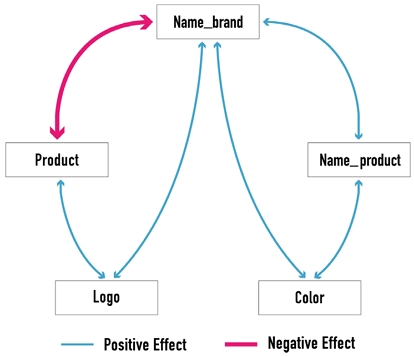
Multiple Linear Regression Effects among Brand Identity ElementsNote. This figure summarizes statistically significant effects (p<.05) among brand identity elements based on multiple linear regression analyses. Arrows indicate positive (blue) and negative (red) effects. Paths with p>.05 are excluded for clarity. This diagram is a visual summary integrating multiple regression models and does not represent a structural equation model or imply simultaneous causality.
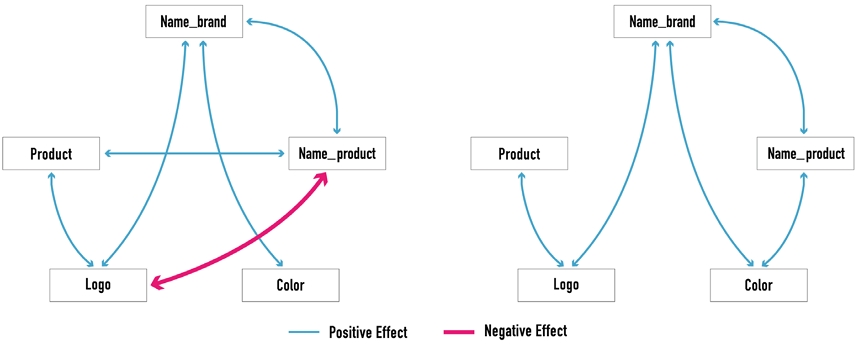
Multiple Linear Regression Effects among Brand identity elements under High-level Transformational (L) and High-level Informational (R) Message StrategiesNote. This figure summarizes statistically significant effects (p<.05) among brand identity elements by message strategy. The left diagram represents the high-level transformational strategy, and the right represents the high-level informational strategy. Arrows indicate positive (blue) and negative (red) effects. Paths with p>.05 are excluded for clarity. This diagram is a visual summary integrating multiple regression models and does not represent a structural equation model or imply simultaneous causality.
Secondly, we discuss the result of a Delphi technique analysis conducted on “visual components of video.” Following the completion of the analysis of 388 videos, “visual components of video” extracted from the eight brands on Instagram, the reliability between research participation was measured by Perreault and Leigh’s Ir coefficient, which achieved a robust level of agreement above 0.8 in the first round by “brand”: Apple (N=38, Ir=.926), Google (N=50, Ir=.882), Toyota (N=50, Ir=.904), Mercedes-Benz (N=50, Ir=.872), Nike (N=50, IIr=.932), BMW (N=50, Ir=.910), Disney (N=50, Ir=.962) and Louis Vuitton (N=50, Ir=.913). To examine whether there were significant differences in key variables according to “brand” among “visual components of video” in Table 4, one-way ANOVA was conducted. The results showed that “Tone” (F=5.519, p<.001), “Depth” (F=5.524, p<.001), “Shot Scale” (F=4.355, p<.001), “Camera Moving” (F=6.406, p<.001), “Camera Perspective” (F=11.809, p<.001), “Visualization Process” (F=6.515, p<.001), and “Subjective Speed” (F=3.474, p<.01) showed significant differences according to “brand.”
One-way ANOVA was performed to examine the significant differences in key variables according to “Tone” among “visual components of video”. The results showed that “Depth” (F=2.244, p<.05), “Camera Perspective” (F=3.344, p<.001), and “Subjective Speed” (F=2.493, p<.01) differed positive effect according to “Tone”. Multiple linear regression analysis was performed to examine the effect between “visual components of video” elements. Analyzing the effect of visual components of video on “Depth” showed that the regression model was statistically significant (F=16.290, p<.001), and it was verified that “Shot Scale” (β=-.353, p<.001, VIF=1.075), “Camera Moving” (β=-.289, p<.001, VIF=1.031), and “Tone_saturation” (β=-.094, p<.05, VIF=1.084) were effected in that order. Analyzing the effect of visual components of video on “Shot Scale” showed that the regression model was statistically significant (F=12.862, p<.001), and it was verified that “Depth” (β=-.371, p<.001, VIF=1.129), “Camera Perspective” (β=-.180, p<.001, VIF=1.062), “Visualization Process” (β=-.141, p<.01, VIF=1.030) and “Camera Moving” (β=-.110, p<.05, VIF=1.124) were effected in that order. Analyzing the effect of visual components of video on “Camera Moving” showed that the regression model was statistically significant (F=7.548, p<.001), and it was verified that “Depth” (β=-.330, p<.001, VIF=1.176), “Subjective Speed” (β=.139, p<.01, VIF=1.046) and “Shot Scale” (β=-.119, p<.05, VIF=1.221) were effected in that order. Analyzing the effect of visual components of video on “Camera Perspective” showed that the regression model was statistically significant (F=5.553, p<.001), and it was verified that “Shot Scale” (β=-.202, p<.001, VIF=1.192), “Tone_lightness” (β=-.163, p<.01, VIF=1.066) and “Visualization Process” (β=-.115, p<.05, VIF=1.040) were effected in that order. Analyzing the effect of visual components of video on “Visualization Process” showed that the regression model was statistically significant (F=2.967, p<.001), and it was verified that “Shot Scale” (β=-.165, p<.01, VIF=1.208) and “Camera Perspective” (β=-.120, p<.05, VIF=1.087) were effected in that order. Analyzing the effect of visual components of video on “Subjective Speed” showed that the regression model was statistically significant (F=3.685, p<.001), “Tone_saturation” (β=.181, p<.001, VIF=1.048) and “Camera Moving” (β=.148, p<.01, VIF=1.116) were effected in that order.
Notably, “Tone” was analyzed by separating lightness and saturation to utilize it as a continuous variable. The results of the multiple linear regression analysis of the effect of “visual components of video”: “Tone,” “Depth,” “Shot Scale,” “Camera Moving,” “Camera Perspective,” “Visualization Process,” and “Subjective Speed” confirmed that there was no problem with multicollinearity between the variables, as the VIF was less than 10.
Multiple linear regression analysis was performed to examine the effect between “visual components of video” elements according to “message strategy.” Summarizing the differences from Figure 3, in cases with “high transformational,” “Depth” (F=15.525, p<.001) was “Shot Scale” (β=-.340, p<.001, VIF=1.071), “Camera Moving” (β=-.400, p<.001, VIF=1.048) were effected in that order, and “Shot Scale” (F=8.585, p<.01) was “Depth” (β=-.393, p<.001, VIF=1.237), and “Camera Moving” (F=10.019, p<.001) was “Depth” (β=-447, p<.001, VIF=1.173) showed a two-way effect. “Camera Moving” (F=10.019, p<.001) was “Subjective Spee” (β=.177, p<.01, VIF=1.048), “Subjective Speed” (F=3.207, p<.01) was “Camera Moving” (β=.207, p<.01, VIF=1.229) showed a two-way effect. “Camera Perspective” (F=3.074, p<.01) was “Shot Scale” (β=-.191, p<.01, VIF=1.197), “Shot Scale” (F=8.585, p<.01) was “Camera Perspective” (β=-.168, p<.01, VIF=1.049) showed a two-way effect. Additionally, “Camera Perspective” (F=3.074, p<.01) was verified that “Tone_lightness” (β=-.146, p<.01, VIF=1.069) showed a one-way effect. “Shot Scale” (F=8.585, p<.01) was verified that ‘Visualization Process’ (β=-.141, p<.01, VIF=1.027) showed a one-way effect. “Subjective Speed” (F=8.585, p<.01) was verified that “Tone_saturation” (β=.149, p<.05, VIF=1.054) showed a one-way effect. However, in cases with “high informational,” “Depth” (F=6.727, p<.01) was “Shot Scale” (β=-.316, p<.001, VIF=1.110), “Camera Moving” (β=-.223, p<.001, VIF=1.041), and “Shot Scale” (F=7.241, p<.001) was “Depth” (β=-.311, p<.001, VIF=1.096), and “Camera Moving” (F=3.187, p<.01) was “Depth” (β=-246, p<.001, VIF=1.148) showed a two-way effect. “Tone_lightness” (F=3.244, p<.01) was “Camera Perspective” (β=-.190, p<.01, VIF=1.083), “Camera Perspective” (F=4.663, p<.001) was “Tone_lightness” (β=-.213, p<.001, VIF=1.090) showed a two-way effect. “Camera Perspective” (F=4.663, p<.001) was “Shot Scale” (β=- .199, p<.01, VIF=1.186), “Shot Scale” (F=7.241, p<.001) was “Camera Perspective” (β=-.186, p<.01, VIF=1.107) showed a two-way effect. “Shot Scale” (F=7.241, p<.001) was “Visualization Process” (β=-.201, p<.01, VIF=1.035), “Visualization Process” (F=2.643, p<.05) was “Shot Scale” (β=-228, p<.01, VIF=1.175) showed a two-way effect. Additionally, “Subjective Speed” (F=2.605, p<.001) was verified that “Tone_saturation” (β=.202, p<.01, VIF=1.061) showed a one-way effect. The results of the multiple linear regression analysis of the effect of “visual components of video” elements according to “message strategy” confirmed that there was no problem with multicollinearity between the variables, as the VIF was less than 10.
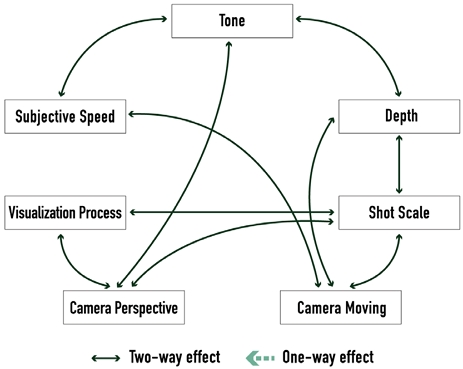
Multiple Linear Regression Effects among Visual Components of VideoNote. This figure summarizes statistically significant effects (p<.05) among visual components of video, based on multiple linear regression analyses. Arrows represent one-way or two-way predictive effects. Paths with p>.05 are excluded for clarity. This diagram is a visual summary integrating results from separate regression models and does not represent a structural equation model or imply simultaneous causality. The visualization highlights how elements such as “Tone,” “Shot Scale,” “Depth,” and “Camera Moving” interact to shape video communication.
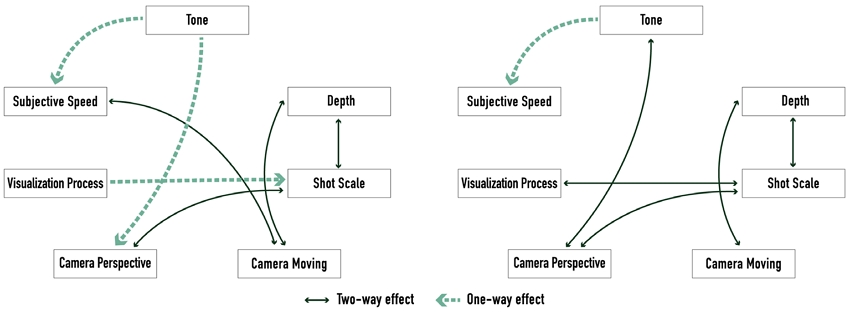
Multiple Linear Regression Effect between Visual Components of Video, High-level Transformational (L) and High-level Informational (R) Message StrategiesNote. This figure summarizes statistically significant effects (p<.05) among visual components of video under high-level transformational (left) and high-level informational (right) message strategies, based on multiple linear regression analyses. Arrows indicate predictive effects. Paths with p>.05 are excluded for clarity. This diagram is a visual summary integrating multiple regression models and does not represent a structural equation model or imply simultaneous causality.
4. 2. Survey
While the preceding section explored the structural relationships among brand identity and visual components of video through a case analysis of branded video content, this section examined the extent to which the content characteristics identified in the case study affected actual user responses, as assessed through survey-based regression analysis. Although the two analyses differed in data sources and methodological approaches, they were integrated under a common objective: to examine the connection between brand content construction and user response from both production and reception perspectives.
This section examined the effects of branded video posts on Instagram on user brand awareness and perception. The reliability verification results of the survey (Cronbach’s alpha=.801) indicated high internal consistency, and reliability was considered acceptable. To examine whether there were significant differences in key variables according to “brand”, one-way ANOVA was conducted. The results showed that “brand awareness” (F=34.869, p<.001) differed significantly according to the “brand”. Moreover, among branded video post, “Comprehending the Post” (F=18.344, p<.001), “Brand Awareness in the Post”(F=17.361, p<.001), and “Brand Association in the Post” (F=24.586, p<.001) differed significantly according to the “brand”.
Multiple linear regression analysis was conducted to examine the effect of “brand identity” on “brand awareness.” The regression model showed statistical significance (F=7.392, p<.001), and it was verified that “Color” (β=-.105, p<.001. VIF=1.322) and “Came_product” (β=-.068, p<.05, VIF=1.207) had a negative effect on “brand awareness” as they increased. Multiple linear regression analysis was conducted to examine the effect of “visual components of video” on “brand awareness”. The regression model showed statistical significance (F=10.072, p<.001), and it was verified that “Tone_saturation” (β=.161, p<.001. VIF=1.913)) had a positive effect on “brand awareness” as it increased.
First, multiple linear regression analysis was conducted to examine the effect of “brand identity” on branded video posts. Analyzing the effect of brand identity on “Comprehending the Post” showed that the regression model was statistically significant (F=72.903, p<.05), and it was verified that a higher frequency of “Logo” (β=-.088, p<.01, VIF=1.577) expression had a negative effect on “Comprehending the Post.” Analyzing the effect of brand identity on “Brand Awareness in the Post’ showed that the regression model was statistically significant (F=3.530, p<.01), and it was verified that a higher frequency of “Logo” (β=-.064, p<.05, VIF=1.577) expression had a negative effect. Analyzing the effect of brand identity on “Brand Association in the Post” showed that the regression model was statistically significant (F=6.099, p<.001), and it was verified that a higher frequency of “Logo” (β=-.100, p<.001, VIF=1.577) expression had a negative effect. In cases with “high brand awareness” on “Brand Awareness in the Post’ (F=3.133, p<.01) was a higher frequency of “Name_product” (β=.096, p<.01, VIF=1.227) expression had a positive effect. The results of multiple linear regression analysis of the effect of “brand identity” confirmed that there was no problem with multicollinearity between the variables, as the VIF was less than 10.
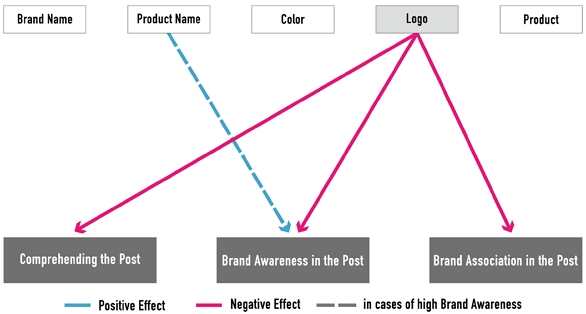
Multiple Linear Regression Effects of Brand Identity Elementson on User Responses to Branded Video PostNote. This figure summarizes statistically significant effects (p<.05) of brand identity elements on user responses in branded video posts, based on multiple linear regression analyses. Dotted lines represent conditional effects based on brand awareness. Paths with p>.05 are excluded for clarity. This diagram is a visual summary integrating multiple regression models and does not represent a structural equation model or imply simultaneous causality.
Second, multiple linear regression analysis was conducted to examine the effect of “visual components of video” on branded video posts. Analyzing the effect of “visual components of video” on “Comprehending the Post” showed that the regression model was statistically significant (F=8.799, p<.001), and it was verified that “Shot Scale” (β=-.161, p<.001, VIF=1.782), “Tone_lightness” (β=-.153, p<.001, VIF=1.399), “Camera Perspective” (β=-.078, p<.05, VIF=1.911) were effected in that order. In cases with “higer brand awareness” (F=4.729, p<.001), it was verified that “Shot Scale” (β=-.171, p<.001, VIF=1.800), and “Tone_lightness” (β=-.156, p<.001, VIF=1.448) were effected in that order. Analyzing the effect of “visual components of video” on “Brand Awareness in the Post” showed that the regression model was statistically significant (F=11.903, p<.001), and it was verified that “Shot Scale” (β=-.177, p<.001, VIF=1.782), “Tone_lightness” (β=-.144, p<.001, VIF=1.399), “Camera Perspective” (β=-.105, p<.01, VIF=1.911) and “Subjective Speed” (β=.068, p<.05, VIF=2.085) were effected in that order. In cases with “high brand awareness” (F=6.520, p<.001), it was verified that “Shot Scale” (β=-.166, p<.001, VIF=1.800) and “Tone_lightness” (β=-.164, p<.001, VIF=1.448) were effected in that order. Analyzing the effect of “visual components of video” on “Brand Association in the Post” showed that the regression model was statistically significant (F=9.701, p<.001), and it was verified that “Shot Scale” (β=-.144, p<.001, VIF=1.782), “Tone_lightness” (β=-.105, p<.001, VIF=1.399), “Camera Perspective” (β=-.083, p<.05, VIF=1.911) and “Camera Moving” (β=-.068, p<.05, VIF=1.434) were effected in that order. In cases with “high brand awareness” (F=5.988, p<.001), it was verified that “Shot Scale” (β=-.161, p<.001, VIF=1.800) and “Tone_lightness” (β=-.121, p<.001, VIF=1.448) were effected in that order. The results of the multiple linear regression analysis of the effect of “visual components of video” confirmed that there was no problem with multicollinearity between the variables, as the VIF was less than 10.
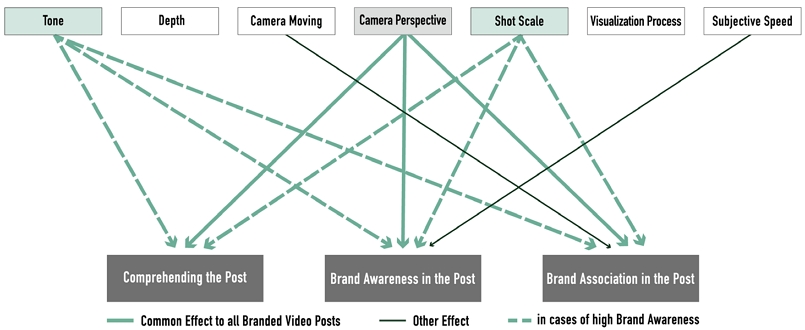
Multiple Linear Regression Effects of Visual Components of Video on User Responses to Branded Video PostNote. This figure summarizes statistically significant effects (p<.05) of visual components of video on user responses in branded video posts, based on multiple linear regression analyses. Dotted lines represent conditional effects based on brand awareness. Paths with p>.05 are excluded for clarity. This diagram is a visual summary integrating multiple regression models and does not represent a structural equation model or imply simultaneous causality. The visualization highlights the influence of “Tone,” “Camera Perspective,” and “Shot Scale” as key visual elements consistently used in brand video communication.
5. Discussion
The research findings confirmed a connection between the brand identity visualization elements analyzed in the brand-case video messages and the elements perceived by consumers as contributing to brand awareness. These findings further enabled a comparison of the elements influencing brand identity visualization according to the message strategy. Brand awareness in video posts indicated that a multifaceted approach to brand identity visualization was essential to conveying the overall atmosphere of the message, rather than merely repeating standardized visual elements. Accordingly, this discussion explores practical and theoretical considerations for visualizing brand identity through refined models and for formulating strategic approaches tailored to various media platforms.
First, effective brand identity visualization in social media video communication demands a deliberate and platform-specific approach. Repeated exposure to symbolic elements is no longer sufficient to foster brand awareness. In fact, excessive reliance on such visual cues may provoke user fatigue or even aversion. Thus, there is a growing need for integrated visual strategies that convey the overall brand atmosphere in a nuanced and emotionally resonant manner. Rather than defaulting to standardized symbolic repetition, video-based brand communication must strategically align visual elements with the distinctive affordances and interaction dynamics of each platform. Meaningful brand awareness in video media requires a refined and adaptive conceptualization of brand identity—one that reflects the fluid and evolving nature of digital communication environments. Empirical findings from this study revealed that frequent exposure to certain brand identity elements—particularly “Color” and “Name_product”—had a negative effect on brand awareness. Notably, while “Color” served as a strong symbolic representation of brand identity, it exerted the most significant negative impact. Conversely, the “Tone” of the visual components of video positively influenced brand awareness, suggesting that atmosphere-driven expressions capable of eliciting emotional engagement were more effective than the mere recognition of symbolic elements. This result challenges traditional views in brand identity research, which emphasize the foundational role of symbolic components in shaping brand awareness (Aaker & Bruzzone, 1985). Furthermore, the findings identified shifts in the influence of visual elements depending on the message strategy applied. This aligns with Tafesse and Wien’s (2018) research, which highlights that social media branding strategies encompass not only the content of the message but also the mechanisms of information processing and their communicative effects. Taken together, these insights suggest that a contemporary understanding of brand identity visualization must anticipate changes in visual expression across platforms and media—and expand the scope of communication design to meet the demands of a dynamic digital environment.
Second, leveraging the interactions among elements within brand identity visualization proved to be an effective approach for enhancing brand awareness. In terms of brand identity, “Name_brand” was most influenced by “Logo,” “Name_product” was most influenced by “Name_brand,” and “Name_brand” had the largest effect on “Color.” “Logo” and “Product” elements mutually influenced one another. ‘These findings confirm the roles of “Logo”and “Color” as visual elements symbolizing the brand. This supports the phenomenon where “Name_brand” guarantees “Product,” and the brand was visualized from “Product” to “Logo.” Furthermore, examining “Logo,” which negatively affects brand awareness on social media, within the interaction among brand identity elements revealed that the influence of “Logo” became significant when presented in conjunction with the “Product,” and that it exerted a positive influence on “Name_brand.” Since frequently exposing “Logo” in video negatively affected brand awareness, it can be inferred that minimal expression of “Logo,” in connection with the “Product” or “Name_brand,” is more effective. In terms of the visual components of video, “Shot Scale” was identified as the element that most strongly influenced “Camera Perspective” and “Visualization Process.” This suggests that “Shot Scale,” which constitutes the video’s aesthetics, influenced the user’ perspective and the process of explaining the theme. “Depth” most influences “Camera Moving,” and “Subjective Speed” most influences “Tone.” These findings indicated that “Depth” was expressed through “Camera Moving,” which effectively contributed to creating the overall mood by linking “Tone” with “Subjective Speed.” In addition, “Shot Scale” and “Depth” demonstrated a reciprocal influence. These confirmed the connectivity among elements within the video’s “Space”, and showed that it verified the influence between “Space” and “Movement,” “Light and Color.”
Third, brand identity visualization in video messages should be strategically adapted to the user’s level of brand awareness. Developing tailored visual strategies that correspond to varying levels of brand familiarity is essential for maximizing communicative effectiveness and reinforcing brand awareness.The study findings indicate that, for users with high brand awareness, minimizing the use of “Logo” and frequently exposing the “Name_product,” or utilizing “Tone” and “Shot Scale,” serve as effective strategies. As illustrated in Figure 5, users with high brand awareness were able to recognize the brand solely through exposure to “Name_product.” This finding aligned with Figure 1, which showed that “Name_brand” had the most effect on “Name-product.” Furthermore, Figure 6 demonstrated that for users with high brand awareness, the effective use of “Tone” and “Shot Scale” was particularly important. When interpreted alongside Figure 3, it became evident that “Tone” influenced “Depth,” “Camera Moving,” “Subjective Speed,” whereas “Shot Scale” affected “Depth,” “Camera Moving,” “Camera Perspective,” and “Visualization Process.” Together, these elements contributed to the overall visual components of video. These findings reinforce the importance of applying brand identity visualization in alignment with users’ brand awareness levels. This means that it is necessary to reflect on the phenomenon of video media activated by the expansion of digital technology. These conclusions are consistent with prior research by Youn et al. (2024), which demonstrated that brand experiences delivered through storytelling were more effective for users engaged in brand communities using video content, compared to those relying on explicit brand representations. In this context, a more expansive visual strategy is required-one that moves beyond the mere repetition of symbolic brand elements such as the “Name,” “Logo,” “Color,” and “Product.”
Finally, based on the findings and limitations of the study, the following directions for future research were proposed. This study discussed brand identity visualization across multiple brands through an experiment using video posts on social media. The results demonstrated significant differences across all variables depending on the brand. Future studies could enhance contributions to brand communication by segmenting the results according to specific products or services. For instance, differences in the industrial nature of the product or service, differences in pricing strategy within the same product category, or cultural and generational differences among users could be explored. Alternatively, future research could investigate additional factors influencing user experience in video communication. The study primarily focused on visual, which Block (2020) identified as the most influential among the three modes of video communication. Subsequent research could further develop the field of social media video communication by incorporating multisensory effects. For example, an integrated audiovisual representation of a brand might offer richer narratives and deeper emotional engagement for users.
6. Conclusion
This study emphasized the importance of platform and media characteristics in shaping brand identity visualization strategies to enhance brand awareness. Within social media brand communities, the contextual interpretation of users’ brand awareness and message strategies may either inhibit or promote specific expressions of brand identity on these platforms. In digital environments, the personalized and dynamic nature of brand-user interactions requires that video communication incorporate both the unique affordances of the medium and the symbolic dimensions of brand identity. The empirical results confirmed that brand identity visualization elements—such as “Color,” “Name_product,” and “Tone”—had varying effects on brand awareness depending on the message strategy and the user’s brand familiarity. Although statistically significant effects were observed across multiple variables, the practical significance of these effects may be limited. Therefore, the findings should be interpreted with caution, particularly when generalizing to broader brand or platform contexts. To this end, the study adopted a mixed-methods approach that translated qualitative observations into quantitative verification, thereby offering both theoretical contributions and practical implications for branding in video-based communication. Future research could further expand this area by segmenting findings by product category, pricing strategy, or user demographics such as cultural and generational characteristics. Moreover, exploring multisensory branding—including sound, motion graphics, and interactivity—may offer richer storytelling possibilities and foster deeper emotional engagement. Ultimately, this study provides insight into how refined and adaptive brand identity models can be strategically implemented across diverse social media and video communication platforms, supporting the development of immersive and resonant brand experiences.
Acknowledgments
This paper is based on Il Kyung Hwang's doctoral dissertation.
This work was supported by the Yonsei University Research Grant of 2023.
Notes
Copyright : This is an Open Access article distributed under the terms of the Creative Commons Attribution Non-Commercial License (http://creativecommons.org/licenses/by-nc/3.0/), which permits unrestricted educational and non-commercial use, provided the original work is properly cited.
References
- Aaker, D. A. (1996a). Building Strong Brands. New York: Free Press.
-
Aaker, D. A. (1996b). Measuring Brand Equity Across Products and Markets. California Management Review, 38(3), 102-120.
[https://doi.org/10.2307/41165845]

-
Aaker, D. A., & Bruzzone, D. E. (1985). Causes of Irritation in Advertising. Journal of Marketing, 49(2), 47-57.
[https://doi.org/10.2307/1251564]
-
Angelini, A., Ferretti, P., Ferrante, G., & Graziani, P. (2017). Social Media Development Paths in Banks. Journal of Promotion Management, 23(3), 345-358.
[https://doi.org/10.1080/10496491.2017.1294868]
-
Anagnostopoulos, C., Parganas, P., Chadwick, S., & Fenton, A. (2018). Branding in Pictures: Using Instagram as a Brand Management Tool in Professional Team Sport Organisations. European Sport Management Quarterly, 18(4), 413-438.
[https://doi.org/10.1080/16184742.2017.1410202]
-
Bagozzi, R. P., Gopinath, M., & Nyer, P. U. (1999). The Role of Emotions in Marketing. Journal of the Academy of Marketing Science, 27(2), 184-206.
[https://doi.org/10.1177/0092070399272005]
- Bailey, I. W., & Schechter, A. H. (1994). The Corporation as Brand: An Identity Dilemma. Chief Executive, (98), 42-45.
-
Baumgarth, C., & Schmidt, M. (2010). How Strong is the Business-to-Business Brand in the Workforce? An Empirically-Tested Model of 'Internal Brand Equity' in a Business-to-Business Setting. Industrial Marketing Management, 39(8), 1250-1260.
[https://doi.org/10.1016/j.indmarman.2010.02.022]
-
Berger, J. (2011). Arousal Increases Social Transmission of Information. Psychological Science, 22(7), 891-893.
[https://doi.org/10.1177/0956797611413294]
-
Berthon, P., Pitt, L., & DesAutels, P. (2011). Unveiling videos: Consumer-Generated Ads as Qualitative Inquiry. Psychology & Marketing, 28(10), 1044-1060.
[https://doi.org/10.1002/mar.20427]
- Blattberg, E. (2014, April 21). Like It or Not, Autoplay Video Won. Digiday. Retrieved from https://digiday.com/media/autoplay-video-beat-regular-video-sorry-guys/.
-
Block, B. (2020). The Visual Story. New York: Routledge.
[https://doi.org/10.4324/9781315794839]
-
Brakus, J. J., Schmitt, B. H., & Zarantonello, L. (2009). Brand Experience: What Is It? How Is It Measured? Does It Affect Loyalty? Journal of Marketing, 73(3), 52-68.
[https://doi.org/10.1509/jmkg.73.3.052]
-
Carr, C. T., & Hayes, R. A. (2015). Social Media: Defining, Developing, and Divining. Atlantic Journal of Communication, 23(1), 46-65.
[https://doi.org/10.1080/15456870.2015.972282]
-
Chinomona, R. (2016). Brand Communication, Brand Image and Brand Trust as Antecedents of Brand Loyalty in Gauteng Province of South Africa. African Journal of Economic and Management Studies, 7(1), 124-139.
[https://doi.org/10.1108/AJEMS-03-2013-0031]
- Choi, S. (2011). A Study of Visual Components for Commercial Film. The Korean Journal of Animation, 7(4), 139-158.
- Coker, K. K., Flight, R. L., & Baima, D. M. (2017). SKIP IT OR VIEW IT: THE ROLE OF VIDEO STORYTELLING IN SOCIAL MEDIA MARKETING. Marketing Management Journal, 27(2), 75-87.
-
Coulter, K. S., & Roggeveen, A. (2012). "Like It or Not" Consumer Responses to Word-of-Mouth Communication in On-line Social Networks. Management Research Review, 35(9), 878-899.
[https://doi.org/10.1108/01409171211256587]
-
Cuevas-Molano, E., Matosas-López, L., & Bernal-Bravo, C. (2021). Factors Increasing Consumer Engagement of Branded Content in Instagram. IEEE Access, 9, 143531-143548.
[https://doi.org/10.1109/ACCESS.2021.3121186]
-
Da Silveira, C., Lages, C., & Simões, C. (2013). Reconceptualizing Brand Identity in a Dynamic Environment. Journal of Business Research, 66(1), 28-36.
[https://doi.org/10.1016/j.jbusres.2011.07.020]
-
Dalkey, N., & Helmer, O. (1963). An Experimental Application of the Delphi Method to the Use of Experts. Management Science, 9(3), 458-467.
[https://doi.org/10.1287/mnsc.9.3.458]
-
De Chernatony, L. (2010). Creating Powerful Brands. London: Routledge.
[https://doi.org/10.4324/9781856178501]
- Digital 2024: October Global Statshot Report. (2024, October 23). W. A. Social & Meltwater, Retrieved from https://www.meltwater.com/en/blog/digital-2024-october-global-statshot-report.
-
Elikan, D., & Pigneur, Y. (2019). A Visual Tool for Identity Communication Strategy. Journal of Small Business and Enterprise Development, 26(6/7), 831-854.
[https://doi.org/10.1108/JSBED-04-2019-0141]
-
Escobar-Farfán, M., Cervera-Taulet, A., & Schlesinger, W. (2024). Destination Brand Identity: Challenges, Opportunities, and Future Research Agenda. Cogent Social Sciences, 10(1).
[https://doi.org/10.1080/23311886.2024.2302803]
-
Ge, J., Sui, Y., Zhou, X., & Li, G. (2021). Effect of Short Video Ads on Sales Through Social Media: The Role of Advertisement Content Generators. International Journal of Advertising, 40(6), 870-896.
[https://doi.org/10.1080/02650487.2020.1848986]
-
Gibbs, G. R. (2007). Analyzing Qualitative Data. London: SAGE Publications.
[https://doi.org/10.4135/9781849208574]
-
Ghodeswar, B. M. (2008). Building Brand Identity in Competitive Markets: A Conceptual Model. Journal of Product & Brand Management, 17(1), 4-12.
[https://doi.org/10.1108/10610420810856468]
-
Gilbert, M. A. (2019). Strengthening Your Social Media Marketing with Live Streaming Video. Smart Technologies and Innovation for a Sustainable Future: Proceedings of the 1st American University in the Emirates International Research Conference, Dubai: UAE.
[https://doi.org/10.1007/978-3-030-01659-3_42]
-
Grandhi, B., Patwa, N., & Saleem, K. (2021). Data-Driven Marketing for Growth and Profitability. EuroMed Journal of Business, 16(4), 381-398.
[https://doi.org/10.1108/emjb-09-2018-0054]
- Grossman, G. (1994). Carefully Crafted Identity Can Build Brand Equity. The Public Relations Journal, 50(8), 18.
-
Gustafson, D. H., Shukla, R. K., Delbecq, A., & Walster, G. W. (1973). A Comparative Study of Differences in Subjective Likelihood Estimates Made by Individuals, Interacting Groups, Delphi Groups, and Nominal Groups. Organizational Behavior and Human Performance, 9(2), 280-291.
[https://doi.org/10.1016/0030-5073(73)90052-4]
- Gustafson, T., & Chabot, B. (2007). Brand Awareness. Cornell Maple Bulletin, 105(1), 1-5.
-
Harper, P. (2016). 'Unmute This': Captioning an (Audio) Visual Microgenre. The Soundtrack, 9(1-2), 7-23.
[https://doi.org/10.1386/ts.9.1-2.7_1]
-
Ianenko, M., Stepanov, M., & Mironova, L. (2020). Brand Identity Development. E3S Web of Conferences, 164, 09015.
[https://doi.org/10.1051/e3sconf/202016409015]
- Kapferer, J. N. (1994). Strategic Brand Management: New Approaches to Creating and Evaluating Brand Equity. New York: Free Press.
- Kapferer, J. N. (2012). The New Strategic Brand Management: Advanced Insights and Strategic Thinking. London: Kogan Page Limited.
-
Keller, K. L. (1993). Conceptualizing, Measuring, and Managing Customer-Based Brand Equity. Journal of Marketing, 57(1), 1-22.
[https://doi.org/10.1177/002224299305700101]
-
Keller, K. L. (2003). Understanding Brands, Branding, and Brand Equity. Interactive Marketing, 5(1), 7-20.
[https://doi.org/10.1057/palgrave.im.4340213]
-
Keller, K. L. (2013). Building Strong Brands in a Modern Marketing Communications Environment. In The Evolution of Integrated Marketing Communications, 65-81. London. Routledge.
[https://doi.org/10.4324/9781315872728]
- Keller, K. L., & Lehmann, D. R. (2003). How Do Brands Create Value?. Marketing Management, 12(3), 26-26.
-
Kennedy, E., & Guzmán, F. (2016). Co-creation of Brand Identities: Consumer and Industry Influence and Motivations. Journal of Consumer Marketing, 33(5), 313-323.
[https://doi.org/10.1108/jcm-07-2015-1500]
-
Kim, B., Hong, S., & Lee, H. (2021). Brand Communities on Instagram: Exploring Fortune 500 Companies' Instagram Communication Practices. International Journal of Strategic Communication, 15(3), 177-192.
[https://doi.org/10.1080/1553118x.2020.1867556]
-
Kim, K., Chung, T.-L. D., & Fiore, A. M. (2023). The Role of Interactivity from Instagram Advertisements in Shaping Young Female Fashion Consumers' Perceived Value and Behavioral Intentions. Journal of Retailing and Consumer Services, 70, 103159.
[https://doi.org/10.1016/j.jretconser.2022.103159]
-
Konecnik Ruzzier, M., & Ruzzier, M. (2009). Chapter 5 A TWO-DIMENSIONAL APPROACH TO BRANDING Integrating Identity and Equity. In Tourism branding: Communities in action, 65-73. Emerald Group Publishing Limited.
[https://doi.org/10.1108/S20421443(2009)0000001007]
-
Kuribayashi, R., & Nittono, H. (2015). Speeding up the Tempo of Background Sounds Accelerates the Pace of Behavior. Psychology of Music, 43(6), 808-817.
[https://doi.org/10.1177/0305735614543216]
-
Leiva, F. M., Ríos, F. J. M., & Martínez, T. L. (2006). Assessment of Interjudge Reliability in the Open-Ended Questions Coding Process. Quality and Quantity, 40(4), 519-537.
[https://doi.org/10.1007/s11135-005-1093-6]
-
Li, F., Larimo, J., & Leonidou, L. C. (2021). Social Media Marketing Strategy: Definition, Conceptualization, Taxonomy, Validation, and Future Agenda. Journal of the Academy of Marketing Science, 49(1), 51-70.
[https://doi.org/10.1007/s11747-020-00733-3]
-
Liu, J., Li, C., Ji, Y. G., North, M., & Yang, F. (2017). Like it or not: The Fortune 500's Facebook Strategies to Generate Users' Electronic Word-of-Mouth. Computers in Human Behavior, 73, 605-613.
[https://doi.org/10.1016/j.chb.2017.03.068]
- Mayes, K. (2013, September 12). An Easier Way to Watch Video. Retrieved from http://newsroom.fb.com/news/2013/09/an-easier-way-to-watch-video/.
-
Moon, J., Erdem, M., Ozdemir, O., Kim, H., & Anlamlier, E. (2025). What drives Millennials and Generation Z to adopt cryptocurrency for hotel payments?. International Journal of Contemporary Hospitality Management, 37(5), 1827-1844.
[https://doi.org/10.1108/ijchm-12-2023-1936]
-
Ng, Y. M. M., & Taneja, H. (2023). Web Use Remains Highly Regional Even in the Age of Global Platform Monopolies. PloS one, 18(1), e0278594.
[https://doi.org/10.1371/journal.pone.0278594]
-
Nielsen, J., & Landauer, T. K. (1993). A Mathematical Model of the Finding of Usability Problems. Proceedings of the INTERACT'93 and CHI'93 conference on Human Factors in Computing Systems, 206-213.
[https://doi.org/10.1145/169059.169166]
-
Pareek, V., & Harrison, T. (2020). SERVBID: the Development of a B2C Service Brand Identity Scale. Journal of Services Marketing, 34(5), 601-620.
[https://doi.org/10.1108/JSM-05-2019-0195]
-
Pelletier, M. J., Krallman, A., Adams, F. G., & Hancock, T. (2020). One Size Doesn’t Fit All: a User and Gratifications Analysis of Social Media Platforms. Journal of Research in Interactive Marketing, 14(2), 269-284.
[https://doi.org/10.1108/JRIM-10-2019-0159]
-
Perreault Jr, W. D., & Leigh, L. E. (1989). Reliability of Nominal Data Based on Qualitative Judgments. Journal of Marketing Research, 26(2), 135-148.
[https://doi.org/10.2307/3172601]
- Petek, N., & Konecnik Ruzzier, M. (2013). Brand Identity Development and the Role of Marketing Communications: Brand Experts' View. Managing Global Transitions, 11(1), 61-78.
-
Phillips, B. J., McQuarrie, E. F., & Griffin, W. G. (2014). The Face of the Brand: How Art Directors Understand Visual Brand Identity. Journal of Advertising, 43(4), 318-332.
[https://doi.org/10.1080/00913367.2013.867824]
-
Phua, J., Jin, S. V., & Kim, J. J. (2017). Gratifications of Using Facebook, Twitter, Instagram, or Snapchat to Follow Brands: The Moderating Effect of Social Comparison, Trust, Tie Strength, and Network Homophily on Brand Identification, Brand Engagement, Brand Commitment, and Membership Intention. Telematics and Informatics, 34(1), 412-424.
[https://doi.org/10.1016/j.tele.2016.06.004]
-
Ronzani, C. M., Da Costa, P. R., Da Silva, L. F., Pigola, A., & De Paiva, E. M. (2020). Qualitative Methods of Analysis: an Example of Atlas.ti™ Software Usage. Revista Gestão & Tecnologia, 20(4), 284-311.
[https://doi.org/10.20397/2177-6652/2020.v20i4.1994]
-
Rowe, G., & Wright, G. (1999). The Delphi Technique as a Forecasting Tool: Issues and Analysis. International Journal of Forecasting, 15(4), 353-375.
[https://doi.org/10.1016/S0169-2070(99)00018-7]
-
Roza, S., Sriayudha, Y., Khalik, I., & Octavia, A. (2022). CONSUMER ATTITUDE TOWARDS ADVERTISING ON INSTAGRAM: THE ROLE OF ADS PERSONALIZATION AND CONSUMER EXPERIENCE. Dinasti International Journal of Digital Business Management, 3(1), 130-140.
[https://doi.org/10.31933/dijdbm.v3i1.1081]
-
Seo, E. J., Park, J.-W., & Choi, Y. J. (2020). The Effect of Social Media Usage Characteristics on e-WOM, Trust, and Brand Equity: Focusing on Users of Airline Social Media. Sustainability, 12(4), 1691.
[https://doi.org/10.3390/su12041691]
-
Shams, R., Chatterjee, S., & Chaudhuri, R. (2024). Developing Brand Identity and Sales Strategy in the Digital era: Moderating Role of Consumer Belief in Brand. Journal of Business Research, 179, 114689.
[https://doi.org/10.1016/j.jbusres.2024.114689]
-
Shatto, B., & Erwin, K. (2016). Moving on From Millennials: Preparing for Generation Z. The Journal of Continuing Education in Nursing, 47(6), 253-254.
[https://doi.org/10.3928/00220124-20160518-05]
-
Stafford, M. R., & Day, E. (1995). Retail Services Advertising: The Effects of Appeal, Medium, and Service. Journal of Advertising, 24(1), 57-71.
[https://doi.org/10.1080/00913367.1995.10673468]
-
Steinmann, S., Mau, G., & Schramm‐Klein, H. (2015). Brand Communication Success in Online Consumption Communities: An Experimental Analysis of the Effects of Communication Style and Brand Pictorial Representation. Psychology & Marketing, 32(3), 356-371.
[https://doi.org/10.1002/mar.20784]
-
Swani, K., Brown, B. P., & Milne, G. R. (2014). Should Tweets Differ for B2B and B2C? An Analysis of Fortune 500 Companies' Twitter Communications. Industrial Marketing Management, 43(5), 873-881.
[https://doi.org/10.1016/i.indmarman.2014.04.012]
-
Tafesse, W., & Wien, A. (2017). A Framework for Categorizing Social Media Posts. Cogent Business & Management, 4(1), 1284390.
[https://doi.org/10.1080/23311975.2017.1284390]
-
Tafesse, W., & Wien, A. (2018). Using Message Strategy to Drive Consumer Behavioral Engagement on Social Media. Journal of Consumer Marketing, 35(3), 241-253.
[https://doi.org/10.1108/JCM-08-2016-1905]
- Upshaw, L. B. (1995). Building Brand Identity: A Strategy for Success in a Hostile Marketplace. New York: John Wiley & Sons.
-
Voorveld, H. A. M., Meppelink, C. S., & Boerman, S. C. (2024). Consumers' Persuasion Knowledge of Algorithms in Social Media Advertising: Identifying Consumer Groups Based on Awareness, Appropriateness, and Coping Ability. International Journal of Advertising, 43(6), 960-986.
[https://doi.org/10.1080/02650487.2023.2264045]
-
Ward, E., Yang, S., Romaniuk, J., & Beal, V. (2020). Building a Unique Brand Identity: Measuring the Relative Ownership Potential of Brand Identity Element Types. Journal of Brand Management, 27(4), 393-407.
[https://doi.org/10.1057/s41262-020-00187-6]
-
Watson, A. B. (1990). Perceptual-Components Architecture for Digital Video. Journal of the Optical Society of America A, 7(10), 1943-1954.
[https://doi.org/10.1364/JOSAA.7.001943]
-
Yenilmez Kacar, G. (2024). Instagram as One Tool, Two Stages: Self-presentational Differences between Main Feed and Story on Instagram. Atlantic Journal of Communication, 32(1), 108-123.
[https://doi.org/10.1080/15456870.2023.2202401]
-
Youn, S., Shah, P., & Dodoo, N. A. (2024). Engaging with Branded Content on Short-Video Sharing Apps: How Motivations Affect Attitude toward Branded Content, Brand Experience, and Relationship Quality. Journal of Interactive Advertising, 24(3), 215-237.
[https://doi.org/10.1080/15252019.2024.2325410]
-
Yu, S., & Wu, Z. (2024). Research on the Influence Mechanism of Short Video Communication Effect of Furniture Brand: Based on ELM Model and Regression Analysis. BioResources, 19(2), 3191-3207.
[https://doi.org/10.15376/biores.19.2.3191-3207]
- Zettl, H. (2011). Sight, Sound, Motion: Applied Media Aesthetics. Boston: Wadsworth Cengage Learning.