
Symbolism in Sustainability: The Role of Jasmine Motifs in Jelami Ecoprinted Silk as a Cultural Artifact
Abstract
Background This study explores the integration of Jasminum sambac (jasmine flower) motifs in Jelami eco-printed silk, emphasizing their cultural symbolism and connection to the four pillars of sustainability: environmental, social, economic, and cultural. Jasmine holds significant value in Indonesian culture, symbolizing purity and humility, and its inclusion in textile design highlights the intersection of traditional practices and sustainable innovation.
Methods A qualitative research approach was used, combining literature reviews and semi-structured interviews with cultural experts, artisans, and local practitioners. The study also employed ecosemiotics to analyze jasmine’s symbolic and ecological roles. Practical experimentation in eco-printing was conducted to create textiles inspired by traditional jasmine arrangements (ronce).
Results The findings reveal that using jasmine in eco-printing aligns with sustainability principles. The natural dyeing processes reduce environmental impact, while jasmine motifs enhance cultural and aesthetic value. The practice also supports local artisans, fostering economic opportunities and preserving traditional craftsmanship.
Conclusions This study demonstrates that nature and culture can collaboratively inspire sustainable textile design. It proposes a framework that integrates local biodiversity, cultural heritage, and sustainability principles for modern applications in the design industry.
Keywords:
Eco-printing, Cultural Symbolism, Sustainability, Textile Design, Ecosemiotics1. Introduction
Sustainable practices in fashion and textiles have become one of the main pillars driving innovation and transformation within the industry. Moreover, in Southeast Asian countries, the issue of sustainability in fashion has become a crucial focus. Many large enterprises in fashion started to pay attention to this due to global competition, consumer awareness, and policies. However, Micro-Small and Medium-sized enterprises (MSMEs) face challenges in adopting the practices due to limited funding, shortage of skills, and lack of consumer awareness (Nayak et al., 2020). Also, one of the key challenges today is the decrease of traditional knowledge. Modern artisans often prioritize market demands only. Therefore, there is a gap in understanding the symbolic and historical significance of certain artifacts (Fajarriny & Sunarya, 2021).
Indonesia, as a Southeast Asian country, plays an essential role in the shift towards sustainable practices in the fashion and textile industry. This is supported by the heritage of traditional textile techniques and the diversities of natural resources. This condition benefits the MSMEs in Indonesia, where the artisans can use natural resources and adopt traditional techniques.
The growing adoption of eco-conscious textile practices in Indonesia is shown through many traditional techniques that have been used in recent years. Batik, eco-print, and other conventional textile dyeing techniques have been developed and modified to meet the needs of artisans, consumers, and the availability of resources. For example, this process is employed by crafters like Sogga Batik in Bantul, which is not only sustainable but also culturally significant, as it preserves the local biodiversity and contributes to environmental sustainability simultaneously (Syafril & Agel, 2023). Another example is the eco-print pounding technique used in Yosowilangun Village, Gresik, which emphasizes sustainability by teaching residents the eco-pounding technique (Satria et al., 2024).
As stated, artisans in Indonesia have adopted eco-printing, and the adaptation is also varied in terms of technique modification, plants used, and arrangements of the patterns. Eco-printing is usually defined as botanical printing that uses natural dyes and botanical products like leaves, fruits, and flowers to create patterns on fabric (Dewi, 2021; Nurliana et al., 2021). Unlike the conventional methods of textile printing that rely on synthetic dyes and machine processes, eco-prints use natural materials. Natural materials used in this technique are leaves, like hibiscus, teak, eucalyptus, and mango leaves. Beyond their role as natural dyes, natural materials are also used to create shapes, acting as natural stencils that imprint their intricate forms onto fabric. Among these, flowers like jasmine (Jasminum sambac) hold particular significance due to its deep cultural and symbolic value in Indonesia. Jasmine is not only the national flower of Indonesia but is also widely used in traditional ceremonies, weddings, and spiritual rituals. Furthermore, Jasminum sambac is one of the flowers that can be effectively utilized in both dye transfer and shape imprinting, adding aesthetic and symbolic depth to eco-printed textiles.
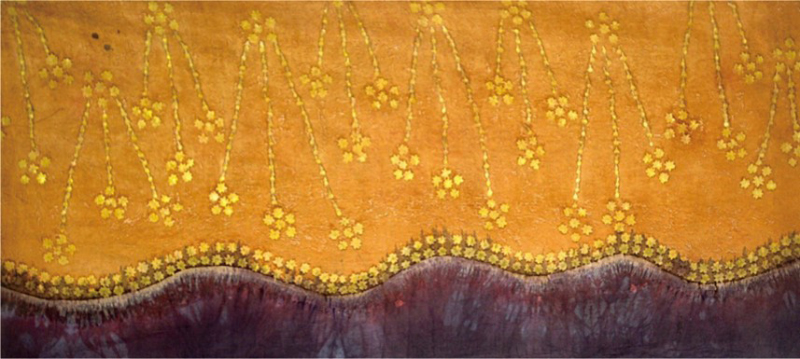
In this study, we discuss one of the eco-printing adoption techniques, Jelami, which stands for Jejak Alami ( Trace of Nature - translated). According to Savitri (2024) in her catalog book “Jelami - Jasmine Bloem op Zijde en staat ceremony,” Jelami has been admitted as a manual method of transferring natural shapes and colors of plants onto fabric. The Jelami technique employs natural elements like leaves and flowers, making this technique sustainable and highlighting its cultural value. The Jelami technique uses flowers with significant value in Indonesian culture (Figure 1).
Jelami technique on fabric
Jelami technique uses flowers that are meaningful and have cultural and natural significance for Indonesia, as they reflect the country’s biodiversity and cultural heritage. Keputusan Presiden Republik Indonesia Nomor 4 Tahun 1993 (Presidential Decree of the Republic of Indonesia Number 4 of 1993) established three national flowers symbolizing different aspects of Indonesian identity. These include Melati or jasmine flower (Jasminum sambac) as the “National Flower,” Padma Raksasa or giant padma (Rafflesia arnoldii) as the “Rare Flower,” and Anggrek Bulan or moon orchid (Phalaenopsis amabilis) known as the “Charm Flower.” Figure 1 shows the Jelami technique applied to fabric using Melati or jasmine flowers as the pattern. Notably, the jasmine flower symbolizes beauty and purity, which is why jasmine is used in traditional ceremonies, rituals, and cultural practices.
In discussing sustainability, there are four key pillars that emerge: environmental, economic, social, and cultural. Environmental sustainability focuses on conserving natural resources, economic sustainability promotes economic growth, while social sustainability is all about equity and well-being. The fourth pillar, cultural sustainability, needs to be addressed (Hawkes, 2004). Traditionally viewed as part of social sustainability, cultural sustainability is now acknowledged for its role in maintaining social cohesion and identity through shared cultural values and practices (Barthel-Bouchier, 2016).
As cultural sustainability plays a role in connecting the pillars (economic - environmental - social), it becomes essential to realize the potential of cultural values. In this context, cultural artifacts, symbols, and traditional practices can bring the values of sustainability. This research focuses on the jasmine flower in Jelami eco-printed silk as a representation of cultural symbolism that is interconnected with sustainability. As written above, the Jasmine flower is rich in cultural and national significance, and it connects these sustainability pillars by promoting cultural symbolism, as well as environmental, social, and economic aspects of sustainability. The research questions for this study are: a) How does the Jasmine flower in Jelami eco-printed silk symbolize Indonesian culture? b) How does using Jasmine in eco-printing (Jelami technique) connect the four pillars of sustainability? By addressing these questions for this study, we aim to highlight how traditional symbols like the Jasmine flower can contribute to a comprehensive sustainability model in textile printing techniques.
2. Literature Review
In this section, we explored relevant literature that informs the study of eco-printing, its connection to sustainability in textile design, and specifically, the cultural symbolism of jasmine in Indonesian tradition. The review draws from scholarly articles in textile, cultural studies, semiotics, and sustainability studies.
2 .1. Jelami Eco-Printing and Sustainability in Textile Design
The term eco-printing has its roots in traditional natural dyeing techniques - which were the only sources of color for fabric back then in the 1800s. Historically, natural dyes were created by brewing or boiling plant materials in large pots. The modern form of eco-printing was pioneered by textile artist - India Flint. Her approach was bundling fabric with leaves and flowers, applying heat through steaming, and that way, the pigments are transferred from the plants onto the fabrics (Sahu, 2022).
Eco-printing is rooted in biomimicry, where natural processes guide material innovation (Salma & Eskak, 2022). Instead of synthetic chemical dyeing, eco-printing mimics nature’s ability to imprint patterns and pigments, aand this offers a low-impact alternative that respects natural ecosystems (Ristiani & Isnaini, 2019).
There are two primary techniques in eco-printing: steaming and pounding. Both methods rely on natural pigments, but they differ in process and result. In the steaming method, the fabric is usually wrapped or rolled and then steamed. In the pounding technique, the plant materials are usually pounded into a fabric with a hammer or mallet, which crushes the plants and transfers their pigments onto the textile. However, nowadays, many techniques have been modified and combined (Putri & Kristi, 2020). In the Jelami eco-printing we created, boiling is used, emphasizing the concept and meaning of the flower used for color transfer.
Sustainability in textile design is a practice that can minimize environmental impact and promote ethical production and consumption (Joy et al., 2012; Lang & Armstrong, 2018). It involves balancing the three pillars of sustainability—environmental, social, and economic considerations—while addressing consumers’ demands for functionality and aesthetics. Unlike synthetic dyeing, eco-printing does not use toxic chemicals to bind colors to fabrics. This, of course, minimizes the water and soil pollution. Regarding water use, eco-printing also requires far less water than dyeing techniques. Another critical factor is pigments. Fabrics with synthetic pigments do not break down easily and leave more lasting pollutants in the environment. Eco-printing techniques use plant-based pigments, making them more biodegradable than those dyed with synthetic dyes.
As part of sustainable textile design, Jelami eco-printing fulfills the need for a technique that minimizes environmental impact while meeting aesthetic and functional requirements.
In short, eco-printing has evolved as a sustainable textile practice that minimizes environmental impact. The Jelami eco-printing is one of the developments, and its process uses the boiling method, so the flowers can be transferred. As a part of sustainable textile design, Jelami eco-printing aligns with sustainability principles because it reduces chemical waste, water consumption, and pollution.
2. 2. Cultural Symbolism of Jasmine in Indonesian Tradition
Jasmine flowers carry cultural and symbolic significance in many countries. Among its many species, Jasminum grandiflorum (Spanish or royal jasmine) and Jasminum sambac (Arabian jasmine) are particularly notable. While Spanish jasmine is known globally for its medicinal properties and fragrance (Ray, 2021), Jasminum sambac, or Arabian jasmine, has a special place in Indonesian culture. Moreover, it has been admitted as Puspa Bangsa (or ‘the national flower’) along with two other flowers (Orchid as ‘the charm flower’ and Giant lotus as ‘the rare flower’ (Presidential Decree Number 4 of 1993).
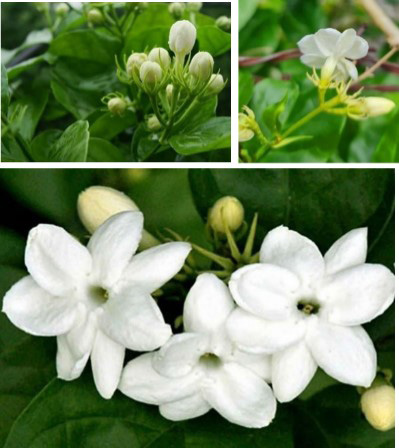
Physical characteristics of Jasminum sambac include small white flowers with a diameter of 2-3 cm, and composed of single or double-layered petals. The flowers have a distinct and sweet fragrance. Jasmine grows in tropical and subtropical climates, with a preference for loose and fertile soil (Purnomo, 2013).
Jasminum sambac
In Javanese tradition and philosophy, Jasminum sambac has symbolic meaning. Lestari (2019) stated that Jasmine is seen as a metaphor for purity and humility. The Jasmine flower’s role extends to cultural rituals, and it is used as a blessing symbol in ceremonies like weddings and other rites of passage. In Serat Centhini (kaca 17, bait 174-176) - a Javanese literary work, jasmine flowers are described as integral to wedding preparations. First, the bride undergoes a traditional lulur (body scrub) treatment using natural ingredients. Following the bath, her hair is dried using fragrant smoke and completed with floral arrangements like Jasminum sambac (Melati) and Jasminum officinale (Melati gambir). Jasmine’s inclusion in the rituals shows spiritual and physical refinement in Javanese aesthetics (Fibiona & Rizqika, 2023).
Interestingly, Jasmine sambac is used a lot to represent Javanese women. The idealized Javanese women are said to be respectful, honorable, and have high dignity. Margana & Nursam (2010) wrote that the Jasmine flower is emblematic of the high regard for women with traditional roles despite being often contextualized in a patriarchal framework. Jasminum sambac also represents the quiet resilience of Javanese women. Traits such as patience, acceptance, and emotional endurance are symbolized by the flower’s ability to thrive in modest conditions (Handayani & Novianto, 2004).
Another source from Serat Centhini (Kaca 295-296, Bait 33-40) mentions jasmine in death rituals. During funeral rites, jasmine flowers are used alongside gambir, menur, cempaka, argula, and roses. The use of jasmine as part of mortuary rites also shows the association with purity and sanctification of the soul (Fibiona & Rizqika, 2023).
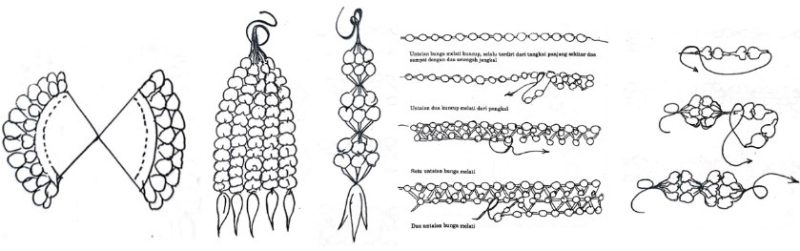
Jasmine flowers are arranged in certain ways when used for rituals (Figure 3). These arrangements are called ‘ronce’. There are several types of ronce or arrangements of jasmine flowers : ronce sisir melati , ronce usus-ususan , ronce telon, ronce gajah ngoling, ronce bawang sebungkul as seen in Figure 3 (Baratawijaja, 1991).
Jasmine arrangements (from left to right : ronce sisir melati, ronce usus-ususan, ronce telon, ronce gajah ngoling, ronce bawang sebungkul)
Based on the literature discussed, jasminum sambac has deep cultural and symbolic aspect in Javanese ritual and philosophy. Its presence in weddings, funerary, other traditional ceremonies indicate that the flowers act more than a functional property, but also ritualistic and aesthetics.
2. 3. Four Pillars of Sustainability and the Role of Cultural Sustainability
The four pillars of sustainability include four dimensions: environmental, economic, social, and cultural sustainability. While the environmental, economic, and social dimensions have long been central to sustainable development frameworks, cultural sustainability has become a critical and complementary pillar nowadays (Hawkes, 2001; Parung, 2024). Mason and Turner (2020) explain that cultural sustainability focuses on balancing the preservation of traditions with their ability to adapt and evolve over time. This idea connects to ecological principles like interconnectedness, meaning that cultural practices are closely tied to and influenced by natural ecosystems.
Another important factor is that cultural sustainability not only needs to be preserved, but it needs to remain relevant to contemporary societies. Therefore, integrating this practice into modern development strategies is important.
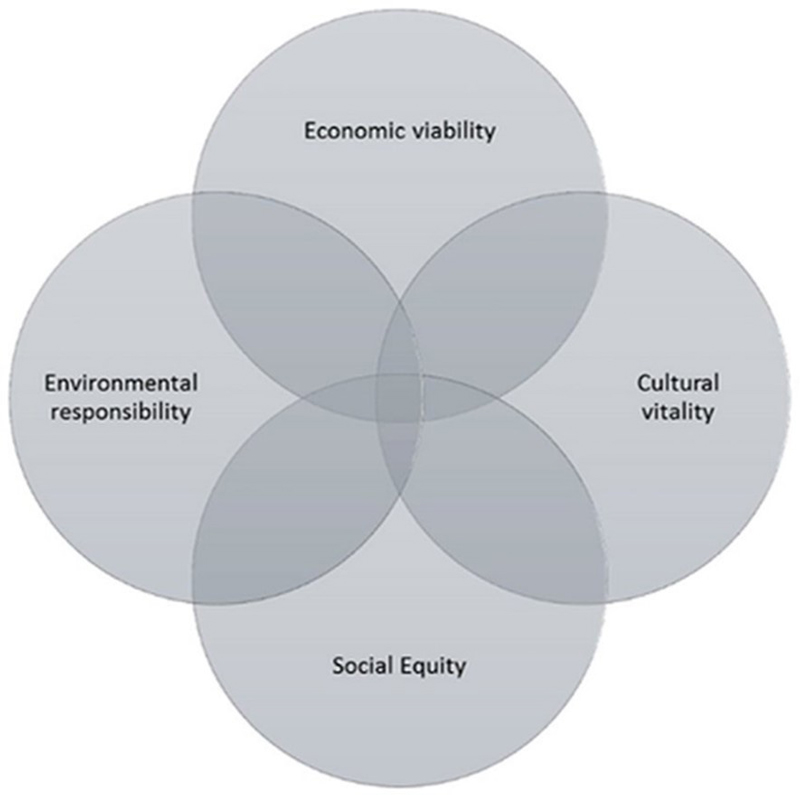
Figure 4 shows the depiction of the relationship between the four pillars of sustainability. In practice, cultural sustainability also aligns closely with ecological sustainability, as cultural practices are frequently embedded in and influenced by local ecosystems or nature. Moreover, in practice, cultural sustainability also must consider inclusivity and accessibility. Therefore, in this study, cultural sustainability is explored as a dynamic process of preservation of culture, nature, and relevance in modern contexts. We use this framework by Loach as a basis to analyze the nature - culture-inspired creation. This approach acknowledges that cultural sustainability is not static, and it requires active reinterpretation (Hawkes, 2001; Soini & Birkeland, 2014).
Depiction of the four pillars of sustainability (Loach et al, 2016)
In the area of textile design, cultural sustainability is implemented as textiles have served as functional and symbolic artifacts. Cultural sustainability in textile design involves reinterpreting traditional techniques, motifs, or concepts in ways that remain relevant to contemporary consumers while still respecting their cultural and historical aspect (Bhardwaj & Fairhurst, 2010). Another way is through an ethical collaboration with artisans. Working directly with communities can also improve the skill preservation of a traditional technique (Vezina, 2019).
In this study, we try to integrate jasminum sambac as a cultural symbol that is preserved while being transformed into another medium. This can be done as an adaptation strategy.
3. Methodology
This study employs a qualitative research approach. We did primary data collection such as semi-structured interviews with cultural experts to gather insights about the cultural values of Jasmine flowers, and secondary data collection such as a literature review (articles and historical texts).
Additionally, this study includes an experimental component where we developed a Jelami eco-printing process using Jasminum sambac. This experiment aimed to explore how jasmine flower motifs can be embedded into textile design through an eco-printing technique, incorporating both traditional cultural meanings and sustainability principles.
Figure 5 shows the conceptual framework for this study. This serves a s a map that guides this research by guiding the relationship of ideas.
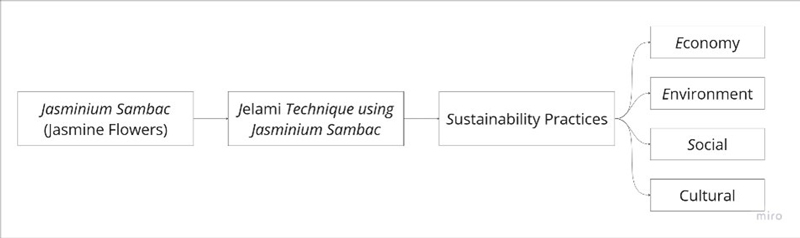
Conceptual Framework
The methodology used multimethod qualitative. Multimethod qualitative is a methodological approach that combines multiple qualitative methodologies such as interviews, observations, and document analysis, within a single study. This methodological integration strengthens the understanding of the subject being investigated (Mik-Meyer, 2020). Unlike mixed methods, which incorporate both qualitative and quantitative data, multimethod qualitative research focuses solely on qualitative methodologies. Figure 6 explains the detail of the steps taken in this study. It integrates primary and secondary data collection, with creation as a central process synthesizing theoretical and practical inputs.
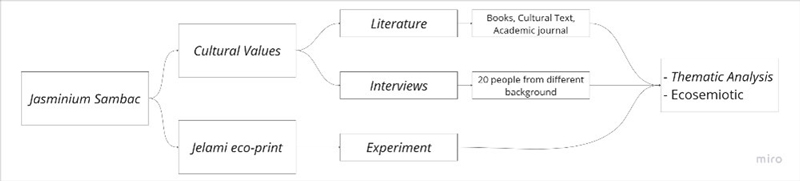
Research Methodology
In detail, first, we understand the cultural, historical, and ecological significance of jasmine and sustainability through literature reviews. The literature reviews include historical and cultural texts like Serat Centhini and academic journals.
Then, we conducted an in-depth interview to collect primary data on eco-printing practices and cultural interpretations of Jasmine. We collected data from interviews with dukun (Javanese shaman), Javanese make-up artists, culture experts, pastors, batik artisans, and staff from Yogyakarta court. Dukun are spiritual leaders in Javanese traditions, as they are really close to the symbolic meanings of jasmine in traditional ceremonies. The interview was conducted in the local language (Javanese and Indonesian) because it was also part of our consideration of participant comfort and authentic expressions when interviewed. However, in the next section, we have translated the summarized data into English to ease the readers.
Figure 6 below shows the sesajen (offering) from the farmers that contains jasmine flowers (Jasminum sambac) that they prepare to seek blessing and protection. Figure 7 shows the interview process with the Batik artisans.
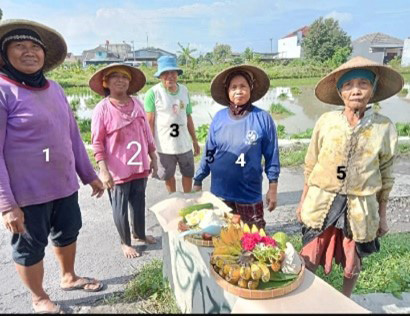
Javanese farmers with sesajen or offering (left to right : Suwarti, Sunarmi, Sular, Wagini, Daliyem)
Finally, the data is analyzed using thematic analysis and ecosemiotics, as eco-semiotics explore the relationship between signs and ecological systems. First, the interviews were transcribed; and then, they were coded selectively with a focus on themes occurred. After that, this data is interpreted using ecosemiotics. Ecosemiotics focuses on the interaction between nature and culture (Noth, 1996; Kull, 1998). Maran & Kull (2014) define ecosemiotics as semiotics branch that examines how natural elements function as communication signs. Ecosemiotics positions nature as an active participant in signification. Jasmine, within this context, functions as a metaphorical sign from nature, that forms meanings in Javanese culture. In this study, we position Jasminum Sambac as more than just a plant, because it carries meaning in tradition and identity. In sustainability perspective, we see this artefact as eco-friendly properties, tradition symbols, and its role in livelihoods and crafts. This is why ecosemiotics is used in the analysis process.
3. 2. Creation Method of Jelami Eco-printed Textile using Jasminum sambac
In addition to qualitative data collection through literature reviews and interviews, this study employed an experimental approach to test the application of Jasminum sambac in eco-printing. The experiment aimed to explore the feasibility of transferring jasmine flower pigments onto silk fabric while maintaining cultural compositions inspired by ronce (traditional flower garlands). The steps included selecting natural mordants (alum, salt, and ferrous sulfate), arranging jasmine flowers based on traditional compositions, and testing the effectiveness of steaming and drying techniques to achieve durable prints. This experiment allowed for practical insights into the interaction between cultural symbolism and sustainable textile techniques, which were then analyzed alongside qualitative findings.
The process of creating Jelami eco-printed textiles using Jasminum sambac involves botanical, cultural, and artistic dimensions. The initial step was to explore the characteristics of the flowers, from interviews and literature, which were done in the previous section. In the literature, we also found that the flowers’ traditional composition (ronce) is present. Hence, we tried to incorporate the composition in this creation.
The stages of creation in this study involves:
a) pre-mordanting process, which is important for eco-printing technique. The materials for mordanting is also natural materials, like Alum, Salt, and Ferrous sulfate, also known as iron(II) sulfate (in the local language, it is known as tunjung). In this process, we soak the silk cloth in the mordant solution for 30 minutes;
b) lift - rinse - spread cloth : after we lift the cloth, we rinse it, and spread the fabric on the table.
c) the flower arrangement process - during this stage, we tried several compositions of Jasminum sambac based on ronce compositions;
d) covering the fabric; this process includes placing a pre-dyed fabric (with natural dyes) as a cover over the fabric with jasmine flowers,
e) rolling and binding, this stage compresses the fabric layers for the pigment transfer;
f) steaming process; this process lasts for two hours to activate the pigment release;
g) drying, this process includes unrolling fabric carefully and hang the fabric to air dry in shaded area (as seen in Figure 8).

Interviews with Batik artisan and Batik workshop owners
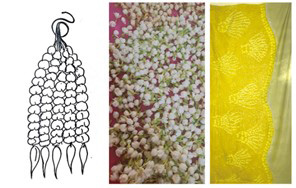
The Jasminum sambac creation inspired by ronce usus-ususan
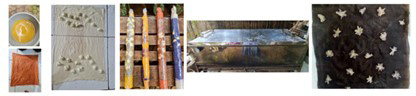
The stages of Jelami eco-printed textile creation using Jasminum sambac
In the creation, not only the material that is culturally aligned, but also the process, and the arrangement. The types of fiber of the textile also become important in this process. The choice of silk fabric expresses the metaphorical significance as well. Silk is commonly known as a luxurious and delicate natural fabric, so this idea aligns with the purity and sanctity of the flowers. Also, the compatibility of the fiber with natural dyes supports the process of staying true to the eco-friendly spirit.
4. Results and Discussion
4. 1. Understanding the Symbolism of Jasmine in Javanese Culture through Ecosemiotics
Before the ecosemiotic analysis process, we tried to map our interview data from dukun (Javanese shaman), Javanese make-up artists, culture expert, pastor, and staff of Yogyakarta court (total of 20 people). There were fivemajor themes based on the interviews, they are : purification and cleansing, love and destiny, respect and ancestral connection, royal and mythical significance, and lastly, artistic interpretation. These themes are based on the interviews conducted with the participants who use and are familiar with jasmine flowers. The interviews were conducted in Javanese and Indonesian to ensure there were no misinterpretations. Table 1 below outlines insights gathered from the interviews. The interpretations highlight jasmine’s diverse meanings in different ceremonial contexts.

Book Literature
Based on the interview, jasmine flowers (jasminum sambac) reveals a consistent symbolism of purity, humility, and moral integrity. The use of jasmine flowers has become important because they are used not only in ritualistic and sacred environments, but also in mythical, royal families, artistic purposes, and even in Christian practice in Java. The books also supported these interviews results, which according to Greenaway (2015), jasmine symbolizes friendliness and acceptance.
As explained, ecosemiotics is used when we want to learn nature’s significance to humans, this includes the communication and interaction of humans and nature. This process involves the symbolic - cultural - and ecological relationships. Kull’s view about different natures is used to analyze Jasmine flower, because, using this framework, we can analyze the different dimensions of the Jasmine flower.
As defined in ecosemiotics by Kull (1998), the connections between nature and humans lie in certain levels. Kull (1998) wrote that there are four types (levels) of nature. These four types (or levels) are based on how humans perceive, modify, and symbolically transform it (Kull, 1998; Maran & Kull, 2014). Zero nature is a concept of nature in its purest and untouched form, meaning, it would refer to the Jasmine flower as it is. It exists in the wild, and it is part of the ecosystem. First nature refers to nature that we see, identify, describe, and interpret. This includes the identification of Jasmine, morphology, and scientific description. Second nature refers to nature that is interpreted by humans. This is usually called changed nature or even produced nature. In the context of this study, the Jasmine flower is interpreted based on its symbolic meaning in cultural traditions. The third nature is when nature is represented in virtual or art forms. The nature here is not directly experienced, but it is symbolized and mediated. Based on the interview data and literature we collected, we mapped how Jasminum sambac (jasmine flower) is perceived and interpreted across the different levels of nature as defined by Kull (1998). This mapping helps to understand the ecological, cultural, and symbolic significance of jasmine through ecosemiotics. Table 2 below presents this analysis.
Interview Details
As written in Table 2, the transition from ‘zero nature’ to ‘third nature’ explains how Jasminum sambac evolves from a natural organism to a cultural symbol. However we found that there is consistency of themes in these levels of nature (zero to third nature), like purity, humility, stability, and sanctity.
Figure 5 below is adopted from Kull (1988), as the formation process in different natures for Jasminum sambac.
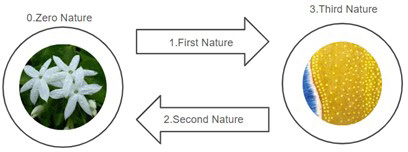
The process of formation in different natures of Jasminum sambac
The formation process if four natures can be understood through logical relationships that are shown in Figure 5. Zero nature is ‘nature from nature’, meaning the existence and role of jasmine flowers are tied to natural processes, without human involvement. First nature is ‘image from nature’, meaning the nature is observed by humans, so it is the image of nature that we, as humans, see. This includes the morphology of the flowers, even when the scientist named it. Second nature is ‘nature from image’, this happens when we humans take the ‘image’ of Jasmine from the first nature and reinterpret it. This reinterpretation is essential because first, we observed and interpreted the physical aspects of the flower, we recognized its fragrance, colors, and ecological role. Then, we created the idea, that we transform nature into culture - such as : white color of jasmine inspired the idea of purity, the fragrance that has elegance, and used in rituals. The nature now comes from the human-created image of jasmine, not just the plant itself. The last one is third nature. The third nature allows the indirect experience of nature (Jasmine), like when it was used to create batik and Jelami eco-printed textiles. The transformation of Jasminum sambac into Jelami eco-printed textiles aligns with Saidi et al. (2025), who states that nature is a source for constructing language and meaning. This means that the formation of meaning from nature is an active, layered process where humans interpret, symbolize, and ultimately create artifacts from nature.
4. 3. Sustainability through Nature Symbolism
The creation of Jelami eco-printed textiles using Jasminum sambac not only incorporates cultural values with symbolic meanings but also aligns with principles of sustainability through its connection with nature symbolism. The process and outcomes reflect the combination of ecological and cultural dimensions. This section analyzes the sustainability impact using the four pillars of the sustainability framework: environmental, social, economic, and cultural sustainability (Hawkes, 2001 ; Barthel-Bouchier, 2016).
4 Pillars of Sustainability in Jelami Practice
As stated, the Jasmine flower has symbolic meaning and is embedded in the textile. The combination of natural dyes, sustainable production methods, and the cultural narratives behind the creation is the practice of these four pillars.
As seen in Table 3, the practice of Jelami eco-printing with Jasminum sambac reflects the four sustainability pillars. Nature provides raw materials and inspiration for symbolism in culture, and culture also promotes sustainability. In the context of Jelami eco-printed textiles, using Jasmine flowers as a design element builds on its cultural basis. This proves that nature and culture are actually inseparable (Roberts et al., 1995).
Symbolism and Meanings of Jasmine Based on Interviews
Nature Level of Jasmine flowers (Jasminum sambac) :
Jasmine’s symbolic role in Javanese culture is also central to the sustainability narrative. It symbolizes purity and sanctity, and it carries meaning not only spiritual but also ethical. This is shown through using the flowers in eco-friendly techniques that ensure minimal environmental footprint.
Through this creation, we can propose a model of sustainable design that is based on nature and culture at once. In this model, nature acts as a source of inspiration (florals, plants, etc.); culture acts as the medium, and sustainability acts as the framework that can guide the design. Figure 8 is the proposed framework for nature-culture-inspired creation with a sustainability framework. In this framework, the center is nature, which is the source of inspiration. This source of inspiration has symbolic relations with sustainability.
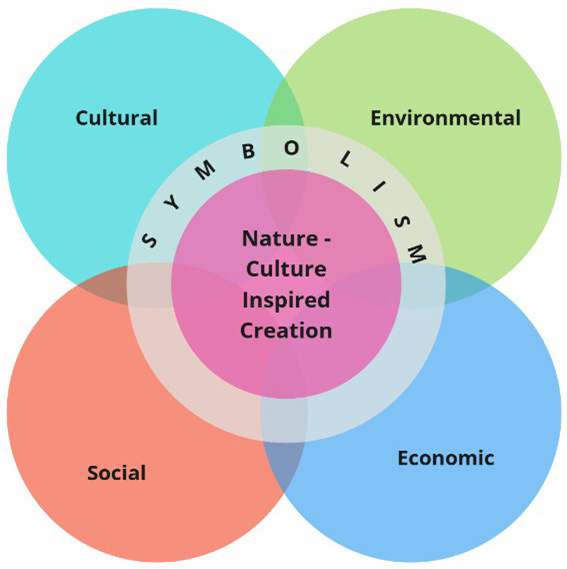
Proposed Framework for Nature-Culture-Inspired Creation in Sustainable Design (modification from Loch’s framework)
Nature provides inspiration, and nature is the origin of the symbols created. As each culture translates natural elements into symbols and practices, culture gives nature meaning. The role of sustainability in this framework is as the guiding principle. Thus, sustainability ensures that the practice is sustained. The interconnectedness of nature, culture, and sustainability is present in this framework.
This approach differs from traditional sustainable design models, which often prioritize functionality over cultural narratives. Here, we re-establish the importance of cultural symbolism in sustainability by showing how natural elements hold deeper meaning within cultural contexts. Although this study focuses on textile design in Indonesia, this framework can be applied across different design disciplines worldwide.
For instance, local biodiversity serves as a universal source of inspiration, and various cultural traditions have their own natural symbols that could be adapted for contemporary sustainable design. While sustainability principles remain global, the methods of application must be localized. In Indonesia, natural dyeing with local plants like Jasminum sambac sustains cultural heritage, while in other regions, designers can adapt their own natural and cultural resources to create meaningful, sustainable products.
5. Conclusion
This study has explored the cultural symbolism of Jasminum sambac, or known as Jasmine flowers in Jelami eco-printed silk, and its relationship with the four pillars of sustainability. The findings showed that materials (flowers and other natural dyes), compositions, and techniques represent symbolic meanings in Indonesian culture. The flower itself symbolizes purity and humility, which also represent the morphology of the flower (physical aspect). Through ecosemiotics, the Jasminum sambac in Jelami eco-printing also has a dynamic relationship between nature and culture. It reflects how communities (human) have interpreted and transformed a natural element into a symbol. The findings also showed that this practice demonstrates four pillars of sustainability, a) the natural materials that reduce ecological impact, b) the creation of new-traditional-technique that is useful for local artisans, c) engagement of communities, d) Jasminum sambac as symbols, that is ensured to be relevant in modern design contexts.
The findings of this study have implications for local artisans and craftsmen who are engaged in the textile, batik, and eco-printing industries. Jelami technique is a development in classic eco-printing technique, and this indicates that traditional technique can always evolve and preserved.
Local artisans can preserve and innovate traditional textile-making practices by incorporating Jelami technique. This can also be modified with another plants which has cultural meaning as well. The analysis of jasmine flowers used in this article also indicates that an artifact can be seen as eco-conscious and culturally authentic at the same time. This creates a market, domestic and international. Workshops and training programs on Jelami eco-printing can later help younger generations learn and adapt the traditional methods to modern needs.
There are several limitations of this study: this research only examines Indonesian culture, so it limits the generalizability (however, this is also an opportunity for future studies to investigate how different cultural and ecological contexts influence the symbolism in certain cultures); this research focuses on Jelami eco-printing, which may not fully represent the various eco-printing techniques globally.The limitations present in this study could be opportunities to conduct future research, so in the future, sustainable design can be expanded and contextually relevant to each culture.
Notes
Copyright : This is an Open Access article distributed under the terms of the Creative Commons Attribution Non-Commercial License (http://creativecommons.org/licenses/by-nc/3.0/), which permits unrestricted educational and non-commercial use, provided the original work is properly cited.
References
-
Barthel-Bouchier, D. L. (2016). Cultural Heritage and the Challenge of Sustainability. Routledge.
[https://doi.org/10.4324/9781315431055]

-
Bhardwaj, V., & Fairhurst, A. (2010). Fast fashion: response to changes in the fashion industry. The International Review of Retail, Distribution and Consumer Research, 20(1), 165-173.
[https://doi.org/10.1080/09593960903498300]
- Bratawijaya, T. W. (1991). Seni dekorasi Janur Dan Ronce Bunga Melati. Pustaka Sinar Harapan.
-
Dewi, D. N. Y. (2021). Penerapan Teknik Eco Print Menggunakan Buah Dan Sayur. Bhumidevi : Journal of Fashion Design, 1(1).
[https://doi.org/10.59997/bhumidevi.v1i1.300]
- Fibiona, I., & Rizqika, M. K. (2023). Pemetaan Ritual Daur Hidup manusia dalam serat centhini. Kementerian Pendidikan, Kebudayaan, Riset, dan Teknologi, Direktorat Jenderal Kebudayaan, Balai Pelestarian Kebudayaan Wilayah X.
- Greenaway, K. (2015). The Language of Flowers. Pook Press.
- Hawkes, J. (2001). The fourth pillar of sustainability: Culture's essential role in Public Planning. Cultural Development Network : Common Ground.
-
Joy, A., Sherry, J. F., Venkatesh, A., Wang, J., & Chan, R. (2012). Fast fashion, sustainability, and the ethical appeal of Luxury Brands. Fashion Theory, 16(3), 273-295.
[https://doi.org/10.2752/175174112x13340749707123]
- Handayani, C. S., & Novianto, A. (2004). Kuasa Wanita Jawa. LKiS : Distribusi, LKiS Pelangi Aksara.
-
Kull, K. (1998a). Semiotic ecology: Different nature in the Semiosphere. Sign Systems Studies, 26, 344-371.
[https://doi.org/10.12697/sss.1998.26.15]
-
Lang, C., & Joyner Armstrong, C. M. (2018). Collaborative consumption: The influence of fashion leadership, need for uniqueness, and materialism on female consumers' adoption of clothing renting and swapping. Sustainable Production and Consumption, 13, 37-47.
[https://doi.org/10.1016/j.spc.2017.11.005]
-
Lestari, N. S. (2019). Jasmine flowers in Javanese mysticism. International Review of Humanities Studies, 4(1).
[https://doi.org/10.7454/irhs.v4i1.119]
-
Loach, K., Rowley, J., & Griffiths, J. (2016). Cultural Sustainability as a strategy for the survival of museums and libraries. International Journal of Cultural Policy, 23(2), 186-198.
[https://doi.org/10.1080/10286632.2016.1184657]
-
Mason, M. A., & Turner, R. (2020). Cultural sustainability: A framework for relationships, understanding, and action. Journal of American Folklore, 133(527), 81-105.
[https://doi.org/10.5406/jamerfolk.133.527.0081]
- Margana, S., & Nursam, M. (2010). Kota-Kota di Jawa: Identitas, Gaya Hidup, Dan Permasalahan Sosial. Ombak.
- Mik-Meyer, N. (2020). Multimethod qualitative research. In D. Silverman (Ed.), Qualitative Research (pp. 357-374). London: SAGE.
-
Nayak, R., Panwar, T., & Nguyen, L. V. (2020). Sustainability in fashion and textiles. Sustainable Technologies for Fashion and Textiles, 3-30.
[https://doi.org/10.1016/b978-0-08-102867-4.00001-3]
-
Nurliana, S., Wiryono, W., Haryanto, H., & Syarifuddin, S. (2021). Pelatihan ecoprint Teknik pounding bagi guru-guru Paud Haqiqi di Kota Bengkulu. Dharma Raflesia : Jurnal Ilmiah Pengembangan Dan Penerapan IPTEKS, 19(2), 262-271.
[https://doi.org/10.33369/dr.v19i2.17789]
-
Parung, C. A. (2024). Exploring cultural sustainability through contemporary Indonesian fashion brands. Advances in Science, Technology & Innovation, 139-147.
[https://doi.org/10.1007/978-3-031-52726-5_13]
- Presiden Republik Indonesia. 1993. Keputusan Presiden Republik Indonesia Nomor 4 Tahun 1993 Tentang Satwa dan Bunga Nasional.
- Purnomo. (2013). Tanaman kultural Dalam perspektif adat Jawa: Kajian Aspek filosofi, Konservasi, Dan Pemanfaatan Tanaman Dalam Kultur Dan Tradisi jawa. Universitas Brawijaya Press.
-
Putri, A. W., & Kristi, J. I. (2020). Eksplorasi eco printing Daun Lanang Dan Pewarnaan Alam Kayu Tegeran Pada Kain rayon sebagai potensi material fashion sustainable. Gorga : Jurnal Seni Rupa, 9(2), 317.
[https://doi.org/10.24114/gr.v9i2.20271]
- Ray, S. (2021). A "small" story of the jasmine flower in the age of global botany . In Crafting Enlightenment. Artisanal Histories and Transnational Networks. essay, Liverpool University Press.
- Ristiani, S., Isnaini, I., Farida, F., Salma, I. R., Sulistyaningsih, T., Eskak, E., & Fitriani, A. (2020). Pewarna Alami Kayu Secang (Caesalpinia Sappan L) Dengan Variasi Fiksator Pada Tekstil Kerajinan Ecoprint. Balai Besar Kerajinan dan Batik.
-
Roberts, M., Norman, W., Minhinnick, N., Wihongi, D., & Kirkwood, C. (1995). Kaitiakitanga: Maori Perspectives on conservation. Pacific Conservation Biology, 2(1), 7.
[https://doi.org/10.1071/pc950007]
- Sahu, D. (2022). Eco-Printing. International Journal of Creative Research Thoughts, 10(11).
-
Saidi, A. I., Puspitasari, D. G., Parung, C. A., & Luzar, L. C. (2025). Traditional metaphors of Indonesian women's beauty. Open Cultural Studies, 9(1).
[https://doi.org/10.1515/culture-2025-0046]
- Salma, I. R., & Eskak, E. (2022). Teknik dan Desain Produk Ecoprint dalam Berbagai Material Baru (Non Tekstil). Prosiding Seminar Nasional Industri Kerajinan dan Batik 2022.
-
Satria, V. H., Baihaqy, A., Zuhroh, N. F., Laily, N., & Yahya, Y. (2024). Pounding nature into profit with sustainable techniques for crafting high-value eco-print products. South Asian Journal of Social Studies and Economics, 21(6), 111-120.
[https://doi.org/10.9734/sajsse/2024/v21i6836]
-
Soini, K., & Birkeland, I. (2014). Exploring the scientific discourse on Cultural Sustainability. Geoforum, 51, 213-223.
[https://doi.org/10.1016/j.geoforum.2013.12.001]
-
Suwandi, E. F., & Sunarya, Y. Y. (2021). Motif Tenun Sebagai bentuk bahasa rupa dari Masyarakat Suku Mbojo Di Bima Nusa tenggara Barat. JURNAL RUPA, 6(1), 24.
[https://doi.org/10.25124/rupa.v6i1.3727]
-
Syafril, E. P., & Agel, H. H. (2023). Eco-print batik: Eco-friendly products of green business based on indigenous knowledge in Bantul. Proceedings of London International Conferences, (8), 54-65.
[https://doi.org/10.31039/plic.2023.8.166]
- Vezina, B. (2019). Curbing cultural appropriation in the fashion industry. In Presentation at the ABC Copyright Conference. Saskatoon, Saskatchewan, Canada, May 31. https://pdfs.semanticscholar.org/0725/4965e32967001380b9933fafab2a19f722e0.pd.